








Sign up for our newsletter

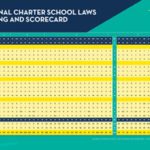
National Charter School Law Ranking & Scorecard

17th Edition March, 2017

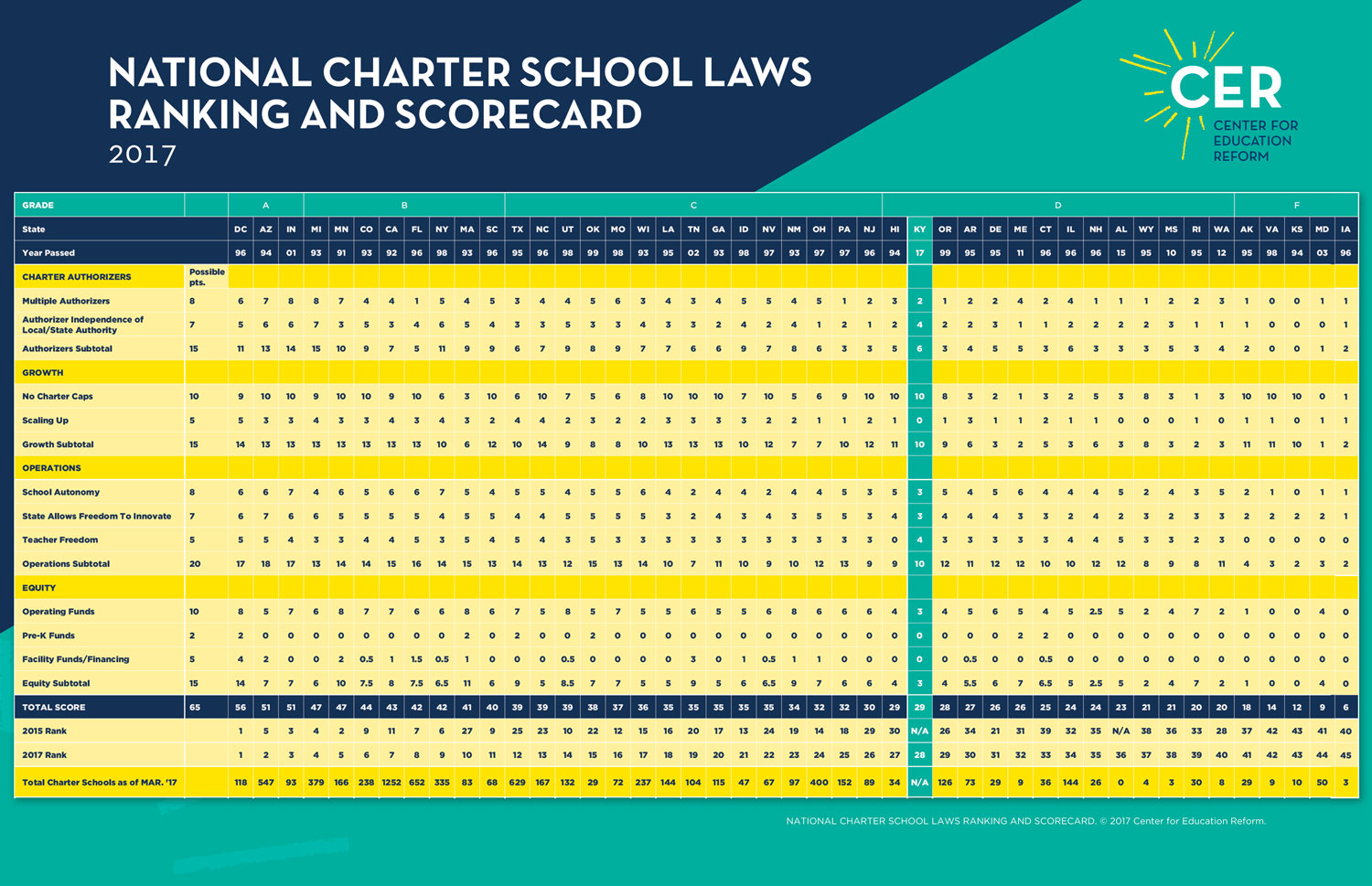
Since 1996, CER’s yearly scorecard and ranking of state charter school laws has provided guidance and feedback to policymakers on the relative strengths and weakness of charter school policies and their effectiveness in fulfilling the true meaning of the words “charter school law,”— i.e., paving the way for high numbers of strong, autonomous, healthy charter schools, that provide meaningful opportunities for families and their children, and the chance for innovation for all involved.

Sixteen successive reports were based on a variety of criteria first designed and validated by the pioneers of chartering. Each year, the national rankings established by CER have not only predicted how a particular law might work in practice, but presented a real-time evaluation of whether, and how, charters are able to operate given the freedoms or restrictions embedded in law. The rankings and corresponding analysis are grounded in the principles and intent of chartering. We review whether a state’s charter school law:

  • establishes the ability for citizens to create schools that are independent, in oversight and operations, from the traditional school bureaucracies;
  • gives schools wide latitude to operate and innovate without onerous administration rules and regulations dictating what they can do and how they do it at every turn;
  • and provides parents with an expansive amount of options from which to choose the schools that best meet the needs of their students.

We are now well into the third decade since Minnesota passed the first state charter statute. The number of charter schools has continued to increase each year at a steady but relatively slow pace. But this past year, that growth abruptly came to a near halt. Overall, the nation’s nearly 7,000 charter schools still serve a fairly small percentage of the total number of students receiving public education, roughly six percent. Some states and cities have far more market share and point the way to what healthy expansive choice does for the whole of public education.

Overall, the impediment to consistent, sustained growth of charter schools is that most state officials view charters, or other school-choice policies, as a core strategy of education reform. National and state top-down policies, intended to broadly impact all public school students or teachers in a state—whether standards and testing, teacher evaluation/compensation, or other efforts—continue to be perceived as the main action, often engendering fierce debates and then later being abandoned after a number of years. Yet, overall improvement in U.S. student achievement on the National Assessment (NAEP) is minimal at best and American students are not closing the gap with our top international competitors.

CER noted in its 2015 report that while “…demand [for charter schools] continues to outstrip supply…” there has been a “lack of progress made in state houses across the country over the past few years to improve the policy environment for charter schools” and, more specifically, “… it is abundantly clear that little to no progress has been made over the past year…”.

In recent years, there has been significant attention—especially, but not exclusively, among authorizers—on a perceived need to focus on charter “quality over quantity”. The strategies discussed have included more stringent approval processes as well as “culling the herd” during charter renewal to let only those schools deemed strong performers continue.

This year, the movement crept to a near halt, a result of these very ill-conceived state policies and what is being termed “regulatory reload.” There is widespread evidence of creeping regulatory intrusion in decisions regarding academic programming, curriculum, discipline, and teacher qualifications. The problem, it appears, is policymakers who are given numerous recommendations no longer know the difference between policies that advance the cause of effective charter schools and those that strangle them.

But are charter regulators really the key actors in improving the quality of teaching and learning in charter schools? We see no evidence of that. In keeping with CER’s historic values and philosophy, which guided the strongest charter school laws, we have introduced some new elements to better reflect the policies to which states should aspire. By focusing on achieving perfect scores in four critical areas, states can reverse the encroaching isomorphism – the inexorable push to make all schools look and operate similarly – and spawn the kinds and quantities of schools that truly put students on a path to access exceptional educational opportunity. Those elements are based on the following principles:

Multiple Authorizer Independence: Multiple authorizers remain critical, but almost as critical, is the independence of those authorizers. A new trend since the 2015 analysis is the prevalence in states of entities we call “uber authorizers,” newly created regulatory bodies, or existing state agencies, endowed with more power to regulate and revise rules. Such policies are sold as “standards” to drive quality, but they are no more standards than requiring a teacher to be certified is a qualitative standard. Uber authorizing provisions put state agencies in control of independent authorizers, negating independence. Those same agencies then become empowered to do precisely what they are not capable of doing – deciding when and how parents should have options over what types of schools under what types of conditions. The net effect is a growth of oversight powers that are intended to police quality but end up micromanaging, and thus discouraging, the creation, growth, and advancement of independent public schools.

States that assure independence for authorizing from traditional state entities and are free from uber authorizing, score higher than those that do not. While still number one in our rankings, D.C. risks losing ground if it continues on a slow but slippery slope of allowing the city and its agencies to micromanage the authorizer’s processes. It’s also unique in that it has one authorizer that was created when the city did not have a “state” board of education, and when the city was under the control of an independent board itself from the city council. That legacy of independence is now threatened by the restoration of city structures that have begun to assert various controls over chartering in the city. The law provides for the establishment of new entities for authorizing, such as universities. Pursuing additional authorizers would allow the existing D.C. Public Charter Board to stay on its feet, and create alternative innovations for opening and managing new schools.

Scaling Up: Much focus has been put on scale in the last few years. Philanthropic dollars, research reports, and even federal policy encourages scaling up of proven practices and networks. But there is more to scaling up than expanding an already existing model of schooling. Scaling up should include the extent to which state laws permit the natural expansion of schools – whether they are single site or network – as well as the expansion of the number of schools. If only proven schools are scaled, what does that say about the notion that chartering is intended to provide for not just replication but innovation in brand new schooling ideas? After all, those who today are proven were once new and unproven.

The rankings account not only for whether a state’s law provides for growth, but whether the policy in law actually results in growth in practice.

Freedom to Operate, Freedom to Innovate: Traditionally, the National Charter School Law Rankings factor in any limitations or freedoms to operate and are awarded points based on such conditions. However, it is increasingly clear that complexities in the law are growing, and they now not only stipulate the degree to which schools are free from state and local laws, but often stipulate substantial conditions dictating not only how and when charters are created, but how they operate. States that permit innovations to be developed and adopted – innovations in curriculum, technology, structure or even the kinds of businesses or partnerships with which they engage – will yield more innovation and diversity than those that do not.

Many critics often argue that charter schools no longer look or seek to be as innovative as had been – reportedly – their intent. It was actually something much more compelling than that which brought charter schools into existence. It was the demand for parental choices for diverse learning options that did not follow the same model as the monolithic school districts. It was diversity and choice, and diversity would allow the creation of innovations. Innovation need not be something dramatic or new (indeed innovation can be doing the same thing slightly differently). The reality, in all too many instances, is that charters have been forced into the traditional education box. Thus, the freedom to innovate reflects whether a state law allows, for example, both on-ground and online or blended models, whether they can contract with all manner of educational provider, whether same-sex schools are allowed, whether there may be alternative high schools with alternative assessments attached to them, and numerous other potential innovations that neither humans or law may have yet conceived.

States that permit schools the freedom to innovate and do not prescribe conditions that look and operate like traditional public schools will rank higher than those which limit variety and innovation.

Equity – As important as being able to open and operate in a state that has multiple independent authorizers is being able to focus on the work needing to be accomplished. To do that requires funding, funding that is often woefully inadequate and often deliberately skewed to be inferior to traditional school districts. Many in the charter school advocacy world have been open to negotiating lower per-pupil dollar amounts to get a law passed, even though doing so would hamstring those schools from the start. Others ignore complex funding formulas or simple words and phrases that sound good in law but can often be widely interpreted in practice. For example, take the word “proportionate” which is in a companion funding law to Kentucky’s new below-average charter school law. Proportionate technically means relative or in measure of other things. Such terminology gives the funding authorities, in this case school districts, the authority to determine what is and isn’t proportional to all other spending categories. They can, and will, self select which funding and which amounts go to charters. Districts can narrow the amount spent per pupil. In other words, just one word sanctions arbitrary decision-making. That is why they were opposed to using the words “pro-rata” in the funding language, which would have clearly required precise, individual, equalized student funding to follow students to charters.

States are evaluated not only on both the policy and practice of operational funding statutes, but also on whether and how they fund facilities and this year, for the first time, Pre-K. If, as it should be, chartering is part of the overall education landscape and education reform efforts in this nation, funding must also be both commensurate and comprehensive.

A final word about chartering –

The debate over charter schools is now divided neatly into two camps – those who believe that accountability means there is additional oversight from centralized government entities, including state education departments and the federal government in driving start up grant funds, and those who believe that accountability is multi-dimensional, beginning with parents making choices and not being confined to conventional definitions of what works for every child.

The parent choice accountability camp also believes that data is essential to any educational enterprise and that it must be available and transparent. The role of government is to require data to be reported; it is not to require hostile government entities to parse and use the data to close schools when that data is not only easily manipulated but often misunderstood.

Raising the academic quality of charter schools is best achieved by enabling students to leave mediocre charter schools and select from higher quality nearby charter school options. The “culling of the herd”, where necessary, should result from stronger competition that enables parents to choose more effective schools, not sudden regulatory termination that dumps students back into the very public schools they were seeking to avoid (and which may be worse). In economic terms, overall quality is raised by good charter schools “crowding out” mediocre charter schools. Charter authorizers should fulfill a significant, but limited, academic accountability role of terminating or not renewing consistently, demonstrably bad schools, by documenting that the education they offer is not only not meeting students needs but that enrollment reflects such failures. Authorizers should also terminate charters for other non-academic reasons, such as safety or financial malfeasance.

To accomplish what we, along with well-known researchers and other choice advocates, agree represents a hearty charter school movement, the emphasis should be on eliminating hurdles to growth of well-managed charter schools and organizations to serve more students.

Charter regulation, approval, and oversight should be transparent, predictable, and avoid micro-management of academics, discipline, and staff hiring and termination. Regulation should be flexible enough to encourage charter schools designed to meet the needs of special populations by allowing them to meet requirements that are reasonable and appropriate for their students. And yet, it is precisely that regulation that is discouraging new charter school growth. With barely 6 percent of all public school students in charter schools nationwide, two percent growth over one year is totally unacceptable and an indication that something is amiss. Risk-averse, highly bureaucratic state and local actors are causing the stagnation. It comes not just from opponents, but from heavy-handed friends. Their heavy reliance on government to solve perceived issues of quality will bring charter schools to a screeching halt unless the policies they espouse reverse course.

We hope the 2017 updated criteria and rankings will catalyze a necessary, national and state-level debate on the most effective ways to ignite charter growth in order to increase educational options as well as achieve excellence. It is clear from the trends that real education reform does not result from local compliance with federal regulations or statewide requirements but, comes instead, school by school and classroom by classroom. It succeeds when educators work with parents at the local/institutional level to create, refine, and maintain high-performance schools that raise achievement and meet the needs of their students. Current charter requirements and policies that unnecessarily constrain charter growth and competition or deter investment need to be rethought and revised. The predictable absence of significant NAEP achievement gains in recent years in all but a handful of communities and states with the strongest laws, and the lack of consensus on what comes next, means there is an opening for fresh thinking on what constitutes education reform.

Jeanne Allen
Founder & CEO
March 22, 2017
Please click here for the official press release

Newswire: March 15, 2017

A weekly report on education news and commentary you won’t find anywhere else spiced with a dash of irreverencefrom the nation’s leading voice in school reform.


CHARTERS GO TO WASHINGTON. Wouldn’t you know that on the day CER was taking a diverse bi-partisan group of charter leaders to meet with Secretary of Education Betsy DeVos, a major snowstorm threatened the nation’s capital?  It turned out to be more of a whimper than a roar. And most made it here, using trains, planes and automobiles from as far as California. They shared the challenges that all schools face with the imposition of more and more regulations, funding inequity and lack of air and ground cover. But no matter what the problems caused by friend and foe, these leaders are providing great opportunities for students and will not be deterred. This meeting is just the beginning.

Among those CER was proud to accompany on our trek through the snow (slush, actually) were: 7 Degrees of Change Foundation’s Paul Norcross (NC); Friendship Public Charter School’s Patricia Brantley (DC), State University of New York (SUNY) Charter Schools Institute’s Susie Miller Carello; Dawn Evenson and Amber Raskin, iLEAD Schools California; Charter Schools USA’sJonathan Hage;David Hardy,Boy’s Latin Charter School of Philadelphia; Rob Kremer, Connections Education; and K12’s Stuart Udell. Involved but unable to make it through the storm were GEO’s Kevin Teasley, Constellation Schools’ Rick Lukich (OH), Sabis Schools’ Jose Afonso and Indiana’s Tony Bennett.


TODAY: The Fight for Choice in Kentucky continues, and they are aided again by the experience of other states. From iLead Spring Meadows near Toledo, Ohio came LaTanya Wilson and her 5th grade son, Ellis, to tell their story about why this new school, opened only because of the presence of the state’s first university authorizer, has changed their lives. Governor Matt Bevin, who knows that without parent power there can be no economic opportunity, has been personally campaigning for a bill to open up the state for the first time to choices. CER has been fighting along side him, and against those who would prefer to maintain the tight grip of school districts on all education, despite their spotty success throughout the state and nation.  As all of us know, that’s like giving the competition the keys to your safe.

We are proud to be fighting on the side of educational opportunity in the Bluegrass state. If you’re in Kentucky or know others who are, use this tool to tell the legislators that you want a charter school bill that promotes real opportunity please click here.


WOW? Little noted yesterday was something called the Presidential Executive Order on Comprehensive Plan for Reorganizing the Executive Branch, which includes this provision: “In developing the proposed plan described in subsection (c) of this section, the Director shall consider, in addition to any other relevant factors: (i) whether some or all of the functions of an agency, a component, or a program are appropriate for the Federal Government or would be better left to State or local governments or to the private sector through free enterprise.”

For us nonlawyers, what does this mean? It may mean, “Wow!” It may also mean that the Department of Education (and a lot of other federal departments and agencies) could look very different by the end of the year. More to come on this, too.


SOARING INTO EDUCATIONAL EQUITY. Last Friday, the House Oversight Committee held a hearing about on the reauthorization of the Scholarships for Opportunity and Results Act. SOAR, as it’s known, provides 1,100 poor students the opportunity to attend schools of their choice. You’d think that a successful program that grants opportunity to low- income kids and closes the achievement gap would be popular across party lines. Unfortunately, you’d be wrong; for opponents of choice and opportunity have done their best to stonewall SOAR. Fortunately, the bill passed the committee and now awaits a vote by the full House.

TWITTER. Every day, CER advocates for educational opportunity through the wonderful world of Twitter. As a testament to our success, we just passed 37,000 followers. Help us get to 40,000 by following us — then tell your friends.

And speaking of Twitter, an op-ed on this very subject by our CEO, Jeanne Allen, was tweeted this morning by none other than Kellyanne Conway.

The mission of the Center for Education Reform (CER) is to expand educational opportunities that lead to improved economic outcomes for all Americans, particularly our youth, ensuring that the conditions are ripe for innovation, freedom and flexibility throughout U.S. education.

3 Things You Need to Know About the DC Opportunity Scholarship Program

The DC Opportunity Scholarship Program

Today, the House Committee on Oversight and Government Reform will consider the Scholarships for Opportunity and Results Reauthorization Act.

In 2002, the SOAR Act created a three-sector strategy that ensured a boost in support for traditional and charter public schools. The Act also created the DC Opportunity Scholarship Program, which has been a lifeline for low-income students to attend accredited private schools.

It’s been six years since the program was reauthorized. As a result, annual renewals have been difficult, since opponents have been unwilling to extend the program for the typical five-year authorization.

For members of Congress, their staffs, and other interested parties who don’t know a lot about SOAR or the DC Opportunity Scholarship Program (OSP), here are three essential facts to get you up to speed:

1. The three-sector strategy improves education for students across the city.

The SOAR Act is a unique, relatively small but impactful program that forms the foundation for an improving education environment. In this, this environment has resulted in improved economic conditions and a vibrant, safer city in which to live.

2. The Opportunity Scholarships help students succeed.

The OSP has enabled student success, increased student retention, and high parent satisfaction. Ninety-eight percent of all OSP students graduated from an OSP participating school, and 94% of them moved onto some type of post-secondary education. In 2016, 87% of all OSP parents reported satisfaction with their child’s school and academic success.

3. Educational choice across public, private and public charter schools is popular.

In 2016, 2349 students applied for 234 opportunity scholarships. Meanwhile, a staggering 20,880 students are on waiting lists for public charter schools in DC.

KENTUCKY HOUSE PASSES CHARTER SCHOOL BILL

Paul Clement

FOR IMMEDIATE RELEASE                                                                                CONTACT
March 3, 2017                                                                                                  Patrick Korten
pkorten@staging.edreform.com | 202-750-0016

Hope for a better charter school law now lies with State Senate

The lower house of the Kentucky legislature passed HB520 this afternoon, a bill which in all but isolated cases strengthens the hands of school districts to limit charter schooling in Kentucky.

Applicants wanting to open a charter school in the state will first have to get permission from the district, which experience shows is rarely given in the absence of a swift and binding appeal to the state board of education or multiple chartering authorizers.

While an amendment offered by Representative Phil Moffett adding the Mayors of Louisville and Lexington as authorizers improved the bill, other changes, including a provision barring charters from contracting with businesses to support and manage their schools, and barring online education, made it much worse.

The Kentucky Education Association president opposed even the dramatically scaled back version of the measure. As has been typical elsewhere, Kentucky school boards and superintendents have been lobbying hard against charter schools, and creating fear among rural legislators that charter schools would drain their school funding.

“This isn’t about money or preserving power, and the end of the day it’s where are we are getting bank for the buck and are we helping kids succeed, said Kentucky Governor Matt Bevin, who personally asked the House Education Committee to pass the bill.

Promoted as a program primarily designed to help minority children trapped in failing schools, left unchanged the bill would result in a dramatically different environment than states with strong charter school sectors. Read More…

“CER has been working for months with leaders in the state to create a better understanding of the conditions necessary for a strong charter school law, said the Center’s CEO, Jeanne Allen. But we respectfully disagree with our colleagues who joined the fight later that simply passing a bill is progress.

“It’s very disappointing to see such hard work give way to the determined defenders of the status quo. We’re hopeful that the State Senate can do better next week,” said Allen.

Read More on Charter Schools in Kentucky.

The Top 9 Moments You Missed When We Debated Charter Schools

Are charter schools overrated? This was the topic at hand for Wednesday night’s Intelligence Squared debate. Jeanne Allen and Gerard Robinson advocated for charter schools as they took on Gary Miron and Julian Vasquez Heilig. The discussion was impassioned, intelligent, and civil (mostly). If you didn’t get the chance to tune in, here are the highlights:

  • Jeanne Allen responds to the fear of for-profit companies’ involvement in charter school:
    • “Who cares what the tax status of a company is if our kids are learning?”
  • Jeanne Allen counters Heilig’s accusation that charter schools “are anti-democratic”:
    • “There is nothing more democratic than parents actually participating directly in the education of their children.”
  • Gerard Robinson calls out traditional public schools for their lack of accountability:
    • “In 2016-2017, 35 charter schools in that state closed and identified exactly why they closed. In this fiscal year, right now, there are nearly seven that have closed. You go to a Department of Education and they say we are going to close a school, either driven by the authorizer or number of factors … How many public schools have you seen close because students didn’t do as well?”
  • The audience chimes in on Twitter:

  • Jeanne Allen underlines the real issue at hand:
    • “You’re a parent. You open your door and you are zoned to your traditional public school because of your zip code!”
  • Which won the applause of the room and some folks on twitter:

Jeanne Allen’s closing remarks:
“I thank Gary and Julian. I vehemently disagree with your position but I respect your passion, your integrity, and your commitment. I will work every day of my life to change your minds.”
While Gerard and Jeanne didn’t land the New York vote, they had plenty of support from people watching at home.

What We Want to Hear From President Trump in His First State of the Union Address

Donald Trump

The theme must be freedom.

“President Trump has a primetime opportunity to tell Congress that the watchwords in the field of education for the next four years are parental choice and freedom for children to attend a school that meets their needs,” declared Jeanne Allen, the founder and CEO of the Center of Education Reform (CER).

CER, which has championed fundamental changes in the field of education since its founding a quarter century ago, has played a key role in the mainstream acceptance of education choice and the dramatic expansion of charter schools in the United States. Today, 43 states and the District of Columbia have charter school laws, and private school choice options are available in 14 states. Several other states are poised to join them.
“The president’s greatest opportunity in his address before the joint session of Congress tomorrow is to use the bully pulpit of the Presidency to advance the cause of true education reform,” Allen said.

“Universal adoption of educational opportunity will be a tremendous milestone,” Allen said, “but other forms of school choice are equally worthy of adoption, and high on the list of needed reforms are steps to expand access to efficient, sophisticated information technology in smaller towns and rural areas to increase families’ options for high quality education,” she added.

“Just as when Rural Electric Cooperatives brought electric power to those communities nearly a century ago, transforming rural America dramatically for the better, 21st Century communications can transform their lives and opportunities once again,” Allen said.

President Trump addresses Congress Tuesday evening at 9:00 p.m. Eastern time in the chamber of the House of Representatives.

Allen will be live-Tweeting the president’s speech. Follow her @JeanneAllen.

Newswire: February 21, 2017

OK-LA-HO-MA. Choice in the Sooner State may soon have more meaning if a bill that passed the Senate Education Committee becomes law. The measure, SB 560, would allow public money to follow students to private schools. That’s the good news. The bad news: the bill was amended to limit it to counties with 150,000 residents or more, so it would only apply to Oklahoma, Tulsa and Cleveland counties. The bill’s sponsor, Sen. Rob Standridge, said the measure is about opportunity and school choice for inner-city students—which leaves the question, “What about the rest of the state?” Still, it’s a step in the right direction, although some, like Deborah Gist, Tulsa Schools Superintendent (also former Rhode Island Commissioner of Education, and a founding member of Chiefs for Change) were having none of it.


Truth is; “We should be funding students, not schools; whichever school best meets their needs.”


“THE TRUMP ADMINISTRATION IS CONSIDERING a first-of-its-kind federal tax credit scholarship program that would channel billions of dollars to working class families to enable their children to attend private schools, including religious schools,” so says Politico. The bottom line: “Details of how such a program might be structured are not known.” Still, it’s a nice synopsis of what might be in store in the weeks and months ahead.

WHOA, KENTUCKY! At the moment, Kentucky is galloping in the wrong direction in its quest for charter school legislation. Worried that a strong charter law might not be constitutional, the leadership has offered up an anemic, watered-down bill that will do more harm than good. But, legal scholars have determined that a strong bill IS constitutional so let’s back up and do this right. As CER founder Jeanne Allen said (along with a lot of other things) in her Courier-Journal op-ed today, “A quarter century of experience and the success of tens of thousands of charter school graduates points the way. There is no reason not to do this the right way, and enact a strong law in the Bluegrass state.”  (By the way, check out the new page devoted to Kentucky on staging.edreform.com.)

VOUCHERS v CHARTERS: “THERE’S NOTHING LIKE A GOOD VOUCHER BATTLE TO REFOCUS REFORMERS’ ENERGIES!” Sometimes when states drift away from some of the core principles of charter schools (like Oklahoma, for example, where increased administrative burdens are being placed on charters—pushing schools farther away from their intended focus, i.e. on kids, and toward one the primary ailments they set out to avoid in the first place, i.e. stifling bureaucracy) a discussion of the value of vouchers helps re-strengthen waning charter efforts. That may not always the case but the near Pavlovian negative response to voucher-talk that occurs in most states does seem to help make charters a more welcome alternative. In any case, it’s worth noting these voucher rumblings in Tennessee.


AND, SINCE WE’RE TALKING ABOUT IT“It” being the aforementioned increased administrative burden being advocated for/placed on charters schools, you should read the February 8th EdWeek commentary “Untie Charter’s Bureaucratic Strings,” to learning how it is that “Charters are slowly morphing into bureaucratic, risk-averse organizations fixated on process over experimentation.”

Action This Week in Kentucky House on Charter-School Legislation

This week, a charter-school measure sponsored by Rep. John Carney, HB520, will be taken up by the House Education Committee, probably on Thursday. HB520 is a very weak charter bill, apparently because of unjustified concerns about the constitutionality of a stronger bill.

The Center for Education Reform recently asked former Solicitor General of the United States, Paul Clement, who has argued 80 cases before the U.S. Supreme Court, to provide a legal analysis of the Kentucky Constitution’s provisions regarding the state’s educational system. He and a team of constitutional lawyers at the Washington, D.C. firm of Kirkland & Ellis found that the Constitution does “not limit the General Assembly’s broad authority under Section 183 to structure the common school system as the General Assembly sees fit.”

Some Kentucky policymakers say they’ve been told that the state constitution requires the operation of schools exclusively through existing elected school boards. But in his report, Clement finds that Section 183 of the constitution “clearly grants the General Assembly broad authority to decide what reforms will make the common school system most efficient.”

Jeanne Allen, the founder and CEO of the Center for Education Reform, said that the report was great news for the cause of parent power in Kentucky, and urged policymakers to change course. “To embrace a watered down, ineffective, measure on the erroneous notion that a strong bill is unconstitutional would be tragic,” Allen said. “There’s no reason that this weak legislation should go forward.”

HB520 would put Kentucky’s charter school law in the same category as states like Iowa, Virginia and Kansas, the weakest and least effective charter programs among the 43 states that have enacted charter laws over the past 25 years.

Read the Clements report here.

The Case for Charter Schools in Kentucky

Paul Clement

BREAKING: Constitutional law experts led by former Solicitor General of the United States Paul Clement have determined that the Kentucky state constitution does not in any way prohibit enactment of a strong charter school law.

The report “is great news for the cause of parent power in Kentucky,” says Jeanne Allen, the founder and CEO of the Center for Education Reform. “There’s no need to water down the law or undermine the core principles of charter schooling to address a non-existent conflict with the state constitution. And there’s no reason that the legislation cannot move forward.”

The Bluegrass State remains one of seven states that have not passed charter school legislation. With more and more nationally-reputable researchers and reports indicating charters’ consistent success and efficacy in boosting student achievement across the board, it is becoming increasingly difficult to ignore demand for the schools, and the regressive policies holding Kentucky lawmakers back from passing charter legislation.


Kentucky’s charter law is new but weak. See why it scores so low:

Kentucky Earns a ‘D’ in CER’s 2018 Charter School Law Rankings & Scorecard


In an interview earlier this year, CER Founder and CEO Jeanne Allen said that Kentucky’s Charter School Law does a disservice to Kentucky families:

Kentucky’s charter school law is not a top-10 achievement (Courier Journal, Part of the USA Today Network)


  • Charter schools across the United States are funded at 64 percent of their district counterparts. Read more…
  • Do bad charter schools close? You bet, by a percent larger than any other schooling sector. Read more….


Just the FAQs: Charter Schools

Here, you can find answers to frequently asked questions regarding charter schools and what they mean for students, educators, schools and communities


Charters Can Put Kentucky in Education Super Bowl

“Advocates of school choice in Kentucky have struggled and persisted in their efforts to enact a charter school law. For the sake of the children, we hope they win.

“Myths and misconceptions have kept Kentucky one of only seven states still denying its most needy students access to the choice of a public charter school. Unfounded arguments often deter lawmakers from taking the bold step of reforming their public school system, a monopoly that challenges its teachers, staffs and students.


New Report on Charter Schools Offers Best Evidence to Date of Their Impact

“Despite their proven success, many opponents across the nation continue to advance myths about charter schools at the expense of kids.

“There is a myth that charter schools somehow take resources away from local public schools. …despite money following children, in most states charter schools… are forced to do more with less.


Just the Facts: Success, Innovation, and Opportunity in Charter Schools

Only 28 percent of Kentucky’s 8th-grade students score proficient in math on the latest national assessment. Only 36 percent were proficient in reading. Fewer than 33 percent of Kentucky residents finish high school and go on to earn a two or four-year higher education degree.

More from the Courier-Journal:

“Once empowered with choices, families show their preference for schools that fit their needs best by switching to a charter school that simply offers them a better opportunity to learn.”

“Charter schools can help lure new investment and philanthropy to the state, and provide a better environment for youth to learn, prosper, and stay in the state. …the future of our children is not a game and losing cannot be an option.”


Kentucky has a rich history of wanting to improve how it serves students. As it considers charter legislation it could break the mold by ensuring 100% educational equity for all students.

In Public Charter School Legislation and the Kentucky Constitution, Paul D. Clement summarizes,

“Whatever obstacles to the creation of charter schools may exist, the Kentucky Constitution should not be one of them.”

Download Clement’s white paper here.


The 2008 policy report Fears vs. Facts About School Choice, by John Garen, Ph.D. and the Bluegrass Institute, further confirms these truths and debunks claims of charters’ ill-effects, saying,

“School-choice reform brings competition and market-based incentives into primary and secondary education. Americans rely heavily on free and competitive markets for most goods and services and it generally works quite well. But education leaders and lawmakers balk at allowing them to work in public schools.

“The considerable dissatisfaction with public schools warrants adopting this alternative approach. Many states already have moved in this direction; unfortunately, Kentucky has not.

“Establishing charter schools would represent an important step toward embracing a system with market incentives. Charter schools are elementary and secondary schools that are publicly funded but operate without many of the regulations that can limit the effectiveness of traditional public schools. Charter schools are founded by different entities, including teachers, parents and universities.

“Charter schools do not “skim the cream” but enroll a diverse student population. They induce better performance from nearby traditional public schools while providing schooling services in response to parents’ unique demands. Finally, charter schools and vouchers perform well regarding student outcomes. Outside Kentucky, charter schools and voucher systems have become increasingly common and represent good policies opportunities for Kentucky.

Momentum is truly building for new opportunities for students in the Bluegrass State with a new governor, a choice-friendly House, and Kentucky lawmakers visiting DC charter schools earlier this year.

A Strong Kentucky Charter School Law Clearly Meets Constitutional Requirements, Top Legal Experts Find

Paul Clement

WASHINGTON, DC (February 16, 2016) — A team of Constitutional law experts led by former Solicitor General of the United States Paul Clement has determined that the Kentucky state constitution does not in any way prohibit enactment of a strong charter school law, with multiple authorizers, equal funding and not under the control of traditional school districts. Clement, who has argued 85 cases before the U.S. Supreme Court, was joined in the analysis by two fellow attorneys at Kirkland & Ellis, one of the nation’s top law firms specializing in constitutional law.

Some Kentucky policymakers say they’ve been told that the state constitution requires the operation of schools exclusively through existing elected school boards. But in his report, Clement finds that Section 183 of the constitution “clearly grants the General Assembly broad authority to decide what reforms will make the common school system most efficient.”

Clement and his colleagues find that “by their plain terms, these provisions do not limit the General Assembly’s broad authority under Section 183 to structure the common school system as the General Assembly sees fit.”

The only constitutional constraints on legislative authority are found in Sections 184 and 186, which “concern only how the common schools shall be funded.” Section 184 “says not a word about school boards, school districts, or elected officials,” the analysis points out. And Section 186, while mentioning school districts, “certainly does not mandate that all common schools operate under the control of those districts – or, for that matter, under the control of any other designated entity.”

The report also takes a look at Kentucky court rulings in this area, and notes that the courts have “repeatedly recognized that ‘school districts are creatures of the legislature, and the legislature has the power . . . to alter them or even do away with them entirely.’”

Charter schools are public schools that are allowed the freedom to innovate and operate without the bureaucratic constraints imposed on traditional schools. The report by Clement and his team notes that the proposed charter schools in Kentucky “satisfy ‘the one main essential’ of a common school system: ‘they are free schools, open to all the children of proper school age residing in the locality, and affording, so long as the term lasts, equal opportunity for all to acquire the learning taught in the various common school branches,” Louisville v. Commonwealth, 121 S.W. 411, 412 (Ky. 1909).

The report “is great news for the cause of parent power in Kentucky,” says Jeanne Allen, the founder and CEO of the Center for Education Reform. “There’s no need to water down the law or undermine the core principles of charter schooling to address a non-existent conflict with the state constitution. And there’s no reason that the legislation cannot move forward.”

The full report is available here.

Related: Check out the case for charter schools in Kentucky.