





Sign up for our newsletter

Though Many Doubt Their Capacity, Parents Are Still Their Child’s First And Best Teachers

Forbes | April 9, 2020
By Jeanne Allen, Founder and CEO of CER

It was a simple statement I made on Twitter after seeing some less-than-nice comments about a parents’ ability to do education at home.

“Every family has the capacity to educate their children.”

It elicited many responses, some in agreement; others, not so sure:

“I think all families want their kids educated, but I have been personally talking to the neediest - homeless and [English Language Learning] and many are incapable by lacking basic literacy and severe emotional health right now. They are at a loss.”

“This is a nice sentiment and many probably can, but social workers don’t want us to forget about the families that they work with. There are also children with special needs that rely on expensive services.”

And this from a well-informed, respected education change advocate:

“After 2 weeks, I’m questioning this; not anyone else’s capacity, but my own. One thing for sure... 95% of Americans will better appreciate and understand our kids’ schooling. Dropping kids off for a full day feels like a luxury right now.”

Then there’s this commentary from a reporter in US News and World Report:  “Teachers who are also parents say that remote instruction is, unsurprisingly, quite challenging”What isn’t challenging to learn?

It got me thinking: as complex as it is to educate, those who question the capacity of parents to educate their own kids, which right now is the only option for most (even if some states disagree) may be overlooking one indisputable fact - that most parents are educating their kids in real time without even considering it education.

Potty training? Check.

Learning to walk & talk? Check.

Dressing, eating? Check.

How about the child’s first day of school? How to talk to others? Manners and living basics?

I know what some of you are thinking: But, Jeanne, this doesn’t happen in all families and children in dysfunctional homes don’t have what you describe.

As in everything, there is truth in that statement. However, it’s not universal.

Celebrated author  J.D. Vance argues in Hillbilly Elegy that while he grew up amidst a sea of family dysfunction, he did have one family unit - a grandparent - whose influence allowed him to develop and learn and to grow up and out of a beleaguered industrial town and dysfunctional community.

Todd Rose, a welfare parent turned Harvard psychologist argues in his End of Averageresearch that the very concept of ‘average’ relies on the assumption that there is one composite of a person that fits neatly into certain categories based on certain attributes (e.g., a poor family can’t educate). 

That misconception actually ignores the fact that a person’s capacity to do anything is not understandable without the full context of who they are. There is no average, as Rose argues, so we must put an end to generalizing people’s conditions based on some notion of average. The reality is there is no way to know of a person or family’s capacity to do something extraordinary in an extraordinary time.

More often than not, education is nothing more than influence. No matter what their lot in life, a parent’s ability to influence their kids is extraordinary. They may be able to impart lessons, or simply encourage them, or they may create the conditions for them to learn on their own. The bias in the policy and media dialogue today is that there is something inherently superior in having a traditional teacher, in traditional schools with brick and mortar propping them up, rooms divided by walls and desks and materials, highly prescribed programming and curriculum, and lots of other students there to make the entire experience enjoyable, or perhaps, depending upon the teacher, miserable. It is thought that this trumps having to administer home learning for one or just a few students. But a parent in her home right now need not be operating what we collectively conceive of as ‘school’ to have an impact on the education of their children. 

Many parents across all income levels are justifiably daunted by the present crisis.  They were not prepared or equipped with the knowledge or tools to continue for the entirety of a school ‘day’ all that is typically delivered, and expected, from lessons to assessment. And it’s no wonder. For generations we’ve told parents to butt out of school, leave it to the experts. For years, education has resisted change and innovations that make learning more personalized and less dependent on a 9 month, 180 day, agrarian calendar.

But they want to engage, and always have. A Gallup poll released this week found that 42 percent of parents are concerned that this crisis will have an adverse affect on their students’ learning. With most districts still not putting in place a plan for all students to be learning remotely, it’s up to families to pick up the slack. 

Here’s what we do know: Even if a parent can’t muster time or skills to do more than one or two subjects at most, every parent or caregiver in the nation can give their students agency, and provide the encouragement, space and tools (which are myriad and plentiful for free) to allow their students to drive their own learning during these stress-filled days confined at home.

The best case for this notion of student agency was made by Sugata Mutra, an education researcher and Professor of Educational Technology at the School of Education, Communication and Language Sciences at Newcastle University, England. 

Back in 1999 before technology was so ubiquitous, “some colleagues and I sunk a computer into the opening of a wall near our office in Kalkaji, New Delhi,” he writes. “The area was located in an expansive slum, with desperately poor people struggling to survive. The screen was visible from the street, and the PC was available to anyone who passed by. The computer had online access and a number of programs that could be used, but no instructions were given for its use.”

What Mutra and his colleagues discovered was extraordinary - that given the freedom, students can manage and discover their own learning. 

“Over the next decade we did extensive research in self-directed learning, in many places and through many cultures. Each time, the children were able to develop deep learning by teaching themselves. I decided to call the method of instruction we had developed Minimally Invasive Education (MIE). The rest of the world continues to call it the ‘Hole in the Wall.’”

Mutra’s findings are actualized in the work of Summit Public Schools, a charter network begun in east Palo Alto and focused on students with the most exceptional of needs. Diane Tavenner, the network’s founder, had her own personal challenges as a child, and she was determined to create a school that would be both sensitive to the traumas students endure and recognize and promote the individual learning needs of every student. While the story of Summit’s personalized learning approach becoming a widely embraced national model is in and of itself a story worthy of attention, it’s what Diane discovered about parents that is most germane here.

Bill Gates, one of Summit’s early supporters recounts: “It was unlike any school I had visited before. Some students worked on their own, moving at their own pace through their courses. Others worked together on projects. Instead of lecturing at the front of a class, teachers acted like coaches, providing one-on-one guidance to students. Everyone was engaged.”

Summit students are self-directed. They develop their own learning plans, assessments and projects. They learn at their own pace and have mentors who help them navigate their academic goals. And the result? “98% of graduates are accepted to at least one 4 year college and students complete college at double the rate of the national average.”

Summit Learning Blog: What Is Summit Learning’s ‘Secret Sauce’? Diane Tavenner Answers

Tavenner is among the successful educational leaders who believe not just in a students’ ability to learn, but in a parents’ predisposition to support that learning. Eva Moskowitz, another charismatic education entrepreneur has been both praised and criticized for expecting much from parents. According to Success ‘biographer’ Robert Pondiscio, her approach triggers “muscular expectations of students AND parents [by] attracting some number of families who are eagerly buying what she's selling. This enables her to create and sustain a culture bringing along for the ride families for whom this becomes their new normal (and some number who ultimately reject it or for whom it's too much).”  Witness the thousands of families competing in lotteries to enroll their students in Success’ schools in some of New York City’s poorest neighborhoods.

Said Pondiscio, “the point is she starts with a critical mass as a pre-condition that allows her to turbocharge achievement.”

Serving students in the least advantaged communities in Washington D.C., Friendship Public Charter Schools’ leadership believes in the capacity of every parent to support their students’ learning. “Phase II of your virtual-learning materials,” they announced through all mediums. “Drive-thru pick up at every FPCS campus is on this Friday & Saturday, April 3-4, 8:30 a.m. - 3 p.m. School administrators will contact families with their pick up time.” Since then, Friendship teachers have been in touch regularly with students and parents are engaging substantially. Friendship expects parents will do what they can to help their students succeed and they rise to the occasion.

Some remain skeptical parents can pull ‘this’ off. “This massive rush to move K-12 education online is a mistake,” says CNN commentator David Perry. “It’s going to intensify pre-existing inequities and it just doesn’t feel necessary. Instead of pretending we can instantly create virtual classrooms for every American child, we should shut the school year down - meaning not even educate - until it's safe enough to return.”

Translation: Kids should do nothing while waiting until school opens again.

That’s nonsense, of course. Shutting schools altogether with no potential for students to learn not only guarantees learning loss, which is profound particularly for children from fragile communities, but it also creates anxiety in children through unpredictability. When students have anxiety, learning is that much harder! 

With a more hopeful outlook, Khan Academy founder Sal Khan argued recently that“coming out of this crisis might help equity in the long run - personalization, access to rigorous materials, equipment” and basic learning challenges we have across the education spectrum may finally be addressed as we go through this.

Every family has the capacity to help students learn and if we take the advice of the good doctor from India (among others) to heart, we’ll see that students can not only learn in this new environment but gain enormously valuable skills to guide their own education during this crisis and long after it is over.

Newswire – April 7, 2020

Perhaps the most famous literary first line in history (if you were fortunate to be exposed to English literature, which, for all too many people is not the case) is “It was the best of times, it was the worst of times” from Dickens’ “A Tale of Two Cities.” COVID is creating for many the worst of times. Yet the overwhelming response from Americans of all stripes and the outpouring of help, including for education, indicates that in some ways these may be the best of times for Americans’ generosity and public spiritedness.

HOW DO YOU GET THE ANSWERS? If you want to know anything about where we are and what to do to avoid COVID-19, you watch or read the words of the amazing Dr. Anthony Fauci. But if you want to know anything about where we are in education or how to teach remotely or manage your kids distance learning, you kind of have to figure it out yourself, unless someone is….

BRINGING ORDER OUT OF CHAOS. One of the few downsides to the enormous outpouring of ideas and solutions for the millions of students, parents and educators suddenly thrust into unfamiliar digital learning roles has been the sheer volume of information — one colleague compared it to “drinking out of a fire hose.”Put down that fire hose and avail yourself of the first searchable database of curated resources from around the country which CER will launch on Wednesday, April 8.  Follow us on Twitter or check into FB or just log onto staging.edreform.com to get to the new CER Essential Database and just tell us what else you need or have to offer!

YOU CAN ALSO WATCH the first in our Virtual Ed Tech Mini-Fest Series! Ed Tech entrepreneurs from across the globe and learn what’s happening first hand with the tools and ideas that will get us through this crisis.Don’t miss the next one Tuesday, April 4, at 11:00 am EST to get the best advice from the best education leaders who are managing remote learning programs right now that are available to all schools!

BANNING REMOTE EDUCATION? Yep, it’s happening. Jeanne Allen points out the absurdity of some state actions, while highlighting the winners, too, in this recent posting on Forbes.

THE ANSWER IS TO CLOSE CHARTER SCHOOLS?   Alex Caputo-Pearl, the president of United Teachers Los Angeles (UTLA), is spending his time demanding that ALL charter schools in the LAUSD be closed.  Why? Because charter school students, families and staff are “unique hazards to public health” and “invaders”. Myrna Castrejón, President and CEO of the California Charter Schools Association sets him straight in no uncertain terms, pointing out accurately that his tactics are “shameful, dangerous, dehumanizing”. We’d ask Mr. Caputo-Pearl “do you have no shame?”, but he has already answered that question.

ANSWERS FROM MINNESOTA. In the good news department, CER favorite Joe Nathan of The Center For School Change takes a clear-eyed look at the upsides and downsides of teaching kids in these challenging times. He gives real life examples of what’s working with realistic appraisals of challenges — and rewards-to come.  Nathan knows his stuff — he helped write the country’s first charter school law in 1991.

NEED INTERNET ACCESS BUT DON’T HAVE IT? Schools and parents wrestling with how to help their students during this unprecedented crisis will want to hear Daniel Neal, Kajeet (@Kajeet) Founder & CEO, on another remote edition of  Reality Check. Learn what he and Kajeet are doing now to “bridge the digital divide” and what you can do to respond to or get help during this challenging time.

——We are hunkered down just like most of you.  But this too shall pass. Of that we are certain. In the meantime, please let us know if there is anything we can provide you and your family in the way of educational assistance.  Be safe and remember the words of Franklin Roosevelt, “We have nothing to fear but fear itself”. 


Founded in 1993, the Center for Education Reform aims to expand educational opportunities that lead to improved economic outcomes for all Americans — particularly our youth — ensuring that conditions are ripe for innovation, freedom and flexibility throughout U.S. education. 
We’re always delighted to hear from our readers...suggestions, questions and even the occasional complaint!
 

Amidst COVID-19, America’s Schools Don’t Need A Hall Pass

Forbes | April 2, 2020
By Jeanne Allen

While the impact of the pandemic on education doesn’t have an official start date in the United States, by March 11th, many of Washington state’s schools, including in Seattle, were closed for business. Meanwhile in neighboring Northshore, Washington, whose schools had closed a week earlier out of precaution, 23,000 homebound students were notified they would be continuing their education remotely.

The initiative was short-lived. Northshore was told to halt its remote program a mere week later by the state, and instructed to make any work done by students supplemental, arguing that if they couldn't reach or guarantee learning for everyone, they shouldn’t expect it of anyone.

In that one week test drive, “attendance” in school increased dramatically. Northshore Superintendent Michelle Reid reports that on a normal week in school, more than 7,000 are absent. When she opened up online learning, fewer than 500 students were “absent.”

Despite positive signs that both students and parents want to continue their education in whatever way it can be delivered, in just 3 short weeks, the country has witnessed states and districts actively banning “school” even where online platforms are readily accessible for use, and where educators are vocally up for the task.  

Oregon closed school for all students - even those already enrolled in virtual schools, with their Department of Education categorizing any form of remote learning as just supplemental and not counted for grading - though pressure from the public has caused officials there to reconsider.

Michigan says online instruction will not count toward traditional “seat time” requirements, meaning if students don’t finish the year as, say, a fourth grader, not only will their status be up in the air, but more importantly they will lack the continuity in learning needed to progress. 

Oregon and Michigan join the rousing chorus of district officials who argue that equity is at stake, that children with special needs or limited English proficiency are not capable of learning on their own (another subject I will cover in the future) - and that some parents cannot be expected to expect their children to learn, and moreover, to guide their progress in doing so.

Meanwhile on the East Coast, New Jersey’s State Board of Education voted unanimously on April 1 “to approve emergency changes in the state administrative code to allow students with disabilities to receive their special education services remotely while schools are closed due to the coronavirus pandemic….” 

Said Education Commissioner Lamont Repollet, “without this increased flexibility,students with disabilities will not receive the special education and related services they are entitled to as determined by each student's individual educational plan.” 

“I’m not going to make you repeat the year if you do all your school work. This is school,” said Rhode Island Governor Gina Raimondo. “This isn’t vacation. This is real school. Work as hard and as serious as you would in real school.” 

These promising signs by state officers in key roles reinforce that students should be “entitled” to learning no matter what the circumstance, should be the rule, not the exception.

In all of this discussion and delay, however, there are some voices that are making these difficult decisions more about their own existence than the welfare of children.  

The leader of the Pennsylvania Association of School Administrators said he was worried that online learning would draw students away from traditional schools when this is all over.

“You have got to give the school districts time to make some decisions, make plans, and put alternative learning delivery systems together,” said DiRocco, arguing it is not fair to “allow the charter schools to say, ‘Well we are open for business now.’” “How can we prevent mass numbers of students from enrolling in cyber schools," a union leader in the Keystone state went so far as to ask his members.

These actions and attitudes are but a microcosm of what is the norm among traditionalists in education.

Outside times of crisis, nearly every facet of society has continued to evolve through ambitious innovation and technological advancements, but education has always dragged its feet. 

Could it be that this crisis will trigger a critical demand of the typically sleepy U.S. education system; a demand that pushes for more advances, and for a wholly different kind of delivery method?

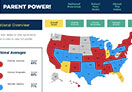
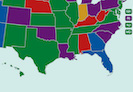
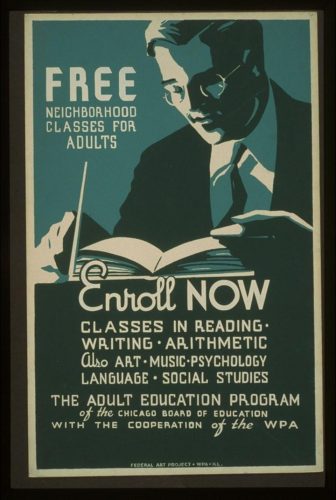
WPA Ad (Source: WPA)

The big issue for many is, however, what to do about the limited access to technology and internet that is an issue in pockets of every state. Or the needs of children in special education who some fear will be left behind because teachers and specially-trained professionals are not physically present to ensure the success of their individualized education plans. This equity gap is at the core of the well-intentioned but flawed decisions that some states have made to limit education or to tell teachers to assure parents that work going home should not count, which anyone who has children knows will result in very little being done. 

Just consider the dramatic change in students “attending school” in that Washington state district. That more went online than went to school regularly underscores the reality of today’s students, who are digital natives. They have grown up with a menu of technology, and are handed phones and ipads almost at the same time as their first sippy cups. Many students already have access to the devices they would need to continue their learning online straight away. Others would only need access.

Take Miami, where the school district figured out a way to get 56,000 devices to families in under one week. 

Or New York City’s Success Academy, the largest and most successful charter school network in the Big Apple, whose majority low-income student population had a remote learning program and computers in hand in just four days, ready for students and teachers to get to work at their new ‘schools’ - their homes, where the only expectation was that learning would continue.  

In Bridgeport, Connectiuct, school leaders regularly converse with their parents and teachers, inspiring them with the expectation that they continue to work, to study, and to learn - as learning during this time will count, and their time spent won’t be wasted.

In Chicago, the Learn Charter Network noted, “[We] have been in constant communication, by phone and email, with each of their families to answer questions and help with any challenge a child or family may be facing.” 

That’s the attitude we all need right now as we are increasingly confined to our homes and endure weeks more of this virus and daily devastating news. And as cases spike in major cities like Chicago, the network’s early responsiveness to connectivity between teachers and families will prove to be a game-changer, should the virus continue to keep students at home, learning.

Experts like Robin Lake of the Center for Reinventing Education at the University of Washington agree that while we must address these unprecedented challenges, you don’t stop, because not all can’t benefit. “Doing nothing guarantees certain inequities and hardships. Students with disabilities, for example, receive no services and no social interaction,” said Lake. “Doing something produces unknown inequities that can be addressed with enough will, creativity and innovation.”

The reality is undeniable - we can do something. And many will choose to. 

The private sector, and particularly ed tech companies, are delivering to Americans’ doorsteps a plethora of products, tools and services, many free, that make learning remotely not only possible, but trackable, leaving no room for categorization of remote learning as solely supplemental. 

There is no rulebook for how to take care of the education of our most precious resource, our children, during COVID-19. And if there is no rule book, the old rules must  be abandoned. 

Innovation requires risk. It’s time to throw caution to the wind, and provide the tools necessary to allow parents and educators to take control - everywhere. Hopefully, if they can do that until their eventual return to school, our kids will be prepared for what the future holds.

We can do this. After all, we’re Americans.


Jeanne Allen is Founder and CEO of CER, the Center for Education Reform.

Digital Learning Virtual Mini-Fest hosted by CER


**Media Advisory**

COUNTERING COVID: Don’t Let Education Fall Into the Curve

Digital Learning Virtual Mini-Fest hosted by CER

April 2, 2020 - 11am - 1pm ET

 
WASHINGTON - The Center for Education Reform (CER), a leading voice in promoting education opportunity, will host a virtual mini-fest featuring the world’s leading Ed Tech developers and educators to address innovations available now as policymakers, educators and families nationwide are racing to catch up with a tidal wave of ideas, programs and services for digital learning. Topics will include everything from Early Ed to the Workforce, and AI, VR and more.
 
WHEN: Thursday, April 2, 2020 -- 11:00 AM-1:30 PM ET
 
FORMAT: Panel discussions with live Q&A from audiences around the world Media will have the chance to ask questions with two Q&A sessions.
 
EXPERTS: Jeanne Allen, CEO and Founder of CER (moderator)
Anne Brown, VP, Waterford Institute
Jamey Heit, Co-Founder, and CEO, Ecree
Sam Caucci, Founder and CEO, 1Huddle
Michael McDonald, Founder, Gold Lotus
Janine Caffrey, CEO, Lexplore
Ulrik Christensen, CEO, Area9 Lyceum
Ash Kaluarachchi, Managing Director, StartEd
Lucilla Crosta, Co-founder and CEO, Edulai
Jeff Kwitowski, SVP, Public Affairs and Policy Communications, K12 Inc.
Michael Moe, Founder, GSV
*More speakers to be announced
 
RSVP: Please RSVP to PR@staging.edreform.com for login credentials and event details.
 

Founded in 1993, the Center for Education Reform aims to expand educational opportunities that lead to improved economic outcomes for all Americans — particularly our youth — ensuring that conditions are ripe for innovation, freedom and flexibility throughout U.S. education.

Newswire – April 1, 2020

YOUR NO FOOLIN’ GUIDE TO EDUCATION IN THE TIME OF COVID

Yes Today is April Fools’ Day - but there is no fooling around in this Newswire. Just information we know you can use whether you’re a parent, teacher, student, administrator or just a foot soldier in the one answer to COVID that we can control — quality schooling from home.

A NEW RESOURCE PLATFORM is your one-stop shopping for the best and latest efforts in accessing substantive, innovative education options, here and across the globe. We designed this specifically for families, students, educators and anyone who wants to know what 5-star programs can be yours — for free. This will be the most worthwhile 10 minutes you spend today.  And come back often as we continuously update the offerings.

THE LATEST ON THE FEDERAL RESPONSE TO HELP SCHOOLING FROM HOME Details are contained in the comprehensive remarks of Education Secretary Betsy DeVos from Friday’s press briefing where you will learn about the full range of help available from D.C., including making sure students impacted by school closures still have access to the school meals, the delay of a year in federally mandated standardized tests, plans to insure that students with disabilities have full access to distance learning and a rundown of initiatives taken by various states.  This and more available to you at the Department’s COVID information page.

DISABILITIES MUST NOT BE A DISABILITY TO ACCESS DISTANCE LEARNING, now during the COVID crisis or ever. You can read CER's Jeanne Allen's take on this in a report broadcast on  National Public Radio.

REASONS TO SMILE. There are no doubt tens of thousands of them in America today, but we share these 2 stories of KIPP Charter Schools in Newark, NJ ensuring its largely low-income and minority students have full access to technology by distributing 3,000 laptops to its students to take home. And then there’s Miami-Dade Schools, which has distributed 57,000 devices to families. Talk about overcoming obstacles. Keep it up folks. America’s kids need you!

TODAY’S REALITY IS ONLINE AND DISTANCE LEARNING. Not coincidentally, Jeanne Allen’s guest on the latest Reality Check podcast is Mark Defusco, CEO and President of Bay State College, a leader in providing students in high school, college and those returning to higher ed access to online and remote education that makes it easier for them to succeed.  We don’t often say this — but think this episode is a must listen in these times.

FROM OUR FAMILY TO YOURS, this from the Book of Numbers: “The Lord bless you and keep you; the Lord make his face shine on you and be gracious to you; the Lord turn his face toward you and give you peace.”  Stay safe and strong everyone.


Founded in 1993, the Center for Education Reform aims to expand educational opportunities that lead to improved economic outcomes for all Americans — particularly our youth — ensuring that conditions are ripe for innovation, freedom and flexibility throughout U.S. education. 
We’re always delighted to hear from our readers...suggestions, questions and even the occasional complaint!


Teaching Students with Disabilities During Coronavirus School Closures : NPR

With Schools Closed, Kids With Disabilities Are More Vulnerable Than Ever

NPR | March 27, 2020

With school closed, Marla Murasko begins her morning getting her 14-year-old son, Jacob, dressed and ready for the day. They have a daily check-in: How are you doing? How are you feeling? Next, they consult the colorful, hourly schedule she has pinned on the fridge.

Jacob, who has Down syndrome, loves routine. So this daily routine is important. Schools in Hopkinton, Mass., are closed until May 4th, so Jacob's morning academic lesson — which according to the schedule starts at 9 a.m. — has been temporarily moved to the basement.

But there's been one big hiccup to all this: What, exactly, to learn during these at-home sessions? Some of Jacob's teachers have sent packets home — one, for a science class, includes a video and a worksheet on wolves — but teachers haven't included any of the modifications, or "accommodations" he normally gets that are designed to adapt the lessons to his learning style. Normally, Jacob is in a general education classroom, with special help. In some subjects, like reading and math, he works with different teachers and sometimes does different lessons.

"It has been very frustrating for us," says Murasko, "he can't look at a five-page worksheet and learn. He needs it very simplified in order for him to learn it. If there's no accommodations or modifications for him, he really can't attend to that lesson plan unless I modify it for him." So Murasko, who insists she is not and has never been a teacher, has had to get creative. She found some worksheets online that help break down readings into Who, What, Where, When and Why? She says they're helping.

"I'll be honest with you, I've approached my day at this point with trying to figure out the positives," she says, "because I can't keep staying in this negative arena of when are they going to provide me something?"

As the vast majority of schools in the U.S. have transitioned from the classroom to the computer — teachers and administrators have struggled to offer learning to special needs students. The Hopkinton school district, where Jacob attends, did not respond to requests for comment on how it's handling the needs of students in special education.

Some districts have plowed ahead with holding one-on-one lessons over software like Zoom and virtual meetings to discuss the individualized education plans — known as IEPs — that are required for students in special education. Others have put all learning on a pause, as they figure out how to use distance learning to serve all students — not just those with disabilities but also those who don't have computers or high-speed internet.

As we've reported, schools have had to move online within a very short time frame, often without extra resources and very little training.

An estimated 14% of public school students receive special education services in the U.S. The federal Individuals With Disabilities Education Act ensures that those children have a right to a free, appropriate public education whenever and wherever schools are operating.

"Our district overall is implementing Google Classroom," explains Ann Hiebert, a special education teacher for the Ferguson-Florissant School District, in the suburbs of St. Louis, "but that doesn't work well for my students, since I have students with more significant needs."

Her students have intellectual disabilities, including autism. Many are non-verbal, and some struggle with writing and typing and can't use technology independently.

"So all of these things that are out there aren't really going to be the best option for my kids," Hiebert says. She has been sending emails with videos of her classes' morning routine — they include familiar songs and pictures of their classroom calendar. "Routine is very important to my students," she says. She sent packets home for students, but she's "still trying to figure out ways that I can have meaningful content for them."

An urging to stay flexible

On Saturday, the U.S. Education Department announced it was giving schools flexibility in interpreting IDEA, saying that complying with the law, "should not prevent any school from offering educational programs through distance instruction."

Jeanne Allen, who founded the Center for Education Reform, an advocacy group that promotes school choice, said she was relieved to get the guidance, as there's been, "confusion about what schools, school districts and educators were permitted to do." She acknowledges that there are concerns about equity, but argues that schools should be looking to ed tech innovators and seeking creative solutions, rather than putting a hold on all learning.

"The law does not say if you don't educate every single person today in real time, you're going to get penalized," she maintains, "You don't stop schools and leaders from educating students to find the perfect solution."

A new federal relief package, which President Trump signed into law on Friday, offers Education Secretary Betsy DeVos the opportunity to go one step further: She now has 30 days to seek waivers for additional provisions of IDEA in order to provide schools with "limited flexibility."

This provision makes disability advocates nervous. "We're talking about waiving a civil right for our most vulnerable people in our society, children who don't vote, who have no voice, who are relying on their parents to advocate for them," says Stephanie Langer, a Florida civil rights attorney who focuses on education and disability.

She worries that if the federal government lets states and districts off the hook for providing accommodations for students with disabilities, schools and teachers won't even try. "If they know they won't be held accountable at the back end, they simply will not try," Langer maintains. "Having the requirements in place requires schools to do something rather than nothing, even if it's not perfect."

In the meantime, it's really up to parents.

For the first few days of virtual learning, Ann Hiebert says she was focused on how to adapt lessons for her students, but in recent days she has shifted her thinking. Now, she says, "I'm trying to be more of a resource to parents." She's planning on making videos — with help from her own son, who is also home from school — to demonstrate to parents how she works with students in class, so parents can model her movements.

"Parents have now become the teacher, the therapist, the advocate. They are everybody all in one," says Catherine Whitcher, who works with both families and school districts to craft IEPs. "The teachers have really started to flip their thinking of, 'How can I support the parents and what they're doing during this time?' "

Whitcher says parents are stressed out because they're worried their special-needs child isn't going to make academic progress at home, but she argues that's not where the focus should be for families. "Right now, we need to stabilize as human beings inside of our homes. It's about life skills. It's about community. It's about connection."

She says the time spent over video chat, or at home, is a great opportunity for parents and teachers to actually get to know the students in the context of their family.

Lessons from a virtual school

There are schools with extensive experience teaching online, including a number of virtual charter schools. "All of our instruction has always been delivered online," says Jamie Desrochers, the director of special education at the PA Distance Learning Charter School in Pennsylvania. "Our special ed teachers, pretty much everything that they can do in a brick and mortar school, we can do on a cyber." The only services they normally do in-person are things like speech therapy, occupational therapy and physical therapy, but they have partnerships with companies like PresenceLearning that offer these services over video chat, and are leaning on them even more now.

When everything is through a computer, Desrochers says, teachers "have to be that much more animated to get the kids' attention." Sometimes teachers wear different silly hats and they ask lots of questions about the students' living environment. "The kids love to show off their pet," she says. "Giving the students an opportunity to do a show-and-tell online gets them engaged and builds that relationship."

For special education teachers adapting to a new virtual reality, Desrochers suggests making sure lessons connect to real life. And she urges teachers and parents to lean into the tools and objects students have in the home.

For example, if you'd use blocks for counting in the classroom, use something like pasta. For a lesson about surface area, have students count how many tiles are in the kitchen, or how many steps it takes to get from one side of the room to the other. And for parents, she adds, don't forget about household chores: "Cooking with your kids, is a great way to teach math."

Newswire – March 25, 2020

THE FUTURE IS NOW 

Our resolve is more firm than ever before. We are not blinking — never have and never will. We are redoubling our commitment and efforts to help education advance through and despite this crisis.

Whenever this COVID19 crisis ends, and it WILL end, one thing is certain  things will never be the same. The crisis has brought to the forefront the innovators and entrepreneurs who will make education  in America and abroad  agile, adaptive and successful in the 21st century.  

DON’T LET EDUCATION FALL IN THE CURVE.Tens of thousands of amazing people, programs, organizations and content have been produced, updated and made free online. We’re doing our part to make sure our kids don't fall into the curve, with a one-stop shopping platform for all who need access to how and what to learn in this new digital age.

MOVING FROM BC to AD APRIL 1.  This new digital age requires new thinking. Our partners at ASU+GSV are taking a portion of their annual summit online to help you think through what’s next across the globe.

MINI-VIRTUAL SUMMIT APRIL 2. After hearing scores of challenges with this new “normal,” CER will be connecting ed tech leaders with our most important customers — the parents and educators on the frontlines. Register Here


TAKE A BREAK FROM COVID-19 and..

Listen to our Podcast! This week’s edition of Reality Check with Jeanne Allen features Scott Cheney executive director of Credential Engine, who explains the burgeoning marketplace of credentialing, and how those streamline the pathways between high school, higher education and the workforce.


Take a Virtual Reality Lesson - in Italy! While theU.S. - Italia Education Innovation Festival has been postponed, you can give some encouragement to good folks in Italy.  Michael McDonald, an EdTech teacher living in Lecce, Italy, is running a 24 hour English lesson in virtual reality to raise funds for the Red Cross.  Open your heart a lot, and your wallet even a little, and help with this wonderful gesture.

Read An Unfinished Journey Take a break,  grab a coffee — or adult beverage — and relax with Jeanne Allen’s new book. Inspired by her Italian heritage and passion for education, her writings will have you both laughing and crying — and best of all forgetting about our mess, at least for a while.

Rather than curse the darkness of the virus, CER chooses to light candles by providing you with the best, most up to date information and resources anyone could use to get through this.

 Our closing thoughts are hopes and prayers that you and yours stay safe.  We will get through this.

After all, we’re Americans.


Founded in 1993, the Center for Education Reform aims to expand educational opportunities that lead to improved economic outcomes for all Americans — particularly our youth — ensuring that conditions are ripe for innovation, freedom and flexibility throughout U.S. education. 
We’re always delighted to hear from our readers...suggestions, questions and even the occasional complaint!


IMPORTANT NEWS: US Department of Ed Issues Much Needed Guidance

Dear Friends,

As we all work to provide rapid solutions to the COVID-19 crisis and the impact it is having on education, we learned last week from our partner network that many states and school districts — some of which had already started remote education of students — told educators that any remote learning would not count and they should literally CLOSE school, remote or not.

The justification by governors and state leaders in Washington state, Pennsylvania and Oklahoma for example, was that there would be no assurance of equity for all and therefore no one should be educated. Some states told very innovative district superintendents that they’d likely be violating federal special education laws if they were not careful. So the districts stopped. (I wrote about this in my blog Friday.)

CER has been working closely with our partners across the country and monitoring situations in each state as well as nationally, and we believed that it was critical we all come together as one voice to try and fix the hurdles in the way for our educators and schools systems.

So, we convened a remote meeting on Friday with a diverse group of experts and practitioners, with US Department of Education Assistant Secretary Jim Blew who was quick to respond to our outreach. I am so pleased to report that due to our work together as a coalition, the US Department of Education over the weekend issued clarifying guidance that encourages school administrators and educators to use their resources to continue to educate students.


“This is a time for creativity and an opportunity to pursue as much flexibility as possible so that learning continues. It is a time for all of us to pull together to do what’s right for our nation’s students,” said Education Secretary DeVos in the statement.

Neither students nor schools will be penalized for doing so. 

None of this would be possible without you and the work we continue to do together, and I personally want to thank everyone involved for putting forth innovative, real time solutions that are making their way to students this Monday!  

We are gratified by this outcome and urge all in the US and abroad to continue to share and use the amazing tools and resources that have emerged from amidst the thousands of education innovators and technology gurus that work round the clock to make great progress in education! 


Hoping you and yours are safe.

Urging States to Continue Educating Students with Disabilities, Secretary DeVos Publishes New Resource on Accessibility and Distance Learning Options

Urging States to Continue Educating Students with Disabilities, Secretary DeVos Publishes New Resource on Accessibility and Distance Learning Options

New Fact Sheet Provides Additional Information on How Distance Learning Can be Used to Meet Students’ Needs During COVID-19 National Emergency

WASHINGTON — U.S. Secretary of Education Betsy DeVos announced the Department has released new information clarifying that federal law should not be used to prevent schools from offering distance learning opportunities to all students, including students with disabilities. This new resource from the Office for Civil Rights (OCR) and the Office of Special Education and Rehabilitative Services (OSERS) explains that as a school district takes necessary steps to address the health, safety, and well-being of all its students and staff, educators can use distance learning opportunities to serve all students.

“It was extremely disappointing to hear that some school districts were using information from the Department of Education as an excuse not to educate kids,” said Secretary DeVos. “This is a time for creativity and an opportunity to pursue as much flexibility as possible so that learning continues. It is a time for all of us to pull together to do what’s right for our nation’s students.”

“Nothing issued by this Department should in any way prevent any school from offering educational programs through distance instruction,” she continued. “We need schools to educate all students out of principle, rather than educate no students out of fear. These are challenging times, but we expect schools to rise to the occasion, and the Department stands ready to assist you in your efforts.”

As the fact sheet states, schools “… should not opt to close or decline to provide distance instruction, at the expense of students, to address matters pertaining to services for students with disabilities. Rather, school systems must make local decisions that take into consideration the health, safety, and well-being of all their students and staff. To be clear: ensuring compliance with the Individuals with Disabilities Education Act (IDEA), Section 504 of the Rehabilitation Act (Section 504), and Title II of the Americans with Disabilities Act should not prevent any school from offering educational programs through distance instruction.”

To help schools provide distance learning in compliance with federal law, this fact sheet explains:

The Department recognizes that exceptional circumstances may affect how special education and related services and supports are provided to students with disabilities, and the Department will offer flexibility.

School districts must provide a free and appropriate public education (FAPE) to students with disabilities, and the provision of FAPE may include, as appropriate, special education and related services that can be provided via computer, internet, or phone.

Although online learning must be accessible to students with disabilities, federal law does not mandate the specific methodologies by which distance education must be provided.

In instances where technology is not accessible or where educational materials are not available in an accessible format, educators may still meet their legal obligations by providing equally effective alternate access to the curriculum or services provided to other students.

The Department will continue to work with state and local leaders to identify any additional areas where it can provide resources to support educators in their important work, and both OCR and OSERS are available to provide technical assistance during these uncertain times. The Department continues to update www.ed.gov/coronavirus with information for students, parents, educators, and local leaders about how to prevent the spread of COVID-19.

For more information about COVID-19, please visit the following website: www.coronavirus.gov.

###

The Media


Our picks of the best sources for news on programs, changing times and circumstances in Education resulting from Covid-19… Send us your thoughts.


Matt Barnum
Nat’l Education Policy & Research Reporter, Chalkbeat
@matt_barnum
https://chalkbeat.org/author/mbarnum/


Erica Green
D.C. Education Corresp., New York Times 
@EricaLG
(Latest from) https://www.nytimes.com/by/erica-l-green 


Dana Goldstein
Nat’l Education Corresp., New York Times
@DanaGoldstein
(Latest from) https://www.nytimes.com/by/dana-goldstein 


Alexander Russo
Founder & Editor, The Grade
@alexanderrusso
(Phi Delta Kappan online, The Grade) http://kappanonline.org/category/the-grade/


Liz Willen
Hechinger Report
@L_willen
hechingerreport.org 


Andrew Ujifusa
Assistant Editor, Education Week
EDWEEK CORONAVIRUS & SCHOOLS: https://www.edweek.org/ew/collections/coronavirus-and-schools/index.html
https://www.edweek.org/ew/contributors/andrew.ujifusa_5926680.html