







Week 8 of Quarantine?
For some it’s 6, 7 or 8 but it’s been a long time. Everything has changed, including when we publish our content and what we are doing. In fact, some suggest that this pandemic has forced us to all do things differently, that have been a long time coming. Change is hard, so while CER won’t change its focus, its DNA or its approach (apologies, foes and fair-weather friends!), we do adapt when the necessity arises. Here’s what you need to know on this 5th day of May 2020–
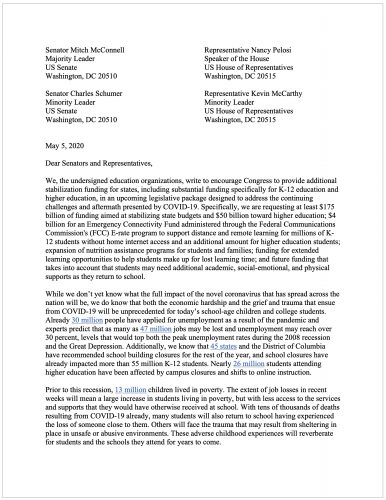
 THIS IS WHY WE CALL IT THE BLOB. Dozens of education groups are mobilizing to get more money moving to education, which you might think is a good thing, if not for the fact that the traditional system has failed a majority of students — for decades. Asking for $200 billion, on top of the $13 billion in new monies already delivered for education (see related story below) to fund federal programs in anticipation of state budget cuts is the epitome of throwing good money after bad. Never mind that the rest of the nation has to try to figure out how to tighten belts, which includes the taxpayers who pay for federal funding. Never mind that students are being educated in many diverse ways, and not just through Districts. Never mind that not one mention of the fact that the system they seek to fund has been doing a stunningly poor job.
Rather than cast a vision that ensures learning for all students, and dealing with a new reality, the Blob is demanding more money for business as usual. They are petitioning Congress for:
"$25 billion to be allocated to Title I, IDEA, and other ESSA programs serving historically marginalized students to provide targeted support to vulnerable students most likely to be affected by prolonged school closures.
At least $175 billion for the Education Stabilization Fund distributed directly to LEAs and IHEs, with minimal state set-asides in an equitable and targeted fashion.
Inclusion of a strong maintenance of effort requirement to prevent inequitable impacts on high-poverty school districts and colleges that ensures any reductions to state education funding do not disproportionately affect high-poverty local education agencies.”

If only THAT worked!
Check out the list of who is doing this, versus who is focussed on doing education well, which last we checked had little do with districts and federal money.
GOVERNOR’S FUNDS FOR THE NEW NORMAL. The CARES Act has sent billions to states to support learning for students and encourages innovation. There is also a new Rethink K-12 Education Models Grant focused on tools and resources for students to access education no matter where they live or are learning and a Reimagining Workforce Preparation grant.
 WE ENVISION A NEW FUTURE OF SCHOOL. COVID19 has yanked things out of the future and put them on our doorsteps — today. To manage this unprecedented time, you may be one of the thousands joining the dozens of virtual meetings and podcasts entertaining people with models, ideas and dialogue about all the issues of the day. The CER ACTION Series - that’s ACTION — meaning Accelerating Change through Innovation and Opportunity NOW! — has been covering the schools and their bold leaders who are delivering quality education to literally hundreds of thousands of students remotely and digitally with much individual attention. Watch and see for yourself . Said Friendship Public Charter Schools CEO Patricia Brantley in a recent webinar event, “Remote & digital learning has been great for family engagement — it is putting families in the classroom and producing a much greater appreciation for teachers…we are now letting teachers and parents decide how to do school well.”
“This is a watershed moment for education’s future,” said Academica VP Antonio Roca. “Attendance has been better than pre-COVID. Most of our schools have 90% + attendance, some are at 100%. Students want to learn!”
HIGHER ED CHANGING, TOO. We hear that residential colleges are experiencing reductions in enrollment while it’s going up at schools with distance learning and skills-based programs. This should surprise no one. We know that while many benefit from the traditional college, residential living has driven up costs of attendance, and may finally be facing a long overdue comeuppance to account for the millions spent on non-teaching staff, food service and gyms rather than the basics. And as we know from innovations in higher ed over the past decade, some of the best universities have figured out how to do both well and inexpensively.
VERIZON ON THE HORIZON. Many companies have stepped up to help education in the current crisis, including telecommunication companies, and they all deserve our thanks. One of the most generous and innovative has been Verizon, with its Verizon Innovative Learning program, which offers a huge array of free resources, content, tools and solutions for the challenges YOU face. It will be well worth your while to browse — and in the meantime a big tip of our hat to our friends at Verizon.
 TIME TO END THE TURF WARS. CER favorite Kevin Chavous explains the tragedy of some public schools and unions resisting working with public charters to ensure every kid has an opportunity to learn during the current crisis. As he says, “Now is not the time for a turf war”. Hard to argue with that logic. Let’s hope the education establishment listens and takes Kevin’s sage advice to heart.
EVERY CHALLENGE IS AN OPPORTUNITY. It’s the work we do to help others overcome their challenges that presents us enormous opportunities to help change their life trajectory.
We seize those opportunities daily, and COVID-19 is no exception.
Never before has our passion for and growing expertise in the field of education innovation and technology been so timely or necessary. Thanks to all working toward the same goal, the same mission — we are grateful for your interest and for making it possible — either through your moral or financial support (or for those who don’t like what we do, giving us the impetus to continue!)
Stay safe and please stay in touch!
Founded in 1993, the Center for Education Reform aims to expand educational opportunities that lead to improved economic outcomes for all Americans — particularly our youth — ensuring that conditions are ripe for innovation, freedom and flexibility throughout U.S. education. We’re always delighted to hear from our readers...suggestions, questions and even the occasional complaint!
 THE FUTURE OF SCHOOL? If you’re interested in that, you’ll want to be joining the CER ACTION Series (That’s ACTION — meaning Accelerating Change through Innovation and Opportunity NOW)! Part III on the Future of School covered the experiences of two Change Makers who combined, serve almost 80,000 students remotely and digitally with much individual attention — despite the challenges presented by COVID. Learn more about the work of Jon Hage and his team at
  PLAN TO JOIN US FOR MORE…
 RAYS OF HOPE. From Arizona comes word that the
 STILL LOOKING FOR HELP AT HOME? Let CER help keep school going no matter where you are. Find the resources you need with our


For Success In Schools Post-Coronavirus, Education Must Transcend Location
Forbes | May 5, 2020
By Jeanne Allen, Founder and CEO of CER
Academica students and teachers engage in virtual classrooms from all over the country. ACADEMICA
With the doors to most of K12 and higher education shut for the rest of the academic year and beyond, it’s time to implement a dramatically different way of educating our nation’s youth, and make it stick. We can’t allow our kids to stop learning and slide back because facilities are closed.
Where you live is no longer relevant right now, and may not be relevant consistently over the next two years as the nation jigsaws its way through possible repeat outbreaks of COVID-19. What is relevant is the ability to deliver education seamlessly, via low- and high-tech tools, with substantive programming, expectations and American ingenuity. Innovation is happening, and it’s the innovative institutions we must seek to expand and emulate.
And indeed, across the country, tens of thousands of students are “going to school” from their homes. But those are the fortunate minority, whose families happen to live either in school districts led by aspirational leaders, or who attend a myriad of diverse schools, most charters, some private, some specifically designed to be virtual.
If you’re lucky, your kids attend schools managed by Friendship Public Charter Schools in Washington, DC, Academica, with more than 90 charter schools in nine states, or networks like Charter Schools USA, National Heritage Academies, Rocketship, Seton, Success, and Vista College Prep and hundreds more around the nation.
If you’re lucky, your students go to school in Colorado, Florida, or Rhode Island, where governors expect students to be taught remotely, though how well still depends on the quality of your school.
But why must people be lucky to get educated, even during a pandemic? We’ve had access to world class technology that removes barriers to educating and connects subject matter experts, coaches, educators, and families for more than a decade.
The truth is that students need not remain “assigned” to their current zip code to be educated. The very concept of zoning students by where they live is a 100-year-old concept. Districts were created to provide support services and central management of funds and programs for the schools in their “zone” for the purpose of allowing schools and educators to focus on the students.
Those once small, locally controlled and independent districts once numbered over 100,000 with each community responsible for its own schools (and as a result much more responsive to its constituency). Today, fewer than 14,000 districts exist, consolidated since 1940 into powerful, centralized bureaucracies closely resembling feudal states.
To be sure, there are those who argue that large, consolidated governments are more efficient. But that’s in theory. Because while it may sound rational, it simply hasn’t resulted in successful education for the vast majority of students, particularly in large districts.
Changes in eight-grade NAEP U.S. history average scores, by U.S. history themes NAEP: THE NATION'S REPORT CARD
The failure of most of those very districts to educate the majority of students has never been more apparent. One can look at the most recent scores on the National Assessment of Educational Progress, where a paltry 15 percent of eighth-grade students are proficient in history, and fewer than 24 percent and 25 percent are proficient in civics and geography, respectively.
Or you can look at the fact that when the pandemic closed school facilities, it took weeks for most districts to turn out programs for their kids. They stalled, challenged by their signature inefficiency and ongoing adversity to innovation that left them totally unprepared to take learning online.
Every student, regardless of city or state, should be able to attend a school that can provide the education that their parents believe they can handle - right now, at this moment in time. Each student must be able to go beyond their school, district, or even state lines to obtain that education from a school that can and wants to deliver for them.
And even without a crisis, why should the challenges of life - a parent’s job loss, an illness, or (on the upside) an opportunity to travel or change jobs - get in the way of a student’s education?
We must not return to normal, as normal is a nation where fewer than 30% of students - and fewer than 15% in poor communities - read, write, spell, do math or know history, science, or civics on grade level. Normal is an education system which has consistently failed to deliver what students need and isn’t permitted - by its very design - to put student interests ahead of rules and contracts.
Most families long for some normalcy. But the response by schools and districts to this pandemic is a wake-up call. Given the choice to go back to “normal,” or to choose a new, different school for their child, in either case most will likely choose to be “in” a school with buildings, people, educators, and other students close by. That doesn’t preclude education happening in new and better ways, however, starting now.
READ: The Future of Schools CER’s report sets a new course for policymakers, advocates and families and educators to follow as we work to reshape education during (and after) COVID-19.
Founded in 1993, the Center for Education Reform aims to expand educational opportunities that lead to improved economic outcomes for all Americans — particularly our youth — ensuring that conditions are ripe for innovation, freedom and flexibility throughout U.S. education.