










Vol. 15, No. 21
OPPORTUNITY FORWARD. Just this morning, the North Carolina House Education Committee moved legislation forward that would bring vouchers to the Tarheel State. Following a heated debate, The Opportunity Scholarship Act, HB 944, passed 27 to 21. As one lawmaker said in favor of the bill, “Some think we were elected to represent public schools, but we were elected to represent the people of North Carolina… Parents have a God-given right [to choose.]”
BEANTOWN CHAMPS. Charter schools in Massachusetts turn 20 this year and they are only getting better with age. A new report by the Massachusetts Institute of Technology (MIT) finds that high school students attending Boston’s charter schools are outperforming their traditional public school peers and are more likely to go on to attend four-year colleges. Although, this finding is not surprising since a majority of charter schools in Boston have a college preparatory emphasis and have created a competitive culture that encourages students to succeed. The report also finds that Boston’s charter students are more likely to take AP courses and pass the state graduation exam. It’s clear that Boston’s charter schools continue to be “Champions of School Achievement.”
THERE’S NO SUCH THING AS A ‘GOOD’ CAP. Last week, Maine lawmakers killed a bill that would have significantly improved the Pine Tree State’s charter school law. The legislation, introduced by Gov. LePage, would have removed the cap of only ten schools within ten years and allowed for truly multiple and independent charter school authorizers. Outraged by the lack of progress to open and approve schools since charters became legal in Maine in 2011, Governor LePage railed against the commission back in January, stating that Maine needed “people with backbones.” Well, clearly there weren’t enough people with backbones at Thursday’s joint education committee hearing. Let’s hope Maine’s slow approach to charters doesn’t drag on as long as Texas’ 18-year battle over caps, which finally gained some ground over Memorial Day weekend. While the cap on the number of charter schools in Texas was not eliminated for good, the legislature increased the limit on the number of schools from 215 to 305 by 2019. A victory indeed for Texas students, but still not enough in a state where there are over 100,000 students on waiting lists. Sadly, this cap issue will rear its ugly head again in just a few short years in The Lone Star State. A lesson Maine lawmakers and others should be mindful of when debating “Good Cap, Bad Cap.”
DIGITAL DIVIDE. With a single signature, Gov. Pat Quinn of Illinois once again put on display his unwillingness to embrace any legislative measure expanding educational choice. In the same state that received an ‘F’ for digital learning on the Parent Power Index©, Quinn and his supporters in the legislature imposed a one year moratorium on new charter schools with virtual learning programs in communities with less than 500,000 residents. In the meantime, a report will be conducted on the effectiveness of virtual learning, which won’t be submitted to the General Assembly until March 2014. This moratorium makes clear Illinois lawmakers don’t want to adapt, choosing establishment interests over innovative ways of educating students.
Digital learning is also slated to be scaled back in Louisiana thanks to the same state Supreme Court ruling that found the funding mechanism for vouchers to be unconstitutional. State Superintendent White vowed to find department funds to ensure access, but widespread offerings of online coursework in the “course choice” program will be affected.
PARENT POWER AT WORK. When a local school district was unable to provide a quality education to her children, mother and military wife Calyn Holdaway decided to take action. When Holdaway moved her family to a new school district in hopes of getting a better education for her oldest son with autism, her two youngest children ended up facing challenges. In what we would call a true act of parent power, Holdaway started a non-profit in her home state of Washington with the goal of opening a charter school in 2014. Thanks to a recently passed law allowing for non-profits to start up to 40 charter schools over five years, Holdaway’s plan for a charter that targets ‘non-traditional learners’ has a chance of becoming a reality. She realizes there will be a lot of opposition to a charter school in the community, but luckily for students in Tacoma in desperate need of an alternative, Holdaway says she isn’t afraid.

What makes a person who benefitted from choice repel it?
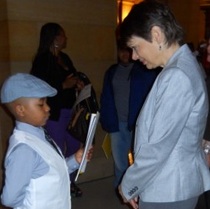
“Do you have a card?”
She had a huge smile, coming up to me right after I spoke to the NC House Education Committee —the largest, it would seem, in the free world with 53 members (!)– about the need for opportunity scholarships to provide poor children access to quality schools.
“Um, I’ll get you one,” I answered. Then I noticed her sticker on her lapel, which was a circle, with the word vouchers in the middle, and a SLASH through the word.
“Why do you want my card, you clearly don’t agree with me,” I responded.
The inquirer responded – “I just want to know who is paying you; where you get your money.”
Wow. So belief is all about who pays you? I was stunned.
Her name was Elizabeth Haddix, and it turns out Elizabeth works for the UNC School of Law Office of Civil Rights.
During the whole hearing, this man stood behind her, near the door, and cued her with motions and non-verbal hand signals as people were talking. (See minute 44:16 in the video of the hearing below.) He actually looked like the union boss in “Won’t Back Down.” But upon further research, it turns out, he’s the manager of said Office of Civil Rights, and, it would seem, her coach.
It was a quick hearing, and only an hour was allocated for pro- and con-, and the basic introdution of the bill by members, but clearly Elizabeth waited with anticipation to deliver a zinger of remarks… which never came because they had to stop the hearing due to time. Thankfully, the voucher hearing continued in the NC House Ed Committee today, and 27 lawmakers had enough sense & strength to see past typical status quo arguments and pass opportunity scholarship legislation.
One of the most frustrating things I have to contend with in my job is the insinuation that some of us wake up every day and simply do someone else’s bidding. That I would have funders that might dictate who I am or what I believe is, of course, insulting. But more insulting is the notion that a smart, Duke and UNC Grad like Elizabeth – quite possibly subsidized by the state – would think more about who “pays me” than what I believe… as her manager looks on.
What’s more is that this hearing was about a bill that is largely going to benefit black and brown children, from poor neighborhoods, who can’t even spell UNC or LAW because the schools are so bad. And yet, little white Elizabeth and her Manager help run an organization with TAX PAYER DOLLARS that claims to “extend America’s promise of justice, prosperity and opportunity by elevating families and communities above the boundaries of race, class and place. Its mission is to use community-based impact advocacy and legal education and scholarship to advance strategies that secure social, economic and environmental justice for low wealth, minority families and neighborhoods.”
Huh? You are working to elevate families above the boundaries of place, but you want children consigned to failing schools they are required to attend by virtue of their zip code and poverty? Please.
Elizabeth didn’t get to talk but I can surmise what she would have said. I’ve met thousands of Elizabeth’s before – privileged people who so desperately want to help others that they lose sight of the fact that the institutions created to help and the laws written to protect us all often fail to deliver on promises.
Elizabeth probably would have said, however, to give her credit:
– Public schools are the very foundation of American society, and scholarships undermine that foundation
– Public schools are egalitarian and must take everyone, while private schools can select – and discriminate
– No one cares more about kids than educators, and public educators work hard every day to ensure they teach the kids.
Then she would have attempted to say something about civil rights, forgetting that phrases rarely deliver social justice. After all, Brown v Board was the law of the land more than a decade before anyone had real justice.
I wonder if she’d ever say that she had a choice to go to school, if not during K-12 than most certainly at Duke and UNC Law!
What makes a person who benefitted from choice repel from it? Is it their love of the status quo? Their fear of the potential of real parent power? What is it that actually robs otherwise smart people of their ability to see behind their own little paradigm and book learning? I will die trying to know, but I will never stop.
And then there’s that smile. I think more than the fact that I can predict what she’d say by her allegiance to failing public schools in NC, is the fact that when she first asked me for my card, Elizabeth had an enormous and apparently quite phony smile on her face as if getting my card was the key to her salvation. Thankfully I asked her why she’d wanted it, and she told me. “I just want to know who’s paying you,” she said. Wow. That’s your big concern?
Disagree if you want, represent your own narrow interests, but do me a favor Elizabeth – if you really believe what you believe, be honest about it and don’t fake the smile next time. Be the person you really are and demonstrate what you believe. And celebrate the fact that you had a choice in getting there.
by Jeanne Allen