








Agudath Israel Files Supreme Court Brief: Is Excluding Religious Schools from a School Choice Program Constitutional?
Agudath Israel of America | April 12, 2019
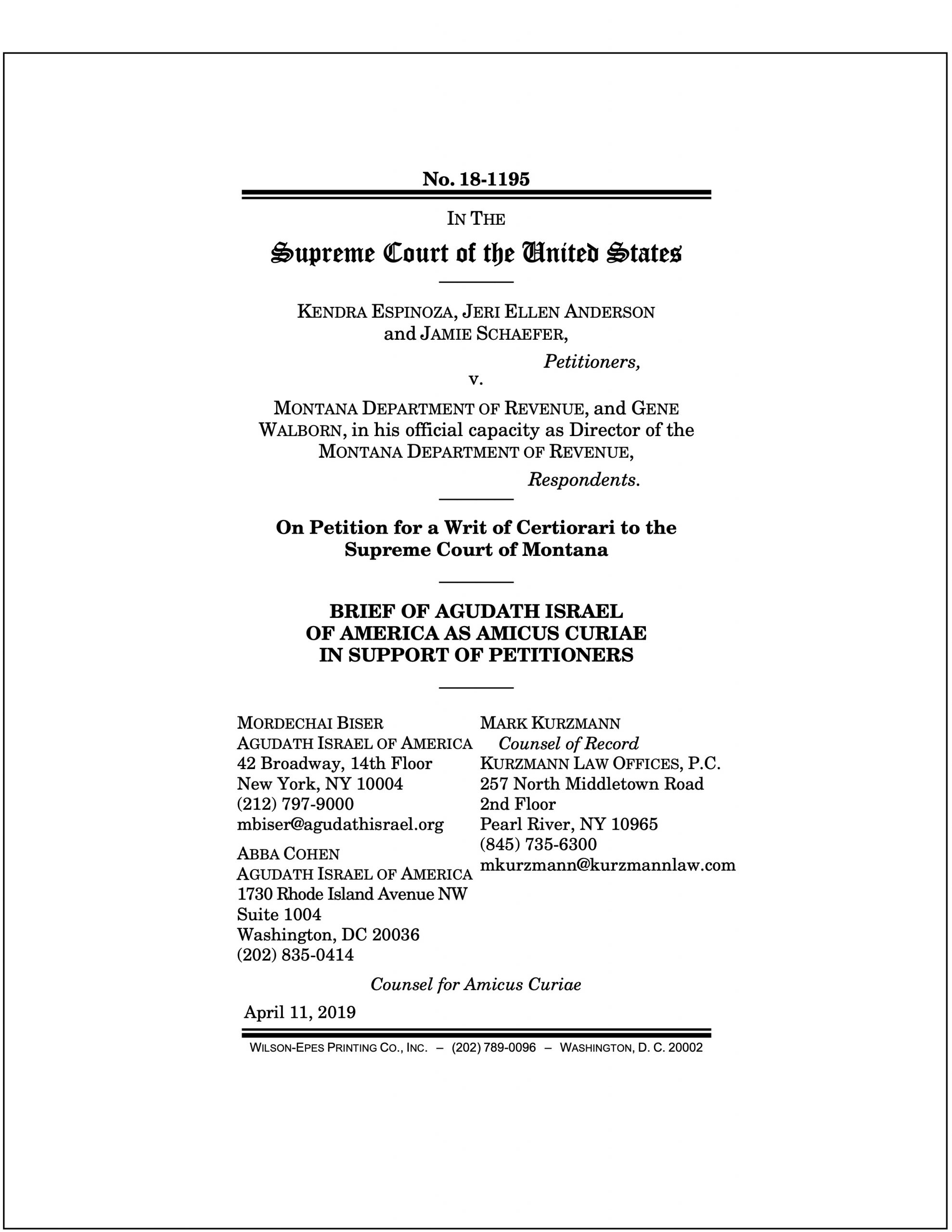
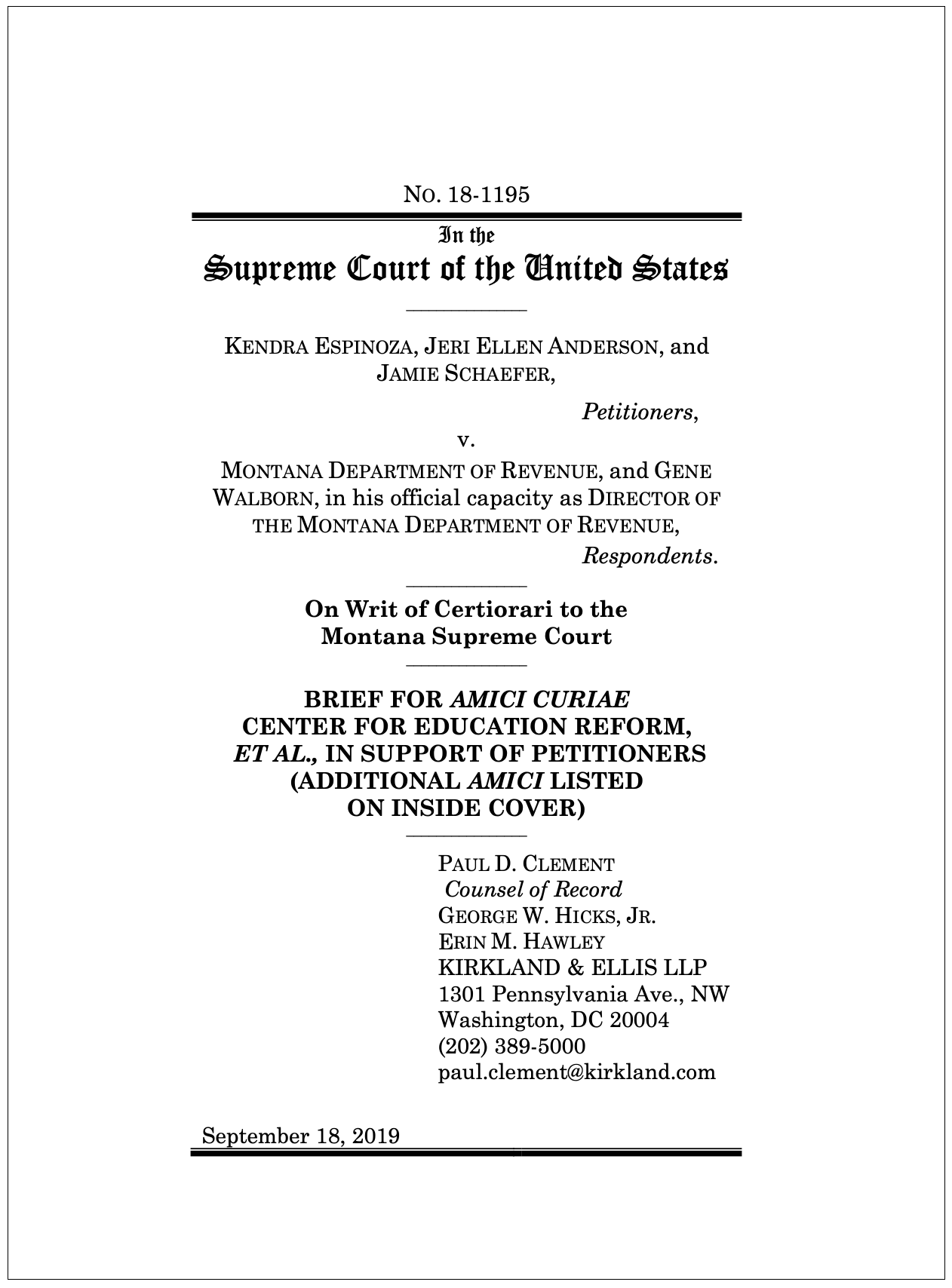
"Agudath Israel has filed an amicus curiae (friend of the court) brief in the Supreme Court of the United States in a case, Espinoza v. Montana Department of Revenue, involving a Montana tax credit program for donations to scholarship funds for students attending private schools. The Montana Department of Revenue ruled that the scholarship could not be used at religious schools, on the grounds that the state Constitution contained a provision that prohibited government aid, even indirect aid, to religious institutions. The Department’s decision was challenged in court, and, eventually, the Supreme Court of Montana upheld the position of the Department. Agudath Israel had submitted a brief in that case as well, arguing that under the Free Exercise Clause of the United States Constitution, states should not be allowed to exclude religious institutions from public benefit programs.
In its current brief, Agudath Israel urges the United States Supreme Court to hear the Montana case. The brief argues that under the Supreme Court’s own precedents, notably Trinity Lutheran Church of Columbia v. Comer, decided in 2017, government grant programs may not exclude religious institutions from benefits solely because they are religious institutions. In that case, the Court held that a Missouri program that provided state funding for playground resurfacing could not, under the Free Exercise Clause, bar churches and other religious institutions from the funding program.
The Agudath Israel brief argues that there should be no constitutional distinction between a state denying funds from religious institutions for playground resurfacing and denying private school scholarship funding from students who choose to attend religious schools. If the Supreme Court agrees to hear the case and upholds the program, it would be a significant precedent, especially in states that have provisions in their constitutions that bar aid to religious institutions, and could pave the way for expanded programs of parental choice for the religious school community.
The brief was signed by Mordechai Biser, Special Counsel for Agudath Israel; Abba Cohen, Agudath Israel’s Vice President for Government Affairs; and Mark Kurzmann of Kurzmann Law Offices, as Counsel of Record. Agudath Israel thanks Scott Whitman, a law student at Georgetown Law Center, for his assistance with the research and drafting of the brief."
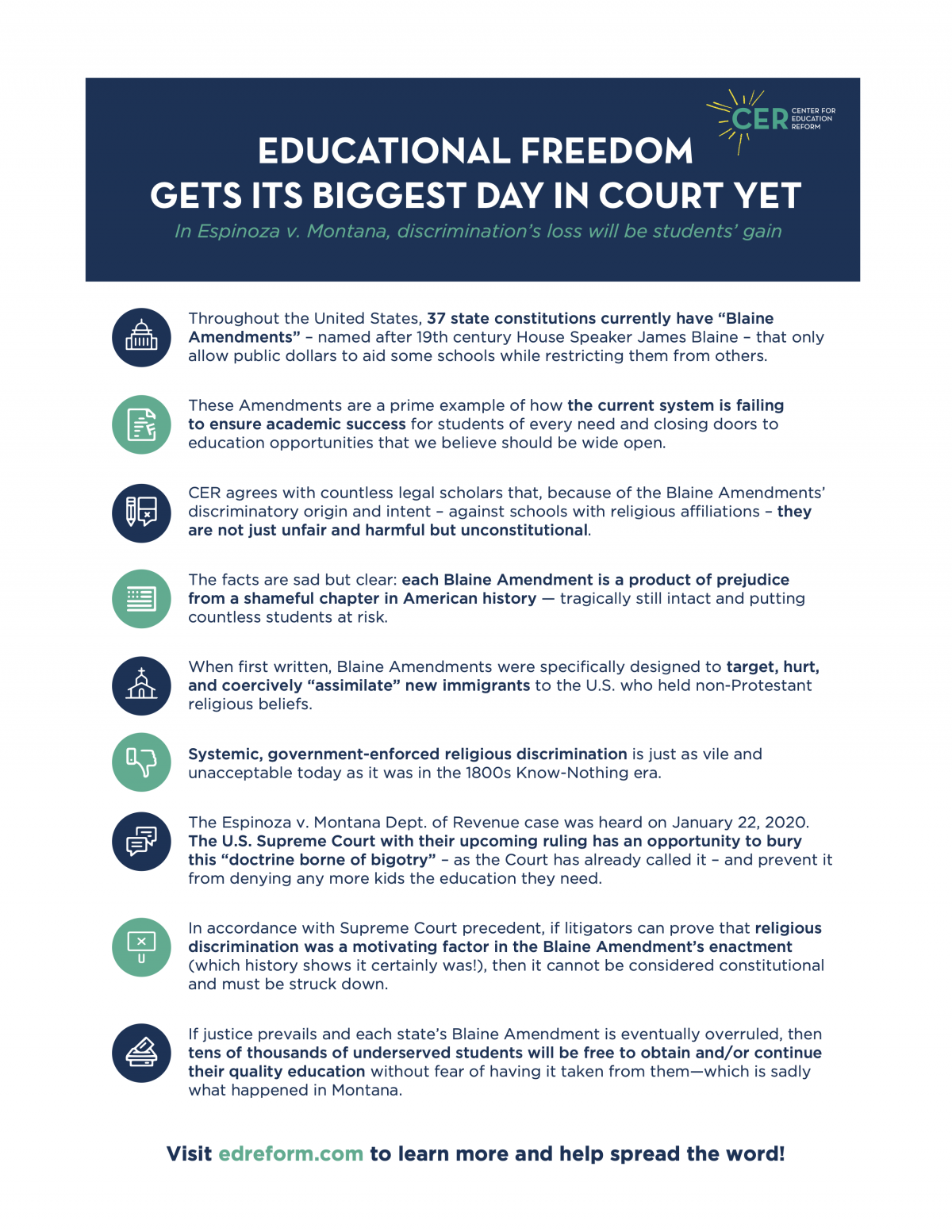
Answers to Frequently Asked Questions About Blaine Amendments
About the Center for Education Reform
Founded in 1993, the Center for Education Reform aims to expand educational opportunities that lead to improved economic outcomes for all Americans — particularly our youth — ensuring that the conditions are ripe for innovation, freedom and flexibility throughout U.S. education.
As a non-partisan, nonprofit organization, CER does not endorse candidates or take political positions but will always recognize and applaud those who advance sound education policies, no matter what their affiliation.
 BUT WAIT – THERE’S MORE! In between Alaska and Maine you’ll find


 INNOVATIONS THAT MADE CHARTERS WORK ARE ILLUSTRATIVE FOR ALL SCHOOLS DURING COVID. We learned this week for example, on CER’s latest Virtual Action Series Event that Valor Preparatory Academy in Arizona integrates a hybrid learning model into their curriculum that is designed with an eye on students’ growing— and now widespread need — for coursework that reflects who they are: digital natives. Middle and High School students at Valor were able to continue their education without a beat in the wake of school and state closures following news of the COVID-19 pandemic, as they had already adopted digital curriculum solutions from StrongMind (look for StongMind President Mary Gifford in
  THE VIRTUAL BACKPACK SOLUTION. Unless we act now to ensure that “every child in America has access to the education they need the education curve created by COVID-19 will be irreversible,” writes Jeanne Allen in

NY TImes: DeVos Funnels Coronavirus Relief Funds to Favored Private and Religious Schools
Education Secretary Betsy DeVos, using discretion written into the coronavirus stabilization law, is using millions of dollars to pursue long-sought policy goals that Congress has blocked.
New York Times | May 15, 2020
By Erica Green, correspondent in Washington who covers the U.S. Department of Education and Secretary Betsy DeVos, focusing on higher education policy, educational equity and civil rights enforcement in the nation’s K-12 schools.
Follow Jeanne on Twitter or LinkedIn or some of her other work here.
READ: The Future of Schools CER’s report sets a new course for policymakers, advocates and families and educators to follow as we work to reshape education during (and after) COVID-19.
Founded in 1993, the Center for Education Reform aims to expand educational opportunities that lead to improved economic outcomes for all Americans — particularly our youth — ensuring that conditions are ripe for innovation, freedom and flexibility throughout U.S. education.