









Sign up for our newsletter

Tennessee Senate Approves School Voucher Measure

One of Many Reform Proposals to Advance in Legislature

CER Press Release
Washington, D.C.
April 10, 2014

The Tennessee Senate on Thursday passed school choice legislation that would allow low-income students in failing schools to use vouchers, adding to the vast array of legislative proposals aimed at improving student outcomes in the Volunteer State.

“Efforts to create a voucher program are part of a broader trend going on right now in Tennessee to introduce educational options through multiple avenues of innovation,” said Kara Kerwin, president of The Center for Education Reform.

If enacted, the bill in its first year would issue vouchers to as many as 5,000 income-eligible students in the bottom five percent of schools in Tennessee. The Senate version and its House counterpart complement other legislative plans that would expand quality charter schools and give parents input and influence into revamping neighborhood schools in ways that best serve the needs of their child.

“Whether it’s instituting a program to give low-income students a better chance at success, facilitating the state charter school sector or allowing parents to petition for change in schools, Tennessee lawmakers are well on their way towards allowing for better educational options to flourish,” said Kerwin.
Louisiana school voucher assignments delayed 10 days due to court order

Danielle Dreilinger, The Times-Picayune

Louisiana voucher assignments were scheduled to be mailed to parents and schools this week. But they will be delayed until April 21, as a result of the latest court order in a politically charged lawsuit pitting the U.S. Justice Department against the state Department of Education.

U.S. District Judge Ivan Lemelle on Tuesday issued the order outlining information that the state must provide for the Justice Department to monitor the program, which the federal government contends might have worsened public school segregation. The Education Department must disclose data on voucher applicants and the private schools they are assigned to attend 10 days before alerting families and schools.

State Education Superintendent John White announced the delay to April 21 in a Wednesday letter to voucher schools. He painted it as a minor annoyance. “This will not significantly impede the program,” he wrote.

New Orleans voucher enrollment is handled through the OneApp process that manages signup for most of the city’s public schools. Those public school match announcements will still be sent out this week.

The new reporting requirements for the voucher program also push back and shorten the second round of voucher enrollment by one week. Applications now will be available April 21, not April 14, with a May 9 deadline.

“We do not anticipate any further delays or negative consequences for schools and parents,” White wrote.

Jan Lancaster, superintendent of metro New Orleans Roman Catholic schools, was not concerned. “We understand with the growing program that there can be administrative challenges,” she said.

The voucher program, officially the Louisiana Scholarship Program, lets low-income students attend participating private schools at public expense. They must be entering kindergarten or now attending C-, D- or F-rated public schools.

About 6,750 students participated this year. Education Department spokesman Barry Landry said Wednesday that application numbers are up for 2014-15.

U.S. Attorney General Eric Holder originally sought to block voucher assignments altogether in 33 parishes that remain under long-standing school desegregation orders, unless a federal judge first cleared the assignments. By the time of the November court hearing, however, Holder had downgraded the request and asked only that the state provide information about the program.

Lemelle agreed to that in November. Since then, the parties have been hammering out the specifics, arguing over such things as the exact timelines and the definition of “African American.”

In the end, Lemelle came down on the state’s side. For each round of voucher awards, Louisiana must submit a list of participants with demographic information at least 10 days before sending voucher matches to families. The Justice Department had requested 45 days’ notice.

Lemelle also decided, contrary to the Justice Department’s request, that the state need not submit analyses of how the voucher program affects segregation in public schools. And he exempted the state from naming the public schools to which students would have been assigned in their home school system. There is a generous amount of time granted to report actual voucher enrollees each fall: six weeks after the state finalizes student counts.

In addition, the state must submit an annual list of all its public schools and their performance scores, as well as documentation showing voucher schools do not discriminate by race.

Gov. Bobby Jindal, a would-be candidate for president in 2016, has made political hay of the Justice Department’s suit from the start. He will not appeal Lemelle’s latest decision, considering it a victory.

He said he was “pleased that the court did not issue a ruling that would obstruct the state’s established process of awarding school choice scholarships.” Voucher advocates feared the monitoring requirements would be so onerous and time-consuming they would essentially end the program.

White also characterized Lemelle’s order as a victory, writing, “We are grateful and proud to have overcome another hurdle in our continued mission to provide every Louisiana family the ability to choose the schools that will best prepare their children for lifetimes of success.”

Other voucher proponents praised the developments. They expressed relief the delay wasn’t longer.

“Though we would have preferred to see minimal federal oversight on this program, a 10-day deadline for review of applicants is not overwhelmingly onerous,” said Eric Lewis, Louisiana director of the Black Alliance for Educational Options. The group had sought to intervene on the state’s side on behalf of voucher parents. “Our main concern was that the program not be burdened with unnecessary red tape, and we believe this ruling is a strong deterrent to that threat.”

Lewis said he hadn’t heard much concern from families in the program. The voucher law survived a 2013 state Supreme Court constitutionality challenge; Lewis was in Baton Rouge Wednesday preparing to testify against bills that would limit voucher eligibility. “There’s always threats to the program,” he said. “I think people have come to expect it.”

Kara Kerwin, president of the Center for Education Reform, said Lemelle’s order “takes a lot of the teeth out of the Department of Justice’s original efforts to block the Louisiana Scholarship Program.”

But Sen. David Vitter, R-La., who is running for governor, said the decision was still too intrusive. It “only brings federal bureaucrats into Louisiana children’s personal lives,” he said.

Holder, however, also painted the decision as a win. “We welcome the court’s order as it rejects the state’s bid to resist providing even the most basic information about how Louisiana’s voucher program will affect school desegregation efforts,” the attorney general said.

Speak Up Release of National Findings

As technology continues to constantly change and grow at an incredible rate, it can be difficult to keep track of the impact that it has on the education system in America today. While technology is often characterized as detrimental to the social skills and attention span of young people, it’s important to also look at the variety of benefits that it can provide.

Project Tomorrow, a California-based national education nonprofit, released the findings of their 2013 Speak Up National Research Project on April 8th in Washington, D.C. This project reports on the views of K-12 students on the role of technology in education. Last year, over 400,000 students, parents and educators answered polls on their opinions regarding the use of technology in the classroom and how they hope it will be used in the future.

The 2013 report is titled “The New Digital Learning Playbook: Understanding the Spectrum of Students’ Activities and Aspirations,” and it aims to move beyond the “mythology” that exists regarding the role of technology within the education community in the U.S. today. Julie Evans, the CEO of Project Tomorrow, gave the presentation of the project’s findings and how they demonstrated the positive impact that technology can have on students’ learning. The findings highlighted the many ways that technology can benefit students both within the classroom and at home.

Many schools and districts sign themselves up to take the survey because they recognize the need to counteract the idea that technology is harmful to education. Adults assume that children use technology in the same way that adults use technology (as entertainment or to keep in touch with friends), but this survey demonstrates the many innovative ways that children and young adults are benefitting from the use of technology in their classrooms. Computers and tablets are often used to create videos for projects or to access important class information through online portals.

After the release of the national findings, there was a panel discussion with students from public schools in Baltimore, MD, Fairfax, VA and Winchester, VA. The students ranged from 2nd grade to high school and all provided very insightful responses to a variety of questions on how technology is used in their schools and how it affects them. Though it probably doesn’t come as a surprise that all of the students were very pro-technology, the reasoning behind their opinions was far from superficial.

When asked why they enjoyed using technology in school, the most popular responses were the collaboration and research that computers and tablets allow. Through programs like GoogleDocs, students are able to easily work together on group projects, and through websites like Blackboard and Edline, they are able to maintain contact with their teachers even when they’re outside the classroom. On top of this collaboration, students also use the Internet for research and use programs like First In Math to improve their math skills.

Although the students on the panel ranged in age and background, they all seemed to agree on the fact that technology has helped their education in many ways. Whether through a high school coding class or a simple math game played online, the students were all very clear about the fact that technology has given them a wealth of resources that wouldn’t have been available to them if they were students 20 years ago. It’s easy to worry about the negative affects that technology can have on children, but it’s equally important to be open to the wide array of benefits that it can provide.

Bethany Tietjen, CER Intern

Court Ruling Protects Scholarships in Louisiana

State Will Continue Awarding Scholarships to Students in Need

CER Press Release
Washington, D.C.
April 9, 2014

On Tuesday, a District Court Judge ruled that the State of Louisiana can continue with the overwhelmingly popular School Choice Scholarship Program without unwarranted intervention, representing a victory for Louisiana families.

“This decision takes a lot of the teeth out of the Department of Justice’s original efforts to block the Louisiana Scholarship Program, and puts in place safeguards to both the success of scholarship students and students as a whole in Louisiana,” said Kara Kerwin, president of The Center for Education Reform.

The Department of Justice first filed a motion against the Louisiana Scholarship Program on August 24, 2013 , acting on a claim that the Program impeded desegregation efforts, which was later debunked by a state-commissioned report. Department of Justice efforts sought to block the further issuance of vouchers in school districts with standing desegregation orders until it could be proven that the approximately 600 voucher-receiving students from those districts were not compromising the desegregation process.

The initial injunction against the program may have been dropped, but federal requests for data and oversight persist.

“Tuesday’s court ruling affirms that the decision of how students are educated is rightfully in the hands of parents who know what’s best for their children,” Kerwin said.

NEWSWIRE: April 8, 2014

Vol. 16, No. 14

SINK OR SAIL. There’s a perfect storm brewing in Tennessee, with proposals aimed at expanding educational choices coming from all directions. It’s a perfect storm because while there are pieces in place that could expand the state’s charter school sector, there are also proposals that would help expand the entire portfolio of options for Volunteer State children, and students need quality schools of ALL shapes and sizes. Items proposed run the gamut of factors that affect much-needed Parent Power from permitting parents to petition for change in schools, to awarding opportunity scholarships for underserved students, to creating more favorable conditions for charter schools to truly flourish. It’s extra critical that lawmakers put aside political considerations to focus on legislation that would both increase school choice and accountability for students who deserve better. Now, it’s time to seize the opportunity.

DEAN OF STUDENTS. In an evolution possibly slower than Vermont’s signature maple syrup, former Green Mountain Gov. Howard Dean recently declared a newfound support for the charter school movement and the young generation of reformers set on finding solutions to America’s educational woes. Dean has been out of office for a few years now, but better late than never for witnessing first-hand the benefits of charter schools. When talking about his son’s experience teaching in an inner city school, Dean correctly frames the conversation of obtaining a quality education as a civil rights issue, prompting his realization of the need for any solution that could improve the U.S. school system. Dean’s conversion reinforces that lawmakers should take time and visit charter schools to see how they’re a positive force in the communities they represent before taking a status-quo stance against these innovative schools.

TELL THE TRUTH, MR. ATTORNEY GENERAL. U.S. Attorney General Eric Holder is dismissing the claim that the DOJ has taken an anti-voucher stance in its actions against the Louisiana Scholarship Program, saying it was only looking for information about the program and never intended to stop it in its tracks. Holder must be forgetting that pesky injunction the DOJ initially sought against the program, which was pretty hard to miss seeing as it was the very first item mentioned in the original complaint. After all, the injunction was the major reason why the DOJ’s actions deserved condemnation in the first place. If Holder really meant what he said (under oath), the DOJ would end efforts to provide excessive oversight over a popular and necessary program for so many Louisiana families.

A REAL K12 EDUCATION. According to K12 Inc. educator Summer Shelton, the online learning experience is just like being in a brick-and-mortar classroom in terms of what’s being taught, except  that students are being educated completely online instead. And, being educated online doesn’t mean that students aren’t held to high expectations. Online learning is a growing and exciting trend, but many parents still don’t have the necessary access to the best options that fit their child’s learning needs. Provided an online experience is right for a student, learning is based on mastery of subjects, and educators like Shelton are held to high standards themselves. As student populations continue to grow (in the coming years it’s expected that the U.S. will gain 11 million more students!), it’s paramount to increase availability of new and innovative options, and inform parents through toolkits and media of the facts behind approaches such as online learning.

EDUCATION REFORM: BEFORE IT WAS COOL. Finally, there is now a detailed anthology of the modern-day education reform movement designed for people who want to understand the real practice and successes of the past 20 years by the pioneers in the field who worked tirelessly to improve schools for all children. Broken down into seven parts, this indispensable book is great for anyone interested in learning about the groundwork laid for the next generation of reformers. Click here to secure your copy today!      

JOIN SUNSHINE STATE PARENTS making their voices heard THIS Wednesday at a press conference at the FL State Capitol, sharing how charter schools have positively benefitted their children. Click here for more information. Don’t forget to like The Florida Parents Network on Facebook so you can stay informed on preserving the rights of parents to choose quality schools for their child, expand in-demand options and ensure all students are receiving equitable treatment.

State Law Hinders Charters

Editorial, Wyoming News

The issue: The Center for Education Reform has given Wyoming’s charter school statutes a “D” grade.

We believe: This is one big reason that the state has so few charter schools: The law hinders, rather than helps, advance the concept.

It continues to be a mystery why Wyoming does not have a robust charter school movement.

This is a state that treasures independence, free market competition and local control of schools. It also has a conservative political mindset, which should make it fertile ground for education reform.

True, the Legislature has been busy with other matters. It has been trying to install a system of school accountability. And the brouhaha over State Superintendent of Public Instruction Cindy Hill is consuming a lot of energy and time.

But that does not mean lawmakers should not be looking at this issue.

Accountability is one big piece of the puzzle. But so is competition. Academic success outside the system n which charter schools offer n can help push the public schools off dead center.

Perhaps the biggest impediment to the charter school movement in Wyoming is the state law. Quite simply, it gets in the way of charter schools, rather than helping them to prosper.

That the state law needs work was proven once again n as it is every year n by a report from the Center for Education Reform. It gives Wyoming’s charter school statutes a “D” grade, ranking them 40th out of the 43 states that have such laws.

Two of the biggest impediments in the law are a lack of multiple authorizers and the freedom for charters to operate in ways they see fit.

In terms of authorizer, the current process of having school boards approve charters is unproductive. It forces boards to worry about a charter’s impact on funding. Then there is the fear that it actually may succeed and what that says about current schools.

Wyoming needs an independent authorizer to open up the system. Besides, that could allow for greater expertise in the decisions; even district officials admit they are in over their heads in analyzing the quality of charter petitions.

As for autonomy, charters now have to rely on the districts’ goodwill if they want to operate outside current policy. Yet the movement relies on a trade: charter school freedom for results. If that is not given n and it is not in Wyoming n then the full benefits of the charter idea cannot be enjoyed.

Lawmakers must open the system to the competition that they say they so dearly love. Perhaps some legislative candidates will make that point about the charter law in this year’s elections.

Follow the law

The Laramie County Commission clearly broke the state’s open meetings law this week. Rather than meeting at its announced time of 2:15 p.m. on Monday, it met earlier.

The commissioners say it was just an error. Perhaps. But another opinion being expressed is that they wanted to meet with off-track betting officials outside the view of the public. A variety of motivations for that have been speculated upon.

No doubt, the commissioners will say none of that is true. But that is why there is a law: Meeting in public doesn’t allow for rumors or innuendo n or bad behavior, if any.

The County Commission should know better. The law is clear. Follow it.

New Book Offers Vital Insight for Next Generation of Education Reform

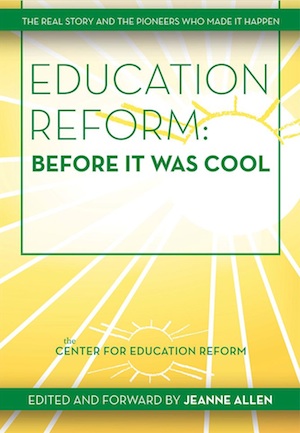
     Education Reform: Before It Was Cool –The Real Story and The Pioneers Who Made It Happen

CER Press Release
Washington, D.C.
April 4, 2014

An indispensable new anthology on the beginnings of the modern-day education reform movement, Education Reform: Before It Was Cool – The Real Story and The Pioneers Who Made It Happen, is designed for people who truly want to understand and learn first-hand from the greatest contributors to the movement to make our nation’s schools work better for all children through choice, accountability, and innovation.

Published by The Center for Education Reform (CER) and edited by founder and president emeritus Jeanne Allen, Education Reform: Before It Was Cool is born not out of theory, but out of real practice and success witnessed in over twenty years in the field.

“As The Center for Education Reform turned 20 years young and looked back at the history it helped create, it became clear that the next generation of reformers should learn from the lessons of the past, the battle lines drawn and re-drawn, the missteps made, and the victories won,” said Allen. “One must know who fought the early battles, who took the first arrows, and who made it cool for a new generation to come to the party.”

Education Reform: Before It Was Cool breaks down the history of the movement into seven parts, relating the experiences of accomplished activists and policy makers across more than a dozen states and numerous communities. Highlights include the efforts of a parent turned state superintendent of schools the growth of a city wide block of charter schools and social service organizations in one of the poorest sections of Los Angeles, the leadership of an African-American Mom who had lost her son to gun violence and who made it possible for other sons and daughters to receive a safe and successful education, and the evolution of a city councilman from establishment to reformer. These and other leaders paved the way for today’s reform efforts.

“I’m grateful to the leadership at CER for producing this important historical book and guidepost to the future. Without an opportunistic outlook we will become just like the institutions we sought to change twenty years ago,” said Allen. “Good intentions won’t deliver American kids from embarrassingly low proficiency in the basics, restore rigor to their classrooms, or ensure college—and career-readiness. Only hard, smart decisions and substantive efforts will.”

History is the best teacher, and Education Reform: Before It Was Cool equips the next generation of leaders with rare insights about how real substantive and structural change got started, and is a handy guide to avoiding repetitive failure and ensuring repetitive success.

To purchase an e-copy of Education Reform: Before It Was Cool or reserve a hard copy, please go here.

About the Editor: Jeanne Allen is the founder of The Center for Education Reform and served as its president from 1993-2013. Today, Jeanne is a Senior Fellow and president emeritus, and serves on CER’s Board of Directors. Jeanne Allen is Vice President of K-12 Programs for HotChalk, Inc., an education technology company.

Tennessee Turns Its Back on Results

Lawmakers Decline to Improve School Conditions

CER Press Release
Washington, D.C.
April 3, 2014

The Center for Education Reform’s President, Kara Kerwin, issued the following statement in reaction to the blocking of HB 1693 in the Tennessee Legislature today:

“There is no reason a bill allowing for public-private partnerships in the oversight and administration of charter schools should have been rejected by the Tennessee House Calendar and Rules Committee.

“In every industry, including education, the State government and city of Nashville has approved, time-and-again, the use of for-profit, private entities to manage public services that affect every aspect of people’s lives.

“The reason Tennessee’s charter school sector is still considered to be nascent is due in large part to the incremental steps lawmakers have taken to bolster it. The assimilation of groups that prioritize performance and outcomes above all else would represent a monumental step forward in improving Tennessee schools, both charter and traditional.

“The careless dismissal forbidding charter schools to contract with education management organizations unfairly eliminates high quality, results-driven providers from helping Tennessee charters create a better option for students, parents and teachers.”

###

Read why Tennessee’s Charter School Sector Would Benefit from Public-Private Partnerships here

New Hope Academy Charter School Students Speak Up

New Hope Academy Charter School students made an open letter video to voice their concerns to the York City School Board members.  These Pennsylvania students were prohibited from speaking at the March 19th meeting. Board members barred students and other school supporters as well, claiming they were solely accountable to “taxpayers”. The Board voted not to renew New Hope Academy’s charter, despite the school’s repeated successes and high achievement. Fighting to keep the doors of New Hope Academy open, students ensured their voices would be heard through this open letter.

The Real Threats to Charter Autonomy

In recent remarks, Robert Cane, executive director of Friends of Choice in Urban Schools (FOCUS), issued a powerful warning to the charter school movement in the District of Columbia.

Cane spoke of the momentous progress that has been made over the years in making charter schools promising educational options for DC students, but also of the threats to derail the engine driving much-needed reform in the District.

There’s no denying the strides made in DC’s efforts to create a robust charter school environment and the increased student proficiency as a result, but even the most Parent Power friendly areas still face challenges.

Of all the attacks on the charter movement, Cane says, “the most insidious is the continuous assault on what truly defines charter schools: individual-school control over operations and freedom from burdensome oversight.”

This assault comes through in a number of ways, from the ‘controlled choice movement’ to the burdensome regulations charter schools increasingly endure.

Said Cane, “Over the years legislation and regulations have been proposed that, for example, sought to require every charter school to use the same reading program; to impose uniform truancy and disciplinary policies and procedures on charters; to require every charter regardless of its mission, to adopt  “universal values,” “financial literacy,” and “environmental literacy” curricula.

He continued, “Now getting serious traction nationally, the controlled choice movement would limit choice by empowering the government to centrally engineer school admissions in order to achieve increased racial and socioeconomic diversity or other goals.”

“The idea that central planning of any kind should be applied to the charter schools is more frightening than any moratorium on chartering,” he said.

In Cane’s view, charter autonomy is crucial to improving student achievement:

“The success of the charter schools also shows what all of us already know:  that we’re still far short of our goal of educating every charter school kid to the limits of his or her ability.  I know that many charter educators spend the majority of their waking hours working on this problem and I’ve no doubt that over time they’ll solve it in their own individual ways if given the leeway to do so.”