









Sign up for our newsletter

Wanted: More gutsy leaders to drive schools into digital age

Meghan E. Murphy, The Hechinger Report

A second-grader in a Middletown, N.Y., school furrows her brow, searching her keyboard to find that funny number sign for her password. A third-grader holds her Chromebook aloft, hoping to speed the connection to a wireless router. A high school teacher puts his iPad in a drawer, having wasted precious minutes taking attendance on a new system with no success.

Educational technology, for all its potential, is riddled with glitches and start-up pains, especially when you’re among the first to trade pencils for tablets. Yet some pioneering school leaders insist that thrusting schools into the digital Petri dish is imperative for students’ success.

These leaders — like Middletown, N.Y. Superintendent Ken Eastwood — risk upsetting staff, parents and budget watchdogs by following their conviction that technology can help teachers target learning and help students master basic skills. They forge ahead, piloting programs, building digital curriculums, enabling enthusiastic teachers and dragging the reluctant ones into the new age.

Eastwood “eats, sleeps and breathes vision,” a colleague says. Hate him or love him, no one in the Middletown Enlarged City School District can deny his success: a 24-percent boost in graduation rates from his arrival in 2004 to 2013, and higher elementary and middle school scores, too, according to state data and a validation study.

Superintendent Ken Eastwood asks second-grader Jocelyn Varela about her work on a digital lesson, which is part of the new blended learning program in New York’s Middletown Enlarged City School District. (Photo: Meghan E. Murphy)

Eastwood also brought $20 million to Middletown — an urban low-income district 70 miles north of New York City — when his 200-page plan earned one of just 16 federal Race to the Top district grants in 2012.

But, Eastwood cautions, “technology initiatives either fail or aren’t sustained because the leader comes and goes, or the jazz around the technology goes away.”

Despite calls from governors, senators, and the president for American education to shift into the digital age, technology-infused districts like Middletown exist only in pockets of the country. Among the reasons: limited high-speed internet access, inadequate teacher training, curriculum that isn’t synched to technology, and, of course, budget constraints.

“Without leadership we have a lot of random acts.” Karen Cator, president of Digital Promise.

About 63 percent of the country’s schools don’t have the required internet connectivity, according to EducationSuperHighway, a nonprofit that works to enable more schools to go high-speed.

And although Maine launched the first statewide one-student, one-laptop initiative back in 2002, today most schools nationwide still haven’t intertwined digital resources into learning, according to an annual survey from the Software Industry & Information Association. More schools are getting devices into classrooms, but they haven’t done the follow-through needed to help teachers make the best use of these devices.

“I would say we have a long way to go,” said Richard Culatta, director of the Office of Educational Technology at the U.S. Department of Education. “We have some really great models out there, but by far the majority of schools have not crossed that tipping point and we need to be able to get there.”

It’s up to leaders with vision and guts to tame this technological frontier.

On a typical day in Mauro Bruno’s Middletown classroom, a third of his fifth-grade students sit at laptops playing math games.

Eight others sit watching a digital lesson that Bruno crafted with an app called Keynote; his voice drifts down from a ceiling speaker, asking them to figure out the area of a square.

A fifth grader at Maple Hill Elementary School works on a digital lesson as part of the new blended learning program in New York’s Middletown Enlarged City School District. (Photo: Meghan E. Murphy)

Then there’s Bruno himself, a teacher for 21 years, who sits in a cozy corner with three students explaining how to do three-dimensional math.

Early in his career, Bruno was one of the first teachers to get a desktop computer and a SMART Board in his classroom. But these tools essentially just replaced pencil, paper and chalkboards.

It wasn’t until Eastwood won federal money for blended learning that Bruno and 35 other teachers got the tools to be the district’s pilot team in transforming their classroom practices. Each participating teacher’s students got a Chromebook and online software that adapts to his or her skills. Teachers also got substantial collaboration time, training and support.

“The tendency for some teachers is to look at some technology as a new fad that’s going to go away,” Bruno said. “But if you’re going to put something in front of them and say, ‘Here are good reasons for using it,’ we’ll do it.”

To usher in digital learning, school leaders must get teachers on board, convincing everyone from eager millennials to experienced skeptics who have seen many fads come and go.

“When we think about leadership, we think about those people who are able to elicit action,” said Karen Cator, president of Digital Promise, a nonprofit that helps schools integrate technology. She defined them as “people who are able to share that vision and get many people bought in, so it isn’t just the leader at the top driving and pushing everyone to do these things.”

That work often requires a philosophical shift toward collaboration rather than hierarchy.

In Overland Park, Kan., Blue Valley School District superintendent Tom Trigg has been orchestrating a culture change emphasizing daily innovation. Trigg’s 22,000-student district has changed schedules and trained staff on how to embrace change and work together. Teachers now have many opportunities to collaborate, including one morning a week before high school students arrive, two planning periods a day for middle school teachers and 13 days where students leave early to provide time so elementary and middle school teachers can meet.

At the high school, social studies teachers used this time to create a game plan for teaching research and writing skills at each grade level. Teachers also regularly updated their teaching strategies using feedback from standardized tests, classroom assessments and student surveys.

“We are on a continual journey to create such a culture,” Trigg said. “Change is very difficult, and while there are ways to encourage acceptance of change, it is a long path.”

Leaders need fortitude on the long road to transformation. Baltimore County Public Schools, led by Superintendent S. Dallas Dance, first spent 13 months drafting a digital curriculum. Next year, 10 of the district’s 106 elementary schools will pilot the initiative, with devices for every child. The entire district won’t be online until 2017-18.

In a stagnant economy, contracting for a $205 million technology plan over seven years raised debates in Baltimore County. People asked why the district should spend money on devices rather than teachers.

“We had to build a case for how education has changed from even the time I was in school,” the 33-year-old Dance said. “We’re expecting kids be able to collaborate and problem-solve. How do you do that in a class of 30 kids unless you’re leveraging technology?”

Superintendent Ken Eastwood is using a Race to the Top district grant to infuse technology into teaching and learning for students at New York’s Middletown Enlarged City School District. (Photo: Meghan E. Murphy)

Jackie Brewster, who heads the Baltimore County PTA Council, said Dance had welcomed questions while keeping sight of the long-term goal.

“It’s easy to change what you’re doing to make people happy, but as a real leader you need to follow through and move forward with your plan, because you know what your vision is,” Brewster said.

Leaders like Dance, Trigg and Eastwood share insights with each other through the League of Innovative Schools, a coalition of 46 members chosen by Digital Promise based on their pioneering technology efforts. League leaders meet at conferences and visit each other’s programs to decode how to make technology work in the classroom.

The federal education department is also working to document and share digital learning successes and failures. “We’ve got to help them see what’s working,” Culatta said.

Unless more leaders step up, educators say, digital education will remain only in pockets, in the classrooms of ambitious teachers willing to troll blogs and Twitter chats for lesson plans.

“Without leadership we have a lot of random acts,” Cator said.

 

Obama’s War on Vouchers Rolls On

Rick Esenberg & C. J. Szafir, National Review

Under the guise of “equality,” the United States Department of Justice is waging a campaign to slam the schoolhouse doors on thousands of poor children living in states that have decided to give them the same educational options enjoyed by wealthy families. The ongoing investigation into Wisconsin’s school-choice program proves that the Obama Justice Department has no intention of letting up.

Policymakers in states such as Wisconsin and Louisiana have determined that one response to a failing education system is to provide low-income families with the ability to decide where to send their children to school, whether it be traditional public, public charter, or private schools. These programs are immensely popular, and demand often far exceeds the spaces available. This year, over 25,000 children are taking advantage of Wisconsin’s longtime school-choice program to attend a private school of their choosing. The newer Louisiana Scholarship Program is allowing 6,775 low-income students who attend schools graded C, D, or F by the state to attend a private school.

But that idea — a vibrant example of states being “laboratories of democracy” and promoting educational innovation – has come under attack by Eric Holder’s Justice Department in both places.

In April 2013, the Justice Department sent a letter to the state of Wisconsin claiming that its school-choice program discriminates against children with disabilities and, therefore, is violating Title II of the Americans with Disabilities Act (ADA). The school-choice program, it declared, must be reformed, or the federal government “reserves its right to pursue enforcement through other means.”

But, as many have pointed out, the Justice Department’s argument is completely unprecedented and baseless. For starters, Title II of the ADA applies only to public entities and not private schools. Using a voucher to enroll a child at a private school does not turn the school into a public entity, just as using food stamps at a grocery store or welfare benefits at a child-care provider doesn’t make them public entities either. There is longstanding U.S. Supreme Court precedent and past U.S. Department of Education policy to uphold this theory.

In addition, Wisconsin law already prohibits private schools from denying admission to any student on the basis of a disability and requires the state to allocate vouchers to all eligible students, irrespective of a disability. So far, these laws seem to be working. According to the state’s superintendent of public instruction, an adamant opponent of choice, the state has received no complaints of disability discrimination in the choice program.

No matter. The Justice Department refuses to drop its investigation into the program. Recent records obtained by the Wisconsin Institute for Law & Liberty, where the writers of this piece work, show that the Justice Department is still in communication with Wisconsin’s education agency, the Department of Public Instruction. In November 2013, for example, the Justice Department demanded that Wisconsin turn over private-school enrollment data. When the state refused, the Justice Department ominously reminded it that the state was subject to an “ongoing investigation.” Yet, when local media ask about the investigation, the Justice Department will not comment.

Sadly, this war on poor families isn’t limited to Wisconsin. In August 2013, after months of sending threatening letters, the Department of Justice filed a lawsuit against the state of Louisiana. It claimed that the Louisiana Scholarship Program violated a nearly 40-year-old desegregation order that prohibits public funds from going to private schools in ways that promote segregation. The problem was not that school choice was enabling white children to flee public education — over 90 percent of children using a voucher are racial minorities — but that these black and Hispanic families might choose schools that do not fit the government’s preferred color palette.

Despite the public outcry and Governor Bobby Jindal’s best efforts, last month a federal judge held that Louisiana, each year, must give the Justice Department data on voucher applicants and private schools in the program. Presumably, the Justice Department will use this information to determine whether parents have chosen their schools in a way that the federal government agrees with.

However one views permitting poor children to have the same educational choices long exercised by the middle and upper classes, it’s a matter for Wisconsin, Louisiana, and the states to decide. It is certainly not the decision of bureaucrats thousands of miles away operating under dubious legal theories.

Apparently, when the preferences of low-income families run contrary to the vested interests of the education bureaucracy and teachers’ unions, the Obama administration’s much ballyhooed “empathy” turns into outright hostility.

New York’s Children are Depending on Us

New York Governor, Andrew Cuomo, must pass the Education Tax Credit Law.

While the Education Investment Tax Credit nearly missed being included in the final adopted NYS budget, the issue appears to be one of the few remaining on the table for end-of-session negotiations this month. Gov. Cuomo’s leadership is needed now in order to get the details of the plan negotiated, agreed to, and made law.

Timothy Cardinal Dolan is running a TV ad, telling Gov. Andrew Cuomo, “Don’t let us down” on the Education Investment Tax Credit.

Take action if you believe all children deserve a great education!

Mobile Devices Increasingly Being Seen as Tools for Learning

Speak Up Report: Mobile Devices Increasingly Being Seen as Tools for Learning

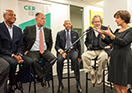
Eager minds both novice and seasoned in nature took their seats and conversations gradually simmered down in preparation for vital updates. It appeared that most of the individuals attending the event were concerned not only with receiving information and comprehending it for themselves, but surprisingly, they also made it a priority to communicate their experiences to others—particularly, coworkers, superiors, and others they felt would benefit from the information.

Surely enough, participants were able to do so, but how? Findings regarding the use of technology in classrooms and the capacity for districts to accommodate them, as discussed at the latest Speak Up report, were dispersed beyond the walls of the well-lit room via Word documents, emails, and text messages. In other words, the distribution of knowledge was made possible by technology. Does the process I just described seem so obvious that mentioning it seems to be doing of an intern? Yes.

We don’t label the use of smart phones and computers at our jobs as “blended” working or the use of texting in our personal lives as “blended” relationships. Visual media is very much a part of our lives. This is the goal of education leaders today: to create a classroom in which technology is interwoven into every aspect of learning; and it’s on its way to being realized. The tide is turning.

While most of us have experienced the vexatious moment when the teacher takes away our phone because it was out during class, future generations may only have to imagine the feeling. In 2010, 63% of teachers said they were unlikely to allow students to use their own mobile devices. In 2013, that number dropped to almost half at 32%. Teachers and parents alike are beginning to embrace the use of technology in school. In fact, approximately 60% of all parents prefer their child to be in a class where personal mobile devices are allowed. In addition, professional development requests of teachers are common among new and veteran teachers.

During the panel discussion, Dr. Patrick Murphy, Superintendent of Arlington Public Schools in Virginia said that the district was starting to explore changing classroom dynamics. He contributed the decrease in the dropout rate (by over 50%) to online classes. Studies found in the report, The New Digital Learning Playbook: Advancing College and Career Ready Skill Development in K-12 published by Speak Up shows that more than 40% of high school principals are now offering online classes for students in math, science, history and English. Similarly, Dr. Katherine Bihr talked about the positive impact technology has on helping students find careers in STEM and consequently, opening their eyes to jobs they may of not considered.

Implementation of digital tools and resources is a means to an end. The actual goal is to equip students with college and career readiness skills. Overall consensus among panelists centered on connecting classroom instruction to real world examples in an effort to prepare students for a tech-savvy job market. Tamika V. Culbreath, reading and English language arts teacher at Prince George County Public Schools emphasized the importance of being up to par with other students across the world. Dr. Patrick Murphy focused on expanding efforts via strengthening collaboration among teachers and community members.

In order to sustain efforts, school districts must evaluate and find ways to increase their own capacity to drive change. This brought us to the last question of the day. Panelists contributed their own takes but all had a common denominator, to increase collaboration across all systems and get everyone on the same page. Dr. Patrick Murphy said, “we need to change what schools look like and we need to change the way we are delivering instruction.”

Tigran Avakyan, CER Intern

NEWSWIRE: June 3, 2014

Vol. 16, No. 22

For many schools across the country, the academic year is sadly coming to a close. But for many, this means the start of a new and exciting life chapter. Newswire congratulates all of the 2014 graduates, whether in charter, traditional public, or other educational settings, and hope many more students receive the opportunity to be in the educational environment that best fits their needs come Fall 2014.

TOP 100.  At Boys’ Latin in West Philadelphia, the charter’s fourth-ever graduating class, continues the trend of getting graduates accepted to top 100 colleges in the country. The self-described college preparatory school has consistently delivered on the mission of providing a quality alternative for young men in need of a more rigorous environment and high academic expectations. Between funding and oversight issues impeding the growth of more and better opportunities, Philadelphia schools are needless to say in turbulent times, but possibly in the near future, policies will be in place to encourage more options like Boys’ Latin.

PARENT POWER IN BIG EASY ATTRACTS BIG STAR. There are many familiar motions characteristic of every graduation ceremony, but it’s pretty unique to have actress Sandra Bullock unexpectedly show up. The star of “While You Were Sleeping” and rom-com pioneer surprised the graduates of Warren Easton Charter High School in Louisiana, and imparted a few pearls of wisdom, such as avoiding one-arm hugs, as well as the importance of eating healthily and basic hygiene. But that’s not the only aspect that separates Warren Easton from other schools. Not only do students score highly on state assessments, Warren Easton, like many other charters, acknowledges the longstanding benefits of parental involvement, creating a homework portal to access coursework along with a plethora of other helpful resources. In a bold embrace of innovation, New Orleans will become the first American city to be completely comprised of charter schools, undoubtedly paving the way for quality education and increased Parent Power.

BRAVING THE COLD PAYS OFF… FOR NOW. On March 4, 2014, the city of Albany, NY was experiencing single-digit temperatures, a fairly common occurrence in upstate New York during winter. But the cold temps didn’t stop the over 11,100 parents and students from New York’s Success Academies from coming out with hats and gloves to push back against plans to displace the schools they love. A new video, part of the “Alise vs. the Mayor” series chronicling the New York City charter sector, captures the organic energy and passion shown by the thousands fighting for their right to a quality education. Since that fateful day in Albany, some of the dust has settled over finding facilities so kids can continue to learn with as little disruption as possible. But without long-term, state-level protections that ensure equitable funding and resources for all schools statewide, issues will remain and inequity will persist, and it will only be a matter of time until another swath of parents and students will have to brave the elements to carry on the same fight.

AND THE HITS JUST KEEP ON COMING. The latest in the PA charter school drama we’ve been keeping Newswire readers in the loop about is that a court ruling sided with Philadelphia’s School Reform Commission, claiming the SRC acted properly within its power to cap enrollment of Walter D. Palmer Leadership Academy. Even Pennsylvania’s highest court has validated the destructive perception that the SRC holds inexorable power over charter schools, despite all of this being in stark contrast to state law. Charter schools will get a chance to restore order in September, however, with the Supreme Court hearing oral arguments as to whether the SRC truly has power to set caps and suspend charters. Hundreds of Walter Palmer families, many of whom come from the poorest areas of Philadelphia, made their voices heard at a rally last week to preserve what some have called a “godsend,” while other charters will likely do the same in the coming months. Meanwhile, Walter Palmer Charter’s obligation is first and foremost to the over 1,200 students it serves, and consequently plans to open this September as scheduled, with an intact student population.

PARENTS GET RESULTS. On May 23, the Superintendent of the entire Los Angeles public school system made a special trip to West Athens Elementary School in the southern part of the city to sign a historic agreement. In an amazing and collaborative agreement with West Athens parents, the District has agreed to invest $300,000 in new staffing positions and professional development measures to make critical improvements to school safety and climate. With only 30 percent of West Athens students reading at grade level, parents thought it was time for a change. After organization and constructive dialogue with administrators, all parties involved were able to reach a final agreement without resorting to the formal parent trigger option available in California. Perhaps it’s because this law is in place that officials are taking parents requests more seriously than before!?… It’s incredibly encouraging to see mutual understanding when school conditions need to be improved, and when parent trigger laws like the one in California play a productive role in getting parents a seat at the table.

THE 24th ANNUAL EDVentures Conference will be held from July 16-18, part of which will be the EdTech Fair, highlighting the latest innovations from tech startups in southern California. Click here to learn more.

DON’T MISS OUT on Club Ed, to be held on June 13 where some of education reform’s most prominent leaders will discuss how to create positive change in the classroom. Space is limited, so register today!

Thanks For The Education

When I arrived in DC at the end of April, the city and what role I might play in it were a mystery to me. For the past six weeks, CER provided me a backstage pass to the national narrative of education reform as it plays out in the DC theater. Through my work at CER, I have shared space with major players in the education scene and witnessed both the staging and implementation of effective change.

In my first blog post, I expressed a desire for tangible knowledge and experience, as opposed to theoretical. In every sense, my experience at CER has offered me just such an education. From attending Senate budget hearings inundated with political minutia to interacting with students for whom CER exists and advocates, I have accrued a mass of first-hand experiences and developed a multi-faceted understanding of education policy.

My time at the office has also fostered a deep respect for the work CER does. Equipped with twenty years of experience and expertise in the field, CER gives voice to families directly touched by local, state, and national policies. A few minutes with CER can provide a thorough understanding to policymakers whose decisions bear significant long-term impact. By relying on accuracy, transparency, and loyalty to its mission (rather than back-door dealings and cheaply purchased relationships), CER has developed unparalleled credibility among education reform groups and secured my admiration and support.

With shows like House of Cards informing public perception of DC politics, it is easy to become cynical about the future; but I dare you to attend a school groundbreaking and watch high-ranking officials bend low over a microphone to congratulate children (in their own language) on getting a shot at a brighter future, and not be moved. My experience at CER has taught me that education policy is fertile ground for the kind of incremental bipartisan change that makes for real and gratifying progress, and I can’t wait to see what’s next.

CER Intern,  Anna Russell Thornton

Charter Schools are Delivering on Brown’s Promise

Deborah McGiff, The Huffington Post

Sixty years ago this week, my family and other Black families across the country were wondering how the Supreme Court’s Brown v. Board of Education decision would impact their children’s education. How long would it take for the promise of a great education to become a reality?

Despite the call for “all deliberate speed,” generations later, we are still waiting. In urban areas especially, a high-quality education remains out of reach for too many low-income and working class students. But there is hope.

As a former superintendent of Detroit Public Schools, Deputy in Milwaukee Public schools, Assistant Superintendent in Cambridge, MA, an administrator and teacher in New York City, and charter schools movement leader I have seen urban education up close for more than four decades. And one of the most exciting and encouraging developments over the course of my education career has been the growth of high-performing public charter schools that are free to all and open to all.

Stanford’s Center for Research on Education Outcomes (CREDO) conducted the most comprehensive assessment of public charter schools to date and found that Black students in public charter schools are gaining up to one and a half months of additional learning in reading and math, compared to their peers in traditional public schools.

In some places, such as New York City’s Success Academies, public charter schools are actually flipping the achievement gap – helping Black and Latino students outperform affluent, white students across their states.

And in public charter schools from Chicago’s Urban Prep Academies to the KIPP high school in rural southeast Arkansas, nearly every student is going to college and graduating at rates higher than the national average.

Unfortunately, some commentators and academics are looking past this success and claiming that public charter schools are “re-segregating” public education. The supposed proof is that many public charter schools enroll a very high percentage of Black and Hispanics students.

It is true that public charter schools enroll more students of color than white students. Nationwide, 63 percent of students enrolled in public charter schools are students of color. But critics ignore two key points.

First, children aren’t assigned to charter schools; parents choose charter schools for their children. More than 2.5 million children attend public charter schools and another one million names are on waitlists. Parental demand is high because many urban Black and Hispanic parents recognize education options in charter schools that, sadly, they can’t access in traditional public schools.

Second, the racial and socio-economic balance in charter schools is similar to the racial and socio-economic balance in the traditional public school system.

A 2009 study by RAND that examined student-level data in five large cities (Chicago, Denver, Milwaukee, Philadelphia, and San Diego) concluded: “In most sites, the racial composition of the charter schools entered by transferring students was similar to that of the [traditional public schools] from which the students came.”

Charter schools in aggregate have a higher proportion of students of color because charter schools are most likely to be found in urban neighborhoods that are home to a higher proportion of Black and Hispanic families. These are typically the neighborhoods with the greatest need for better schools – and public charter schools are finally filling that need.

The fact that public charter schools are offering hope to students of color is why many Democrats, including President Obama and California congressman George Miller, are charter proponents. It’s hard to imagine they would champion an education reform that “re-segregates” public schools.

Rather than criticizing charters for serving too many Black and Hispanic students, those who want to realize the dream of an outstanding education for all, as I do, should aim to do two things.

1) Make charters available to more students in more places. With waitlists one million names long, we clearly aren’t meeting the demand for public charter schools. The main source of funding for launching new charters is the federal Charter Schools Program. The House recently passed a bill re-authorizing the program and the Senate should do the same.

Furthermore, public charter schools are restrained in their growth by local and state laws that either ban charters outright or cap the number of charters. By authorizing charters in every state and lifting caps, public charter schools can serve students in many more neighborhoods.

2) Take what we know is working in public charter schools and apply those practices to traditional district schools.

In public charter schools, students are spending more time in class; teachers are focusing on reading and math, especially in the early grades; college and career readiness are the goals from day one; and a wider variety of curriculums are offered, including concentrations in the arts and the STEM (science, technology, engineering, and math) fields.

Public charter schools want to share these proven practices with other schools. Rather than seeing charter schools as threats, traditional district schools should see them as sources of great ideas and great results.

Public charter school supporters will continue to do all we can to make charters even better and correct flaws where they exist. But warrantless criticism won’t help any student. Public charter schools are delivering on the promise of Brown by making a world-class education available to students of every race and from every economic circumstance. We need more of them.

Public School With ‘Medically Fragile’ Students May Turn Charter

Melissa Clyne, Newsmax

If a Broward County, Fla., public school successfully transitions to a charter school, it will mark a first in the area to do so, the Miami Herald reports.

While there has been an explosion of charter schools across the country – 6,187 in the 2012-12 school year, according to the Center for Education Reform – charter conversions, turning a public school into a charter, are far less common. There have been fewer than two dozen throughout the Sunshine State and none in Broward or neighboring Miami-Dade County.

A charter school receives public funding but operates as a separate entity from the public school system. The mass popularity of charters has been controversial in many major cities, including Chicago, which last year shuttered 50 traditional public schools before requesting charter schools to apply to open in the 2014-15 and 2015-16 school year, the Huffington Post reported last year.

In New York City, Mayor Bill de Blasio campaigned on his opposition to charter schools sharing space with public schools.

Charter school critics argue that the concept takes a bite out of school funding and is essentially privatizing the education system.

The National Education Association stipulates on its website that it favors charter schools if they are “qualitatively different from what is available to them in mainstream public schools, and not simply to provide a ‘choice’ for parents who may be dissatisfied with the education their children are receiving in mainstream public schools.

Fort Lauderdale’s Wingate Oaks, which serves special needs children, learned a year ago that the Broward school district planned to close the school and one other to consolidate and expand services. The district held off on closing Wingate Oaks after parents argued against it. Many “medically fragile” students would need to ride a bus for more than an hour to get to school if Wingate Oaks closed, the Herald reports.

Wingate Oaks parents partnered with a local nonprofit specializing in disability issues, and some former school district employees, to launch an effort to “save” their school, even keeping the same staff in place. But it’s a long way from a done deal.

The district would have to OK the conversion. Broward Schools Superintendent Robert Runcie warned that running a successful school takes more than good intentions.

“We invest a good number of our resources,” he told the Herald. “That’s hard to replicate.”

Reality Check-In: Why Education Reform really does need a reality TV show

Reality Check-In, with Jeanne Allen
Vol. 1, No. 1
May 28, 2014

Why Education Reform really does need a reality TV show

I would not have said this a year ago. I’ve been opposed to such a thing, despite being auditioned once for a show that promised to show the real challenges schools face daily. (I was supposed to be the provocateur, calling out bad practices on screen. Thankfully they dropped me from consideration when I insisted we had to talk about solutions. So much for my worldwide fame!)

But now I have another take. Having been “on the outside” for 6 months now, after 25 years “in,” I now understand clearly why EdReformers bang their heads against a wall daily and make only marginal progress:

Only a few thousand people – maybe 20,000 – are actually paying attention.

I know that’s hard to believe. After Waiting for Superman, the trials of Michelle Rhee, Facebook, KIPP, and people from Cory Booker, to presidents from Reagan to Clinton and more, only a fraction of the people in our otherwise exceptional nation have a clue that reformers are doing what they are doing to create better opportunities for kids.

I was shocked to learn this, and it hasn’t been an easy conclusion to reach. The reasons are numerous, but I’m going to offer just one primary reason in this commentary…

…Reformers are (generally great but) clueless.

This Memorial Day I sat by the water among dozens of families with whom my kids grew up. They come from all over the East Coast. They are old and young and in between. Most are politically engaged and hardly apathetic. They are right, left, and center. They go there to relax and when socializing, they share what they know and ask one another about what they don’t know. These are not wealthy people; they are mostly working and middle class Americans including researchers, plumbers, bank employees and educators. One thing they all have in common though, is that all are Americans, or aspire to be.

These citizens are, like most citizens, informed about the issues when they need to be, but most of the time they are just folks. Because they are pretty civic-minded and because they have known me a long time, they do have some sense of what’s happening in education.  But this is just one little piece of their world, and as such they know only what they see in their community or from their own trusted sources of news, and that’s not very much.

Yet, nearly every Memorial Day until this year I’ve arrived at the Bay convinced otherwise. Every other time I arrived having just spent months engaged in protracted battles as the head of the Center for Education Reform, a post from which I stepped down in the fall. Arriving at the Bay last year for the first time since the previous season, I had just completed terse negotiations with Pennsylvania legislators and others over amending the State’s charter school law so that the schools might finally have equitable funding and communities more opportunities to start schools and serve kids. At the same time we were in the thick of developing new protocols to push out the daily education news through our Media Bullpen.  We were involved in local advocacy work with New Jersey charter leaders who couldn’t find a friend in their own state. On top of that, efforts were underway in many states to craft better policies on issues ranging from teacher evaluations to achievement standards.

All of this was occurring against the backdrop of continued failure in our schools as revealed by the National Assessments.  I had spent many hours on television and in print commenting on these issues.

This was pretty standard for my work, and upon reengaging with the folks at the Bay year after year I’d assume they all were as clued in as I was to all of these important battles. I’d stroll down to the water and as the typical “how are you what are you doing these days” would evolve, I’d say things like, “Well Philly has been really difficult these days,” or “still trying to break through the barriers to get more reform.”

There would be questions and comments about this school or another that they know about, and sometimes arguments about whether unions can work or not. Eventually somebody would always say – “hey-I-saw-you-on-TV-that-was-great.”

Of course this all made me believe they knew exactly what I was talking about and that they were actively engaged in education reform issues.  At a minimum I thought my long time seasonal friendships had persuaded them to at least be quiet supporters of the movement or maybe even committed voters for reform.

Clearly I was projecting.

This year I arrived wearing a new hat. I am still personally and professionally engaged in education reform but I am no longer leading the charge nor am I intimately engaged day to day.

The questions have been the same, but my answers have been different. Having now become a “normal, ordinary” person — the kind I pushed my team to find and educate so that more people would join our cause — I now have come face to face with a cold reality. Those of us who bleed “EdReform” assume that once exposed to the hard facts, others will not only follow us but also fully engage. It isn’t so.

As my inaugural weekend at the Bay reminded, our individual lives — our families, our work and our friends — largely dictate what we do and how we conduct ourselves with regard to the issues of the day. If we are “in it” we feel like others are in it with us. If we are not, the subject changes, and the focus shifts.

I walked around for years thinking that people were interested in education reform because when we talked about it they seemed to be interested. My friends and I would often discuss the topics they knew were foremost in my mind. “What are you up to?” They asked me over and over again, and I’d respond about the issue du jour. Not anymore. Six months of having been “out of it” means others are, by extension, out of it too.

Now the conversation is not about work — because until now work was always my passion – but about the other things that consume my time, like adult kids and activities, vacations, and the stuff of daily life. When we all have kids in school, they supply an endless sea of discussion topics. As they age, so does our interest in school related issues.

It’s hard to tweet and Facebook and Instagram things that are no longer your daily focus. Don’t get me wrong — I still read and participate in numerous efforts to change the system and I continue to write about it.  I still consult regularly with colleagues and other stakeholders with whom I’ve been connected all these years.  That won’t change, nor will my personal passion for reform.

I am, however, living it differently and seeing first hand why it was so hard to get people to show up at a meeting, to write their lawmaker or to push back a failing system.  I used to consume the reform stuff almost 12/7. It was what I read for fun on the weekends (seriously), what I talked about at parties, what I talked about with my kids and husband nonstop. I read every blog, every newsletter, and every tweet. I attended events, blogged, wrote and managed a small but robust team, which in turn created armies to tackle the opponents of choice and accountability in word or deed.

There was no question we had to work hard to attract attention and I was relentless in getting the work done to educate, inform and galvanize the masses, those great EdReform-unwashed. Once they became interested or engaged, it was definitely our job to keep them engaged. Inevitably we — and others like us — grew frustrated about how difficult that was. We would question why someone who was an activist one-year suddenly stopped responding to emails, or why a small dollar donor stopped writing checks.

I had an inkling that life got in their way, but I also thought sometimes that the growth of the reform movement had resulted in their finding other outlets for their interests.  But what is clear now is that ordinary people just don’t have time for it all. Wearing a new hat, I understand fully now to me that we engage and outrage only when our friends and family clue us in, either because they are “in it” by virtue of their work or service on boards and in their communities. Without those connections, we — the masses — don’t even know there is an EdReform movement out there.

I imagine many people who were part of other social movements felt the same frustration.  Remember that most people didn’t go to Woodstock and most people didn’t fight in the Cultural Revolution.  Most people don’t focus on politics (let alone vote!) and most people don’t know much about education reform. But we can change that.

Professional education reformers must face the reality that their world is actually small and will continue to get only sluggish results, unless they grapple with the issue of how real people spend their time.  They — we— must stand back from the reality of the hundreds of e-letters that fill “our” inboxes, that are loaded with confidence-boosting calls for help, showers of praise from our colleagues, and news of thousands of media hits, and realize that such noise is having little impact on actually reaching the people who can help “us” make real change.

While there have been many great wins in expanding access to great education to more kids, the wins are isolated and often short-lived, because the ordinary people involved go back to leading busy lives. So, what do we do about this?

• First, be honest with yourselves and assume no one new is reading your newsletter. Find other ways to communicate directly with real people right where they live. Bring back the town hall meeting or the community dinner, because guess what? Real people don’t have time to go to conferences during the day but they do like food!

• For every New Schools summit or Fordham Institute seminar you hear about or attend, spend two days in a neighborhood or at a community organization (like a Kiwanis club) doing nothing but asking this question and listening to people’s answers:  “What do YOU do to help your family and your community, and how do you do it? Where do YOU spend your time?”

• Stop writing about the same things — please. People outside of education reform can’t relate to all the stories about Newark, KIPP, quality authorizing, or even teacher evaluations! Try talking about pocket book issues — how taxes are spent on schools and what programs get funded; how their fellow Americans (not necessarily their kids or grandkids because the vast majority of us don’t have kids) spend their time. It’s not that people don’t care — it’s that they need other reasons to care. This leads me to the next point:

• Make education an issue of patriotism — which it is — because most of us deeply believe in our country and want it to continue to be the best nation in the world. Craft your communications to expose the connection between schooling and democracy. Show where and how it is that our children learn uniquely American values and where they don’t. When Americans know that only a handful of 17 year-olds can correctly identify the time and the purpose of the American Revolution, they can’t be confident the product of that Revolution will last or benefit their own kids, which will spur them into action.

• Expose inequality of opportunity and lack of freedom, not just lagging math scores. Most of us don’t think about math as relevant anymore. Explain the connection between a student’s lifelong achievements and earning power.

• Take the issue to TV. When searching for a new “standard” television this year, I was shocked to learn that standard now seems to include every kind of media outlet possible at the touch of a remote. Take the Reality TV plunge and knock the sleazy stuff out of first place. If a Nun could be on the Italian equivalent of “The Voice,” why can’t an Ed Reformer?? You’ll be amazed how many people will start to engage.

• Finally, ask for feedback. If people aren’t writing back and talking to you about what you say, how do you know it’s working? News Flash: It’s probably not.

When I wrote the School Reform Handbook nearly 20 years ago, it was with ordinary people in mind. As our movement grew, we assumed everyone grew with us. Some did. But most people always will be focused on the basics of their everyday life. To engage them, we need to focus on how ordinary people live ordinary lives, and become part of their lives, not the other way around.

 ###

 Jeanne Allen is founder, senior fellow and president-emeritus of the Center for Education Reform, and the author of Education Reform: Before it Was Cool – The Real Story and The Pioneers Who Made It Happen, an indispensable anthology of the modern education reform movement.

NEWSWIRE: May 28, 2014

Vol. 16, No. 21

$10 MILLION TO NOWHERE. The National Education Association (NEA) will be redirecting $10 million in union dues alone for political purposes in the 2014 election cycle, in hopes that the widening consensus on the benefits of choice and accountability won’t prevail this November. Help CER spread the word to set the record straight in the face of this political onslaught, so Americans can spot the real reformers in their community.

OH, THE DEPTHS THEY WILL GO. A union proxy organization in Philadelphia is running TV ads describing charter schools as ‘private,’ when charter schools are in fact (as Newswire readers know) publicly funded, publicly administered and publicly held accountable. The PA-based group is called, ‘Friends of Public Ed,’ a friendly, newspeak description for Enemies of Reform. The mislabeling of charter schools as non-public options irresponsibly suggests that public charter students shouldn’t receive equitable funding and resources, when they are already underfunded as it is. Parents and community members must realize the inexorable depths at which union bosses will go to advance a political agenda, whether it means exploiting a local school tragedy or misidentifying the role of charter schools in public education. Parents in Pennsylvania have the power to correct these attacks, and must speak out to preserve positive changes and opportunities for their kids.

IN CASE THERE WAS ANY CONFUSION about union unwillingness to adopt best practices regardless of the delivery method, UFT Chief Michael Mulgrew made that position unequivocally clear when saying, ”We are at war with the reformers,” first reported by Chalkbeat and highlighted in a video that chronicles the ongoing friction in New York education. It would be much more helpful to vilify low proficiency rates and expectations combined with static learning environments, and to highlight success stories, but of course hack political statements are never intended to come across as ‘helpful.’ At the end of the day, parental access to a full range of choices and data is what enables students the best chance at finding their educational fit, and that’s what should really matter.

LEGACY BUILDING. As the school year comes to a close, high schools nationwide break out the pomp and circumstance to commemorate yet another graduating class. But for some like Legacy Charter in South Carolina, the Class of 2014 will be the school’s first, and graduating seniors will receive their diplomas from a charter described as an “Early College” high school, where approximately 1 in 5 students are enrolled in college courses. This is due in large part to the school’s innovative partnership with a local technical college, enabling students to obtain college credit while in high school. When not in Legacy’s classrooms, students participate in athletics and are also expected to give back to the community through fulfillment of a service requirement. Congratulations to Legacy’s Class of 2014, and all graduates as they apply what they’ve learned to life’s next great adventure.

SWEET HOME FOR SCHOOL CHOICE? A circuit judge just ruled the Alabama Accountability Act unconstitutional on a number of counts, mostly procedural in nature. This is the third lawsuit against the program, and unfortunately the first to actually gain any sort of traction. Proponents have vowed to appeal and are confident that the program will prevail. In the meantime, the ruling represents a devastating blow to the parents who wish to exercise their fundamental right to place their child in the school right for them. Since going into effect last year, the Accountability Act’s popularity has been such that the cap on tax credit disbursements was fast approaching by the end of last year. As a result, more income-eligible students were able to escape failing systems and attend schools where they now love to learn and can excel. Evidenced by other states, school choice programs are possible to implement and can be entirely valid, but it remains to be seen whether Alabama can get on board.

REALITY CHECK-IN. New commentary from CER senior fellow and president emeritus Jeanne Allen weighs in on the ed reform movement today. Read more here.

CLUB ED hosted by Choice Illinois is right around the corner, where participants will get the chance to hear from an impressive list of panelists on what happens when educators are free to innovate. Click here to learn more and RSVP. Space is limited, so register today!