











Sign up for our newsletter

Cesar Chavez Annual Senior Thesis Symposium

Every year Cesar Chavez Public Charter Schools, located in the Washington, DC area, have their annual senior thesis symposium. Starting in the ninth grade, Chavez scholars are introduced to the topic of public policy and up until their senior year they participate in several activities that involve public policy. For example, in the ninth grade scholars participate in a community action project (CAP), which takes place during the last two weeks of school. CAP allows scholars to select a public policy topic and collect information on that topic through various methods. When I was in the ninth grade my class chose obesity/healthy eating as our topic. Obesity is a major disorder that is rapidly spreading to the youth more and more each year. My class took recognition in that and decided that we wanted to educate our community on the disorder. Obesity is the result of unhealthy eating; therefore learning about healthy eating as well would only strengthen our argument.

Scholars complete another community action project in the tenth grade, and then once they enter the eleventh grade they participate in fellowship. This year I participate in fellowship, which is similar to an internship with the only exception being that instead of getting paid we receive academic credit. Chavez has partnered with various non-profit organizations as well as government agencies over the years that have agreed to provide fellowship opportunities for their scholars. My fellowship organization is The Center for Education Reform, whose main focus is improving the education system into a system that can sustain for years to come. Each fellowship has a connection with public policy therefore scholars are constantly learning about issues that impact the country. Following the fellowship is the senior class thesis in which scholars select a public policy topic to write a ten to fifteen page paper on, as well as a PowerPoint presentation that consists of fifteen slides.

The senior thesis symposium included two students from the Capitol Hill campus and one from the Parkside campus. Due to their outstanding thesis presentations, all three of these students received a $2,000 dollar scholarship. The three topics that were presented were Felon Disenfranchisement, Guantanamo Bay, and Urban Education Reform. My personal favorite topic was Urban Education Reform. African-American and Hispanic minorities have always been known for falling into the bottom of the education system due to the high percentage of dropout rates that make up the group. This is an issue that needs quick resolution because this generation makes up the future of America.

All of Chavez public policy classes are a requirement for graduation therefore students must complete the courses. This upcoming school year I will walk the halls as a Chavez senior and hopefully thesis doesn’t turn my hair gray! Overall I look forward to participating in thesis and hopefully my topic is interesting enough to a point where I can participate in the senior thesis symposium.

Imani Jenkins, CER Intern/César Chávez Fellow

School Choice Today: Education Tax Credit Scholarships Ranking & Scorecard 2014

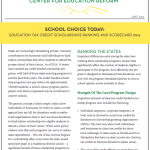
Out of 14 states that have tax credit-funded scholarship programs, two earn A’s, five earn B’s, four earn C’s, two earn D’s, and one earns an F on a new ranking and analysis from the Center for Education Reform (CER), School Choice Today: Education Tax Credit Scholarships Ranking & Scorecard 2014.

The first of its kind, the Education Tax Credit Scholarships Ranking & Scorecard 2014 is an in-depth analysis and state-by-state comparison of the 14 tax credit-funded scholarship programs currently in existence.

Click here to read the School Choice Today: Education Tax Credit Scholarships Ranking & Scorecard 2014 report
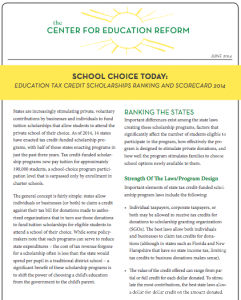
Click here for the Education Tax Credits Scholarships Ranking & Scorecard 2014 chart

Press Release

D.C. officials seek stronger oversight of charter schools after recent fraud allegations

Emma Brown, Washington Post

Recent fraud allegations against leaders at two D.C. public charter schools have illuminated what city officials are calling a gap in their ability to effectively oversee the financial dealings of the fast-growing charter school sector.

Following two cases in which the D.C. attorney general has accused charter school leaders of schemes to divert millions of tax dollars to private companies they owned, the D.C. Public Charter School Board is seeking legislative changes that would give it greater authority to examine the records of some of the organizations that manage the city’s charter schools.

The charter board also is looking to tighten standards that charter schools must meet to sign contracts with “related parties,” such as school founders, school employees, members of the board of directors and their relatives.

While the move indicates that the charter board wants more transparency, it also shows that city officials often don’t know how management companies are spending tax money that is meant for students’ benefit.

Any new authority probably will be narrow: The charter board’s draft legislation, developed months ago, would allow it to examine the records of only a small number of companies. The notion of broad new oversight power probably would spark protest from some in the charter school movement, which is built on the premise that schools should operate free of outside interference as long as they produce solid academic results.

The D.C. Attorney General on Monday filed a lawsuit alleging that the founder of a D.C. public charter school diverted millions of dollars to a for-profit company he owns. Read it.

Scott Pearson, the charter board’s executive director, said he doesn’t want new rules to be so onerous or invasive that they deter good charter operators. But “they’re using taxpayer dollars, and there should be a standard” for how those dollars are used, Pearson said.

The D.C. attorney general in October sued three former managers ofOptions Public Charter School for allegedly funneling more than $3 million from the school to two for-profit companies they owned. In May, the attorney general sued the founder of another charter school, Community Academy, alleging that he enriched himself by creating a shell management company that was paid more than $13 million in taxpayer dollars for work largely performed by school employees.

The charter board had given a clean bill of financial health to both schools in June 2013, finding “no patterns of fiscal mismanagement” at either, according to a charter board report.

Defense lawyers in both cases have argued that the charter schools’ business deals were legal and no different than contracts that more than a dozen D.C. charter schools have with outside management companies to operate the schools in exchange for a fee.

Several charter school management companies declined to comment on the board’s effort to seek additional oversight authority because legislation has not yet been introduced. Ramona Edelin, executive director of the D.C. Association of Chartered Public Schools, also declined to comment, saying that her members haven’t yet discussed the issue.

Donald Hense, executive director of the Friendship charter schools, one of the largest networks in the city, criticized the D.C. attorney general’s most recent lawsuit as unfair and said the charter board’s desire for more authority is part of a pattern of overreach. And Kara Kerwin, president of the pro-charter Center for Education Reform, said she worries that giving the charter board more power “is a slippery slope.”

“Allowing the legal process to take care of malfeasance is the proper way to go, as opposed to the charter board imposing more regulation,” Kerwin said.

City taxpayers send more than $600 million to charter schools, and in return, charters — which are required by law to be nonprofit organizations — submit independent financial audits, annual budgets, large contracts and other financial data to the city charter board.

The charter schools that have contracts with outside management organizations send fees that range from 2 to 100 percent of their operating budgets.

The management agreements are something of a financial black hole, according to charter school board officials, who say they have limited ability to monitor how the tax dollars are used. When the management organizations are private for-profit companies, they are not subject to the same financial disclosure rules as nonprofits.

There are at least four for-profit charter management companies operating in the District now: Imagine Schools Inc., a Virginia company that runs Imagine Southeast and Imagine Hope Community schools for a fee of 12 percent of each school’s revenue; Academica, a Florida company that runs Somerset Prep Academy for a 5 percent fee; Community Action Partners, which collects a 6 percent fee to run the Dorothy I. Height Community Academy Public Charter School; and Basis Educational Group, an Arizona company that runs Basis DC for a 20 percent fee.

Phil Handler, a spokesman for Basis Educational Group, said the company’s fee is relatively high because the company covers the salaries of the school’s top officials.

Most of the management companies operating in the District are nonprofits, and two charter schools slated to open in D.C. next fall —Democracy Prep and Harmony — also are run by out-of-state nonprofits.

Nonprofits must disclose some financial information with the Internal Revenue Service annually via Form 990, including the salaries of any employees who make more than $100,000. But charter board officials said that the publicly available information is not necessarily sufficient for strong oversight.

St. Coletta Special Education Public Charter School transfers its entire $16 million budget to its management organization. As a result, the charter school’s public budget is stark, showing that the school spends zero dollars on personnel, office expenses and student services.

The management organization, St. Coletta of Greater Washington, operates two schools under the same roof, a D.C. public charter and a private school that accepts tuition-paying students from Maryland and Virginia. Pearson said that while the board has no reason to suspect wrongdoing at St. Coletta, it’s difficult to know for sure that D.C. tax dollars are being used only to serve D.C. public school students.

St. Coletta executive director Sharon Raimo said the charter school and the parent organization already go through multiple layers of financial review by independent auditors and the IRS, state education agencies, Medicaid oversight agencies and the D.C. Public Charter School Board.

“I don’t know what else we could possibly give them that they don’t already have,” Raimo said, adding that she wasn’t afraid of additional oversight but that it would take more of her staff’s time.

Last fall, the charter board proposed legislation that would give it access to the books and records of only a subset of management organizations: those that received more than half their income from D.C. charter schools or received more than 20 percent of any one school’s budget.

Such expansion of oversight probably would affect only a few existing management organizations. Robert Cane, executive director of the pro-charter group Focus, said he could support such narrow expansion, but it would not be appropriate to demand financial records from management companies that run schools across the country and receive only a small fraction of their income from D.C. charters.

The charter board’s existing draft legislation would require schools entering contracts with related parties to ensure that those deals are fair and that conflicts of interest are fully disclosed to the school’s board of directors. Currently, schools have to meet one of those two conditions to comply with the law. The charter board is working to refine the proposed legislation.

D.C. Council Education Committee Chairman David A. Catania (I-At Large) said last fall that he was willing to work with the board to pass legislation and a spokesman for Mayor Vincent C. Gray (D) said Gray is also supportive.

There has been no public movement on the issue, but the May lawsuit against Kent Amos, the founder of Community Academy, appears to have kick-started discussions again. “My sense is we’re both committed to resolving this, so I would be surprised if we don’t have some legislation by the end of the council term,” Pearson said.

Teacher Tenure, Layoff Laws Ruled Unconstitutional in CA

The Blaze
June 11th, 2014

Kara Kerwin on The Blaze discussing teacher tenure and the importance of the landmark decision, Vergara v. California. This court case goes beyond Brown v. Board of Education. For the first time in U.S. history, a child’s education has been solidified as a civil right. But, U.S. teachers win too, because archaic laws will no longer hinder great teachers from having autonomy in their own classroom.

v

The Fall of Teachers Unions

Stephanie Simon, Politico

As the two big national teachers unions prepare for their conventions this summer, they are struggling to navigate one of the most tumultuous moments in their history.

Long among the most powerful forces in American politics, the unions are contending with falling revenue and declining membership, damaging court cases, the defection of once-loyal Democratic allies — and a multimillion-dollar public relations campaign portraying them as greedy and selfish.

They took a big hit Tuesday when a California judge struck down five laws they had championed to protect teachers’ jobs. The Supreme Court could deliver more bad news as early as next week, in a case that could knock a huge hole in union budgets. On top of all that, several well-funded advocacy groups out to curb union influence are launching new efforts to mobilize parents to the cause.<

Responding to all these challenges has proved difficult, analysts say, because both the National Education Association and the American Federation of Teachers are divided internally. There’s a faction urging conciliation and compromise. Another faction pushes confrontation. There’s even a militant splinter group, the Badass Teachers Association.

Leaders of both the NEA and AFT have sought to rally the public to their side by talking up their vision for improving public education: More arts classes and fewer standardized tests, more equitable funding and fewer school closures. Those are popular stances. But union leaders can’t spend all their time promoting them: They must also represent their members. And that’s meant publicly defending laws that strike even many liberals as wrong-headed, such as requiring districts to lay off their most junior teachers first, regardless of how effective they are in the classroom.

The result: an unprecedented erosion of both political and public support for unions. And no clear path for labor leaders to win it back.

“People increasingly view teachers unions as a problem, or the problem,” said David Menefee-Libey, a politics professor at Pomona College who studies education politics. That’s a striking shift, he said, because “for decades the unions were viewed as the most likely to contribute to the improvement of public education.”

Winter Hall, the mother of a 7-year-old in a Los Angeles public school, echoed that sentiment.

“Whenever there are teachers unions, it always comes off like the unions serve themselves — like it’s not about the education of the children,” she said.

Eager to push back, Hall helped organize a “parent union” at her daughter’s school, with help from the nonprofit Parent Revolution, which has received millions in funding from some of the nation’s richest philanthropies to organize moms and dads into a counterweight to teachers unions. She said it wasn’t a hard sell.

“I know tons of parents that are frustrated,” Hall said.

‘SHAMEFUL’ POLICIES?

Teachers unions still have too much money and too many members to be counted out. Collectively, they represent 3.8 million workers and retirees. They bring in more than $2 billion a year.

Yet the share of Americans who see teachers unions as a negative influence on public schools shot up to 43 percent last year, up from 31 percent in 2009, according to national polling conducted by Harvard’s Program on Education Policy and Governance and the journal Education Next. By contrast, 32 percent see unions as a positive force, up from 28 percent in 2009, the poll found.

Labor’s fading clout was evident earlier this month in the California primary, when unions representing teachers and other public-sector workers spent nearly $5 million to boost state Superintendent Tom Torlakson to a second term — but failed to bring in enough votes for him to win outright.

Instead, Torlakson will have to fight for his seat in a runoff against a fellow Democrat, former charter school executive Marshall Tuck, who has bucked the teachers unions on many issues — and who has been endorsed by every major newspaper in California. In backing Tuck, most of the editorial boards specifically cited the urgent need to curb union influence.

Another sign of the shifting sands: the ruling this week in Vergara v. California striking down laws governing the hiring and firing of teachers. In a withering opinion, Judge Rolf M. Treu essentially blamed the unions for depriving minority children, in particular, of a quality education by shielding incompetent teachers from dismissal.

The unions argue that the laws in question simply guarantee teachers due process. They plan to appeal. But the judge’s rhetoric clearly hit a nerve. Education Secretary Arne Duncan hailed the ruling. So did Rep. George Miller, a leading Democratic voice on education policy in Congress. He called the union policies “indefensible.” A New York Times editorial went further, referring to the laws the unions had defended as “shameful,” “anachronistic” and straight-up “stupidity.”

Even Rep. Mark Takano (D-Calif.), a veteran classroom teacher who has strongly backed unions in the past, said he was “open to reviewing and adjusting tenure laws,” though he called the ruling “disappointing.”

Ben Austin, a veteran Democratic operative who served in the Clinton White House, said the ruling was bound to make liberals uneasy about sticking by unions.

“It will be very difficult for Democrats to make the case that they are on the side of civil rights and social justice if they are defending unconstitutional laws that objectively harm poor kids and children of color,” said Austin, who serves on the board of Students Matter, the organization that brought the lawsuit.

Union leaders may be even more anxious about the upcoming Supreme Court case, Harris v. Quinn. Several of the conservative justices hinted during opening arguments that they might use the case to overturn a four-decades-old precedent that requires workers to pay dues if they benefit from a union’s collective-bargaining work, even if they don’t officially join the union. That could slice away a big chunk of union revenue.

Already, the National Education Association has lost 230,000 members, or 7 percent of its membership, in the past few years and is projecting a further decline this year. The American Federation of Teachers, meanwhile, has seen revenue slip.

NEA President Dennis Van Roekel acknowledges that these are difficult times.

But he says he’s also confident that unions will not only survive, but thrive, because they give voice to teachers — and through teachers, to students.

Union foes, he said, “just want to silence that voice.”

A HUNT FOR ALLIES

In many capital cities, the headquarters for the teachers union occupies prime real estate within a block or two of the statehouse.

That’s just one indication of the unions’ historic clout.

In states such as California and New Jersey, teachers unions have often been the biggest campaign spenders. Democrats counted themselves lucky to have their support, not only because of the financial resources but because the unions commanded armies of foot soldiers available for door-to-door canvassing, phone banks and other campaign grunt work all summer long.

The unions, in turn, could count on Democrats to have their backs.

No more.

In 2007, a handful of wealthy donors teamed up under the umbrella Democrats for Education Reform. Their explicit goal: to finance the campaigns of Democrats willing to break with the teachers unions by supporting policies such as expanding charter schools, weakening tenure and holding teachers accountable for raising student test scores.

It worked. Big names like former Los Angeles Mayor Antonio Villaraigosa, Chicago Mayor Rahm Emanuel, Philadelphia Mayor Michael Nutter and New Jersey Sen. Cory Booker have sided with DFER. So have scores of state legislators and local school board members.

The self-styled reformers quickly developed a narrative that let them claim the moral high ground in public debates. Teachers unions, they said, were out to protect their own members first and foremost. They didn’t have kids’ best interests at heart.

Unions have responded, with outrage, that teachers pour their hearts and souls into helping students and know better than any millionaire campaign donor what schools need. “There’s not a tension between student interest and teacher interest,” said Jim Finberg, an attorney for the California Teachers Association. “In fact, they are aligned.”

But reform groups have put so much money into their efforts — and won the backing of so many high-profile Democrats, up to and including President Barack Obama — that their rhetoric has largely prevailed, said Menefee-Libey, the Pomona College professor. “They have the brand identity as the people most interested in improving public education,” he said.

Unions continue to fight back, and have notched some notable victories in local elections — such as the recent mayoral race in Newark, N.J. — by portraying reformers as corporate tools intent on dismantling or privatizing public education. AFT President Randi Weingarten has drawn support from other unions, too, with an old-fashioned activist campaign to “Reclaim the Promise” of public education by staging rallies across the nation.

In the meantime, though, the reformers are moving on to new strategies.

David Welch, a Silicon Valley entrepreneur, spent millions to press the Vergara lawsuit in California. He and his allies are now preparing to bring similar cases in other states; they’re scouting a half-dozen potential locations, from New York to Oregon. A New Jersey state senator this week invited the legal team to get to work in his state as soon as possible.

DFER, meanwhile, is planning to launch its first major public outreach campaign next week. It’s aimed at persuading ordinary voters — not just the hedge-fund and dot-com millionaires it has so successfully courted — to support local and national candidates who will take on the unions.

Meanwhile, a conservative organization, the Center for Union Facts ran a full-page ad this week in USA Today asking, “How can you stop teachers unions from treating kids like garbage?” Its answer, over a photo of a child stuffed head-first into a trash can: “Sue.”

Add it all up and the unions “have got to feel like they’re on their heels a little bit,” said James Ryan, dean of the Harvard Graduate School of Education. “For sure.”

‘BADASS’ REBELS ROIL THE RANKS

Union leaders have responded to the mounting political pressure with flexibility. They’ve supported some reform proposals they once recoiled from, including rating teachers in part by how far they raise students’ standardized test scores.

And they have swallowed their frustration and put their political muscle behind powerful Democrats who come down firmly in the reform camp, starting with Obama.

But that impulse to accommodate has sparked a furious backlash from some rank-and-file members who long for their unions to stick to their principles and fight the good fight, whatever the political consequences.

The leaders “completely ignore us — and it’s supposed to be our union,” said Bill Morrison, a high school history teacher in Connecticut.

The roiling anger has led some affiliates to elect firebrand leaders determined to bring a more militant spirit to teachers unions. It’s launched insurgent groups like the Badass Teachers Association, which has a strong presence on social media.

And it’s illuminated the many fault lines within the teachers unions. There are schisms over the importance of tenure and the wisdom of fighting to preserve traditional pensions. There’s a deep divide, too, over the Common Core academic standards.

Yet another source of strife: The American Federation of Teachers has pursued growth in recent years by absorbing workers who have nothing to do with education.

The AFT now represents a huge contingent of nurses, along with public defenders, dental hygienists, police officers and even lifeguards — sparking resentment among some teachers who fear their voice is diluted and their priorities ignored.

Those fault lines, analysts say, weaken the voice of teachers unions.

“There are tensions … [that] make it difficult and hazardous for national union leaders to say ‘This is what we stand for’ in one breath,” said Charles Taylor Kerchner, a research professor at Claremont Graduate University who has written extensively about teacher unions.

Van Roekel, the NEA president, said dissent is inevitable. “When there are 3 million members, we’re rarely going to have 100 percent unanimity,” he said. But he said he believes “the vast majority” of union members back the strategies the leadership has laid out.

What’s more, Van Roekel said he senses an “organic groundswell” of support for the union’s vision of the future of public education and believes parents will rally behind their teachers, no matter how the legal cases go or how much money rolls in to support opposition candidates.

“I’ve actually been saying to people, and they kind of look at me strange … that I’m more optimistic than ever,” Van Roekel said. “We’re not going away. I can guarantee it.”

Polls do show that parents have strong trust in teachers. But support for labor unions in general has fallen.

And some analysts, even those sympathetic to organized labor, say the teachers unions risk alienating the public with their constant complaints about the conspiracy of wealthy forces arrayed against them and their defense of job protections like those found unconstitutional this week in California.

“It’s entirely possible,” Kerchner said, “that unions can turn public education into a bad brand.”


A Start To My Journey

The first year of my undergraduate experience was a whirlwind of trying new classes and discovering the path on which I would travel for the next four years. While I took courses with many different focuses, the two most influential classes were a sociology course with a focus on the inequalities that persist in the education system in the United States, and a course on social justice through which I had an opportunity to tutor elementary school students. I learned about the school system through an in depth analysis of overall societal issues and I was then able to watch the effects of the system unfold on the development of young students. These experiences shaped my interest in social issues, and more specifically, spurred my interest in education policy and reform.

Now, as a rising senior at the George Washington University majoring in Sociology and minoring in Human Services and Social Justice, I am ecstatic to have the opportunity to apply all that I have learned over the past few years to my internship at The Center for Education Reform. CER is one of the most experienced leaders in education reform and continues to be an advocate to ensure all students are provided excellent opportunities for their education. CER aims to bridge the gap between policy and education by making sure all schools and teachers have the power to create transformative and substantive reforms in education.

After my first few hours at The Center for Education Reform, I can already see the excitement that backs the work that is done here and I am realizing how fortunate I am to have the opportunity to work alongside and learn from such influential people in the education reform movement. Through this internship, I am excited to gain insight into important issues such as the charter school movement and aid in raising an awareness of the importance of education reform in the nation. As I begin to explore the potential of my position in the education reform movement, I hope that this internship will lead me on that same path that I originally discovered in the first year of my undergraduate experience.

Mandy Leiter, CER Intern

Environments To Thrive In

A dozen first graders’ hands shot up in chorus at each question, and I might have concluded that their teacher had simply rehearsed the whole performance for the sake of window dressing the tour. But the enthusiasm and engagement I found in classroom after classroom was backed up with awards and recognitions that put this South Los Angeles charter school in a league of its own. Born from the vision of two former LAUSD teachers, the school had taken students–almost entirely from Hispanic families and low socioeconomic backgrounds–from the surrounding neighborhood, and transformed their educational opportunities. By the time I had become involved with this inner city gem, its students were outperforming those in wealthy district schools of Beverly Hills. And it showed.

The tour’s purpose was not to impress parents or attract new students. It had been designed for educators and administrators from surrounding areas to share with them insights into the school’s success. It aimed to improve quality across schools and ensure that students–regardless of their families’ resources or backgrounds– had access to the environments in which they could thrive.

As an intern with the Center for Education Reform this summer, I am excited to find the organization’s mission so aligned with these same ideals. I look forward to applying the coursework of my Master in Public Affairs program toward the research, outreach, and analysis of education quality and school choice across the country. Through exposure to the issues and debates of the reform movement this summer, I hope to gain a greater appreciation of the challenges facing both parents and policymakers, and ideally, help work toward their solutions.

– Matt Beienburg, CER Intern

Teacher tenure law ruling: A step forward or backward?

CNN Newsroom
June 11th, 2014

CER founder, Jeanne Allen, defends the Vergara v. California decision on CNN Newsroom with Randi Kaye. The landmark decision ruled that California’s teacher tenure, dismissal, and layoff laws are unconstitutional.

From DC Public School to Charter School

The transition from a public school to a charter school was not very difficult for me because, for starters, I was young and did not really understand the difference between the two. Before attending Cesar Chavez PCS: Parkside Campus I attended Burrville Elementary and before that Merritt Elementary.

The two schools shared one thing in common — none of the classrooms were enclosed with walls or doors. Everything was out in the open and once I entered the doors of Chavez I recognized this change. Chavez Parkside Campus has both middle and high school students, which was an adjustment for me mainly due to the fact that there were so many students in one school. Burrville was a big school and those who don’t know their way around could end up getting lost, but at Chavez this wasn’t the case.

It was fairly easy for me to find my way around the school due to how it is structured. When I was in middle school at Chavez the first floor belonged only to high school, the third floor belonged only to middle school, and the second floor was shared among all grade levels. Throughout the years this created a lot of congestion because occasionally a middle school class would collide with some high school students transitioning to their classes. Minor incidents like this still occur to this day.

When entering Chavez I had no idea what to expect. My parents decided to send me there because it was my neighborhood school and it was convenient for them, and I didn’t have a problem with their decision because all my friends were going there as well. Before starting at Chavez, students have to take an online test, which measures their skills in math and reading. My nerves were sky-high while taking the test because I knew that my future at Chavez depended on it.

My parents decided to send me to a charter school rather than a traditional public school because I’ve been at traditional schools all my life, and Chavez met their standards for what type of school where they wanted to send their child. Every child is nervous on the first day of school but since the majority of my classmates from Burrville were attending Chavez my nerves weren’t as bad.

One aspect that Chavez focuses on is discipline. They heavily enforce uniform policies, PAR, which stands for professional, actively engaged, and respectful, and the importance of upholding the school in a positive manner. Also, Chavez tries to focus on public policy here and there. Starting in the ninth grade, students participate in community action projects (CAP) for the last two weeks of school.

During those two weeks students select a public policy topic to focus on and they gather information along the way. Finally, on the last day of school students present their projects. Students earn fifteen hours for community service while participating in CAP. CAP allows students to take an active role solving problems that exist in their communities and society itself.

Even though Chavez is known for being one of the best charter schools in the Northeast Washington, DC area the school still has its flaws. Since Chavez is a “college prep” school I never understood why so many of the students weren’t attending some of the most prestigious colleges in the country. Many of the students are pushed towards colleges in which they are guaranteed acceptance into instead of applying to competitive colleges such as Duke University, University of Pennsylvania, and Stanford University.

The reason why many of our students apply to “mediocre” colleges is mainly due to the fact that they are only used to receiving a mediocre education. Several times this school year I have gone without a teacher. My pre-calculus teacher went on maternity leave during the start of the second quarter and as a result my class went without an adequate substitute teacher for the remainder of the quarter.

We went from teacher to teacher and learned practically nothing that entire quarter. I fell behind and took it upon myself to learn the material the best way that I could. An incident like this discourages students and sets them back from reaching their full academic potential. Pre-Calculus is not a very difficult course, once my teacher taught a new lesson and went over several examples I understood it.

But some improvements or additions that Chavez can add are a variety of Advanced Placement (AP) and Honors courses. Honors courses should start in the middle school portion of Chavez and carry out into high school. If students are introduced to a new level of difficulty in work at an early age, then honors and AP courses would not feel brand new to them once they enter high school. Also every grade level (9-12) should have the opportunity to participate in AP courses; the courses should not start in the eleventh grade, they should start being offered in the ninth. If more AP courses that applied to students’ respective career focus were offered, then the amount of students passing the course would increase. When individuals learn about a topic that they’re interested in they are more likely to remember that information as opposed to information from a topic that they have no interest in at all. Therefore, Chavez should offer a new variety of AP courses, such as AP Biology and Chemistry, in order to increase students’ intellectual capacities.

CER Intern, Imani Jenkins

California Court Strikes Down Teacher Tenure, Unions Howl

Steven Nelson, U.S. News & World Report

Los Angeles County Superior Court Judge Rolf Treu declared California’s tenure protections for public schoolteachers unconstitutional Tuesday, rattling powerful unions that support protection for long-term educators.

Opponents view tenure as a free-pass from accountability for low-quality teachers and nine student plaintiffs made that argument in a lawsuit, Vergara v. California, alleging unprepared and incompetent teachers were savaging their students’ potential.

Treu agreed.

The judge leaned on the U.S. Supreme Court’s landmark 1954 Brown v. Board of Education ruling, which outlawed racial segregation in schools, finding California’s tenure system deprives minority and low-income students of equal education, The Associated Press reports.

The court did not make the decision available in digital form, instead opting to sell printed copies.

The National Education Association, the largest American teachers union, promptly condemned the ruling.

“A California Superior Court judge today sided with Silicon Valley multimillionaire David Welch and his ultrarich cronies in the meritless lawsuit of Vergara v. State of California,” the group fumed in a press release. “The lawsuit was brought by deep-pocketed corporate special interests intent on driving a corporate agenda geared toward privatizing public education and attacking educators.”

NEA President Dennis Van Roekel called the ruling “deeply flawed.”

“Let’s be clear: This lawsuit was never about helping students, but is yet another attempt by millionaires and corporate special interests to undermine the teaching profession and push their own ideological agenda on public schools and students while working to privatize public education,” Van Roekel said. “Today’s ruling hurts students and serves only to undermine the ability of school districts to recruit and retain high quality teachers.”

The American Federation of Teachers, the second-largest U.S. teachers union, also bristled at the news.

“While this decision is not unexpected, the rhetoric and lack of a thorough, reasoned opinion is disturbing,” said AFT President Randi Weingarten in a release.

“[Treu] argues, as we do, that no one should tolerate bad teachers in the classroom. He is right on that. But in focusing on these teachers who make up a fraction of the workforce, he strips the hundreds of thousands of teachers who are doing a good job of any right to a voice,” Weingarten said.

“This will not be the last word,” she added. “No wealthy benefactor with an extreme agenda will detour us from our path to reclaim the promise of public education.”

In a June 2 press release AFT complained that “three exemplary teachers” were “named as ‘ineffective teachers’ by the plaintiffs’ lawyers” without negative evaluations or complaints on file, and expressed confidence of success on appeal.

Treu stayed his opinion, which does not apply to public universities, pending appeal.

Foes of teacher tenure immediately celebrated the protection’s possible judicial demise. Proposing modifications to teacher tenure has proven risky for elected politicians and appointed education officials in the past.

Bonnie Reiss, California’s secretary of education under former Republican Gov. Arnold Schwarzenegger, praised the ruling.

“Too often, it is nearly impossible to pass needed education reforms through the legislature,” said Reiss, global director of the USC Schwarzenegger Institute. “The broken tenure system unfairly hurts our state’s most vulnerable students and denies equal education for all.”

The Center for Education Reform, a pro-charter school group, called the decision “a tremendous victory” for students.

“Any framework that prioritizes hire date does a disservice to teachers, who deserve merit-based appreciation like other professionals, and does a disservice to students in need of a superior educator at the head of the classroom,” Center for Education Reform President Kara Kerwin said in a release.

The tenure fight in California, home to more than six million students, is unfolding across the country, and victories don’t belong exclusively to one side. In North Carolina, for example, a state judge ruled in May that legislators violated the state constitution by voting to repeal tenure.

U.S. Secretary of Education Arne Duncan addressed the California ruling in a Tuesday afternoon statement that avoided directly addressing the dispute.

“This decision presents an opportunity for a progressive state with a tradition of innovation to build a new framework for the teaching profession that protects students’ rights to equal educational opportunities while providing teachers the support, respect and rewarding careers they deserve,” Duncan said. “My hope is that today’s decision moves from the courtroom toward a collaborative process in California that is fair, thoughtful, practical and swift. Every state, every school district needs to have that kind of conversation.”