





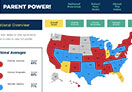




CER President, Kara Kerwin, discusses a recent study from The University of Arkansas on the effectiveness of charter schools with Rod Arquette. The first of its kind, “The Productivity of Public Charter Schools,” conducted on a national scale, analyzes the cost effectiveness and return on investment in the public education system.
Charter school conference coming to Wilmington
July 28, 2014 By
The 2014 North Carolina Charter Schools Conference will be held in Wilmington, July 30 through Aug. 1, at the Hilton Wilmington Riverside hotel, 301 N. Water St., according to a news release.
The gathering of charter educators, administrators, and supporters is themed, “Waves of change, oceans of opportunity” and will provide training sessions on charter governance, operations, advocacy and instruction.
Nina Rees, president of the National Alliance for Public Charter Schools; Kara Kerwin, president of the Center for Education Reform and Jim Goenner, president of the National Charter School Institute, will discuss of the direction of the charter movement in North Carolina.
The event is open to the public. Visit www.NCPublicCharters.org or call 704-236-1234 for more information.
Huffman weighed shutting down embattled Tennessee Virtual Academy
July 28, 2014 By
Joey Garrison, The Tennessean
In a standoff over a struggling statewide cyberschool, Tennessee Education Commissioner Kevin Huffman says he weighed pulling the plug on the school altogether.
Instead, at his urging, the next incoming class of new students at Tennessee Virtual Academy won’t be admitted — an action that has nevertheless put an education chief known for favoring school choice under unfamiliar fire from national reform groups.
The move to “un-enroll” 626 incoming students marks the boldest action yet in what has been a turbulent three years for the online virtual school operated by the for-profit K12 Inc., which has produced woeful test scores every year in Tennessee since a change in law paved the way for its 2011 arrival.
Because of the school’s third straight year of poor results in student growth, the commissioner had the authority to direct the closure of the school. Huffman chose a less harsh option, recommending that the Union County School Board, which contracts K12 to operate in Tennessee, stop admitting students for the time being.
The board obliged on Thursday, voting to request a waiver from the state to cancel enrollment of students it had recently accepted. Tennessee Virtual Academy’s some 1,200 existing students, who live across the state and take coursework from home, will remain part of the school.
Why not close it outright? Huffman noted Tennessee Virtual Academy students have shown improvement in years two and three, and that the challenges rest primarily with first-year students.
“We definitely considered it, but we wanted to take a deeper look at the data, and when you take a deeper look at the data, you see that the students who have been there two years or three years perform at a reasonable level,” Huffman told The Tennessean on Friday.
Moving forward, he said, “They need to show better results and have a plan also for how they’re going to on-board new students and ensure that students who they’re enrolling are students who can succeed.”
Tennessee Virtual Academy, made possible by a 2011 law, has challenged Gov. Bill Haslam’s administration from the outset, quickly becoming an easy punching bag for Democrats and other critics.
Virtual education could be at a crossroads in Tennessee. The Virtual Public Schools Act is set to sunset next June, meaning the legislature will review the merits of the law during the next session.
Though the school will remain open for now, parents and other supporters of Tennessee Virtual Academy aren’t happy with the outcome.
Nearly 1,200 people as of late Friday had signed an online petition asking that the Union County board not cancel the enrollment of the more than 600 students.
“Our country’s educational system is in the midst of a technological revolution,” the petition reads. “We are making history by utilizing virtual schooling. The fact that there are challenges in the virtual system isn’t a surprise.”
Other groups weighed in as well. The Tennessee chapter of PublicSchoolOptions.orgcalled for an “immediate meeting” today between parents of the school and Huffman and Haslam — a request Huffman told The Tennessean he hadn’t seen.
The Washington-based Center for Education Reform issued a statement saying it “strongly condemns” the directive of Huffman. “It’s an outrage that these 626 legally enrolled students are now being forcefully turned away, just two weeks before the start of the school year,” said Kara Kerwin, the organization’s president.
In slowing down the growth of the Tennessee Virtual Academy, Huffman has had to take aim at an option he has supported exploring. In addition to low test marks, the school also has had high attrition, meaning kids have often gone back to their local districts with low proficiency marks.
“I believe that it’s important to try things like virtual education,” he said. “That’s why, at some level, it’s been disappointing to me to see the results.”
As for the Union County school system, Huffman called it “irresponsible” and “disappointing” for it to initially accept new students for this fall, alleging the board was alerted of its “Level 1 status” on June 15. Results from the 2013-14 Tennessee Comprehensive Assessment Program for individual districts are to be publicly released next week.
Union County officials initially balked at following Huffman’s directive, suggesting that it didn’t have the legal authority to do so and that it lacked the data Huffman was reviewing. In a follow-up letter Friday after the board’s action, Union County Director of Schools James Carter told the commissioner that “we are willing to acknowledge your recommendation.”
Still, Carter has claimed the district only first learned of its status during a conference call with Huffman and others on July 10 and stopped enrolling new students immediately.
Jeff Kwitowski, senior vice president of public affairs at K12, says Tennessee Virtual Academy has turned down all 1,600 students who have applied to the online school since that time. The company also contends it made “significant academic progress” during the past school year.
Best Way to Grade New Jersey Teachers Debated
July 28, 2014 By
Hannan Adely, The Record
New Jersey’s adoption of teacher evaluations that relied on student test scores was hailed by Governor Christie as a way to make educators accountable for how much students learned.
Last week, however, under pressure from lawmakers, parents and teacher unions, the governor announced plans to lessen the impact that those test scores will have on judging teachers. But despite the vocal criticism, those who supported the evaluation system say they have not wavered in their commitment to it.
“I think the Board of Education and the community in general supports [evaluations],” said Mark Biedron, president of the state Board of Education. “The question is what system do you use and how much of it and frankly how much do you weigh on tests?”
New Jersey approved an evaluation system a year ago that rates teachers partly by student scores on state tests — with results counting in such high-stakes decisions as whether to grant or take away tenure.
But over the past year, educators have strongly protested that they need more time to adjust to new academic standards and new computer-based state tests. They said they have to teach new material, prepare students for the tests and improve computers and Internet connections.
Lawmakers said they were responding to those concerns when they appealed to the governor for change, but were not backing off strong measures to judge teachers. change, but were not backing off strong measures to judge teachers. Sen. Kevin O’Toole, R-Cedar Grove, said it makes sense to give less weight to test scores until problems with the new tests can be resolved, but that the state will still hold teachers accountable.
Asked about test scores as a measure, O’Toole said, “I don’t think anything can be hard or fast or set in stone. There are some in the education community who think it’s a real metric that can be used, others that think it’s a false metric.”
Christie’s latest proposal is that student test scores count for only 10 percent on teacher evaluations rather than the 30 percent weight that the state Board of Education approved for the coming school year. The weight can be increased up to 20 percent in the following two school years by the Department of Education.
Michael Drewniak, a spokesman for Christie, said the changes were in response to confusion over new tests and evaluation systems. But the changes, he added, “should in no way be interpreted as backing off our desire to improve teacher accountability and instruction.”
In an interview last week, Acting Education Commissioner David Hespe stressed that test scores will remain as one of the measures used to judge teachers, along with student improvement on tests and teacher observations.
“We are going forward as planned,” he said. “It’s just that we’re going to use it as a lesser extent until everyone is comfortable with how it rolls forward.”
Assembly education committee chair Patrick Diegnan, DMiddlesex, said he still supports using student test scores to evaluate teachers but doesn’t think they should be given as much weight as the Christie administration first proposed.
“The administration was adamant in original tenure reform legislation that test scores would be a determining factor,” he said. “I’ve always been a believer that it should be a part of the process but should not be a dominant one.”
New Jersey isn’t alone in changing the way it evaluates teachers. Many states are revising, dumping or delaying the use of test scores to evaluate teachers — largely over concern about the new academic standards adopted in New Jersey and dozens of other states.
Some critics are also urging state leaders to review or to abandon the entire set of standards, known as Common Core, and the tests that go with them. In New Jersey, Christie formed a new commission to study the standards and all federal and state tests that measure what students are learning.
Brian Backstrom, senior policy adviser at the Center for Education Reform in Washington, D.C., said it was “encouraging” that Christie was using a phase-in method, instead of getting rid of the evaluation system altogether.
“It’s a healthy approach because it isn’t a total trashing of a requirement for teachers to be accountable for student performance,” he said.
Poll supports teachers
Many education groups oppose student test scores as measures to rate teachers, arguing they don’t accurately reflect a teacher’s performance and diminish other more important factors, such as poverty, class size or classroom makeup.
Most New Jersey residents side with teachers on the issue, according to results of a Fairleigh Dickinson University poll released this week. Only 20 percent of New Jersey voters say that it is fair to punish teachers based on how their students do on standards-based tests, with 74 percent saying that it is unfair, according to the poll.
Still, 42 percent agree that teachers should be rewarded for their students’ performance on the tests.
But Backstrom said the people criticizing the use of new tests for evaluations may be seeking to avoid accountability measures completely.
“I think the big question to ask teachers unions and others is will they be satisfied with any tests?” he said.
The steps announced by Christie have been hailed as a compromise — a rollback of how much test scores count in teacher evaluations for three years while a task force reviews what students should be learning and how accurately state and federal tests measure that.
Some lawmakers and educators said they also expect the task force to investigate the use of any tests scores for teacher evaluations, although that goal is not specifically stated in the governor’s executive order. Steve Baker, a spokesman for the New Jersey Education Association, said it was related to the overall issue of overemphasis on high-stakes tests that the task force will review. The task force, he said, should “find the best way and most appropriate way to make these measurements,”
He added, “The hope is now that we have this opportunity to take a step back and look at what we’re doing. We want to do it the right way.”
Policy and Professionalism: Lessons Learned From Education Reform Advocates
July 28, 2014 By
On Tuesday, interns from various public policy organizations piled onto a 7th floor conference room where CER’s interns organized a panel discussion titled, CER Interns Present: The Next Generation in Education Reform. Preceding the panel, interns from The Center for Education Reform, the U.S. Department of Education, The Fund for America Studies, The National Alliance for Public Charter Schools, The Brookings institution, and many other organizations mingled and shared stories of their experiences within their respective organizations.
Panelists sat before the future reformers to discuss current policy issues along with providing any insights that they may have concerning working in education. There was a full house of reformers featuring Kara Kerwin, President of The Center for Education Reform, Daniel Lautzenheiser, Education Policy Program Manager for the American Enterprise Institute, Jack McCarthy, President and CEO of AppleTree Institute of Education Innovation, Michael Musante, Senior Director of Government Relations for FOCUS DC, and Amber Northern, Vice president of Research for The Thomas B. Fordham Institute. The event covered a multitude of topics ranging from common criticisms of charter schools to the return on investment in education spending. The panelists also engaged in a fruitful discussion on the use of technology in the classroom and opinions on teacher tenure and union involvement in reform.
After the panel, the audience members posed challenging questions on political philosophy and bipartisan efforts, career trajectories, and classroom strategies.
Here are some of the important messages that I took away from the event
- When discussing the achievement gap, Michael Musante mentioned that a “classroom can feel like a prison” for a ninth grader who reads at a third-grade level. This really spoke to the importance of standards and expected outcomes for all students.
- Amber Northern commented that, “Technology is at its best when it questions the assumptions of what we’ve been doing in classrooms, and actually then enhances teaching and learning.” At an event speaking about reform, it was beneficial to discuss the available directions to steer the reform movement.
- Daniel Lautzenheiser spoke to how the changing policy landscape has the potential to enhance research in the future; specifically, he commented on how education savings accounts may make it easier to track the flow of spending.
- Jack McCarthy on the “humbling” experience of being an intern: “You are idealistic and naïve, and trusting and believing, and energetic and passionate. You’re sort of throwing yourself into these situations, and sometime you get bruised, and your feelings get hurt, and you feel diminished. But it’s sort of like that process of the tide coming in and cleaning up the beach every twelve hours…You will work in dysfunctional environments, but you may get the opportunity to create your own environment with your own values in the future.”
- Kara Kerwin added an insightful point towards the end of the panel, “If you know what you really believe in or stand for, you will find a career path that will make your life much more enriched.”
In the end, I found the event to be inspiring and informative.
Adiya Taylor, CER Intern
Tennessee Education Commissioner Takes Away Right to Virtual Education for 626 Students
July 25, 2014 By
Center for Education Reform Stands with Families Denied Access
CER Action Alert
Washington, D.C.
July 25, 2014
The Center for Education Reform strongly condemns the recent directive by the Tennessee Education Commissioner to un-enroll 626 students from the Tennessee Virtual Academy (TNVA), denying them their school choice rights.
“It’s an outrage that these 626 legally enrolled students are now being forcefully turned away, just two weeks before the start of the school year,” said Kara Kerwin, president of The Center for Education Reform. “This represents an unreasonable attempt by Commissioner Huffman to virtually block the schoolhouse door.”
More than 1,000 parents, students and educators have positively attested to the Tennessee Virtual Academy experience, and more than 1,100 petition signatures have been collected in support of Tennessee families accessing the school of their choice.
“With more than four million students nationwide enrolled in some sort of online-based learning method, it’s become clear that families seek out online learning as a viable alternative to the traditional school model,” said Kerwin. “The Center for Education Reform stands with Tennessee parents and students who want to access the educational opportunity right for them.”
Teachers union sues to prevent expansion of privately-funded voucher program
July 25, 2014 By
Sean Higgins, Washington Examiner
In an impressive display of “we don’t care how this looks,” the Florida Education Association has sued the Sunshine State to prevent students from receiving more state-managed, privately-funded scholarships, including a new scholarship program for disabled students.
The lawsuit, filed June 16, and the accompanying press release didn’t even try to offer any proof that the voucher programs are somehow bad for students. The best it could do was to argue that vouchers cannot be linked to any student gains.
Instead, FEA claims it is suing Republican Gov. Rick Scott and other top officials because the attempt to expand Florida’s Tax Credit Scholarship Program and add a similar program aimed at the disabled is in technical violation of state legislative rules.
Umm, ok.
It is a fairly thin reed to hang a lawsuit on, but if it prevails, thousands of middle class and disabled students will be denied access to funding for private education. The FEA, whose 140,000 members are primarily public school teachers, is the state branch of the 3 million-member National Education Association.
Voucher programs threaten teacher unions because they boost private education, which isn’t nearly as heavily unionized.
The unions have long said they object to school voucher programs for more altruistic reasons. The main argument is that vouchers drain funding away from public schools, leaving the children outside the program worse off.
But Florida and 13 other states have instituted a version that relies on private funding. The Tax Credit Scholarship Program, created in 2001, works with outside nonprofit groups who raise the funds. The state regulates the program, vetting the groups and setting the educational standards.
It’s a popular program, with about 60,000 students currently receiving scholarships. This year, Scott signed legislation to expand it further, raising the tax credit cap to $874 million and opening the program up to families making about $60,000 annually. It is currently limited to families making about $43,000.
The system is not entirely private money though: The state provides tax credits to the nonprofits. The available credits are currently capped at $286 million annually. On that basis, FEA argues the program still uses public money.
Is that lost revenue really hurting public school students, though? According to state data, in 2007, the state had 2.6 million students and spent $9.7 billion on education, putting per pupil spending at $3,690. That’s not including local and federal contributions.
State education spending has varied from year-to-year, hitting a low of $8.7 billion in 2011. But in the latest budget Scott signed last month, state education spending will rise to $10.6 billion. Enrollment has risen too, to 2.7 million students, putting per-pupil expenditures at $3,911.
So state spending has actually grown overall in both categories. At the same time, the system is taking care of 60,000 fewer students than it would otherwise due to the program.
Is it possible that public school students are still worse off? I asked FEA for any figures they have for how much revenue has been lost to the state public education budget due to the program. I am still waiting to hear back.
Brian Backstrom, senior policy adviser to the Center for Education Reform, which supports voucher programs, points out that the tax credits may have other benefits that ultimately boost state education.
“New economic activity is likely to be stimulated by businesses attracted by the credit-funded scholarship program to stay and even expand in Florida, which actually could generate new tax revenue for the state,” Backstrom told the Washington Examiner.
FEA’s legal case is built entirely around the argument that the state constitution limits the legislature to passing bills that “embrace but one subject.” The tax credit expansion however “contains provisions that were lumped together because the legislature had been unable to enact them in separate bills.”
Given that the expansions were included in a broader bill regulating state education policy, it doesn’t seem on its face to violate even the letter of the state constitution. Then again, who knows what the Florida courts will do? The teachers union might get its victory and limit students’ choice in education.
Cheating Cloud Comes Over Sunshine State
July 24, 2014 By
Allegations of cheating on the Florida Comprehensive Assessment Test (FCAT) have surfaced at a St. Petersburg area elementary school, marking the first time in state history a school grade has been withheld to allow for an investigation.
The state Department of Education ordered an internal probe into the matter after an unusual amount of students were providing the same wrong answers on the same questions. According to a state analysis, the likelihood of this being coincidental is less than one in one trillion.
If the investigation does reveal cheating had occurred, district officials say it would not have been enough to alter the school grade. Those at the state level insist there is no automatic assumption of foul play.
Cheating scandals are nothing new, and Kara Kerwin, president of The Center for Education Reform notes that cheating “is a much more widespread problem than Atlanta or Philadelphia,” two municipal districts notoriously plagued by a culture of educator-driven cheating.
Regarding cheating scandals, Kerwin says, “it’s important that we set high expectations. The problem is with low quality educators or administrators who aren’t up to par. There are these tenure policies that keep poor performers in the classroom for a long time.”
Funding Comprehensives and Charters
July 24, 2014 By
On July 21st, I attended an event at the American Enterprise Institute called “Comprehending Comprehensive Universities.” A fitting title – since my exact purpose in visiting the institute was to learn more about what a comprehensive university is. KC Deane, Aspen Institute’s College Excellence Program Manager, spoke to this question first.
Like many other panelists, she defined a comprehensive university by what it is not. A comprehensive university is not a research university. It is also not a community college or a flagship institution. Rather, a comprehensive university is best defined as a four-year, public university. Alisha Hicklin Fryar, an associate professor of political science at the University of Oklahoma, urged the audience to think of “state schools and the University of’s;” Fryar insisted that most of these schools will be comprehensive universities, and often times the backbone of higher education. Her research indicates that 69% of undergraduates are enrolled in such institutions. Diversity in student population is largely present: 74% Latino, 70% Native American, and 65% African-Americans. Comprehensive universities are also diverse in size, ranging from 711 to 56,326 students. They are located in 400 of 535 congressional districts.
Fryar further mentioned that the majority of students enrolled in comprehensive universities are graduate students, studying topics focusing on education, business, and health. Such institutions work to train a large majority of the workforce, yet they are only minimally studied (compared to community colleges, research universities, etc.). They also receive less funding than other university models.
In a way, comprehensive universities remind me of charter schools – a lot of people today do not know exactly how to define a charter perhaps in the same way that they might not know how to define a comprehensive university. Yet, much like comprehensives, charter schools serve a larger part of the American student population than the public realizes. Still, they receive little attention and also not enough funding.
William Doyle, an associate professor of higher education at Vanderbilt University, stated that the goal of a comprehensive university is to increase the production of bachelor degrees—to prepare students for a successful future after college. The inputs include the faculty, students, and money. The output is simply the degree. If we desire to increase bachelor degree production, money must be spent at the comprehensive university.
I think back to charters once more. During the first semester of my sophomore year in Boston, I visited one of the elementary schools in the Boston Collegiate Charter Schools chain. All the homeroom teachers decorated their classrooms in accordance with their alma mater in an effort to instill in the minds of their students that college can be a possibility for them. This charter school, like a comprehensive university, is working to pave the way for future movers and shakers – yet they do not receive adequate funding despite providing services to the majority of the population.
Jeffrey Selingo, the author of “College (Un)bound” continued to state that comprehensive universities are innovative. Austin Peay State University developed a program called “Degree Compass,” which takes in student data and enables advisors to provide more accurate guidance to students so as to enhance their college careers. This program has worked very well and Selingo states that the University of Massachusetts – Amherst might adopt this program as well. This also speaks to the innovation of charters – so many of the clips I read from The Media Bullpen speak of news about a new online tool or an afterschool program to improve students’ proficiency in math to meet state standards. Comprehensive universities are clearly doing the same.
Kim Clark, senior writer for Money Magazine, concludes that like K-12 schools, comprehensive universities are teaching the toughest crowds. I believe that charter schools are as well. Attending this event was a very humbling experience. I learned something new and was able to connect it back to something I have heard talked about at Boston University’s School of Education and at The Center for Education Reform.
Both comprehensive universities and charter schools serve so much of the student population – they certainly deserve more attention from both our citizens and our government, and from me as a future educator even more.
Navraj Narula, CER Intern
The Importance of School Choice
I am proud to say that my intern friends—Adiya Taylor, Mandy Leiter, Matt Beienburg, Tigran Avakyan—and I hosted a very successful event: “CER Interns Present: The Next Generation in Education Reform.” I would like to extend a thank-you to the Thomas B. Fordham Institute for letting us use their space as well as to the staff at CER for their encouragement and support throughout this entire process—which, I’m sad to say, is now over.
Our speakers were also instrumental in transforming our event from a small idea that started in a conference room to a reality that ended up in about 40 attendees, eagerly asking questions and inclined to network.
Kara Kerwin, Daniel Lautzenheiser, Jack McCarthy, Michael Musante, and Amber Northern are experts in their fields regarding education policy and certainly had a lot to bring to the table. Our moderator, Tigran Avakyan, engaged them in discussions regarding teacher tenure, technology use in the classroom, and the return on investment. Charter schools were also a prominent topic that came up.
I’ve been thinking a lot about charter schools, actually. I first heard the term “charter school” in a class at college, and I never thought about it later after that semester. I am close to completing my first internship here at CER and only now can I truly tell you what it means. Charter schools are innovative, public schools that are free from regulations set forth by the government. They serve some of the most disadvantaged students and are kept accountable for their results. New charter schools are always opening up as well. For instance, 11 charter schools are expected to open up in the DC area alone this coming fall. Many charter schools—new or having already existed for a while—may also face closure in the future due to a lack of resources. This is quite unfortunate considering the fact that charter schools are beginning to serve an increasing number of students.
I do not think that I will ever forget McCarthy’s anecdote about the Josiah Quincy school in Boston. A while back, McCarthy worked for a real investment firm in Boston. His friend, who wanted to start a charter school, believed that McCarthy would be able to provide him with a building. As the process went on in starting up the charter, McCarthy mentioned that 1,600 people had applied for 600 available seats. There was a “mass of humanity in the gymnasium.” Many people were dissatisfied with the school choice options in the Boston area and made a conscious choice to put their faith into a new school. Names were being pulled out of a hat—as if it were a lottery. The 1,000 people whose names did not get called simply cried, and McCarthy mentioned that he did as well. It was a “moving experience.”
Though 1,000 people were unable to secure a place in the Josiah Quincy school, those 1,000 people were still greeted by choice in the form of a charter. McCarthy ended his anecdote by stating that charter schools do not cream people—it’s “baloney.” I completely agree with him. I still wonder about those 1,000 people, though. Did the charter not get enough funding to enroll more than 600 students? Did those parents ever get a “choice” option later? I hope so.
I learned many things from our event, especially how to work well with a team, but more importantly, I learned of my passion for charter schools. All our speakers—from such diverse backgrounds and organizations—were able to agree that charter schools are a positive school-choice option. I join in with the panelists in saying that I do, too.
Once more, I thank them all for their contributions. I am excited to see how things will turn out when CER hosts their next event!
Navraj Narula, CER Intern