










Sign up for our newsletter

LAUSD’s outrageous ‘parent trigger’ suspension

Kara Kerwin, LA Times

To the editor: It’s outrageous that the Los Angeles Unified School District thinks it’s above the “parent trigger” law by suspending it for the upcoming school year. (“LAUSD says it’s not subject to state’s ‘parent trigger’ law this year,” Aug. 14)

In the letter to L.A. Unified granting a waiver from federal requirements, there was nothing that would condone or justify the circumvention of state law. Parent-trigger author Gloria Romero is rightfully livid, as this breach of public trust by district officials is in complete contradiction to the spirit of a law designed to give parents a voice.

Parents don’t have the luxury of establishing a new timeline for assessing school performance; their children’s learning needs are too important for that. Accountability and parental involvement are critical to a school’s success, and it’s a shame that the district feels compelled to undermine the positive relationship between parents and educators.

Kara Kerwin, WashingtonThe writer is president of the Center for Education Reform.
Investing in Student Outcomes: Can We Get Spending Right in Public Schools?

Andrew Broy, Huffington Post

Last year, public education funding in the United States eclipsed the $600 billion mark for the first time. Despite the volumes written about specific school reforms and programs, precious little attention is paid to whether we are spending those dollars in a way that achieves our desired result–a quality education for all students and, ultimately, improved life opportunities for all. Unfortunately, the data suggest that we are not doing enough to prioritize funding in the areas most likely to have an impact on student outcomes.

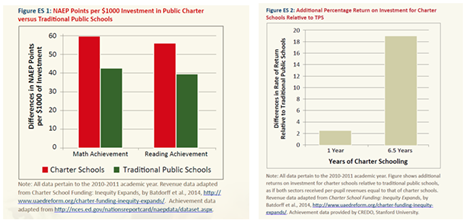
A new national study entitled, “The Productivity of Public Charter Schools” sheds light on this very topic and should serve as the start of a long-needed discussion about school funding trade-offs. For the first time, researchers at the University of Arkansas’ Department of Education Reform examined the important issue of cost effectiveness and return-on-investment (ROI) of charter public schools compared to traditional district-run schools. It looked at two measures to compare financial input with academic and long-term results. First, cost effectiveness was measured by comparing per pupil funding to National Assessment of Education Progress (NAEP) scores for both charter and district schools. Second, the return on investment was examined by comparing learning gains developed over time to an estimate of economic return over a students’ lifetime.

The results are impressive. Despite historical underfunding for charter public schools in comparison to district-run schools, the study found that charter public schools produce more learning with less money. For every $1,000 invested in education, the study found that charter schools, on average, scored about 40 percent higher in math and reading when compared to traditional district-run schools.

2014-08-12-graphs1.png

Charter schools are unique public school options for families. They are granted flexibility and freedom to be innovative and tailor curriculum and school culture to student and community needs in exchange for strict accountability and improved academic outcomes. Charter public schools all across the country are improving student outcomes and changing the trajectory of low-income and minority students’ lives by providing critical access to quality schools that develop the skills and knowledge necessary to persist in college and compete for jobs in the 21st century.

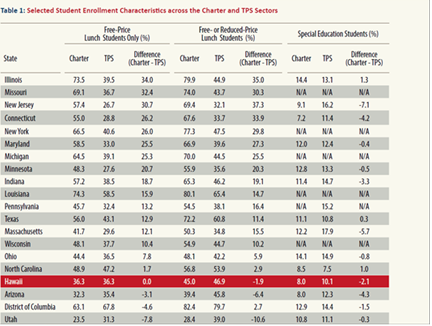
The results of this study in Illinois were particularly compelling. The study found that among the states studied, Illinois charter public schools serve the highest percentage of low-income (based on free and reduced lunch students) and special education students when compared to district-run schools.

2014-08-12-graph2.png

Despite serving a population of students that are widely recognized as more expensive to educate, these unique public school models are improving academic growth and student outcomes. However, current Illinois law allows for charter public school students to be funded at only 75% of what students attending district-run schools are funded. All students deserve a quality education and the resources needed to get it. Imagine the possibilities for students if we prioritized efficiency and effectiveness in our public school system when allocating resources.

There are certainly reasonable limitations to the data set examined. Long-term earnings predictions are a blunt instrument to gauge the effectiveness of public schools. Likewise, examining the NAEP data in a few, select grades does not paint a full picture of longitudinal achievement with the same set of students over time, which is a better measure of relative school quality. Nevertheless, these data suggest strongly that educational efficiency analysis should be included in all the current debates about public education reforms.

We urge lawmakers and district leadership to consider the return on taxpayers’ investment for our public schools when allocating limited funds. If we are to improve our public education system for all students, academic growth and student outcomes must be the main driver in all decision-making. Charter public schools work and are delivering on the promise to families of improving academic achievement and opportunity. We hope more studies are commissioned to examine these issues for the betterment of public schools. Investing in our schools is an investment in the futures of our students and our communities – let’s make it a smart one.


Closing Time

During my orientation at CER, Outreach Coordinator Tyler Losey informed me that I would be doing real work that mattered for the organization. Of course, I did end up taking on some of the administrative tasks such as stuffing envelopes, labeling, and scanning documents; however, I hardly ever felt like such work was meaningless. CER’s mission is to bridge the gap between policy and practice, and everything that I have done, including intense research and effective event planning, speaks to that very mission.

I am astonished at how much I have learned from my internship—so much more than I ever expected to. I will leave this organization with the ability to research so efficiently that I could find my next employer the names of all charter schools in the New England area that have received approval to open up for the coming school year in the span of just one hour. I know where to look for certain information, what sources to trust, and how to organize my information in a presentable way.

I was taught how to write briefly and matter-of-factly, but also informatively. Using the Media Bullpen as my medium for practice, I have written summaries and critiques for articles in just about three sentences total. Getting a message across in a manner like this makes it much easier for my audience to not only remember tidbits from my analysis, but to also gain my perspective regarding a certain topic much quicker than going through a long article trying to find what may be the most important point.

I have stepped out of my comfort zone and have even dabbled a little bit in designing an info-graphic for CER’s Instagram. Through this experience, I learned that it is okay to try new things and make mistakes while experimenting. All I really have to do is try again, and I did. For this reason, I saw an improvement in my work and an increase in a skill I thought I never had.

I now read the news with passion rather than boredom. CER’s Daily Clips, an email full of educated-related articles, has made me come to depend on news to wake me up in morning more than my usual cup of coffee. I am more aware of what is going around me, and I am better off that way.

I have overcome my shyness and have learned to network—to talk to more people, who often times are more than willing to engage in a conversation with me. In a town like D.C., many people are looking to engage with one another. There was no need for me to even be scared of introducing myself at all.

Clearly, I have enjoyed my time here at CER immensely. Is it really over? It seems like I had my interview with Alison just yesterday, but really that was three months ago—three months that have taught me so much! I thank the CER staff for their laughter, aid, kindness, and open-door policy. I will truly miss working for this organization. I wish CER well in everything that it is doing to encourage a better education system for all children. I hope to see CER happy and settled in their new office when I come back to visit!

Navraj Narula – CER Intern

Breaking Down Teacher Quality

The recent legal challenges in both California and New York have brought teacher quality issues to the forefront of the American consciousness in unprecedented fashion.

In California, Vergara v. California spread through the media like wildfire due to the one-two punch of Judge Rolf M. Treu’s strong ruling along with the particularly egregious teacher employment practices that have ensnared the Golden State.

Now the stage is set in New York, where two separate but aligning lawsuits have been filed challenging some of the same tenets in Vergara, such as a lax tenure system and ‘last-in-first-out’ retention policies.

To break it all down, Fordham’s Michael Petrilli and AEI’s Michael McShane discussed what these lawsuits involve, and their implications.

Credit where it’s due: Petrilli and McShane engaged in an extensive, thought-out conversation, breaking down the issues and defining what’s exactly at stake in these legal challenges. If anyone were looking for a refresher, they’d find it here.

If the vitriolic attacks on Campbell Brown and other proponents of reform are any judge, substantive conversation can often get lost in the Twitterverse.

Petrilli said to have “never actually heard,” the teacher unions mount a credible defense for ‘last-in-first-out’ as the sole determinant for retaining teachers in times of economic downturn. The discussion then branched out to what policies such as tenure are actually trying to accomplish, and what’s going to create good teachers in the classroom.

One primary source of agreement came on the point that the conversation should be more about the policies in question. That’s what happened in Vergara, but has yet to be fully realized in New York.

New York students and teachers deserve a system that rewards success. Job security for America’s most important profession cannot be a rubber-stamp process, where 97 percent of eligible teachers in New York City, for instance, were granted tenure in 2011-12.

The 2014 predictions for proficiency rates in math and reading among NYC students grade 3-8 are abysmal. Every step must be taken to improve student achievement, and these bold, judicial actions are just one piece of the puzzle.

NEWSWIRE: We Want to Hear From YOU!

This isn’t your typical Newswire (We warned you we’d be on break, remember?)

This week, we want YOU supplying the latest stories in education reform. From state officials to school leaders to engaged citizens, no story or anecdote is too small in the effort to better student outcomes, and CER wants to know:

How do YOU help #DeliverThePromise of an excellent education for ALL students? 

Together we can show the world how changes to education are making a difference through your tales of inspiration and student achievement.  SHARE YOUR STORY by:

1) Posting to Social Media using the hashtag #DeliverThePromise. Be sure to tag The Center for Education Reform when you post!

Example for Twitter: I’m a teacher choosing to work at a charter school that focuses on dropout recovery #DeliverThePromise @edreform

Example for Facebook: I’m a lawmaker pushing for changes that allow parents learning options outside of their zip code #DeliverThePromise @The Center for Education Reform

Example for either: I’m a concerned citizen that spreads the word about #edreform because ALL students deserve an excellent education! #DeliverThePromise

2) Replying to this email. Yep, it’s as easy as hitting reply and quickly sharing why you’re invested in education reform.

3) Calling 1-800-521-2118. Email not your thing? Pick up the phone and chat with The Center for Education Reform instead!

4) Sharing on our website. Click the link, type your story, hit submit, and you’re done!

The Summer Comes To An End

I can’t believe how much I have gained from this experience as an intern at The Center for Education Reform (CER). I originally came into the internship with the expectation of getting informed about the charter school movement, among other things, and I had no idea that this internship would go way beyond that expectation. Not only do I fully understand the discussion surrounding charter schools, but also I can speak of experiences hearing from CEO’s and founders of charter school networks,and I can recognize the names of charter school authorizers across the country. Beyond charter schools, I have learned about, tax-credits, school choice, STEM education, the “summer slide”, online learning, and teacher evaluation.

One of my favorite aspects about this internship was that I had the opportunity to read about the current issues surrounding education reform, and then hear from and speak with the leaders in the movement. After reading about the changes in education policy, I had the opportunity, along with my fellow interns, to actually meet with Katherine Haley, the policy advisor to the Speaker of the House. She spoke with us about her experiences on Capitol Hill, and the successes she has had over the years.

Interning at The Center for Education Reform got me talking to everyone about education. Throughout the summer I have found myself mentioning studies about education, or sharing links to articles that I read. After my internship, I have even been successful in signing-up my friends and family for CER’s weekly Newswire.

I am excited about how much I have learned over the past ten weeks and seeing where it will bring me in the future. I have enjoyed the support from each staff member and working alongside the other interns. I am very thankful to have had such a great summer here at CER.

Mandy Leiter, CER Intern

Two Ravitches In One!!

Diane Ravitch has had it with celebrities openly discussing education policy because they don’t know anything about schools (read: express an alternate viewpoint).

Ugh, how awful must it be for public figures to talk about things in a free and open society. Kudos to Ravitch for bringing this horridness to our attention.

Ravitch has taken a similar position in the past with respect to celebrities nosing around issues related to our nation’s schools. For example, take when Ravitch called Matt Damon, “A Hero of American Education,” following Damon’s public appearances in support of status quo conditions.

In fact, so adamant was Ravitch about how celebrities shouldn’t comment on education that she vehemently defended Damon against the perceived hypocrisy of him exercising school choice with his own kids while advocating for a system that locks other kids into schools solely based on zip code.

At the end of the same August 12, 2013 blog post, Ravitch went so far as to say, “[Damon] is not only a hero on the big screen, he is a hero to millions of parents and teachers who need him.” Wow, sure told him off!

More recently, Ravitch took a similar anti-celebrity stance when discussing comedian Louis C.K.’s dabbling into the education debate, when C.K. publicly criticized the Common Core.

Wrote Ravitch, “Louis C.K. Takes Aim At Common Core – And We’re All Smarter For It.”

The absolute nerve of Louis C.K. talking about standards and testing prompted Ravitch to eagerly thank him for having such a positive impact on the national conversation surrounding Common Core:

“The standards and tests can be improved, but only if their advocates are willing to listen and think critically,” Ravtich wrote critically.

“Louis C.K. may have made that possible. Thanks, Louis.”

As anyone can plainly see, Diane Ravitch has consistently denounced any attempt by a celebrity to talk about education policy in an open forum.

Sort of.

Importance of Strong Charter Laws

In a new analysis intended as a conversation starter about the impact of charter school laws, the Democrats for Education Reform (DFER) found little ties between the strength of a charter law according to The Center for Education Reform’s own rankings and student learning.

To be fair, and as DFER points out in the conclusions section, charter student success is based on a number of variables, and it’s this type of positive customization and versatility that makes a charter school a charter school. This does not take away, however, from the importance of having a strong charter school law on the books.

Though the analysis isn’t meant to illustrate cause and effect, The Center for Education Reform still cautions against drawing any inferences when charter student performance is based on the very questionable results produced by the 2013 national CREDO study.

CER noted in 2013 that the national CREDO study is fraught with unreliable methodology that leads to equally unreliable conclusions.

The initial effects of having a strong charter law are twofold. Not only does a law with multiple, independent authorizers, no cap and equitable funding allow for more educational options to flourish, but in so doing creates an environment in which charter educators, leaders and parents are a welcomed part of public education.

This relationship is exemplified by the 335 additional charter campuses created during the 2012-13 school year in states rated ‘A’ or ‘B’, on the law rankings, contrasted with the 13 campuses in states rated ‘D’ or ‘F.’

The removal of oversight mechanisms — whether in the form of a politicized state commission or an ill-equipped local school district — that lack a vested interest in the success of charter schools go a long way in attracting excellent charter models.

As Kara Kerwin wrote in the charter school ‘wonk-a-thon’ earlier this year, the varied nature of charter success helps explain the proven stories found in places such as Boston, where charter schools may not be bolstered by a strong law but still produce learning gains in the face of legislative adversity. This begs the question of how much more the Massachusetts charter sector could do without policy inhibitions, such as a restrictive cap.

But the main takeaway from Kerwin’s ‘wonk-a-thon’ post is that ‘more’ is the operative word for building a successful charter sector. This means more children sitting in more seats in more schools made available by more choices. Strong laws help make that happen.


Letter to the Editor: “Building Successful Schools for North Carolina”

Wilimington Star-News

This week, North Carolina school leaders, parents, community members and policymakers are gathering in Wilmington to discuss what must happen to encourage the growth of successful charter schools, and how best to interweave them into the fabric of North Carolina’s public education system.

It’s heartening to hear inspirational stories from charter classrooms, but future stories aren’t possible without policies in place that allow charters and the students they serve to thrive. Sound policy is what ensures charter school growth from the ground up so schools and educators can innovate. Provisions such as creating multiple, independent charter authorizers and structuring a funding formula that equitably distributes public dollars truly show a vested interest in charter success.

And these reforms are worth pursuing. A recent study examining the cost-effectiveness of charter schools compared with traditional public schools showed for every $1,000 invested per-pupil, North Carolina charter schools were 26 percent more cost-effective in delivering reading gains and 27 percent more in math on national assessments.

Over the past year, the North Carolina policy atmosphere has been nothing short of tumultuous. Kids and parents deserve better, and it’s time lawmakers deliver the promise of more and better educational options to North Carolina families.

Kara Kerwin is president of The Center for Education Reform, Washington, D.C.

Will Massachusetts Be Next?

In a thoughtful opinion piece for The Boston Globe, CATO’s Jason Bedrick and Ken Ardon of Salem State University propose an educational tax credit scholarship program for low-income students in Massachusetts.

According to CER’s Education Tax Credit Scholarships Ranking & Scorecard 2014, only 14 states currently have tax credit scholarship programs on the books, Massachusetts not being one of them. Should the Bay State decide to pursue this school choice avenue, it would be the eighth state to enact a tax credit scholarship program in just the last three years alone.

Even with so few states, tax credit scholarships are used nationwide by approximately 190,000 students, second only to charter schools in terms of student enrollment in a school choice program.

Tax credit-funded scholarships are fueled by private, voluntary contributions from individuals and businesses, which in turn go towards scholarships that help students attend the school of their choice. Those individuals and businesses are then able to claim a credit against their tax bill for donations.

The strongest programs tend to have broad student eligibility requirements, increased funding to maximize availability, preserve private school autonomy and include automatic escalator clauses to meet growing demand each year.

Similar to other states, demand for school choice in Massachusetts is remarkably high. While only 14 states have tax credit scholarships available, it remains to be seen whether more will follow suit to expand access to more educational opportunities for students in need.