








Sign up for our newsletter

Charter School Achievement Data

Links to various reports & studies highlighting charter school achievement across the U.S.

December 2019

A Good Investment: The Updated Productivity of Public Charter Schools in Eight U.S. Cities, by DeAngelis et al., University of Arkansas, April 2019
Lifetime earnings for students attending charter schools are four- to six-times the amount of money invested in their education. On average, they’ll reap .37 for every dollar in charter schools and .41 for every dollar in traditional public schools.

Charter Schools Bright Spot in Disturbing Schools Report, by Will Flanders, RightWisconsin, Oct. 30, 2019
Per NAEP scores, Milwaukee’s charter schools are performing much better than traditional Milwaukee Public Schools (MPS) district schools. In 4th grade math, Milwaukee charter schools scored 235 , close to the state average for 4th graders of 242. MPS scored a 212.

Apples to Apples, The Definitive Look at School Test Scores in Milwaukee and Wisconsin for 2019, by Will Flanders, Wisconsin Institute for Law and Liberty
Milwaukee's 24 independent public charters outperform MPS by 8.2 % in math and the 13 district public charters outperform traditional MPS schools by 13 percent in math.

Student Achievement in Florida’s Charter Schools: A Comparison of the Performance of Charter School Students with Traditional Public School Students, Florida Department of Education, March 2019
Florida's annual charter report showed that in 89% of comparisons, African American students in charter schools performed better than African American students in traditional public schools

DC Graduation Rate Holds Steady in 2019, Despite Drop in Traditional School System, by Perry Stein, The Washington Post, Nov. 8, 2019
D.C Charters are college & career pipelines and consistently graduate more seniors than traditional public schools (76.4 % compared to 65.1%)

DC’s Public Charter Schools, DC Public Charter School Board, Feb. 2019
In Washington, DC, charter-school enrollment has increased by nearly 60% since 2009. DC’s public charter schools educate a student body that is 75% African American and 44% at-risk, with both populations outperforming traditional public schools.

Let the Numbers Have their Say, Evidence on Massachusetts’ Charter Schools, by Thomas J. Kane, Harvard Graduate School of Education, 2018
Thomas Kane, a Harvard Graduate School of Education professor stated that “the oversubscribed charter schools in the Boston area are closing one half of the Black-White achievement gap in math and roughly one fifth of the Black-White achievement gap in English.”

Charters Continue to Close the Proficiency Gap, New York City Charter School Center, Aug. 26, 2019
New York City charter students have shown greater improvements than their traditional school counterparts, showing 63 additional days of learning in math, and 23 days in reading.

What We’re Learning: Nashville’s Charter Schools, Scarlett Family Foundation, Jan. 23, 2019
The two highest achieving charter elementary schools in Tennessee almost doubled the district’s overall student achievement. Purpose Prep had 57% of students achieve on track or mastered for ELA and 65% for math; Nashville Classical had 49% and 55% respectively

Get the Facts: Charter Public Schools Change Lives, Here’s How, Illinois Network of Charter Schools, 2019
In Chicago, charter students have a 7.2% college enrollment rate compared to 2.2% of similar high school students in traditional public schools. Charter students have a higher completion of college coursework with 21.4% completing at least 4 semesters compared to 13.0% of traditional public school students

The Charter Effect, by Mary Neiderberger, PublicSource, Aug. 14, 2017Based on academic performance, Downtown-based City Charter High School stands out as having the most impressive record of achievement among charter schools in Allegheny County, and among all schools in the City of Pittsburgh, with a school performance profile score of 89.8. In Pittsburgh, City Charter High School enrolls 85% of its students from the Pittsburgh Public Schools and still has the highest-achieving as it outscores all of the Pittsburgh district schools. In addition, the graduation rate at City Charter, which is 97 percent, exceeds all of the Pittsburgh district high schools, whose graduation rates range from 96.5 percent at Pittsburgh CAPA to 63 percent at Westinghouse.

Historical AzMERIT Dashboard, Arizona Charter Schools Association, 2015-2018 Data
AzMERIT scores released last month showed public charter students outperformed by 9 percentage points the state average among students who took the English/Language Arts portion of the test. In terms of Mathematics, charter students exceeded the state average by 6 percentage points. Charter students of every race and ethnicity, as well as low-income, Limited English Proficiency and Special Education subgroup, scored better than the statewide average of their peers on AzMERIT.

School Performance, Colorado League of Charter Schools, 2019
According to U.S. News and World Report, seven of the top ten Colorado high schools in 2017 were charter schools. Seven of the top 10 public schools with the highest SAT scores in Colorado in 2017 were charter public schools according to the Colorado Department of Education SAT school results.

Charters Up Close: Kids First, California Charter Schools Association, 2019
Across the state of California, charter schools are increasing student learning for low-income and minority youth. Research proves charter school students gain extra weeks and months of learning annually. The Los Angeles charter school sector is one of the strongest in the nation. Oakland charter school students are outperforming their peers in traditional district schools.

The Nation’s Report Card, Public, Private, and Charter Schools Dashboard, National Assessment of Education Progress (NAEP), 2019
Although 2019 NAEP results did not show significant growth in 4th and 8th grade math and reading achievement nationally, the data shows that charter schools do a measurably better job of educating low-income African American and Hispanic students than their traditional public school counterparts.

Poor children are still left behind in DCPS schools, by David Osborne and Tressa Pankovits, The Washington Post (Dec. 6, 2019)
The city’s annual PAARC test results confirm what we saw on the NAEP. In wards 5, 7 and 8, which have the highest concentrations of poor children, 22 of the top-performing 23 schools were charters. The one DCPS school in the top 23, McKinley Tech High School, selects its students. The charter schools vastly outperform DCPS schools in these three wards — roughly doubling DCPS’s percentage of students who score a 4 or 5 (meeting or exceeding expectations).

From Rising Tide: Charter School Market Share and Student Achievement, by David Griffith, Fordham Institute, Sept. 26, 2019

1. In large urban areas, higher charter market share is associated with significant achievement gains for black and Hispanic students.
2. In suburban and rural areas, higher charter market share is associated with significant achievement gains for Hispanic students, and black students in rural districts also see gains.
3. There is no evidence that higher charter market share is associated with achievement gains for white students.

Study: Maryland charter students’ gains outpace those at traditional schools; black, Hispanic pupils benefit most, by Jean Marbella, Baltimore Sun, Jul 16, 2019
A new study has found that students at Maryland charter schools, especially those who are black or Hispanic, have on average made greater academic progress than their counterparts in traditional public schools.

Charter School Performance in Maryland 2019, Center for Research on Education Outcomes, Stanford University, 2019.

CREDO found that "In the last school year of the study, 2016-2017, students in Baltimore’s public charter schools gained an additional 47 days of reading and an astronomical 59 days of math achievement. These additional days of achievement are not due to more physical time in school but done in the same 180 days required of all public school students.
(Note: Credo has found several states and cities’ charter schools outperforming traditional public schools. However, we have concerns about their methodology that underestimates the effects of charter schools because of their use of “virtual twin” methodology. For more on this topic, please see CER’s brief on this topic here: https://staging.edreform.com/wp-content/uploads/2011/09/No_More_Waiting_Charter_Schools1.pdf)

CER Survey of America’s Charter Schools
2014 report highlights the environment and conditions charter schools function in, which lead to achievement

The Productivity of Public Charter Schools, July 2014
A University of Arkansas study reveals charter schools use public dollars far more efficiently than traditional public schools. For every ,000 invested, eighth grade charter students achieved on average an additional 17 points in math and 16 points in reading on the National Assessment of Educational Progress (NAEP).

Louisiana Charter School Achievement, August 2013
Part of CREDO’s state by state look at charter school achievement, results show Louisiana charter school students learning more in a school year than traditional students. While CER finds flaws in CREDO’s methodology, local instead of national achievement comparisons, makes results more comparable and therefore more reliable.

D.C. Charter School Achievement on DC-CAS, July 2013
-Additional Commentary and Data on D.C. Charter Schools, Matthew Ladner
D.C. public schools showing showing improvement on standardized test, but charter schools improving at much faster rate

Illinois Charter School Achievement, June 2013
Students in Chicago charter schools higher-achieving than traditional school counterparts.

Michigan Charter Schools Outperform Traditional Public Students, May 2013
CREDO state report finds Michigan charter school students gaining at a faster rate than traditional school students. Provides more detail on CER’s critique of their methodology.

Massachusetts Charter School Achievement, March 2013
Six-year study showing charter school’s surpassing traditional schools, especially in Boston.

New York City Charter School Achievement, February 2013
Continued success of New York City charter schools compared with conventional public schools in the Big Apple.

CMO’s Positive Impact on Student Learning, November 2011
Report by Mathematica Policy Research found that charters operated by a Charter Management Organization are generally more effective managerially, academically, and operationally.

CER Fact-Checking Charter School Achievement, October 2010
CER-issued document to counteract the first CREDO report. Contains great information on charter school achievement, demand, and demographics

Hoxby and New York Charters Affecting Achievement and Closing Achievement Gap, 2009
Dr. Caroline Hoxby examines charter schools in New York City to find that they are closing the achievement gap for students the longer they attend a charter school.
Wisconsin Sunk $139 Million Into Private Schools Booted From Voucher Program

By Arianna Prothero
Education Week
October 13th, 2014

Over the past decade, Wisconsin has spent around $139 million on school vouchers to pay tuition for students attending private schools that were eventually disqualified from the state’s program, according to a review by the Wisconsin State Journal.

In an August report, Wisconsin was ranked, alongside Ohio, as having the second best voucher program in the country by the advocacy and research group Center for Education Reform. CER’s rankings are based in part on how much autonomy private schools are allowed to keep once they enter a voucher program.

Read the rest of the article here.

Making the Grade: Where Does Your State Voucher Program Rank?

Maggie Thurber, Watchdog Wire

Want to know how state voucher programs stack up? The Center for Education Reform has the answer.

In their new report, School Choice Today:  Voucher Laws Across the States Ranking and Scorecard 2014, CER takes a look at the 15 voucher programs currently in existence and gives them a grade. There are three As, three Bs, seven Cs and two Ds.

It’s the first analysis of its kind, providing a state-to-state comparison of the various voucher laws and builds on the work CER has done to rank charter school laws and tax credit-funded scholarship programs.

“Having a voucher law on the books is a good start, but not enough to make sure students are actually benefitting from school choice programs,” Kara Kerwin, CER president said in a press release. “Policy design is critical, but the true strength of school choice voucher programs depends heavily on implementation.”

The state voucher programs were evaluated in four areas:

  • Student eligibility requirements
  • Program Design
  • Preservation of private school autonomy
  • Student participation

“From the types of students eligible to the number of regulations imposed on private schools, each element of a voucher program’s design impacts how effectively the voucher truly empowers parents with the ability to choose the best school for their child,” Brian Backstrom, CER senior policy advisor and author of the report, said.

Indiana, Ohio and Wisconsin earned an A grade for their programs.

With 31 out of 50 total points, Indiana offers a universal voucher program available to all students and imposes no limits on the number of vouchers awarded. But it ranked second worst in the nation when it comes to infringing upon the private schools’ autonomy because it mandates course content and allows government observation of classes.

Ohio earned 30 points for what the report called a “piecemeal” approach to vouchers with five different programs. But its top ranking for student participation was praised as a “worthy achievement.”

Wisconsin, home of the oldest voucher program in the county, also earned 30 points, with its strong Milwaukee/Racine programs offering choice to 12 percent of the state’s school-aged population.

Washington, D.C., Arizona and North Carolina tied for fourth place with 27 points, earning them a B grade.

The D.C. program has a high percentage of children receiving vouchers, but its strict income eligibility threshold is the lowest in the country which limits the program’s reach, the report said.

For the 2014-15 school year, North Carolina’s program got twice as many applications as there were vouchers available. The state is currently defending a lawsuit against the voucher program which is on hold due to an injunction halting the distribution of the funds.

Arizona’s personal education accounts worked so well it was expanded in 2013. The state deposits educational funds directly into an account controlled by the parents who can choose how to spend the funds using a type of debit card that is coded to allow its usage only for pre-approved expenses. The accounts can be used for tuition at any school, to pay for college or university courses while their child is still in high school, for online education, certified tutors, testing preparation like for SATs, or even a la carte public school courses (foreign languages, for example). They also have the choice to not spend it and put it toward a future college education. Anything not used in a year is allowed to accumulate.

It’s a popular idea. Florida just implemented a similar one and Delaware just proposed their own program based on the concept.

Louisiana, Florida, Georgia, Oklahoma, Colorado, Utah and Mississippi all earned a C grade with scores of between 19 and 23 points.

Louisiana imposes “such significant regulatory intrusion” that it ends up with a C. Their regulations are such that new private schools are prohibited from participating.

The ranking for Florida, Georgia, Oklahoma, Utah and Mississippi are due primarily to the fact that their programs are only for special needs students.

Colorado’s program is tied up in legal wrangling, but even if it were implemented, it only offers 500 vouchers for the more than 62,000 eligible children.

Vermont and Maine both earned D grades because they don’t offer a modern-day voucher program, but merely a method by which students in areas and towns without any district school systems can get an education.

The report states that legislators considering vouchers or modifying their existing programs “would be well-served by examining the design elements that have led to the success of several state programs, and the components of state voucher program laws that are holding some states back.”

With “reliable policy blueprints and visible implementation of strong voucher programs, more state leaders need to step up to the plate in order to grow and expand school choice opportunities across the U.S. so more children have access to options that best meet their individual learning needs,” Kerwin said.

D.C. school spending: Don’t forget to read the fine print

Scott Pearson
Fordham B. Institute Flypaper
October 15th, 2014

The Thomas B. Fordham Institute’s Metro D.C. School Spending Explorer offers the public a great resource by sharing data on public school spending (at the school level) across the District. As with any financial data, though, the fine print is as important as the headline.

The map says that D.C.’s public charter schools had a total operating expenditure of $18,150 per pupil in the 2011–12 school year, compared with total operating expenditure at D.C. Public Schools (DCPS) of $15,473. But this is misleading. Many public charter schools rent their space, and rental payments are considered operating expenses. Meanwhile, school-system buildings are decades old and are almost exclusively paid for from the city’s capital budget—which is not included in the comparison. Moreover, more than $1,000 per pupil of DCPS maintenance expenses are provided free by the city—these expenditures aren’t included either.

The fine print found in the Fordham Institute map describes the real situation—public charter schools receive less money per pupil than DCPS. This disparity is carefully documented in a 2012 study commissioned by two charter advocacy groups. It found that the total amount of extra non-uniform local operating funds DCPS receives compared to public charter schools ranges from $72 to $127 million annually. The report also makes the case for why some of these disparities exist, noting that charters are schools of choice, while “DCPS operates as a system of right, which requires schools be available across the city to serve every neighborhood at every grade level.”

Indeed, the District government’s own funding adequacy study, issued a year later, found D.C. education funding to be inequitable, and “these disparities in funding are contrary to D.C. law.” The funding inequities are also the subject of a lawsuit against the city jointly filed recently by the D.C. Association of Chartered Public Schools and individual charter schools. The outcome of this lawsuit likely won’t be known for years. Meanwhile, the city has taken some measures to reduce, but by no means eliminate, the inequities that have been so carefully documented.

These inequities have real impacts on charter schools. I frequently hear from public charter school leaders how they struggle to match salaries and bonuses paid at DCPS. As D.C.’s charter authorizer, we support the recommendation in the Adequacy Study that critical resources given by city agencies to both the traditional schools and charter schools should be funded through the Uniform Per-Pupil Funding Formula. This remedy would bring us closer to the funding equity required by law, as well as tap into fundamental fairness.

In the meantime, charter leaders have found innovative ways to support their programs and serve students. Charter school students outperform the state average in reading and math and, according to a recent CREDO study, receive the educational equivalent of ninety-nine extra days of school each year. Those are impressive results, especially given the funding inequities. It brings real meaning to the term doing more with less. D.C.’s charter schools and their students prove that every day.

NEWSWIRE: October 14, 2014

Vol. 16, No. 40

BEAUTIFUL DAY IN THE NEIGHBORHOOD SCHOOL. Every morning, New Orleans native and local pastor Oscar Brown greets students at Homer A. Plessy Community Charter School. Boasting an art-centered curriculum that brings out students’ creativity, Plessy is a neighborhood school in the truest sense. Prior to opening, parents and community members all pitched in with painting, upkeep, and any other tasks needed to ensure a safe, adequate facility for students, and parents have had ample input in how their kids are learning in the classroom. The facility undertaking provides some tangibility to the financial and operational challenges charters face reflected in CER’s Survey of America’s Charter Schools. Now in its second year, Plessy’s diverse student body and creative approach are emblematic not only of New Orleans’ rich culture, but also the resolve to unite neighborhoods through improving education.

THERE’S NEED FOR THE OSP. Refuting the suggestion from a recent federal report that there is dwindling demand for the wildly successful DC Opportunity Scholarship Program (DCOSP), the American Federation for Children rightfully set the record straight. A staggering 97.2 percent of participating students are African-American and Hispanic, and more schools are accepting DCOSP scholarships since the 2011 passage of the Scholarships and Opportunity for Results (SOAR) Act, which reauthorized the DCOSP. Expanding student eligibility would bolster the DCOSP’s effectiveness, a program currently earning a “B” grade according to the 2014 Voucher Laws Across the States Ranking & Scorecard. At the end of the day, something about less demand for school choice in a city with underserved students in one of the most vibrant charter sectors in the nation just doesn’t pass the smell test.

SETTLING THIS ONCE AND FOR ALL. Perhaps a little more frustrating than the Carolina Panthers tie with the Bengals this past Sunday is the fact that North Carolina families still must face uncertainty due to a legal challenge against the state’s new Opportunity Scholarship Program now helping approximately 2,000 kids receive a better education. That said, the State Supreme Court has now decided to hear the case, expediting the legal process and potentially giving parents more security knowing they’ll have this life-saving educational option available for their kids. Fourteen voucher programs exist in other states; it’s time North Carolina gets fully on board with true implementation.

AP PROGRESS. There are some positive takeaways from the numbers surrounding Advanced Placement (AP) exams released by The College Board. For one, more kids from all backgrounds are taking AP courses, up 3.8 percent from last year, meaning there are more students who are consciously deciding to lift internal expectations and make the month of May that much more stressful. Approximately 57 percent of kids who took AP exams received a three or higher, a score usually considered as passing by most colleges and universities. AP exams offer many key benefits, such as obtaining college credit while in high school, which increases college preparedness as well as chances of graduating on time. The uptick in students taking these types of courses is a promising sign that families are demanding more out of education, and want learning environments and options to help make that happen.

ARE YOU VOTING THIS NOVEMBER?… For the candidate that will put student results first? Do your research before heading to the polls by checking out Education50, CER’s newly updated resource delivering hard-hitting analysis on candidates in each of the 36 gubernatorial elections. Want to spot the real education reform-minded candidate in other races too? This toolkit on how to spot the real reformer has everything you need to know.

CER IS 21! On October 13, 1993, The Center for Education Reform was officially incorporated to unite varied coalitions under the banner of school choice and accountability. Twenty one years later, we continue that important work to create the conditions for more educational choices in communities nationwide.

AS CER ENTERS ITS THIRD DECADE, the Board of Directors welcomed David Hardy, CEO of Boys’ Latin of Philadelphia Charter School and nationally recognized authority on school reform, and elected new leaders with Frank Bonsal III, EdTech investor and Director of Entrepreneurship at Towson University, as Chairman.

Survey: Utah parents have ample power in child’s education

Tracie Sullivan, The Spectrum

Utah parents appear to have ample control over their child’s education, the Center for Education Reform reported. It ranked Utah sixth out of 50 states and the District of Columbia.

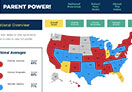
Climbing four spots from its previous number 10 ranking last year, Utah earned an 80 percent ranking on the Parent Power Index, a Web-based report card put out by CER.

The Index evaluates and ranks states based on qualitative and proven state education policies.

According to a press release put out by CER, the higher a state’s grade, the more parents are afforded access and information about learning options for their children.

“The index tool is for parents and policy makers to use in order to understand what policies and laws may be needed to bring about better educational opportunities. There are five main components that comprise state PPI scores — charter schools, school choice, teacher quality, transparency and online learning,” said Kara Kerwin, President of CER.

Utah has improved in several areas, which has helped move it up on the index including improved online educational options, a special-needs voucher and charter schools.

The voucher is available to disabled students ages 5 to 21, although participation is limited to the amount of money appropriated each year by the Utah State Legislature. Currently the state has appropriated $3.9 million, providing funding for 650 students to use the voucher.

CER considers Utah’s charter school laws strong because it provides equitable funding for the schools. However, it threatens parent access by imposing enrollment caps, Kerwin said.

Michelle Cameron recently moved to Utah from West Virginia. With two children in school, Cameron said she feels she has a lot more say in what happens with their education here, especially with her autistic son.

“We have options here we didn’t have in West Virginia like speech therapy, and one-on-one speech therapy too,” she said. “They had quit offering him that there a long time ago, so I was surprised when here they asked me if I wanted to put him in it.

“They also asked me if I wanted him to have time in other classes like cooking and music with the other kids. They never took him out of the classroom in West Virginia even for the minimum time he was supposed to be out.”

In an online discussion about whether parents felt they had control, Lesa Nelson, a Cedar City resident, said she has a significant influence in her son’s education.

“I have always been able to go to any of them (teachers) and express my concerns . . . I have felt I have always had a say in my son’s education,” she said.

But in the same online discussion, several local parents shared their frustration about not having control over their child’s education.

“Around here there isn’t much of a choice other than public or home school,” said Daniel Houchen, a Cedar City resident.

CER Turns 21!

Many say that a Sweet Sixteen or 18th birthday are by far the biggest and most important years to gauge one’s coming of age. However, it is pretty much a matter of fact that the 21st is the biggest of all, especially as it solidifies the final transition into adulthood.

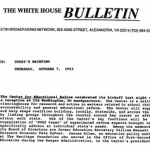
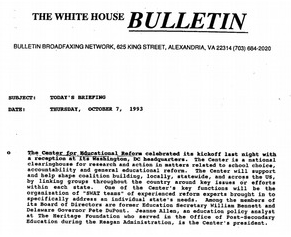
For CER, that day is today! Yes, on October 13, 1993, The Center for Education Reform was incorporated and this White House Bulletin fax announcing our launch is a clear indication on how far we’ve come since then in our ability to communicate and bring commonsense reforms into mainstream thought.

Screen Shot 2014-10-13 at 6.55.59 PM

While we remain a trusted brand for policymakers, the media and parents alike, we continue to churn out research and data at a record pace. We continue to help shape coalitions throughout the country but in new and meaningful ways, and CER is now, and always has been, “the organization of ‘SWAT teams’ of experienced reform experts” ready to take on state and local issues.

Together, we’ve made progress over the last twenty-one years, but it’s not nearly enough to meet parental demand for more and better learning options, with oversubscribed scholarship programs across the nation and charter school wait lists growing to nearly 300 students on average and now totaling over a million.

CER board member and President and CEO of the National Charter Schools Institute, Jim Goenner, stated at our annual Board of Directors meeting last week that “CER is in the opportunity business…We’re in the business of better education for kids, parents and country.” Building on our legacy and solid foundation, CER is forging ahead with fresh, bold thinking and action to do just that.

It has been almost a year since I took the reigns of CER to usher the organization into the next generation of reform, and I am extremely proud of the team in meeting or exceeding critical goals. With your support, we’ve accomplished major successes challenging both our friends and detractors alike. With your support, we’ve reached over a hundred million more Americans with our message. With your support, we’ve maintained a strategic focus to make a positive difference in the lives of students.

With your continued support we can accomplish so much more.

Best regards,

Kara Kerwin
President

P.S. – Consider making a special contribution today to help celebrate CER’s 21st! Donate Button

Top of the Chart(ers): Health of Public Charter School Movement Panel

With the newly released State-by-State analysis, the panel room was buzzing with people eager to hear just how rankings were assigned. Todd Ziebarth, Senior Vice President of National Alliance for Public Charter Schools (NAPCS), began the panel by posing the question, “How do you even start to rate the charter school movement?” The National Alliance for Public Charter Schools ranked schools in the United States by addressing 11 indicators ranging from new charters, closed charters, geographic distribution, innovative practices, and quality. In ranking schools, they preferred charters that focused on underserved students and utilized sources of innovation. While NAPCS plans to add more information to provide a fuller picture, especially regarding innovation efforts, the overarching issue was very clear: data collection for this report was far too difficult. If information isn’t accessible to a group conducting an intricate study, how are people who just need information for life choices able to access this data? There needs to be a priority on data accessibility so that people can accurately gage charter health.

Delving into the NAPCS’ ranking comparisons, Todd noted there is some correlation between states with high-strength laws and higher rankings and states with weaker laws and lower rankings. There are, however, exceptions to the rule. New Jersey, for example, has a low ranked charter law, but it has strong, independent charter schools in a relatively smaller sector that outperform restraints that come along with its weaker law. Nevada, picking up the #26 last place ranking (this report didn’t look at all states with charter school laws), has no law that caps charter school growth or an independent state authorizer. Instead, the multiple entities and lack of charter school funding keeps the schools in shambles and is probably a reason that no communities had more than 10% of their public school students in charters between 2012-2014. Washington, D.C., on the other hand, is ranked #1 and has an independent charter board as its authorizer, autonomy and accountability. Charter schools are often only as strong as their laws allow them to be; therefore, improvements made to the law directly improves the education system.

One of the most interesting conversations that came up during the panel was the differentiation between urban charter schools and suburban charter schools. Todd stated that while the research conducted should encourage statewide movements, NAPCS has a slight bias toward urban charters that typically reach underserved communities. Scott Pearson, Executive Director of the D.C. Public Charter School Board, chimed in and argued against people who say that charter schools are better if the traditional schools around it are doing poorly. “This is not apples to apples;” a charter school in suburban Minnesota is not worse than an urban school in D.C. yielding the same exact results just because the schools that surround it are also high-performing. Achievement has to be based on individual results, not conclusions based on the best of the worst.

Pearson was then given the metaphorical charter school first place trophy and asked to give some insight about the D.C. system. The basic points were that high levels of autonomy and funding were helpful, however, a core impact is authorizers that are committed to quality and equity. Quality comes from holding charter schools accountable and closing them when necessary, and equity derives from charter schools acting as public schools and providing detailed help so that everyone is very informed on programs both in the charter school and at a college level. Thriving schools attract people who usually would not associate with a public charter. The success of public charters depends on strong visions and people stepping up to the plate to take control. D.C. charter schools are constantly stepping up their game regarding their environment and these schools flourish because of this competitive atmosphere.

Kenneth Campbell, president of the Black Alliance for Educational Options (BAEO), gave insight into Louisiana charter schools, a very different part of the country. Campbell said that prior to Hurricane Katrina, not many charters were successful, but now they are on the top of the charts. How do they keep their schools performing at such an outstanding rate? Campbell chalks it up to visionary leaders and incentive programs. In New Orleans, schools are given renewals based on student performance and also prepares for school failures before they even happen. Schools flourish when administrations have their part of the job taken care of and authorizers have the power to give assistance to schools that are thriving. The panel addressed these issues, along with the scoring details, and ways in which they can improve rankings for the future. The health of the charter school movement depends on legislation and policy in order to help good schools continue to produce incredible results.

Brett Swanson, CER Intern

State ranks 36th in report card for parents

Advanced Monticellonian

Arkansas ranks #36 out of all U.S. states and the District of Columbia when it comes to giving parents fundamental power over their child’s education, according to the fifth edition of Parent Power Index (PPI), released by The Center for Education Reform (CER). While only six states earn rankings above 80 percent on PPI, Arkansas scores 63.8 percent.

Parent Power Index is a web-based report card that evaluates and ranks states based on qualitative and proven state education policies. The higher a state’s grade, the more parents are afforded access and information about learning options that can deliver successful educational outcomes for their children.

“While it’s true some states have made progress, it’s not nearly enough to meet demand. Simply put, we need more learning options available to more families, and we need them fast,” said Kara Kerwin, president of the Center for Education Reform.

“Out of the over 54 million K-12 students nationwide, only an estimated 6.5 million students are taking advantage of charter schools, school choice programs such as vouchers or tax credits, and digital or blended learning models,” said Kerwin. ”With the United States’ school-aged population expected to grow at unprecedented rates in the next 15 years, how will our school system be able to meet demand when we already have wait lists for charter schools and oversubscribed scholarship programs?”

A median PPI score of 67.4 percent (Delaware) shows just how poorly most states have implemented policies surrounding charter schools, school choice, teacher quality, transparency, and online learning, the five main components that comprise state PPI scores. Mississippi, ranked 20, made the most progress, moving up 21 spots and breaking into the top 20 states after being in the bottom 11 states on previous analyses.

“With 36 governor races this November, including in Arkansas, it’s time enacting parent-empowering policies take front and center, especially when only 30 percent of Natural State eighth graders are proficient in reading and 28 percent are proficient in math. America’s future depends on states’ ability to enact good policy to accelerate the pace of education reform and grow new and meaningful choices for parents.”

CER President Kara Kerwin and CER Executive Vice President Alison Consoletti Zgainer are available for comment on CER’s Parent Power Index. Members of the media should contact CER Communications Director Michelle Tigani at 301-986-8088 or michelle@staging.edreform.com to set up interviews.

The PPI education scorecard reveals state summary data, while full state-by-state details, including methodology, can be found atparentpowerindex.com.

York City teachers, officials ‘blindsided’ by blended district option

by Erin James and Nikelle Snader
York Dispatch
October 9, 2014

York City teachers and school officials are digesting the surprise alternative to complete charter conversion announced by the district’s state-appointed financial recovery officer Wednesday.

The concept is interesting, said Carol Hill-Evans, a member of the Community Education Council and president of the York City Council.

But it also came with “no warning or notice or anything,” she said.

Recovery officer David Meckley has also attached a mid-November deadline for the new plan to be developed and approved.

“I’m wondering, is there enough time for them to work out all the details?” Hill-Evans said.

Blended approach: On Wednesday, Meckley announced at an education council meeting that he is willing to consider a blended approach to academic and financial reform that would include both charter schools and traditional district schools — though he, personally, would prefer to see the district’s eight buildings converted by July 2015 to charter schools.

However, in the interest of building consensus among skeptical school board members and other stakeholders, Meckley said he is willing to consider a compromise.

Meckley said he envisions a district of three schools operated by Charter Schools USA and five schools operated by the district under a revised transformation plan starting next year.

Charter Schools USA has agreed to the concept of a five-year contract. During that time, performance evaluations would determine whether a school remains charter- or district-operated.

‘Blindsided’: Teacher and education council member Janice Laird said she was “blindsided” by the proposal.

“It was unexpected,” Laird said. “And I was very surprised that he didn’t in any way ask for the opinions of the council he set up.”

Meckley said the new concept will work only if the teachers union agrees to a new contract — which has not happened despite a year of negotiations already.

Also, the district has a little more than a month to revise the strategies of its academic recovery plan for the next five years.

That deadline doesn’t seem realistic to Kim Schwarz, secretary and past president of the teachers union.

“There’s so many unknowns,” she said. “It’s just a very difficult thing to sign away your livelihood over many years’ time when there’s so many uncertainties.”

Parents, teachers and school board members Schwarz spoke with after Wednesday’s meeting don’t view Meckley’s proposal as a “happy medium,” she said.

“There’s obviously a lack of trust,” Schwarz said.

The union has continued to meet with the school district about contract negotiations, said union president-elect Ira Schneider.

“We continue to bargain in good faith and we will work toward a collective-bargaining agreement,” Schneider said. “That’s always been our goal and that will continue to be our goal.”

Concerns: Contract issues aside, Laird said she has additional concerns about the consequences of a hybrid model.

“There’s no equal footing when a $200 million company comes in to take over three schools,” she said. “If they manage to perform well, they get the whole district.”

Aside from each school in the district having its own distinct community, the transiency of students could create larger education gaps if students move and are caught in two different curriculums between the district and Charter Schools USA, Laird said.

“We have kids who are sometimes in six different places in a single school year,” she said.

Hill-Evans said she likes the idea of competition between district-operated schools and charter schools.

“Competition is good. It’s healthy. And it’s reality,” she said.

Agreeing on a new union contract is the largest concern for school board president Margie Orr.

“Until that portion of it is solved, I really can’t go into the other details right now,” she said.