









Sign up for our newsletter

Indiana Conservatives’ Coalition: ‘School Choice’ with Strings Attached not ‘Conservative’

By Dr. Susan Berry
Breitbart
January 6th, 2015

At least 40 conservative groups in Indiana have signed on to an agenda for education reform that will be submitted to the state’s lawmakers Tuesday. Among the top planks of the coalition’s platform are cutting regulations for schools that agree to accept school choice vouchers and freedom to reject the state’s rebranded Common Core-aligned standards.

The coalition’s “Platform for Educational Empowerment” was launched by the grassroots organization Hoosiers Against Common Core, a group working to defeat federal overreach into education.

According to a news release sent to Breitbart News, the coalition of groups will be urging Indiana lawmakers to address these priority issues in the new legislative session:

[R]educing regulations on voucher-accepting schools; Freedom in testing and choice of non-Common Core-aligned/rebranded standards; Forgoing a renewal of Indiana’s federal No Child Left Behind waiver; Greater protection of student data; Empowering parents, as opposed to government-funded institutions, when it comes to the care of children too young for kindergarten; Equalizing basic per-pupil student funding for school; Taking a stand against the College Board’s new and controversial AP U.S. History framework.

“This is a comprehensive document that sets a path for obtaining academic excellence in our schools, by empowering and liberating those closest to the students – local districts, schools, teachers, and parents,” Dave Read of The Central Coalition, a group of 20 central Indiana Tea Parties, says. “It is the antithesis of the failed policies of the last several decades, all of which have been geared toward centralizing government control over Indiana schools. It makes the case for unshackling schools, rather than tightening the government vice-grip.”

At the end of December, the Associated Press reported that Gov. Mike Pence (R) has worked to turn Indiana’s school choice initiative into the most extensive in the nation. Since 2011, when the state’s school choice program was launched, nearly five percent of Indiana students are now using vouchers to enroll in either private or charter schools.

“Pence is pushing to expand it this year by lifting income caps for families seeking state money to send their children to a private school,” AP also reported.

Additionally, Pence would like to see school choice extended to preschools as well, and wants more state funding for charter schools.

However, while many establishment Republicans tout “school choice” programs as a sign of their “conservative” credentials, in reality, many rank and file conservatives are against the idea, especially when the vouchers come with “strings” attached, requiring the voucher-accepting schools to conform to state regulations.

“As conservatives and activists who have been at the forefront of the education debates in Indiana for the past two years, the groups represented here reject recent media reports that the expansion of school vouchers is a major priority for grassroots conservatives,” said Heather Crossin, co-founder of Hoosiers Against Common Core. “School choice needs freedom to thrive; therefore our first priority is to free voucher schools from the stifling regulations which bind them. We believed it was important to set the record straight.”

Similarly, Erin Tuttle, also a co-founder of Hoosiers Against Common Core, added, “Education policy should be driven by parents informed by academia and business, not lobbyists and government agencies informed by their own interests.”

According to the Platform for Educational Empowerment, while Indiana has the largest school voucher program in the country, the Center for Education Reform finds the Hoosier State is “ranked as the second-worst state in the country at ‘infringing on private school autonomy’ due to our voucher program’s many suffocating and unnecessary regulations.”

The Platform continues:

Because of these regulations, Indiana’s voucher program has one of the lowest private-school participation rates in the nation, at one-third of Indiana private schools. State lawmakers should cut all but the most basic of transparency requirements on private voucher schools, given that parents and private accreditation agencies already place higher demands on private schools than any bureaucrat can generate. Particularly egregious is the requirement that voucher-accepting schools administer the new assessment aligned to Indiana’s rebranded/Common Core-aligned standards. Even states such as Florida, a leader in national reform efforts, grant voucher-accepting schools freedom in the selection of standardized assessments, since tests direct curriculum. If true school choice is to be realized, this issue must be addressed so that parents may have genuine and competing curriculum options.

As Breitbart News reported last April, Hoosiers Against Common Core and other groups criticized Pence for signing on to “new” academic standards that are strikingly similar to the Common Core standards the state legislature had repealed.

“For all Pence’s claims of federalism, his signature legislation removing Indiana from the Common Core required the new standards to ‘comply with federal standards to receive a flexibility waiver,’” Tuttle told Breitbart News at the time, quoting from the legislation that had Indiana abandon the Common Core. “His Hoosier process was predicated on satisfying the federal government, thus resulting in a rebrand of the Common Core.”

“The rebrand of Common Core standards in Indiana shows the system is broken,” added Micah Clark, President of American Family Association of Indiana, one of the coalition’s groups. “We will continue to advocate for the liberation of schools from the Common Core-aligned system that still controls them from Washington, D.C.”

Dan Thiele, a conservative activist from northern Indiana, also stated in the press release, “We won’t produce better, brighter students by creating more government programs and expanding the role of government.”

The coalition’s education platform appears timely as Pence said the agenda for this legislative season will be focused on K-12 education, according to WTHR.com.

The report indicates, however, that one of Pence’s agenda items is to urge that the members of the state Department of Education be allowed to elect their chair. Currently, Indiana voters decide who chairs the State Board of Education by electing the Superintendent of Public Instruction.

“By allowing for a vote of the board, it allows a sitting Governor to use appointments to stack the Board in his or her favor,” states WTHR.com.

Pence is considered to be a 2016 presidential hopeful and may be preparing for a run. IndyStar reported that one of Pence’s supporters in the state legislature, Indiana State Sen. Mike Delph (R), submitted legislation that would allow a state lawmaker or sitting governor to seek both re-election to state office and to a federal office at the same time.

“I think it’s good for the state of Indiana to have a sitting governor in the national conversation and because of that I think it’s in our interest to make the obstacles and roadblocks for Pence as minimal as possible,” Delph said.

Breitbart News phone and email requests to Gov. Pence’s office for comments received no response.

Demand High for Online Learning in North Carolina

State Board Encouraged to Approve Virtual Charter Applications

CER Statement
Washington, D.C.
January 7, 2015

As the North Carolina State Board of Education hears virtual charter school applications today, The Center for Education Reform strongly encourages state leaders to uphold the law confirming the establishment of two virtual charter schools for North Carolina students.

“With over four million K-12 students enrolled in online learning options nationwide, it’s clear that the traditional school model isn’t a best fit for all children,” said Kara Kerwin, president of The Center for Education Reform.

“Not only that, but there’s a clear demand for more and better learning options from North Carolina parents, with over 5,500 applications for approximately 2,400 scholarships in the North Carolina Opportunity Scholarship Program’s first year, and home schooling increasing by 27 percent compared to two years ago” continued Kerwin.

“It’s time for North Carolina to put aside its bias against virtual charter schools and listen to families who want and deserve access to this learning opportunity for their children. With the U.S. school-aged population expected to increase at unprecedented rates over the next ten years, and North Carolina counties like Mecklenburg and Wake continuing to experience growth, the State Board of Education must start thinking about new ways to meet demand and approve alternative options as soon as possible,” said Kerwin.

NEWSWIRE: January 6, 2015

Vol. 17, No. 1

CLEARED FOR CONVERSION. The York City School District in Pennsylvania is one step closer to a charter conversion plan, aiming to boost financial solvency, and more importantly, student achievement. A judge granted control of York City schools to a state-appointed recovery officer who is in favor of converting district schools to charters, seeing as internal changes have failed to materialize. Naturally, the district has appealed the court’s decision in a last-ditch effort to block a charter operator with a proven track record of building high-performing community schools. In a district failing to meet academic benchmarks and the union showing no signs of negotiation, change is necessary, even if that means a few growing pains along the way.

TWIN CITIES TRIUMPH. St. Paul, MN student Abdirahman, the oldest of ten children, comes from a family where no one has attended college (yet). But thanks to a dual credit program utilized by approximately 1,000 Twin Cities high schoolers in both charter and traditional public schools, he now has 30 college credits under his belt. Abdirahman now feels empowered in his education, and feels he can handle whatever might come after receiving a high school diploma. Studies on dual credit programs show low-income students are demonstrating just as much college readiness as students from affluent backgrounds. It seems fitting that the state with the first charter law – and one of the strongest – is leading the way in this type of charter-traditional partnership. Not only does the dual credit program show it’s possible to collaborate between charter and traditional systems, but there are innovations in the here and now that are closing the achievement gap.

QUALITY COUNTS, BUT SO DOES PARENT POWER. This week, Education Week will release its annual “Quality Counts,” report with a focus on early education. Of course, state government officials will likely make a beeline for the state ranking section to check for any positive takeaways on how students are faring. However, whereas “Quality Counts” examines a number of factors such as standards and funding, the Parent Power Index is more interested in actions taken at the state level that provide that one-two punch of choice and accountability for parents. It’s important elected officials truly take stock of where things currently stand, but also know that there’s a lot more work to do in giving families the opportunities they both demand and deserve.

20 YEARS OF EXCELLENCE. In eight counties across Western New York, the BISON Children’s Scholarship Fund has provided aid to over 24,000 low-income students since its founding in 1995. This year, BISON will have awarded over 2,000 scholarships, fulfilling a much-needed service in a state ranked 18th in Parent Power. Twenty years ago, the three founders of BISON ascertained that families wanted another choice for their children’s elementary school other than underperforming public schools and mused that their first goal was to go out of business, since they shouldn’t be needed. BISON’s prime metric of success is how children perform in high school: Ninety five percent of BISON scholars graduate high school, and roughly sixty percent graduate from a private institution. Click here to learn more about how BISON is empowering parents and lifting outcomes for young scholars.

EDREFORMU. Make History, Don’t Repeat It. That’s the goal of EdReformU, a full online, mobile course of study designed to provide the next generation of reformers access to the nation’s leading authorities and pioneers in education reform. This is the first pilot course of many designed to ensure the next generation is even better than the first at creating positive change for an ailing system. Apply today, enrollment is limited. Click here to learn more.

EdReformU™ Launches with First Groundbreaking Online Course

CER Invites Applicants for First Competitive Cohort through January 16, 2015

CER Press Release
Washington, D.C.
January 5, 2015

The nation’s leading pioneer and oldest education reform group today announced the launch of its pathbreaking EdReformU™, a full course of study designed to provide the next generation of reformers access to the nation’s leading authorities and pioneers in education reform, via mobile technology.

Applications for enrollment in EdReformU™ are being accepted through January 16, 2015. The ten-week certificate program pilot course represents a partnership with Qualcomm and is the first of a suite of courses to be built on the Qualcomm® QLearn™ Mobile Learning Platform. This higher learning program of education reform mentorship is the first of its kind to connect next generation participants with those who are responsible for the modern-day education reform movement.

This first foundational course, The Decline and Fall of the U.S. Education System – The Development of a Movement, will commence February 2, 2015 and run through April 10, 2015. The course will be led by Jeanne Allen, founder and president emeritus of CER, and is fueled by more than 15,000 resources in the EdReformU™ library. Adjuncts and guest lecturers include former Walton Foundation director and now Students First President Jim Blew, acclaimed researcher John Chubb, school choice founder Howard Fuller, charter school pioneers Donald Hense and Sara Tantillo, and CER president Kara Kerwin.

“Every generation has its talents and dreams, its unique selling points. This generation is leading our best schools, our foundations and our research organizations – and it will be better at it than mine,” said Jeanne Allen. “But the foundation of these organizations is owing to people and stories this generation may have never known – people who took the lumps and the arrows to make real changes possible. That is the purpose and reason for launching EdReformU™, because history is the best teacher and it’s a handy guide to avoiding repetitive failure as well as ensuring repetitive success.”

Only 50 slots are available for students in this pilot cohort. Accomplishment in the ten-week course will be recognized with a certificate and entitle those individuals to the subsequent coursework that is delivered, for free.

To enroll in EdReformU™, visit university.staging.edreform.com.

To learn more about EdReformU™ click here.

6 Issues to Weigh When Choosing a School

Parent & Child Magazine
December 31, 2014

If you’re like many modern parents, your own parents’ school choices were simple: kids walked to the local public school or attended the town’s religious school. In contrast, many parents today face a dizzying array of options, from magnet programs, charter schools, virtual schools, and private school vouchers to religious and independent schools. At least 46 states and the District of Columbia offer public school choice, according to the Center for Education Reform.

“There are great schools out there, but the school that most closely meets a child’s needs is the best one for him,” says Myra McGovern, a spokeswoman for the National Association of Independent Schools. “It may not be the best school for the neighbor’s child, and if you have two or more kids, it may not be the best school for a sibling.”

Here are some issues to consider when choosing or changing schools:

  • Your child’s needs: Weigh school size, class size, and special programs or interests. Does she need the personalized experience of a small school or the social interaction of a larger community?  Single sex or co-ed? Many schools offer signature programs such as foreign language immersion or a focus on science or performing arts. Does your child have special academic needs, whether the challenge of rigorous course offerings or a curriculum adapted for children with learning differences?
  • Your family’s needs: Consider transportation, before- and after-school care, and cost of tuition if applicable. No matter how great the school, “if it’s two hours away, it’s not a good fit. It’s too disruptive to the family,” says McGovern.
  • Academics: Examine test score data, then dig deeper and look at the school’s curriculum, style of teaching, and educational philosophy. “Some parents aren’t comfortable if they don’t see desks in a row,” says Jodi Goldberg, director of local programs for GreatSchools, which offers a comprehensive Guide to Choosing the Right Schooland parent ratings of over 120,000 schools. “If you’re not comfortable walking into your child’s school, then you’re not going to be involved. The child will take cues from the parent.”
  • Extracurriculars: Experts say art, music, and sports can teach discipline, foster creativity, and help children become more engaged in school. Are these “specials” integrated into the school day? Available after school?
  • School finances: Look at the school’s financial health. “Is the school being managed well?” asks Audrey Williams, public affairs manager of the District of Columbia Public Charter School Board. Occasionally, schools close midyear, leaving students scrambling.
  • School culture: Make sure the school’s values match your own. Is the environment nurturing or competitive? Is the faculty and student body diverse? Is parent involvement expected? Is there a dress code or uniforms?  


Start the process a year in advance, as many schools have waiting lists or lottery deadlines. Be sure to visit classes, meet the principal, and talk to parents. Though it may seem daunting, investigate all your options. Says Goldberg: “You’re hopefully not making this choice too many times, so you want to explore all your options the first time.”

New groups seek to amplify teachers’ voice without unions

By Alexandria Neason
The New Orleans Advocate
December 28th, 2014

Kaycee Eckhardt, a former charter school teacher in New Orleans, has decidedly mixed feelings about teachers unions. She believes they play an important role in certain issues, including ensuring teachers aren’t overworked. But she worries they sometimes squelch teacher voices by insisting on a party line.

“You can’t tell teachers what to say,” she said. “Unions do that a lot, even with good intentions.”

So Eckhardt joined America Achieves, one of a growing number of new organizations aimed at amplifying teachers’ voices — but outside of traditional union pathways. The groups go by names like Teach Plus, Educators 4 Excellence and Leading Educators, and they offer teachers everything from media training to peer networking opportunities.

The organizations’ power and influence have been growing, particularly among charter school teachers. But recent developments suggest that unions aren’t dead yet — even in places like New Orleans, where charters are becoming the new norm.

Interviews with several charter school teachers in the city elicited complicated perspectives on the future of unions — a stark contrast to the simplistic, polarized rhetoric that often dominates the national debate.

Like Eckhardt, most teachers want at least some of what traditional unions have to offer, but often they want it in a different and more flexible form. And slowly but surely, they are helping to redefine what it means for teachers to organize.

For some New Orleans charter teachers, that means embracing the new alternative groups; for others, it means working to adapt traditional unions to meet charters’ sometimes unique needs.

“We can create a new and better path forward for unions,” said Greg Swanson, an English teacher at Benjamin Franklin High School, where earlier this year 85 percent of teachers signed a petition in support of unionization. Franklin is one of two New Orleans charter schools — out of about 75 — whose teachers have pushed to unionize over the last year.

But Swanson said the Franklin teachers are steering clear of demanding tenure because “it’s such a poison word.” Instead, they’re pushing for something in between tenure, which can make it difficult to fire even poor teachers, and their current at-will status, which affords them little job protection.

No unions at most charters

Nationally, the vast majority of charter schools have no union affiliation, and most of those charters that have unionized teachers are required to do so by state law. Moreover, the percentage of charters with unionized teachers is shrinking: In 2009, 12 percent of charter schools had some union affiliation compared with 7 percent in 2012, according to a report by the Center for Education Reform, a pro-charter group.

In New York City, the local American Federation of Teachers chapter founded a charter school in Brooklyn that continues to struggle nearly a decade after it opened.

The new organizations like America Achieves differ in their specific goals and structure, but they all seek to amplify teachers’ voice in policy debates, and they rarely, if ever, concern themselves with protecting one of unions’ main reasons for being: teacher tenure.

At times, the groups advocate for specific policy positions, as when Educators 4 Excellence aggressively campaigned against “last in, first out” layoff policies — traditionally espoused by unions — after New York City threatened to lay off 6,000 teachers in 2011. But, as the Educators 4 Excellence campaign showed, some of the groups are just as likely to position themselves against unions as alongside them.

America Achieves, where Eckhardt is now the head of the teacher fellowship program, focuses less on advocating for specific positions and more on helping teachers learn how to advocate for themselves.

At any given time, the fellowship program trains between 50 and 75 teachers from across the country, focusing on public speaking, writing op-ed columns and giving media interviews. Teachers complete an “impact project,” a sort of thesis, on topics such as Common Core.

Mostly, though, the program helps put teachers in front of significant policy makers, as when fellows met with U.S. Secretary of Education Arne Duncan in 2010.

When NBC News launched Education Nation, a multi-day conference in 2010 about the nation’s most pressing educational issues, America Achieves brought nearly 50 teachers to the event. But the group didn’t tell the teachers what to say — something Eckhardt said would never have happened with a union.

“It’s like sitting down and talking about building a building and not inviting an architect,” Eckhardt said. “And then we wonder why the building is constantly crumbling.”

Varying agendas

Jim Testerman, who leads the National Education Association’s Center for Organizing, responded that his union’s agenda comes directly from teachers and is shaped by “tens of thousands” of conversations with members. “This is an association led by members,” he said. “They set the policy.”

Like America Achieves, Boston-based Teach Plus brings together district and charter school teachers with the goal of helping teachers help themselves. Teach Plus works in seven different cities, and their specific agenda and activities vary considerably depending on the locale.

Fellows in Boston partnered with the Boston Public School District to help put in place a recruitment program to place the most effective teachers in the most struggling schools. In Indianapolis, Teach Plus teachers voted to downplay the role of seniority in teacher layoffs, favoring classroom performance. The measure was included in a reform package passed in 2011.

Elizabeth Dean, a Teach Plus fellow, is a special education teacher at Alliance College-Ready Academy High School 16, a charter school in downtown Los Angeles. The program appealed to her because it offered the opportunity to escape the isolation of her classroom and get involved in “big picture” conversations. The Los Angeles group is a mix of district and charter teachers — some unionized and some not.

“So often there is a big rift between charter schools and district ideology, and it’s sort of artificially created,” Dean said.

While Dean, a third-year teacher, has never belonged to a union, she worries that they get absorbed in parochial battles, missing the opportunity to help teachers speak out on more universal issues, like teacher retention.

“We’re all here for the same issues and the same purpose,” she said.

The biggest teachers union, the National Education Association, has teamed up with Teach Plus to win over young teachers, according to Halley Potter, a fellow at the Century Foundation and author of a book about charter schools.

Potter said unions need to find ways to engage and partner with younger teachers, including those at charters, if they hope to remain vital and relevant in the long run.

That’s definitely true in New Orleans, where nearly all of the city’s schools are now charters. Just months after Hurricane Katrina, the city’s school board fired all of the district’s teachers, ending collective bargaining and paving the way for a charter-dominated system where most teachers are at-will employees.

Traditional union values

In recent years, a growing subset of New Orleans teachers, including Franklin’s Swanson, have said they prefer traditional union values that protect teachers’ rights rather than the new union alternatives. A majority of teachers at both Ben Franklin High School and Morris Jeff Community School have voted to unionize, although neither union has yet formalized a contract with the school’s board of directors.

Unions remain “necessary in charters because charters by design are eroding the rights of teachers as workers,” said Rowan Shafer, a third-grade teacher at Morris Jeff and co-president of the school’s fledgling union. “Charters hire young people who will work ridiculous hours and burn out rather than provide a sustainable work environment.”

That said, Shafer stresses that Morris Jeff’s teachers do not feel chronically or systemically abused.

One of the first issues the school’s teachers tackled was letters of employment. In the absence of a contract, teachers weren’t getting any written notice that told them whether they’d be asked back at the end of the school year. The school’s board agreed teachers needed this protection, according to Shafer.

The union also hopes to address the issue of lunch breaks for teachers. At present, some have to eat standing up while monitoring kids.

Teachers at Franklin unionized amid revelations of discrepancies in teacher pay and concerns that teachers were left out of too many decisions.

Mark Quirk, a math teacher at the school, said the staff wants to be consulted when changes are made, even seemingly minor ones.

Last year, for instance, the principal abruptly switched to a new online grading system two weeks before the school year started, Quirk said. Teachers felt that it needlessly made their lives more complicated.

“A lot of complaints building up to our organizing fell on deaf ears,” he said.

Although the teachers remain shy about the word “tenure,” Quirk said their efforts have been motivated by something even more basic: to “know we have a job if we are doing good work and continue to teach kids well.”

NEWSWIRE: December 23, 2014

Vol. 16, No. 50

Walking In a School Choice Wonderland

Children learn, are you listening?
In their schools, nothing’s missing
A beautiful sight, their futures look bright
Walking in a school choice wonderland

Gone away, is the worry
Towards more choice, parents hurry
To get their child a seat, they vote with their feet
Walking in a school choice wonderland

In the District parents can choose a charter
Perhaps another opportunity
Anything but the best fit is a nonstarter
Education is too precious a commodity

State lawmakers, are you listening?
A generation, is what we’re risking
Innovations abound, learning gains will astound
Walking in a school choice wonderland

The Center for Education Reform (CER) wishes all Newswire readers a joyous holiday season, and a Happy 2015!

###

Let’s give the ultimate gift to parents and students this year by committing to making 2015 a School Choice Wonderland. If you’re able, please consider making a tax-deductible year-end donation to CER so we can create the conditions necessary to ensure MORE parents have MORE choices that allow students to thrive in the new year and beyond. Make your secure donation online now at staging.edreform.com, or mail your check to 1901 L Street, NW, Suite 705, Washington, D.C. 20036. Together, we can deliver the promise that every child can learn! Thank you.

Please note that Newswire is settling in for a cold winter’s night, taking a vacation and will be back January 6, 2015.

NEWSWIRE: December 16, 2014

Vol. 16, No. 49

Happy Holidays! We’re cramming in all the news in this extra special Parent Power edition of Newswire, as next week’s Newswire will be reserved for a holiday surprise! Stay tuned.

PARENTS DISSED. While discussing choice and charters following the release of a study on Ohio charter school performance, CREDO’s Margaret Raymond said, “It’s not helpful to expect parents to be the agents of quality assurance throughout the state.” This misguided revelation snowballed into a call for greater “oversight,” a commonly used term to sugarcoat the desire of many to turn charters into the very schools they sought to improve in the first place. To be sure, Raymond walked back these remarks in a note to blogress Valerie Strauss (of all people) saying charter backers were initially too optimistic in expecting fast results, and Rome wasn’t built in a day. All the more reason to keep building more options for more kids, so we can see how Parent Power plays out on a larger scale. In the meantime, let’s hold off on asserting parents don’t know what “quality” is when it comes to their own children’s education.

PARENTS SILENCED…FOR NOW. For over two hours, parents waited patiently at a Miami school board meeting to urge members to drop the lawsuit against Florida’s tax credit scholarship program and personal learning scholarship accounts for students with special needs. When it finally looked like they would get their chance to be heard, parents were instead silenced by board members who chose to table the issue. Following the setback, one parent rightly commented, “This is only the beginning, our children deserve the best. I will climb any mountain for my boys and for all the other kids with this program.” It’s a true inspiration to see this kind of resolve so kids can access education options available to them and parents can preserve their power.

5,500 PARENTS CHOOSE. Not even a year old, the North Carolina Opportunity Scholarship program is weathering a legal challenge from – guess who – union bosses who don’t seem to be bothered by the climate of uncertainty they’re creating for low-income parents wishing to choose a better education for their children. Nonetheless, scholarship applications can now be processed for the 2015-16 school year thanks to a recent legal ruling. The lawsuit may still be going on – the State Supreme Court could rule on the constitutionality of the program as early as February – but at least the recent actions are a step in the right direction in  enabling families to seek out more and better opportunity.

CREEPIN’ ON PARENTS. The New Orleans charter sector has garnered a lot of attention for the steady progress made towards improving student achievement and expanding choice on a citywide scale. However, regulatory creep is starting to take hold, as evidenced by school-level policies related to discipline and student transfers being determined by a bureaucracy rather than school leaders and parents. It’s always a good rule of thumb to resist the impulse to regulate to death schools that are intended to be autonomous and innovative. Given what the New Orleans charter sector has done already, imagine how much more they could flourish with a state charter law grade higher than a “C”.   

FORGOT PARENTS P.O.V. Apparently, all the Detroit Free Press newsroom has is a hammer because every perceived problem with Michigan’s charter sector looks like a nail. A story on the relationship between schools and charter management organizations raises questions on how ownership of school supplies factors into these partnerships. The exact amount of school supplies in question is not only undetermined, but besides the point. The ultimate goal of Free Press charter coverage (as revealed in a Media Bullpen analysis of the Michigan outlet’s coverage on charters) is to push for more “oversight,” and undercut Michigan’s “A” graded charter law. Lawmakers should focus on how to bolster a policy environment that enables successful charter schools to proliferate while being held accountable for results.

SHAMELESS. Okay, we lied. This entry isn’t really focused on Parent Power, but rather the countless attacks on it. Union-backed lawmakers left a series of voicemails with leaders at California Virtual Academies (CAVA), encouraging (read: intimidating) them to drop opposition to unionization. The California Teachers Association is claiming they have the necessary support for unionization, even though there was no election or transparent process, petition signatures were gathered in a statewide push despite virtual charters existing at the district level and numerous teachers felt misled and bullied into signing. Union reps went as far as to show up at the homes of CAVA teachers, telling them to sign now with the promise that more information would be forthcoming. To the union, it’s irrelevant that any collective bargaining agreement would demean teachers and take away their flexibility to help students who deliberately chose a virtual learning model. It’s always about power and control.

GIVE PARENT POWER. Last minute shopping? Give the gift of Parent Power through these page-turners that are sure to be a hit for everyone on your list this year.

Closing the Semester’s Chapter

My internship here at The Center for Education Reform (CER) is drawing to a close and although I have spent an entire semester here, I am finding it hard to piece together words that accurately describe my experience. I met Outreach Coordinator, Tyler, at a nonprofit networking event, and immediately was hooked on CER and everything the organization stood for. On my first day, I was blown away by how much was going on at all times around the office. Press releases were being written, phone interviews were taking place, and all of the sudden I was heading out the door to attend a panel event. Amongst all of the hard work and deadlines, the thing that immediately separated CER from other offices was the heart that the staff puts into the work.

One of the most rewarding takeaways of this experience is seeing how many great people are behind education reform and knowing that I, in some way, helped. Updating data, researching topics, going to events, visiting charter schools; all of these day-to-day tasks I accomplished all went toward a greater goal. I loved that this wasn’t an internship where people were just clocking in and out. Instead, it was an environment of individuals who actually care about making education better. Attending events opened my eyes to the power of conversation and human interaction. I learned so much about other areas of education reform just by attending events and striking up conversation about CER and other organizations with those around me. It was amazing to be able to attend panel discussions, which covered education research and data, as well as First Fridays, where I could experience a more hands-on approach by visiting charter school classrooms. The mix of traveling to events and researching from a computer gave me an authentic behind-the-scenes experience with policy reform.

As an intern at CER, I was also able to write for the Media Bullpen. Analyzing and summarizing articles for the Media Bullpen has changed the way I interpret information and has allowed me to inform other people of news in just a few quick, analytical sentences. Writing those responses has made me more aware of current affairs, both nationally and locally, and has equipped me with the ability to sift through information.

What scares me most about how much I have learned about school choice during this internship is exactly that—how much I have learned. To think that I was so unaware of all of the options out there makes me question how much the rest of the country knows. Consider the people not lucky enough to intern with CER… what do they know about education reform? Knowledge is power, and bringing more people into the conversation is key. There are so many education options available, but none of those strides can be successful if families are unaware that opportunities even exist.

So with that, I unfortunately must leave CER, but my time working towards improving education is far from over. I love what I have been able to do as a CER intern, and as I continue to work in research and policy, I am excited to remain active in the education reform movement. I hope to continue working in research and policy, and the skills I have acquired and honed here at CER will shape my work in the future. I will forever be impressed by the incredible work the staff produces and inspired by their unwavering diligence and passion. CER has given me an example of knowledge into action and the passion it takes to really push for the success of a movement. I have absolutely no regrets about the experience (except for taking five college courses simultaneously…oops) and will continue to channel the skills I have developed here into future endeavors. I cannot wait to continue my involvement with education reform.

Brett Swanson, CER Intern

School Choice & Education: By the Numbers

Data on the current state of school choice programs such as tax credits, vouchers, and charter schools reveals a need to accelerate the pace of education reforms that give parents fundamental power over their children’s education:

    • The U.S. Census predicts the largest influx of school-aged children over the next 20 years at over 11 million kids. In the U.S. today, there are over 300 million people, and approximately 50 million K-12 students.


    • More than 100,000 students across the U.S. are using school choice vouchers to attend the private school of their choice. Over two dozen voucher programs exist in 14 states and D.C.


    • Tax credit-funded scholarship programs now help pay tuition for approximately 190,000 students, a school-choice program participation level that is surpassed only by enrollment in charter schools.


    • And yet, amidst all of the various opportunities made available by enacting school choice nationwide, there are an estimated less than 3 million taking advantage of charter schools, vouchers, or tax credits.


    • The average number of students on charter school wait lists has increased by 44 students since 2009, growing from approximately 233 students to 277 students. Put into context, districts like New York City calculate upwards of 50,000 students on charter school waiting lists.


    • States with charter school laws graded “A” or “B” on The Center for Education Reform’s 2013 Charter School Law Ranking & Scorecard saw 322 more charter school campuses in 2012-13 than states with laws rated “D” or “F.”


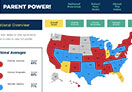
    • When it comes to giving parents fundamental power over their child’s education, most states fall below average according to CER’s Parent Power Index (PPI). Just 6 states earn scores above 80 percent, with the median PPI score coming in at 67.4 percent (Delaware).