







By Arianna Prothero
Education Week
February 6, 2015
North Carolina’s first online charter schools have gotten the final go-ahead to open.
The board of education’s approval of the two virtual schools this week was pretty much preordained: There were only two applications for schools and the board was required by the state legislature to approve two virtual charter schools as part a four-year pilot program, according to the Raleigh-based News Observer.
“While it’s true that North Carolina already has a digital option with the North Carolina Virtual Public School (NCVPS), these new virtual charter schools will expand access to digital learning opportunities, allowing students who aren’t qualified to take classes at NCVPS an alternative,” said Kara Kerwin, president of the Washington-based Center for Education Reform in a statement. “There are over four million students nationwide currently taking advantage of virtual learning opportunities.”


Future of Education in America Depends On Acceleration of School Choice
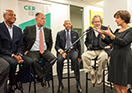
During a discussion at the Brookings Institution on the future of school choice and No Child Left Behind reauthorization efforts, Senate HELP Committee Chairman Lamar Alexander had an interesting exchange with Claudio Sanchez of National Public Radio (NPR).
Sanchez asked Alexander since the Supreme Court has ruled school vouchers to be constitutional, (see: Zelman v. Simmons-Harris), then why hasn’t the creation of voucher programs accelerated at a faster pace?
Alexander responded that the school choice movement, “hasn’t had enough Polly Williamses” to truly move vouchers forward in an accelerated fashion.
To give a little background, the late Polly Williams was a state Democratic lawmaker from Wisconsin who worked tirelessly with the Governor at that time, Republican Tommy Thompson, to install the first modern-day voucher program for low-income students in Milwaukee.
Williams and the school choice advocates of that era ignited a spark that would lead to the creation of voucher programs in 14 states and the District of Columbia, serving over 100,000 students and counting.
This is definitely progress, but as the premise of Sanchez’s initial question suggests, the school choice movement hasn’t gone fast enough.
New research from Dr. Matthew Ladner shows an 8.4 million projected increase in the number of school-aged children between 2010 and 2030. And many of these state level education systems are simply not equipped to handle this influx.
This trend, combined with a growing number of Baby Boomers entering retirement, will make the current levels of K-12 spending completely unsustainable.
Ladner recommends a multitude of school choice avenues as opposed to any one particular policy in order to adapt to the growing student population. Increased parental choice and operational autonomy in education will yield more cost-effective solutions, in addition to a greater return on investment.
The clock is ticking. The time to accelerate is now.