






Sign up for our newsletter

L.A. teachers launch union drive at Alliance charter schools

By Zahira Torres
LA Times
March 13, 2015

Teachers at the largest charter school organization in Los Angeles have launched a drive to unionize, a move that could alter the path of school reform in the city.

Charter schools, which are independently managed and publicly funded, have grown rapidly in Los Angeles, drawing students and funding from the school district. For the most part, their teachers are not unionized. That traditionally has put charters at odds with the teachers union.

Increasingly, charter organizations and the union are seen as political adversaries in charting the future of public schools.

A successful push by educators at the Alliance College-Ready Public Schools would hand an important victory to United Teachers Los Angeles as it struggles to reverse years of declining membership. The move could also pose a challenge to charters, which have been able to hire and fire staff without union rules — a key factor they believe helps provide the best instruction for students.

Nearly 70 teachers and counselors sent a letter Friday to the high-performing charter group, explaining their intention to partner with the teachers union. The letter asked for “a fair and neutral process” that would allow educators to organize without fear of retaliation.

“We believe that when teachers have a respected voice in policymaking it leads to school sustainability and teacher retention,” said Elana Goldbaum, who teaches history at Gertz-Ressler High School, a member of the Alliance group. “We have a lot of talent and we want to see that stay. We want to see our teachers be a part of the decision-making and we want to advocate for our students and ourselves.”

Unionizing would require majority support from the 500-plus teachers and counselors at the Alliance schools. The educators who sent the letter Friday also launched a website and asked colleagues to join them.

In a statement, leaders of the 11,000-student charter group said that they would not stop the teachers from pursuing union affiliation.

“We acknowledge the rights of our teachers to undertake this effort. We also recognize that our teachers are under no obligation to participate,” said the statement from President and Chief Executive Judy Burton and incoming President and Chief Executive Dan Katzir.

Aside from calling for a greater voice in decisions that affect teaching, the instructors said their main priorities include teacher retention, small class sizes, due process rights, budget transparency and fair evaluations and compensation.

A group of Alliance teachers interviewed at UTLA headquarters Friday evening said that instructors should feel free to make proposals they believe would aid students without worrying about job security.

“I may have an idea to improve instruction for my students but there is this general sense of ‘I don’t know whether I should say it or how it will be received,'” said Oliver Aguirre, who teaches at Alliance Susan & Eric Smidt Technology High School.

Another instructor, Sam Taylor Jr., who teaches at Alliance College-Ready Middle Academy 7, said that job security would help retain teachers.

“I want teachers to see this as a career, not a steppingstone,” Taylor said.

Goldbaum said she hopes Alliance leaders will “see the benefit in working together, and I think they will.”

Only 7% of charter schools were unionized nationally as of 2012, according to the Center for Education Reform, a Washington, D.C.-based organization that supports charters.

Although some California charter schools have formed unions, most resist collective bargaining. The conflict between unions and charters also is playing out in the elections for seats on the Los Angeles Board of Education.

California Charter Schools Assn. Advocates, a political action committee, is trying to unseat incumbent Bennett Kayser, the union’s biggest ally on the seven-member board. In another race, UTLA is seeking to oust incumbent Tamar Galatzan, a strong supporter of charter schools. Both incumbents face runoff elections in May.

United Teachers Los Angeles President Alex Caputo-Pearl said it was no secret that the union wants to help organize charter school teachers.

About 1,000 of UTLA’s more than 31,000 members work in charter schools, Caputo Pearl said.

Charters have been increasing in Los Angeles at a rapid pace. Currently, more than 100,000 students, or 15% of L.A. Unified School District enrollment, attend charters, the most of any school system in the nation.

The group of Alliance educators “have enough of a critical mass now, across enough schools, among enough influential teacher leaders,” Caputo-Pearl said. “The next step in the process is to be able to speak about this openly and decide where the larger group of teachers wants to go around this question.”

Alliance has 26 middle and high school campuses, located in mostly minority neighborhoods with traditionally lower performing schools. Alliance has received large donations from some of the biggest philanthropists in the city, including more than $6 million from Eli Broad in 2007 to help expand the group. Former Mayor Richard Riordan is among the city leaders who sit on Alliance’s board of directors.

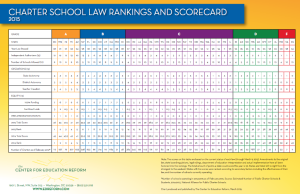
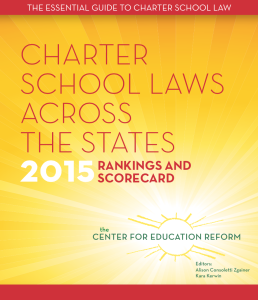
Charter School Laws Across the States 2015 Rankings & Scorecard

In this 16th edition of Charter School Laws Across the States: Rankings and Scorecard it is abundantly clear that little to no progress has been made over the past year.

Charter school growth does continue at a steady, nearly linear pace nationally, especially in states with charter laws graded “A” or “B,” but an even more accelerated pace would allow charter schools to play a more central role in addressing the demands and needs of our nation’s students.

The complete state-by-state analysis, Charter School Laws Across the States 2015 Rankings & Scorecard can be found here.

Charter Laws 2015 report cover

Click here to see the Rankings & Scorecard chart for a side-by-side comparison of charter school laws across America.

2015 Charter Laws Scorecard

Press release.

States Show Little Progress On Annual Education Scorecard

Nineteen Years Of Charter School Policy Analysis Reveal Lawmakers Must Strengthen State Laws

CER Press Release
Washington, DC
March 16, 2015

Of the 42 states and the District of Columbia that have charter school laws, only one-third earned above-average scores for implementing a strong policy environment according to the 16th Edition of Charter School Laws Across the States 2015: Rankings and Scorecard released today by The Center for Education Reform (CER).

“It is abundantly clear that little to no progress has been made over the past year. Charter school growth does continue at a steady, nearly linear pace nationally, especially in states with charter laws graded ‘A’ or ‘B,’ but an even more accelerated pace would allow charter schools to play a more central role in addressing the demands and needs of our nation’s students,” said Kara Kerwin, president of CER.

“Strong charter laws feature independent, multiple authorizers, few limits on expansion, equitable funding, and high levels of school autonomy,” said Alison Consoletti Zgainer, CER Executive Vice President and the report’s lead editor. “Many states that appear to have all of the critical components of a strong law struggle with the implementation of key provisions, which is why the rankings over the past few years have shown little variance and have remained relatively stagnant.”

Only four states and D.C. earned As, with D.C. holding on to the number one seat for seven years in a row. Eight states earned Bs, 19 Cs, and 11 earned Ds or Fs. Thirteen states saw changes to their ranking since last year, but any changes to laws within the past year have been modest at best as this ranking and scorecard demonstrates.

“The lack of progress made in statehouses across the country over the past few years to improve the policy environment for charter schools can be chalked up to a lack of political will leading up to a major mid-term election” said Kerwin. “However, the biggest culprit is a lack of information, and a growing body of misinformation, as to what constitutes strong, responsible charter school policy.”

Since 1996, CER has studied and evaluated charter school laws based on their construction and implementation, and whether or not they yield the intended result of the charter school policy, which is to ensure the creation of numerous quality learning opportunities for children.

Click here for the 16th edition of Charter School Laws Across the States: Rankings & Scorecard

2015 Charter Laws ScorecardCharter Laws 2015 report cover

NEWSWIRE: March 10, 2015

Vol. 17, No. 10

A GEM OF AN IDEA. An exciting initiative is underway in Idaho, as the J.A. and Kathryn Albertson Foundation announced the launch of a new charter school network aimed at growing the blended learning model. Gem Innovative Schools will oversee three blended learning charter campuses and one fully online school. The three blended campuses, which will be located in Pocatello, the Treasure Valley, and Coeur d’Alene, aim to serve as many as 2,500 K-12 students by 2022. In addition to hiring the best teachers, Gem Innovative Schools will emphasize individualized instruction, allowing students to learn at their own pace, and manage school finances and resource allocation so funds are effectively being used to help student achievement. With over four million kids engaged in some form of online learning, the 19th ranked Parent Power state is ensuring its students have a portfolio of options to choose from when it comes to their learning needs.

FIXING FACILITIES. The Academy for Integrated Arts charter school in Kansas City, MO operates out of a converted warehouse, despite the fact that empty school buildings across the city stand ready and waiting to be revitalized. Missouri lawmakers have proposed legislation that would allow charters to make fair-priced offers on vacant schools, and give charters greater access to these unsold empty buildings at lower rates. It’s a start, but there’s a lot more that could be done. Currently, Missouri’s charter law does not provide facility funding for charter schools, a tremendous obstacle when getting a school off the ground and actually a key reason why charters end up closing, according to CER data. All public students, both charter and traditional, deserve equitable learning spaces to receive the education that’s right for them.

THE VERGARA EFFECT. The Vergara ruling heard round the world last June exemplified the fact that 86 percent of Americans favor accountability in education, and California lawmakers are taking cue by introducing a series of teacher quality reforms. On the table are proposals for annual evaluations for both tenured and non-tenured teachers, and for increasing the time it takes to earn tenure from two to three years. A separate piece of legislation would remove the ‘last-in-first-out’ policy that prioritizes seniority over performance when laying off teachers. Whether these proposals have a chance of passage is another story, but the fact that they’re receiving attention is a true testament to Vergara’s impact, and those nine courageous student plaintiffs who stood up for their constitutional rights.

DIGITAL MOMENTUM. Fifteen years into the 21st century, digital learning is an integral part of the effort to increase choice and accountability in education. Two policy areas worth watching in 2015 are competency-based learning and course access programs. Competency-based learning allows students to go at their own pace and is a big reason why many parents choose virtual education. Course access programs, which currently exist in seven states and counting, allow students to virtually enroll in individual courses that aren’t offered at their school or don’t fit with their schedule. CER polling reveals that over 60 percent of Americans favorably view the terms “digital learning” and “blended learning,” but are more divided on whether they’d send their child to a blended learning school. It’s up to reformers to combat the myths about digital learning, and increase public acceptance of opportunities that are revolutionizing the way students master course content. Don’t miss out on the opportunity to share information and facts on social media this Friday, March 13, to celebrate Digital Learning Day!

NJ BLENDED CONFERENCE. CER President Kara Kerwin will be at the Liberty Science Center in Jersey City, NJ tomorrow, Wednesday, March 11, to provide a national perspective on the state of blended learning and virtual schools. Click here for more information and how to register.

MARCH MADNESS… edreform style! Which state will come out on top in this year’s charter school law rankings? Stay tuned for CER’s 16th edition of Charter School Laws Across the States: Rankings & Scorecard out soon!

America’s Attitudes Towards Digital and Blended Learning

Digital Learning Day is March 13, 2015!

According to CER’s 2014 America’s Attitudes Towards Education Reform, Americans are split on a blended learning environment, described as an environment where a portion of learning is done using digital technologies, and the rest through face-to-face instruction. In fact, 42% said they’d be more likely and 42% said they’d be less likely to send their children to a school that uses it.

Still, both terms, “blended learning” and “digital learning,” are viewed positively by over 60% of adults.

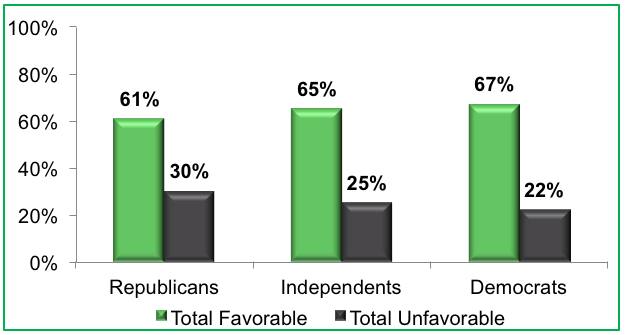
“Digital learning” receives high favorability from nearly all demographics, including 67% of Democrats, the highest favorability of all political parties. Majorities of Republicans and Independents are also favorable toward “digital learning,” with 61% and 65% voicing their favorable opinion respectively. Although Democrats are most favorable overall, Independents showed the most intensity toward “digital learning” as 38% are “very favorable,” 6% more than the average respondent. With the strength of this term among “blue” respondents, this may be a key term to use when messaging to Democrats and trying to bring them into the fold of educational reform.

Screen shot 2015-03-10 at 10.59.35 AM

Those stating that they receive their news from social media sources are 21% more likely than the average respondent (85%-64%) to be favorable toward “digital learning.” This may be because those receiving news from social media and online sources are very comfortable with this medium and can understand its application for education.

Those favorable toward charter schools are also more favorable toward “digital learning” as well, as 70% of those favoring charters also showed favorability toward “digital learning.”

Contrary to other terms tested, there was little difference between those who believe that schools can and cannot fire bad teachers. Both groups are favorable toward “digital learning” at 67% and 64%.

Blended Learning a Popular Approach. In general, men and women supported “blended learning” by 63% and 60% respectively, while dads and moms are favorable toward the term at 58% and 56% respectively.

Those without kids are also more favorable toward “blended learning” by 63% to 56%.

Similarly to that of “digital learning,” Democrats are also the most favorable political party toward “blended learning” as well. Republicans are favorable with 63% and Independents with 52%, but Democrats are favorable at 65%.

Contrary to what one might expect, those saying that their student’s current school works well for them are 13% more likely to have a favorable opinion of “blended learning” (64%-51%).

Those favoring and supporting charter schools are also favorable toward “blended learning” as 64% of those that support charter schools, and 65% of those that are favorable toward charter schools are also favorable toward “blended learning.” 

Geography and Generations. Digital learning can be a powerful tool that can break geographical boundaries. When it comes to rural versus urban support for digital and blended learning, 34 percent of Americans living in urban areas have considered online schooling, and 21 percent of Americans in rural areas have considered online schooling.

There is no generational gap in support for blended learning, as 43% of those over the age of 55 say they’d be more likely to send their child to a school with blended learning, compared to 44% of those under the age of 35.


Learn more about Digital and Blended Learning in the U.S. Check out The Digital Learning Toolkit: The Facts About Digital and Blended Learning.

2015 Charter School Law Rankings & Scorecard

It’s March Madness — edreform style!

Which state will come out on top in this year’s charter school law rankings?

Stay tuned for CER’s 16th edition of Charter School Laws Across the States: Rankings & Scorecard out soon!


FINAL large bracket 2015 charter laws

Click here for the 15th edition of Charter School Laws Across the States: Ranking & Scorecard

Birth of a charter school and Jeb Bush’s vision for education

By Kathleen McGrory
Miami Herald
March 7, 2015

After a bruising defeat in the 1994 gubernatorial race, Jeb Bush approached a well-known civil rights leader in Miami with an ambitious plan.

He wanted to open an experimental “charter” school in Liberty City, one of the nation’s poorest communities. And he wanted T. Willard Fair to help.

Fair, the president of the Miami Urban League, was skeptical. Some members of his inner circle suggested Bush was using him for political gain.

The two men met in Miami. Fair assumed it would be nothing more than a photo-op. But it ended up being a 90-minute discussion on the state of Florida’s schools.

“Jeb was genuine,” Fair recalled. “You can’t fool me. I’m going to test you too many times.”

Two years later, in the summer of 1996, a group of 60 students, donning crisp red uniforms, entered the new Liberty City Charter School. It was the state’s first charter school, and it paved the way for hundreds of others.

There’s no doubt that the experience in building the charter school helped Bush politically, softening his image in advance of his successful 1998 gubernatorial race. But it also sparked a deep interest in education policy that would define his legacy, both as Florida’s governor and later as a leader in the national education reform movement.

“It opened his eyes to aspects of urban issues that he hadn’t thought about before,” said Matthew Corrigan, a University of North Florida political science professor and author of Conservative Hurricane: How Jeb Bush Remade Florida.

As Bush defines himself as a potential 2016 presidential candidate, the story of the Liberty City Charter School is certain to draw attention. It’s a double-edged sword for Bush. Supporters can point to the school’s academic success in boasting Bush’s leadership in education. At the same time, opponents can point to the financial troubles that led to its closing in 2008 as evidence of Bush’s failed education agenda.

Learning laboratory

Bush, who declined to be interviewed for this story, wasn’t focused on education when he first ran for governor in 1994.

His crime-and-punishment platform had resonated with voters — so much so he led in the polls for much of the campaign. But Democratic incumbent Lawton Chiles had surged in the end, securing the seat for a second four-year term.

Only 64,000 votes separated the winner from the loser. It was Florida’s closest gubernatorial race to date.

As the year came to a close, he and former campaign manager Sally Bradshaw — then Sally Harrell — began drafting plans for a privately funded conservative research institute in Coral Gables. They called it the Foundation for Florida’s Future.

Early on, the foundation devoted much of its resources to a new concept in education: charter schools. The privately managed, publicly funded schools had been sprouting up in other states but were not allowed under Florida law. Supporters said the schools would promote innovative teaching and learning practices, and empower parents to play a larger role in their child’s education.

“Nobody really knew about them,” recalled Jon Hage, then a policy analyst for the Foundation for Florida’s Future. “[Bush] said ‘Jon, I want to know everything there is to know about charter schools.’”

Bush later took the idea to Fair.

He already had some details in mind. The curriculum would focus on reading and mathematics, but it would also help children build character. The classes would be small, and parents would sign contracts promising to be involved.

“He said, ‘I need a laboratory to demonstrate that parents do care and that black kids can learn, even though they may come from poverty,’” Fair said.

The political and racial undertones were hard to ignore. One of Bush’s most memorable gaffes in the 1994 campaign had come during a debate when both he and Chiles were asked what they would do for black voters.

“We have elected people year after year that say, ‘I’m going to do this for you,’” Bush replied. “Now it’s time to strive for a society where there is equality of opportunity, not equality of results … . So I’m going to answer your question by saying, ‘Probably nothing.’ I think what we ought to do is to have a society where you go out and pursue your dreams and you’re not punished.”

The words “probably nothing” echoed across the state.

Working with Fair gave Bush credibility in Miami’s urban core. Still, carrying out their plan would not be easy.

Lobbying Legislature

It took two years to convince the Florida Legislature to allow charter schools.

There were obstacles. Some Democrats expressed concerns that the new schools would benefit only affluent, white students, and vowed to fight the proposed legislation.

The teachers union also had reservations.

“We didn’t want to discourage people from having options, but we could see the writing on the wall,” said Maureen Dinnen, then vice president of the Florida Teaching Profession-National Education Association. “We knew there would not be as much accountability, and [charter schools] would draw off money.”

When Chiles signed the charter school legislation in May 1996, Bush and Fair raced to open their school in time for the new academic year. They secured an empty eight-room schoolhouse at Northwest 87th Street and Fifth Avenue — technically in Miami’s El Portal neighborhood — and enlisted parents and community leaders to help paint and prepare the building.

There were other tasks to be completed: hiring teachers, recruiting students, building a curriculum and purchasing supplies.

“He was intent on getting that school opened,” said Cory Tilley, a former Bush spokesman and executive director of the Foundation for Florida’s Future. “He saw an opportunity. There was a lot of momentum, and he didn’t want to let that momentum go.”

The school opened its doors on Aug. 26, 1996, and immediately garnered statewide media attention.

Bush was a frequent visitor that year, both with and without reporters, principal and CEO Katrina Wilson-Davis recalled.

“Sometimes, I didn’t know he was even there,” she said.

When Bush became a gubernatorial candidate in 1997, it was a Liberty City Charter School parent who opened his campaign account in Tallahassee.

The school’s founding became an oft-told story on the campaign trail. Bush mentioned it in stump speeches and at community meetings. He also began visiting other schools across the state.

That November, Bush won election by a comfortable margin. He fared better among black voters than in his previous race.

The new governor had to scale back his involvement with the Liberty City Charter School to avoid having a conflict of interest. But education policy turned into his top issue.

One of his first initiatives was a sweeping education proposal called the A-Plus Plan for Education. It called for students in grades 3 through 10 to take standardized tests, and for schools to receive letter grades based on the results. High-performing schools would receive cash incentives. Poor-performing schools would face consequences, and their students could receive vouchers to attend private schools.

Bush also continued to champion school choice. He promoted legislation to expand charter schools and voucher programs for students with special needs.

“He turned the whole education environment upside down.” said former state Rep. Ralph Arza, a Miami Republican who worked with Bush on many of his education initiatives.

Bush’s influence over education policy extended beyond his time in governor’s mansion.

After leaving office in 2007, Bush continued to drive the state’s education agenda through his Foundation for Florida’s Future. He also created the Foundation for Excellence in Education to help other states adopt Florida-style education policies. The national foundation has done work in at least 45 states and holds an annual summit on education reform.

Mixed success

The Liberty City Charter School, however, had an uneven trajectory.

In its first year, the school was recognized for posting stronger reading, writing and math scores than other schools in Miami-Dade County with similar demographics. But it received a D when school grades were released for the first time in 1999.

“We were under a lot of pressure,” Wilson-Davis said. “We didn’t have a lot of money. We didn’t have a lot of braintrust. Everything we were learning we were learning in real time.”

School leaders pushed ahead, addressing students’ individual deficiencies and engaging parents.

“It was a family,” Fair said. “Our parents went on all of our field trips. Our parents were on cafeteria duty. Our parents were intimately involved in the process. That’s the stuff that drives a school’s success.”

Test scores gradually improved. And in 2006, the Liberty City Charter School received an A from the state.

The celebration was short lived.

School leaders had lost a legal battle with the landlord over a damaged roof and owed $500,000 in legal fees. They plunged even deeper into debt by purchasing a new piece of property in Liberty City.

The school’s finances led to its 2008 closure by the Miami-Dade School Board.

Bush had left office by then and was out of touch with school officials.

“I am not aware of what this is about,” he wrote in an email to the Miami Herald when asked about the school’s closure in 2008. “I do know that the school was an A school, which warmed my heart.”

Despite its closure, the Liberty City Charter School changed the state’s education landscape.

Florida is now home to more than 615 charter schools, which collectively enroll 229,000 students, or nearly one-tenth of the overall student population, according to the state Department of Education.

The state’s charter school movement has been heralded as a national model for increasing parental choice and improving access to education.

In a recent analysis, the pro-charter-school Center for Education Reform wrote that “through a series of education reforms that return power to parents, including charter schools, Florida’s Hispanic students now outscore the assessment averages for all races in 28 states and black students outscore the average in eight states.”

But Florida’s charter school movement has also been the subject of sharp criticism from parent and teacher groups, who point out that more than 275 charter schools have closed in Florida due to financial or academic problems.

The business of charter schools has also been controversial.

A 2011 Miami Herald investigation found that charter schools in Florida had grown into a $400-million-a-year business rife with insider deals and conflicts of interest. The Herald also found that school districts could do little to demand compliance from charter schools caught violating the law.

“There are some very high-performing charter schools that do serve the needs of students,” said Florida education historian Sherman Dorn. “The problem is that nobody makes arm’s-length transactions.”

Bush’s involvement with charter schools could help him in a Republican primary, said Michael Petrilli, president of the right-leaning Thomas B. Fordham Institute.

“He was more successful at expanding school choice than any other governor, and he did it first,” he said.

But Petrilli conceded that Florida’s charter school industry could also be a liability for Bush in the general election. “It is known as a fairly low-quality sector,” he said.

New beginning

In his first major speech as a possible presidential candidate, Bush began to tell the story of the Liberty City Charter School.

“In my city, the schools were failing, opportunity was scarce and for too many, simply being born in the wrong neighborhood meant the American Dream was cruelly out of reach,” he told the Detroit Economic Club last month. “I joined with my friend, T. Willard Fair, a courageous leader in the civil rights movement. We decided that the right to rise, was also a civil right. So we went to work to change education in Florida.”

One week later, Fair introduced Bush at an education summit at Florida State University.

The renewed attention on the Liberty City Charter School has brought some renewed criticism.

Alicia Banuchi, who served as the administrative assistant to the principal from 1997 to 1999, wrote a letter to the Miami Herald saying Bush used the school and community to further his own ambitions.

“Immediately after he won the race for governor by winning the black vote, he abandoned the school and the poor children and families with whom he had developed a personal relationship,” Banuchi wrote.

“They were not doing the right thing by the children,” she later told a reporter.

But principal Wilson-Davis said she never doubted Bush’s commitment to the school and the community. It was the little things, like the way he picked trash off the floors.

“You can’t fake that,” she said.

As Bush prepares for a possible new beginning, so too may Liberty City.

In October, the Miami-Dade School Board approved an application for a new charter school in Liberty City to be called the We Rise Academy.

Read more here: http://www.miamiherald.com/news/local/education/article12923990.html#storylink=cpy

Madison Ott: School choice lets students find best fit

By Madison Ott
Knoxville News Sentinel
March 7, 2015

Every child has dreams. As for me, I dream about becoming an interior designer or photographer. My friends joke that neither of these careers will make me rich, but in my dreams, doing what I love is far more important than making money.

But to achieve these dreams, I know I need a good education. Being able to attend college and go into a satisfying career would open a world of doors for me.

Unfortunately, the high school I am zoned to attend is not the best fit for me, but that is about to change. I just received an opportunity scholarship from the Beacon Center of Tennessee to attend a private school. I will be starting high school next fall, and I am applying to attend King’s Academy in Seymour.

I attended King’s Academy for two years in sixth and seventh grade, where I earned straight A’s and really loved my classes. I also enjoyed the learning environment and my fellow students, who seemed to be there for all the right reasons. My teachers also went out of their way to help each individual student succeed. This really hit home for me because I needed help in certain areas more than others, and my teachers would take the time to help me improve in those areas where I was weakest.

Unfortunately, I had to transfer out of King’s Academy because my parents couldn’t afford the tuition anymore. Without this scholarship, I would be forced to attend my zoned public school, where I would be unable to take classes I think would give me the best opportunities to succeed.

At King’s Academy, I feel that my fellow students will be there for the same reasons I am, to be willing to work hard for a good education so that they have a shot at making it in the real world. And this wouldn’t be possible without the opportunity of school choice.

While my choice is made possible by one scholarship provided by the Beacon Center of Tennessee, not all kids have that choice. In Nashville, state legislators are debating a program that would give scholarships like mine to thousands of Tennessee kids who can’t afford to choose to attend the school that’s the best fit for them.

School choice works like this. We spend a certain amount on each child’s education. With school choice, we would use some of that money to send a child to a different school if their parents decide the one they’re in isn’t working for them. The rest of the money would stay with the kids still attending that public school. We are already spending this money to educate each child. It makes sense that the money would follow the child rather than just fund the school system.

Like me, many students across Tennessee struggle at their current school, and they simply need an opportunity to choose a better place to learn. The Beacon Center’s scholarship is my family’s only shot to send me to the school of our choice.

With school choice, I know I can finally have the opportunity to reach for my dreams. I hope our state gives other kids like me the same opportunity to succeed.

Madison Ott is an eighth-grader in Knoxville. This fall, she will be attending King’s Academy on scholarship.

Investing in New York’s Education System

Thousands of New Yorkers are calling on Governor Cuomo and legislators to pass the Education Tax Credit as part of his budget proposal. Education tax credits would help children access learning opportunities that better meet their individual unique learning needs.

Already, over 1,500 rallied last week in Staten Island #ForOpportunity. The rallies will continue tomorrow into Queens, to the Bronx, onward to Brooklyn, and with the last stop in Long Island!

Take action below by joining the upcoming Thunderclaps using the links below. You can join with your Facebook and/or your twitter account. And remember to share the links with your friends so they too can support opportunity for students in the Empire State, which currently ranks #18 in the nation when it comes to affording parents power in education.

Teachers Support Choice, Autonomy

Teachers support school choice and want autonomy and the freedom to choose, according to a February 2015 member survey from the Association of American Educators (AAE).

Sixty-eight percent of teachers support blended learning in schools. An even higher 94 percent support course choice, which allows students to enroll in individual courses that may not be offered in their traditional school environment. Course choice currently exists in seven states.

In addition to course choice, 56 percent of survey respondents support Education Savings Accounts (ESAs) for students with special needs. An overwhelming amount of teachers (97 percent) support charter schools as not only as an option for students, but for educators as well.

When it comes to evaluating teacher performance, 80 percent of educators surveyed support student achievement growth as a top component in teacher evaluations. And in terms of working conditions, 64 percent reported a preference to negotiate directly with school administrators in order to secure a salary and benefits package that best suits their lifestyle.

The survey findings reveal that teachers want to be honored as professionals in the workplace, which means being held accountable for student learning while having the freedom and autonomy necessary to enable students to succeed.


Related Links:

America’s Attitudes Towards Education Reform: Public Support For Accountability In Schools: https://staging.edreform.com/2013/12/americas-attitudes-towards-education-reform-public-support-for-accountability-in-schools/