






By Berkeley Brean
NBC 10 Rochester (WHEC.com)
May 20, 2015
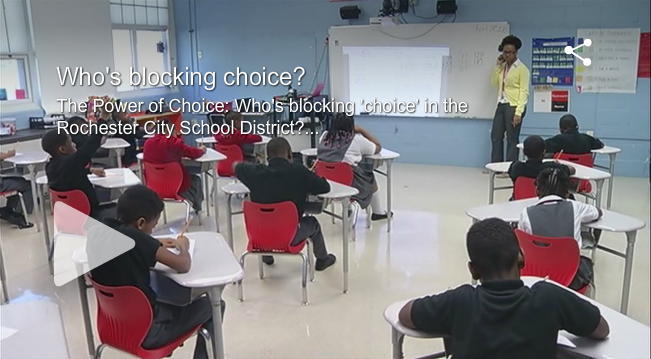
If a family in the city had the money to move to the suburbs for the good suburban schools that would be a choice. But what about the families in the city that don’t have the money to make that move? What choice do they have?
If they don’t win the charter school lottery, their children have to enroll in the worst ranked school district in the state. That’s why News10NBC traveled to Washington D.C. which is the capital of school choice.
We looked into who is blocking choice in Rochester. It’s the people who control the school system the way we know it now, according to the public school reformers we spoke with.
Jade Yates wants to make music and she wants that music to help people. Yates says, “I know a lot of people are going through a lot of things and depression and I think music really helps people.”
Jade is in the eleventh grade at Richard Wright Charter School in Washington D.C. It’s a charter focused on journalism and media arts. Going there was a choice her mother made.
Mother April Goggans says, “I think choice is just that. I think a lot of times parents feel shackled to their school in the neighborhood.”
Doctor Marco Clark is the founder and principal at Richard Wright. He makes a promise to every parent that their child will be accepted to a college.
“The question I ask is, ‘will the public schools do that?'” says Wright. “Do they make that type of promise? Are they bold, do they have the audacity to say things that charters and schools of choice actually have the opportunity to do? We stand by our product.”
Since school choice became the law in D.C., its overall graduation rate increased ten percent. Rochester City School District Board President Van White says, since he took office, the overall grad rate in Rochester has gone up the same.
“When I got sworn in at Number 50 School, where I attended when I was a kid, the four year graduate rate was 39 percent,” says White. “Now we’re not happy, but in August of last year the graduate rate was 48 percent. That’s almost ten percentage points.”
But in terms of choice, 45 percent of all children in D.C. go to charter schools. Only 14 percent of Rochester city children attend charters — that’s 4,200 out of 28,000.
Kara Kerwin of the Center for Education Reform: “Folks in Western New York and the rest of the state really need these options and we need emphasis on how we can scale up school choice in those areas.”
Berkeley Brean: “And who is stopping that?”
Kerwin: “The teachers unions. The status quo. The people who are afraid of change.”
Brean: “So what should parents be demanding then? Should they be getting on the phone and calling their New York State United Teachers’ office and Rochester Teachers Association office?
Kerwin: “They won’t listen to them. What needs to happen is legislative change, so that it takes away the power from those special interest groups and puts the power back in the hands of parents.”
Thursday night, in our exclusive report, we’re going to take that comment to Rochester Teachers’ Union President Adam Urbanski and he’s going to tell you something they he thinks will surprise you.
If you feel strongly about this, what can you do? We think you go straight to the top. You tell the governor he needs to do something. Now, that can be intimidating, so we made it easy. The phone number is 518-474-8390 or you can email him here. We composed a sample email that you can use as a starting point. You can click here for a form letter.
This piece is part of an in-depth, multi-part series called The Power of Choice. Watch the full special here.
Why D.C. Parents NEED School Vouchers
In 4th Grade, Shirley-Ann Tomdio’s life changed forever when she was accepted into the D.C. Opportunity Scholarship Program (DCOSP), which allowed her to transfer from a failing D.C. public school to Sacred Heart, a private Catholic school. Shirley, the daughter of two Cameroon, African immigrants, used the voucher for nine years.
Shirley testified to the House Oversight and Government Reform Committee on May 14, 2015 at Archbishop Carroll High School in Northeast D.C. to discuss the possibility of reauthorizing the DCOSP.
“In 2009, I graduated Sacred Heart School as the valedictorian and took my Opportunity Scholarship across town to Georgetown Visitation (Prep School)!” Shirley told federal lawmakers on Thursday. “At Visitation, I made Second Honors my first two years and First Honors in my third and fourth year. I was a decorated member of the track and field team, co-editor of our school’s Art and Literary magazine, a cheerleader for our school’s pep rally, and the Secretary and Treasurer of the Black Women’s Society. In May 2013, I walked across the stage and accepted my diploma.”
The voucher program for low-income children was enacted a year after congress passed the D.C. School Choice Incentive Act of 2003. The program has been extraordinarily successful for the District’s most disadvantaged children. Consider:
The scholarship program has been under assault since President Obama took office. The program ceased to exist in the first year he took office, but came back in 2011 through passage of the bipartisan SOAR Act. Every single year since then, his Administration has proposed to eliminate program entirely by excluding it from the budget.
Each year, supporters of the scholarship work extremely hard to get congress to reauthorize the program. The critics, led by the president and Congresswoman Eleanor Holmes Norton, fight tooth-and-nail on behalf of failing schools and the unions, by rehashing old arguments and using outdated numbers. Thankfully, the bipartisan coalition led by school choice champions like Sen. Diane Feinstein (D-CA), Sen. Tim Scott (R-SC), and Rep. Luke Messer (R-IN) on Capitol Hill continue to remain strong and committed to ensuring parent choice prevails.