










Sign up for our newsletter

Intersection of Politics and Education

As I prepare to enter into my fourth and final year at Wake Forest University I can’t help but reflect on the opportunities I have been awarded due to my education, which makes me think about what other individuals miss out on due to a lack of access to education. This inequity of access to education continues to propel the achievement and opportunity gaps persistent in many communities throughout the nation, not just in my home state of North Carolina.

This obvious inequity made apparent the need to use policy and politics to better the state of education, not just teacher practices confined to the classroom. Through my time spent in the education department at Wake Forest I have learned ways to work to diminish the achievement and opportunity gaps through teacher practices in the classroom. Although there is a discussion of these persistent problems, there is little discussion of the policies that work to diminish these discrepancies outside of the classroom. I do not discuss this missing component to condemn the education department at Wake Forest, but rather as a springboard to discuss my motivation to spend my summer with CER.

This missing component of my education is the reason why I am spending my summer interning at CER. I hope to gain an understanding of what policies are being enacted at the federal, state, and local levels to make access to quality education available to all, not just those with a coveted address. As well, I hope to learn more about reform initiatives implemented in several schools to see what works and what does not work and hope to continue these initiatives in my future as an educator.

Elizabeth Kennard, CER Intern

What Lies Ahead

Walking into the building this morning, I had no idea what to expect. I had applied for the internship, done my research, had my interview, asked all my questions and yet I had no idea what lay before me.

My passion for education started when I was three years old and I would force my parents to play school for hours on end. As I grew up, my interest and passion for education grew just as fast as I did. I took every opportunity to be in the classroom or tutor someone outside the classroom. I was lucky enough to experience a charter education, public education, and private education during my childhood, which has allowed me to learn and experience different methods of education and teaching. As I learned more about the education system the more I realized there needed to be a shift and reform in the current education system. When I started college in my Introduction to Education class I read A Nation at Risk and everything suddenly made sense to me. If I wanted to fulfill my dreams and make an impact on education, I needed to get involved with the policies that make up education.

Looking around the conference room on my first day at The Center for Education Reform I can see that I am in the perfect place to learn and gain the wisdom I need to make my dreams come true. I am excited and anxious to get started on the many different projects and attend the events CER has presented to us interns. I still may not know exactly what lies before me or what I am about to learn, but to be able to have this experience and to see the possibilities that I have before me is an exciting prospect to have.

Emily Kelleher, CER Intern

My First Day at CER

Today marks the beginning of my involvement in the education reform movement, and I couldn’t be more excited.

I am a rising junior at Bowdoin College in Brunswick, Maine majoring in Sociology and am from Wilton, Connecticut. I became interested in education during high school, when I witnessed the stark contrast between the public education system in my hometown and that of the neighboring city of Bridgeport. I was appalled at their acute differences and simultaneously disheartened that the children in Bridgeport did not have access to the same educational opportunities as others and myself. I also became acquainted with the weaknesses in my own school district while working at a local after school program. These inequities led me to seek out further improvement in Bridgeport and Wilton’s education programs.

While at Bowdoin College, I have continued these pursuits by tutoring children in Brunswick as well as working for Bowdoin’s Upward Bound program, which is an organization that encourages students in low-income areas to pursue a college education.

My experience in education has primarily been hands-on. Although immersing myself in schools of various financial circumstances has been beneficial, I recognize that educational policy is integral to the education reform movement. That being said, for my summer internship, I sought out an organization that is committed to implementing and improving educational policy. This drew me to CER.

I am only a few hours into my internship at CER and have already been introduced to numerous projects that the organization is currently spearheading. I am both impressed and amazed at all that I will be able to learn in the next seven weeks as well as all of the events and opportunities that are at my disposal because of this internship.

There is a palpable energy in this office, and it stems from the common desire to prompt change in the American education system. I initially did not know what to expect from this internship, but I now cannot wait for what lies ahead. I am delighted and honored to be a part of CER’s team.

Hayley Nicholas, CER Intern

First Day Introduction

Today is my first day into my matriculation as a summer intern for The Center for Education Reform. The start of my day began with a brief staff meeting in which the interns and staff were introduced to each other. During the staff meeting the employees here at CER gave us a brief overview of CER and its many programs and upcoming events that we should look forward to. Following the staff meeting the interns participated in an intern orientation in which we learned the basics of what it takes to make the organization run successfully and its mission. Whether it’s from working with grassroots organizations, advocating different educational policies, or even talking to teachers and parents, every aspect makes CER what it is.

As a student at Clark Atlanta University majoring in Political Science much of my interest in the education reform movement stems from learning about the different policies that help create disparities in our education system. In addition to my studies, I have experienced both sides of the coin in dealing with the good and bad of the education system, so I have first-hand knowledge on some of the things that needs to happen in the education reform movement.

While interning at CER this summer I hope to learn more about what exactly makes the education reform movement successful. I want to learn all aspects besides that of my studies in public policies so I can see if this is a field/ career that I would like to explore in life.

Rahdaysha Cummings, CER Intern

The First Day

On my first day as an undergraduate at Syracuse University I was confident that I knew exactly what was to come on my path throughout the next four years. I would attend lectures, live in a dorm, make new friends and graduate as an English Education major ready to head a classroom in an inner city school district. While I have in fact attended lectures, lived in both a dorm and two apartments and made new friends who feel like old friends, the one thing that has changed is the “end goal.” Now, as an English Major with a double minor in both Education and Policy Studies I am more determined than ever to participate in the quest to change the face of education in the United States. After taking a course titled “The American School” I was exposed to a wide variety of issues that those in the field of education have faced and continue to face across the country. This course combined both sociology and education to explore these issues in a way that made them relevant to an audience composed largely of education majors who had limited experience in the field outside of their role as a student.

That being said, the topic that stood out most to me was that of charter schools in the United States. The topic was briefly touched on, almost as if it was a curse word in the education field and when students asked questions about charter schools my professor seemed unsure of his answers. I began researching charter schools almost immediately and stumbled upon The Center for Education Reform’s website. I read the articles on the website and decided to apply for the Summer 2015 internship in the hopes of better understanding the education reform movement as a whole and the role charter schools play in the movement itself. Six months later, here I am on day one. It is evident in the first few hours that the staff at CER is dedicated to the education reform movement in a way that involves the next generation. The goal is to involve a generation of people who want change but more often than not are too lazy to do the research – especially if the research is longer than 140 characters. I hope to help spread the message of CER to the next generation in a way that they can understand while also increasing my involvement in and knowledge of the education reform movement itself. Over the coming weeks I hope to fully immerse myself in the education reform movement in a way that provides me with the knowledge and resources to involve others who could be instrumental in developing the movement.

Ciara O’Sullivan, CER Intern

Newswire: June 2, 2015

Vol. 17, No. 22

UNIVERSAL CHOICE. Late last week, the Nevada legislature sent a universal education savings account (ESA) bill to Governor Brian Sandoval’s desk. The bill would put Nevada parents of children currently enrolled in public school in charge of either 90 or 100 percent of the statewide per-pupil expenditures for their children, depending on the family’s income and the students’ disability status. If the governor enacts it, SB 302 will make Nevada the fifth state to have an ESA law on the books, and the only one to have a universal school choice program which will serve almost half a million students. Certainly an increase in Parent Power for Silver State parents, who live in a state that scores just 69 percent on The Center for Education Reform’s (CER) Parent Power Index. Sadly, Governor Bullock, whose state, Montana, ranks last in Parent Power, recently vetoed a much narrower ESA bill aimed at special needs students and their siblings. Montana did however (without the governor’s signature) enact a new tax credit program. Get the scoop from CER President Kara Kerwin as she discusses the vetoed ESA program and Montana’s new tax credit program on the Heartland Institute’s podcast.

ON THE RISE. If any doubt remained about the need for more students having more access to seats of choice, numbers out from The National Center for Education Statistics reveal parents don’t just need options, but demand them. According to the report, the number of charter school students has increased by hundreds of thousands in just one year. Taking a closer look at the figures echoes what CER’s Survey of America’s Charter Schools already tells us: charter schools do in fact serve minority students, and do so at a greater proportion compared to traditional public schools. Despite the growth in charter school enrollment, the growth of the supply of available seats is linear, and does not meet parental demand. An even more accelerated pace of growth would allow charter schools to play a more central role in education reform over the next few years.

CHARTER BIAS. Palm Beach County School District in Florida is filing a motion to prevent a charter school from opening, even after the State Board of Education ruled it should be allowed to serve students. The district is claiming the school is not “innovative” enough, and has even gone so far as to make new school board policy that says they can deny charter schools that don’t prove to be “innovative” enough. A representative of the denied charter school says it best in the Sun-Sentinel, saying the district is doing everything it can to deny charter schools “because they recognize what we have known for a very long time – when given a choice, parents send their children to schools that best serve their needs.” Indeed, the innovation argument is just an excuse to maintain the status quo, which is why while Florida’s charter school law is a strong one, it could benefit from multiple authorizers since districts are inherently not the best charter school authorizers. This anti-charter sentiment must be stopped, because while charter schools are just one piece of the puzzle in improving education options for parents, they’re an extremely important one that is creating a ripple effect statewide.

TIME RUNNING OUT … to get your application in for a second, NEW EdReformU™ course, History of Charter Schools (HistoryCS-201). The first EdReformU™ course was so successful that we’re excited to be offering this second class that gives students direct access to the people and policies that started the charter school movement. Those who complete the eight-week, fully online and mobile-accessible course starting the week of June 15 will come away with an in-depth understanding of the genesis, politics, and community role of charter school laws. Send either a resume or CV with at least one reference, along with a brief summary of why you want to apply for the course to apply@staging.edreform.com by Sunday, June 7. Learn more at university.staging.edreform.com.

Heartland Daily Podcast – Kara Kerwin: School Choice in Montana and Beyond

by Heather Kays
June 1, 2015

In this edition of The Heartland Daily Podcast, Managing Editor of School Reform News Heather Kays speaks with Kara Kerwin, president of the Center for Education Reform, about Montana’s fight for school choice.

They discuss the reasons the school choice movement has been so slow to make progress in Montana, and how other states rank nationally when it comes to school choice and giving parents power over their children’s education.

Screen Shot 2015-06-08 at 3.49.16 PM

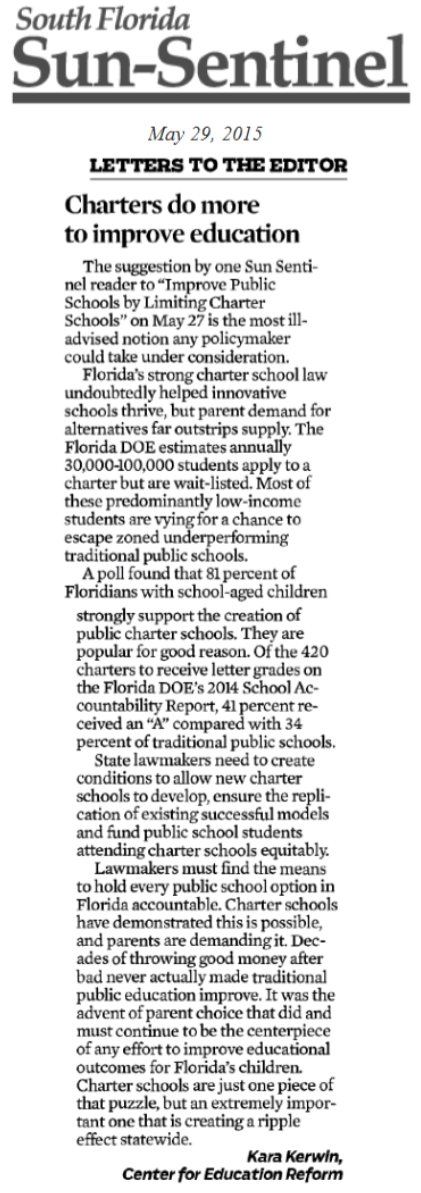
Charters do more to improve education

May 29, 2015
Letter to the Editor
by CER President Kara Kerwin
Sun-Sentinel

On May 29, 2015, the South Florida Sun-Sentinel newspaper printed “Charters do more to improve education,” a Letter to the Editor (LTE) written by CER President Kara Kerwin in response to an article that ran on May 27 in the paper called “Improve public schools by limiting charter schools.”

Click here or the PDF below to read the full LTE clipping.

Screen Shot 2015-06-01 at 2.19.08 PM

Newswire: May 27, 2015

Vol. 17, No. 21

#POWEROFCHOICE. Last week, News10NBC WHEC in Rochester, NY, aired an in-depth, multi-part series on the Power of Choice that explored why parents in Rochester aren’t afforded the same opportunities as parents in Washington, D.C. when it comes to finding the best educational fit for their children. The Center for Education Reform (CER) was honored to weigh in and provide context about how public charter schools are transforming education in our nation’s capital. As News10NBC reported, “Only nine-percent of African-American males graduate and only 10-percent of Latino males get a diploma in four years. These abysmal numbers can’t be blamed on funding – not even close. Rochester spends well over $21,000 — that’s over $9,000 or 72-percent more per student than the national average but still, school leaders say it’s not enough.” This series comes at a time when Governor Cuomo and New Yorkers are working to expand charter schools and bring much-needed tax credits to Empire State families. Newswire readers can stand with them to make sure opponents and special interest groups #DontStealPossible.

CHOICE BOOM. In 2003, there were just over 1,000,000 children ages 5 through 17 being homeschooled in the United States, according to U.S. Department of Education data. Ten years later, that number has jumped nearly 62 percent with 1,773,000 students being educated in the comfort and flexibility of their own homes. To put that 677,000 student increase into perspective, that’s greater than the populations of major cities like Boston, MA, Washington, D.C., and Memphis, TN. But that increase and demand for #ParentPower doesn’t come as a surprise to CER, as we’re seeing school choice programs oversubscribed and charter school wait lists grow across the country. Thankfully, more states in 2015 are working to increase Parent Power, with Tennessee the latest state to sign a school choice program into law, following Montana, Mississippi, Nevada, and Arkansas.

URGENCY NEEDED. Sadly, Maryland didn’t get the memo from other states working to expand education options available to parents, as The Wall Street Journal highlighted last week how changes made to the state’s charter school law restrict choice. Like other prominent media outlets, the Editorial Board of The Wall Street Journal agrees that changes signed into Maryland’s charter school law roll back progress, and do nothing to help improve conditions in cities like Baltimore. It’s sad when the “tricky” politics in statehouses get in the way of doing what’s best for students and providing them every opportunity possible to access excellent education environments. As Kevin P. Chavous notes about the missing link in Baltimore education, “instead of talking incessantly about how and why cities are exploding, let’s develop a sense of urgency around getting as many kids as possible in better schools… because in providing these kids immediate access to a high-quality education, we give them the tools to navigate around the ignorance of others because of the confidence and knowledge gained through education.”

ENROLL, LEARN, LEAD. You’ve broken out the grill, planned vacations and summer camps for the kids, but have you thought about your own enrichment this summer? EdReformU™, powered by CER, has just the thing for you with its Summer ’15 Program, History of Charter Schools (HistoryCS-201), beginning June 15. This new eight-week online course will give you in-depth knowledge about the genesis of charter school laws, and what lessons we’ve learned from over twenty years of educating, advocating, analyzing, and sharing what works within and across state lines when it comes to maximally effective charter school laws. Head over to university.staging.edreform.com to apply NOW and learn more about how you can be part of the next generation of leaders to make real change happen in America’s schools with EdReformU™! But don’t just take our word for it – see what students are saying about EdReformU™. Don’t delay; you must apply by Sunday, June 7!

SURVEY SAYS… That your charter school’s information and feedback is vital when it comes to painting an accurate picture of the charter school environment in the U.S. Since 1996, CER has worked to collect information from charter schools across the nation to provide a comprehensive picture of the day-to-day operational struggles and triumphs of running a charter school. These results are analyzed and published in the Survey of America’s Charter Schools, helping fight myths about charter schools sadly still prevalent today and shedding light on policy changes needed in state houses across the country to ensure charter schools can thrive. So if you’re a charter school leader, click here to take the survey, which should take no longer than 20 minutes to complete. If you’re a charter school association, help spread the word to your schools – click to share the survey on Facebook and Twitter. Thank you for your participation!

What Are Parents Telling You?

The media has been focusing on a certain D.C. school as of late because of its instructional model. But after taking a closer look, parents hold the school in high demand because of its instruction, but also because it’s an open, safe, and diverse community that makes learning fun.

Two Rivers Public Charter School in Washington, D.C. has been the subject of increased media attention since it is the most in-demand charter school in the entire district. Its wait list is 1,381 children long, and has very few seats available to parents annually. As the local ABC affiliate noted, the school is harder to get into than Harvard. What makes seats at Two Rivers the most sought-after in D.C.?

The media points to the school’s expeditionary learning and project-based curriculum, which are used to engage students at a higher level. At a tour of the school this week, CER staff was able to see the project-based model in action. Kindergartners were learning about insects, second graders were conducting physics experiments, and fourth graders were mapping the Anacostia Watershed.

With the increased press pointing to project-based curriculum as the main draw, we wondered – what are parents actually saying about why they chose Two Rivers Public Charter School? CER staff brought this up with Jessica Wodatch, the school’s executive director. As it turns out, parents are looking for something else in the school that they choose for their child. Jessica says parental demand for Two Rivers is high due to the school’s welcoming, safe, and open community, and the diversity of the school. She said of the school’s instructional model, “Parents don’t come for the expeditionary learning, but they stay for it.”

Many parents are going to have the ability to stay with Two Rivers, as the school is opening a second campus in the fall to help address its long wait list. It is clear that the school is listening to what parents are saying, and paying attention to what parents want and need – not the media noise surrounding it.