






Sign up for our newsletter

Lifting Off With STEM Education

Yesterday, the CER interns were given the opportunity to complete a private tour of the NASA Goddard Space Flight Center (GSFC), located in Greenbelt, Maryland. Touring the facilities was like getting a chance to go to Space Camp for a day, but for a group of college students! We were shown the James Webb Space Telescope, the largest space telescope currently in development. We were also shown around the facilities, which measure frequencies, vibrations, and light in order to best research how these devices will be used in space. We were given the chance to enter a space simulator that made it look – and feel! – like we were orbiting the globe.

Despite the space simulator and flashy gadgets, my favorite part of the day was a working lunch with Dean Kern, the deputy director of the GSFC Office of Education. A former charter school principal, Mr. Kern showed us not only the crucial importance of STEM education, but also how the traditional public school model fails students when it comes to STEM. Despite a modest budget, NASA’s Office of Education is working hard to close the well-documented STEM achievement gap, which fails marginalized minority groups in STEM opportunities. The statistics are staggering: 30% of high schools with the highest percentage of Black and Latino students do not offer chemistry; 25% of these high schools don’t offer Algebra II; and half of our nation’s high schools don’t offer calculus.

High schools should be the place students, especially women and minorities, first develop their interests and passions. With just 20% of the STEM workforce being comprised of women, African Americans, and Latinos it’s obvious NASA has its work cut out for them to truly integrate the field and provide equal opportunities to all. With high standards being set for K-12 education in America, any student from any background can lift off and achieve within STEM.

Emma Dodson, CER Intern

The NASA logo

The NASA logo

Intern selfie

Intern selfie

Inside of a space facility

Inside of a space facility

Homemade space ice cream

Homemade space ice cream

NEWSWIRE: July 7, 2015

Vol. 17, No. 27

ESEA. The reauthorization of the Elementary and Secondary Education Act (ESEA) has gotten as far as it ever has, and the debate about what role the federal government should play in education continues today at 2:30pm on the Senate floor. It’s been stressed that civil rights is the education issue of our time, and as lawmakers debate how to improve education this week, that theme rings even stronger and with more urgency given the myriad of civil rights happenings across the nation in recent months. While the White House isn’t supporting either the House or Senate versions of the bill, Politico reports that the Obama administration stopped short of threatening a veto for the Senate version like it did with the House version, and CER is hopeful the President will sign off on much-needed updates. When it comes to the federal role in education, choice and accountability are key, but particularly in that order. It’s school choice that’s going to be the difference-maker once data and performance are fully known, because tests without choice and consequences are meaningless. Listen to the debate live and follow @edreform on Twitter for key updates as the social media conversation unfolds under #FixNCLB and #ESEA hashtags.

UNIONS. The National Education Association (NEA)’s annual meeting and Representative Assembly ended yesterday, and Mike Antonucci, as always, has the most comprehensive and entertaining roundup of the event’s happenings here. Coming soon is the American Federation of Teacher (AFT)’s annual conference, from July 13-15 this year, and the questions CER posed to reporters years ago to determine if the actions of the unions are consistent with their expressed views and stated objectives are still relevant today. Although, the media has been busy lately covering teachers speaking out in favor of more control over their paycheck dollars, especially in light of the U.S. Supreme Court potentially striking down laws forcing employees to pay union dues. As unions have long surpassed their purpose as a professional association, more and more teachers are getting frustrated being forced to pay money to a group that does not represent their beliefs or values.

ONLINE. As Tennessee Virtual Academy has been forced to limit enrollment to returning students only after the good news of the court ruling allowing the school to remain open, online learning in other states is taking off. In Virginia, parents are excited about the opportunity to enroll students in a new fully virtual program. In Ohio, where there’s been drama with a few bad actors in the charter school sector, more children than ever are learning in virtual classrooms. Online learning can come in many shapes and forms; there are blended options, course choice programs, and fully online schools, and these options can be run by outside providers or can be implemented within the framework of the current traditional public school system. Regardless of the mechanism, online learning is a vital component in Parent Power and improving education in the U.S. today, as it’s opening up classrooms to the world and ensuring students access to some of the best content and educators.

#ITRUSTPARENTS. On Tuesday, July 21 at 10:00am, students, parents, teachers, administrators, advocates, and families from around the country will rally on Capitol Hill in support of parents’ rights to access the best education options for their children. The rally, hosted by PublicSchoolOptions.org, will feature CER President Kara Kerwin and CER Board of Directors member Kevin Chavous, in addition to choice champions Senator Tim Scott (R-SC), Rep. Todd Rokita (R-IN), and Rep. Luke Messer (R-IN). Go to publicschooloptions.org/dc-rally/ to RSVP today.


Teachers Want More Control Over Their Paycheck

As the NEA and AFT gather for their major annual meetings this month, the U.S. Supreme Court could be prepared to strike down laws that force employees to pay union dues.

This would be a game-changer for teachers, as they would no longer be forced to pay money to a group that has outlived its usefulness as a professional membership organization.

In fact, stories about teachers’ frustrations of having to pay money to a group that doesn’t represent their beliefs or values is getting more and more traction in the media. Here are the latest stories about teachers speaking out about their desire to control where their paycheck dollars go:

Apollo-Ridge High School teacher sues PSEA over dues
Ahead Of Supreme Court Hearing, OC Teacher Leading Fight Against Union Dues Speaks To CBS2/KCAL9
Massachusetts Teacher forced to pay $600 to Union despite desire to opt out

And The Results Are In!

Schooling in America affects every person in this nation and yet everyone involved, whether it be on the policy and reform side of things or those actually in the schools, are not correctly informed about the other side. The policy makers and reformers are not in the classroom and those in the classroom don’t understand the topics and reforms in K-12 education. The Friedman Foundation for Educational Choice attempts to bridge this gap of understanding by publishing an annual survey that measures public opinion, awareness, and knowledge of these topics. The Center for Education Reform (CER) interns had the pleasure of attending the presentation of the poll results at the American Enterprise Institute (AEI) and had the amazing opportunity to see our very own Kara Kerwin, president of CER, on the panel and see her in action.

The results of the survey revealed many interesting statistics, but what struck me as the most important was the public’s opinion of where the direction of K-12 education is going and the rating of the federal government’s performance in K-12. Both results showed that Americans have a negative view of the education system. Americans are almost twice as likely to say that our education system has gotten off on the “wrong track” and the majority of them give a negative rating to the federal government’s handling of K-12 matters. Just from these two questions it is easy to see that something must be done to improve K-12 education. The general public has different preferences for schooling than the actual schooling that occurs. If given the choice, many would change the type of school they attend, so why not find a definitive way to give the public this choice?

Everyone believes that something needs to change in education and that we all want to be given the choice and freedom to decide what to do. But when it comes to actual implementation of this idea, lines get drawn and sides are formed. It’s clear that education matters to our nation and to each individual state. Gerard Robinson of AEI knows this to be true and said that states want options; they are dissatisfied with the current system and they want the opportunity to diversify. Our own Kara Kerwin added that people don’t understand what their options are even now. Many students who attend a charter school have no idea they are even in a charter school. Educating the public on education is the first step to empowering a nation to change what they are clearly dissatisfied with. The annual Schooling in America Survey is the beginning of this education and can only lead to a more informed population with brighter futures.

Emily Kelleher, CER Intern

Freedom and Independence

Reflecting on the ensuing American Revolution, British political thinker Edmund Burke had this to say:

“We also reason and feel as you do on the invasion of your charters. Because the charters comprehend the essential forms by which you enjoy your liberties, we regard them as most sacred, and by no means to be taken away or altered without process, without examination, and without hearing, as they have lately been.”

Although stopping short of endorsing American independence, Burke believed that George III was unjustly suppressing the colonial forms of governance that had been created in response to the longstanding British tradition of ‘salutary neglect.’

Needless to say, Burke was referring to charters in a purely legal sense, but ‘charter’ has since obtained a unique connotation when discussing education in America today.

Stripped of its context, the above quotation applies perfectly to charter schools, and how their approved ‘charters’ are indeed, “the essential forms by which” school educators, parents and students, “enjoy their liberties.”

It is for this reason that lawmakers and education officials should “regard them as most sacred, and by no means to be taken away or altered without process, without examination, and without hearing, as they lately have been.”

To be sure, the connection is not perfect, and since it’s being examined devoid of context, this is not to say that those who seek to quash charter autonomy are British monarchy sympathizers. (The official teacher union position on sugar taxes and throwing tea into Boston Harbor is best left undetermined.)

But the principle of independence endures, and it presents an opportunity to highlight that charter school educators consider their freedom to innovate and deliver a quality education to be “most sacred.”

239 years ago, 56 brave men signed a document that extended freedom into every sphere of American society. It is this freedom and independence that has helped the United States earn its reputation as one of the greatest nations on Earth. 239 years later, we work to deliver that promise to education.

Screen Shot 2015-07-02 at 4.48.33 PM

Transforming Decades of Failure

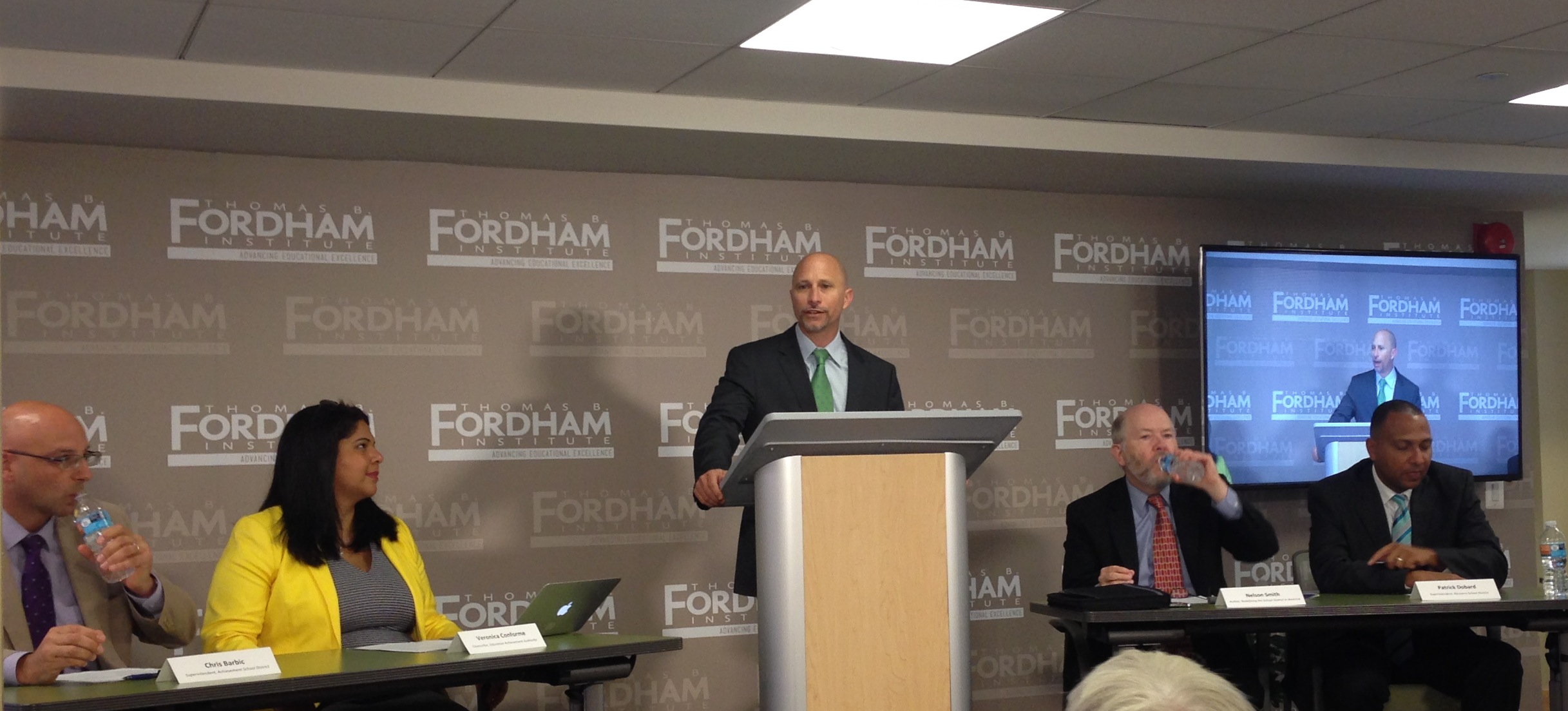
Erin Gruwell, the inspirational teacher behind Freedom Writers, continues to be one of the few educators fueling my desire to teach in a low-income area. Her experience as a transformative educator showed me the power of the teacher in a classroom. However, many teachers remain ineffective in the classroom. The Thomas B. Fordham institute hosted a panel discussion in which individuals talked about their experiences with turnaround school districts in Louisiana, Michigan, and Tennessee.

A turnaround school district is one in which previously failing schools are “turned around” into successful schools through various changes in school leadership. Schools are not being closed or recreated as Chris Barbic, the superintendent of the Achievement School District, and Veronica Conforme, the chancellor of Michigan’s Education Achievement Authority, have made evident. Conforme and Barbic made very clear that turnaround efforts are transforming the neighborhoods into areas of success, not recreating the neighborhoods. This is important to note because it shows that the integrity of the neighborhood is not lost under new school leadership, but rather efforts are made to equip students with the resources to enhance the community in which they live. Turnaround efforts enhance the practices and schools in place. This also helps to encourage community involvement without making it seem like external organizations are imposing themselves upon these communities labeled “failing” and “impoverished”.

Fordham Turnaround PictureIt was interesting to see how improving schools can have a transformative effect on the whole community. Patrick Dobard, the superintendent of the Louisiana Recovery School District, notes that these turnaround school districts often are in areas of generational poverty and work tirelessly to allow disadvantaged students to escape the cycle of poverty. Poverty places a great burden upon communities, but equipping them with the resources to overcome this cycle will help empower the young community members to transform their neighborhood and family. Bringing new leadership and a breath of fresh air into these communities allow the schools to produce students that will not only break the cycle of poverty in their community, but hopefully encourage students to take home the practices learned in school to empower other community members.

Hearing about efforts to turn the bottom 5% of schools into the top 25% of schools heightened my desire to teach in a low-income area because of the passion these panelists had for the work they are doing. Schools have a powerful effect on the community in which they are located and making schools a place of success in an otherwise impoverished area will have a positive and transformative effect far outside the boundaries of the school.

Elizabeth Kennard, CER Intern

Majority of Americans support school choice, poll finds

by Moriah Costa
Watchdog
July 1, 2015

Public support for school choice is increasing, a poll released on Tuesday by the Friedman Foundation for Educational Choice and Braun Research, Inc. found.

About 62 percent of Americans support education savings account, an increase of 6 percent from last year, the poll revealed.

“As families’ learning needs evolve, ESAs have become the most flexible tool to help parents choose the educational ingredients that work best for their children, especially if their assigned school isn’t serving them well,” Robert Enlow, president and CEO of the Friedman Foundation for Educational Choice, said in a statement.

Nevada is the most recent state to expand school choice with a universal ESA bill that allows parents to decide how to spend tax-payer money to pay for their children’s education. The bill allows any public school student who has been enrolled for at least 100 school days to receive up to $5,700 for education expenses for the academic year.

Arizona, Florida, Mississippi and Tennessee have ESA programs but it is limited to students with disabilities, military families, and low-income families.

The survey also found that only 36 percent of those polled thought ESAs should be based on financial needs. More than half said they disagreed.

[IN OTHER NEWS: SCOTUS will hear Friedrichs v. California Teachers Association case]

About 42 percent of those surveyed said they thought giving families whose students attend a failing school  a voucher or scholarship is a good intervention. Twenty-six percent thought failing districts should be turned to charter schools, while 25 percent think  school personnel should be replaced. About 18 percent thought failing schools should close.

A 2013 survey from the Center for Education Reform had similar results, with 73 percent of those polled supporting charter schools.

Class Segregation and Educational Opportunity

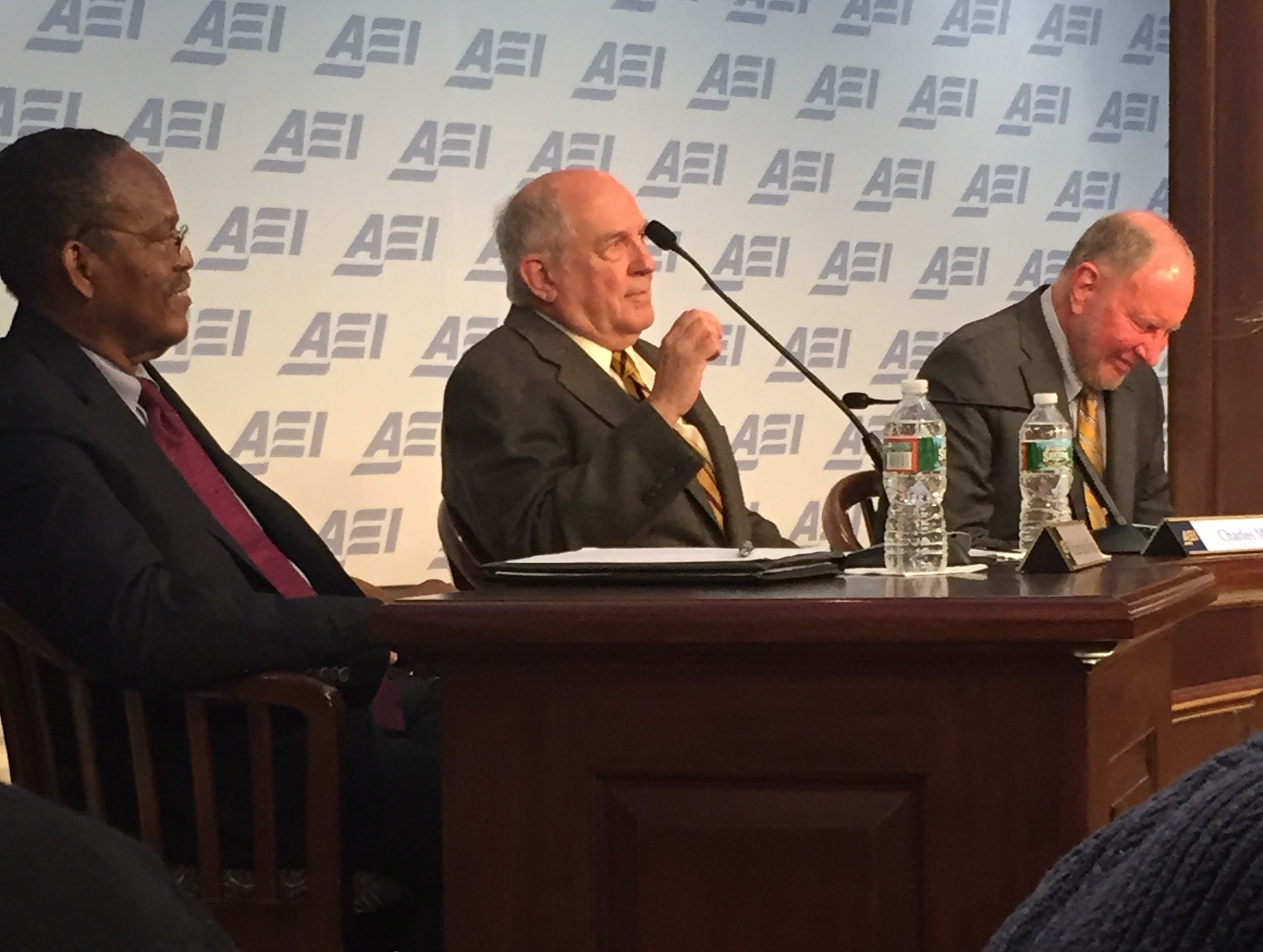
I recently attended a discussion at the American Enterprise Institute with Robert Putnam of Harvard University, Charles Murray, who is a W.H. Bradley Scholar at the American Enterprise Institute, and William Julius Wilson, a sociologist and Lewis P. and Linda L. Geyser University Professor at Harvard University. Each speaker presented their criticism of Putnam’s newest book, Our Kids: The American Dream in Crisis, and offered insight into the increasing opportunity gap among children.

Putnam spoke candidly about the segregation deeply embedded in our society—religious, ethnic, and racial disparities have improved, while classist assumptions have led to greater segregation between the lower, middle, and upper social strata. He briefly explored the implications of these treAEI Putnam Event - Demographicsnds by explaining the terms “summer camp gap” and “Goodnight Moon time” and also called for extensive policy changes to help fix these inconsistencies.

The “summer camp gap” refers to the amount of benefits parents are able to provide for their children, such as piano lessons, sports camps, or vacations, and “Goodnight Moon time” is the portion of the day dedicated to parent-child interaction. Children acquire valuable developmental skills during extracurricular activities and from stable, close contact and socialization with a parental figure. Putnam argues, however, that children in high school-educated homes versus college-educated homes possess fewer resources to hone these skills, which further stratifies social classes.

Murray strongly disagreed with Putnam’s approach to policy implementation, and Wilson believed Putnam’s book did not focus nearly enough on interracial differences.

I believe that the discussion centered largely on the social sphere, and the panelists did not integrate education into the conversation as much as they could have. A child’s social environment is inextricably linked to his or her educational access. This connection can either accelerate or hamper a child’s progress in the social milieu.

Education should have been at the forefront of this discussion, rather than a topic mentioned in passing.

Hayley Nicholas, CER Intern

NEWSWIRE: June 30, 2015

Vol. 17, No. 26

UNCONSTITUTIONAL. As battles for civil rights are going on all across the country, a group that should be leading the charge for civil rights is actually playing a role in blocking civil rights for parents and families in Colorado. In 2011, the American Civil Liberties Union (ACLU) together with other organizations, filed a lawsuit against the Douglas County Choice Scholarship Pilot Program, rendering this vehicle intended to give parents the ability to choose the best education for their child inactive. The program has been embroiled in legal battles since, with the latest decision coming from the Colorado State Supreme Court yesterday, ruling the program unconstitutional on the grounds that it violated the state’s Blaine Amendment provisions, which place constitutional restrictions on aid to religious schools. Douglas County parents and leaders have said they will take this battle to the U.S. Supreme Court, which in 2002 ruled that the state of Ohio was within its constitutional power to enact a school choice program for Cleveland children. Although this case differs in that it would be based on the Equal Protection Clause of the 14th Amendment whereas the Ohio case was based on the 1st Amendment, CER stands with leaders and parents fighting for parent and student rights in education, and we’ll be watching as this story unfolds.

UNION MADNESS. USA Today reported that the U.S. Supreme court may be prepared to strike down laws forcing public employees to pay union dues. “Exciting and encouraging news” said a member of the Association of American Educators (AAE), the nation’s largest non-union, professional educators’ organization, as it would eliminate requirements that forcibly collect fees from teachers simply because they choose to work in public schools. Take Massachusetts for example, where Newswire got wind of a young educator who recently decided she did not want to join the local teachers union, but had over $600 deducted from her paycheck anyway. Unfortunately, Massachusetts is a compulsory union state, and when it comes down to it, teachers there don’t have much control over their hard-earned dollars. They can either join the union and have dues deducted from their paycheck, or decide not to join the union and still have dues deducted from their paycheck anyway because law requires them to pay the union an “agency fee.” Gee, what a choice. It’s time the U.S. put their “money where their mouth is” when it comes to treating teachers like the professionals that they are and give them the freedom to decide if belonging to a union matches their own budget and beliefs, especially as CER knows teachers unions long ago outlived their usefulness as professional associations.

ROOTS. At the end of the 2009-10 school year, a rural Michigan district saw the closure of St. Helen Elementary school. The community decided to take matters into their own hands, and in true grassroots fashion, a charter school was born to serve as another option for parents in place of the shuttered school. But the path to create Charlton Heston Academy (CHA) was not an easy one, as the school had to fight to have a cap lifted and figure out how to meet funding and facility challenges, nor is the day-in and day-out work to ensure the school’s 85 percent economically disadvantaged student population has access to an excellent education. Newswire spoke with Jason Sarsfield, VP of the National Charter Schools Institute who grew up in the rural Michigan community and will be returning to his role as Chief Academic Officer for CHA, who stressed that rural poverty comes with its own set of unique challenges and circumstances, but upward mobility is possible when you give children living in poverty the skills and knowledge to take control of their own destiny. Get the full scoop on the school’s amazing story here.

SURVEY SAYS. A survey by the Friedman Foundation for Educational Choice indicates support for school choice in the form of vouchers, tax-credit scholarships and Education Savings Accounts is on the rise. Specifically, twice as many Americans support school vouchers than oppose them, with respondents citing more freedom and flexibility as their main reasons why. CER President Kara Kerwin was on deck to discuss the findings today at the American Enterprise Institute, stressing the importance of keeping parents informed about education options available to them. Indeed, CER’s own polling points to similar support for school choice, with 74 percent of Americans supporting the term, and 72 percent of Americans supporting the notion of parent choice. It’s difficult to find an issue that most Americans agree on, but the myriad of poll results plus growing number of students in seats of choice are an indication that Parent Power and accountability is it.

ICYMI. While CER has always held the media’s feet to the fire when it comes to getting the facts right and reporting fairly on education issues, it will be interesting to see how the media reports on K-12 education issues in conjunction with the upcoming 2016 presidential election. A new report, Leading the News: 25 years of Education Coverage, by Andrew Campanella reveals that coverage of education policies in presidential election years dropped by an average of 6.5 percent each year since 1992. But it’s clear that with the election getting closer combined with the innate desire by the media to be the outlet that breaks the most interesting news angle on a story that there’s even more room for instances of inaccuracies. For example, Politico “missed the mark on some historical realities in its recent assessment of Jeb Bush’s education work,” CER Senior Fellow and president emeritus Jeanne Allen points out. And speaking of Jeb Bush, Florida is one of the latest states where there have been reports in the media, particularly about charter schools, that are just plain wrong. Thankfully, papers are giving ink to truth-tellers aiming to set the record straight.

A Charter School is Born

A story of how a charter school started out as an idea to meet a need, the struggles it encountered trying to come into being, and the amazing impact it’s had so far on its community now that it is open and serving students.

St. Helen Elementary School, part of the Roscommon Area Public Schools (RAPS) closed its doors at the conclusion of the 2009-10 school year.

The school was located in St. Helen, Michigan, a rural village with a population of less than 3,000 residents. St. Helen, along with the adjacent community of Roscommon, comprised the geographic boundaries of RAPS, with an elementary, middle and high school also located in Roscommon. Until the conclusion of the 2009-10 school year, students from St. Helen attended middle school and high school in Roscommon. The decision of the RAPS Board of Education to close St. Helen Elementary School, due in large part to its perceived lack of financial viability, and consolidate it along with Roscommon Elementary school, resulted in a strong community without a single school. Soon thereafter, RAPS placed the building and the 24 acres of land it was located on up for sale.

A group of community members led by Jennifer Jarosz, a mother of two and owner of the local diner where she waits tables, decided to pursue the idea of establishing a charter school to replace their closed elementary school. Soon thereafter, Rural Education Matters (REM), a non-profit organization whose charge it was to support the idea of establishing a public charter school to serve the children of St. Helen and all others who wished to enroll, was born.

After failing to convince the local community college to grant the group a charter, REM was at an unfortunate crossroads due to the statutorily imposed cap on university-based charter school authorizers being met. Jarosz and REM organized a grassroots effort in support of raising that cap, visiting Lansing and testifying at legislative hearings, and on December 20, 2011, Michigan Governor Rick Synder signed a charter school reform bill that lifted the cap on charter schools in Michigan.

The following April, REM and community leaders from St. Helen were successful in securing a charter from Lake Superior State University. What followed was a profound effort that reflects the power of community collaboration, committed parents and professional willingness to take a risk on a new and exciting public charter school to replace the closed St. Helen Elementary School.

After establishing a Board of Trustees for the new public charter school, the school was named the Charlton Heston Academy (CHA), school leaders were recruited, a team of educators selected, and the former St. Helen Elementary school facility purchased in preparation for a September launch.

While the school was named after an individual who grew up in the community and whose family still has property in the area, the school was not given any financial help from the family or the estate. In fact, the only funds available to get the school off the ground were those granted through the federal Charter Schools Program (CSP) Start-Up and Implementation Grants. However, these funds could not be used for facility renovation, and roughly $100,000 was needed to correct 21 facility code violations before opening the school.

Small businesses and individuals throughout the St. Helen community came together and worked around the clock to get the school open in time, and in a few short weeks the school was able to make the necessary renovations and put a physical school building and educational program in place and open its doors to approximately 200 students in grades K-8.

The former St. Helen Elementary School enrolled approximately 135 students in grades K-6 when it closed.

This grassroots effort, including round-the-clock preparations (literally community members driving their tractors to the school to help with landscaping, grandparents cleaning old desks, etc.) throughout the Labor Day weekend directly preceding the opening of the school, actually made the entire school community more inclusive, strong and resolved.

For the first time, parents in the area had a real choice in where they sent their children to school.

Enrollment continued to increase in the school’s first year of operation, and parents from neighboring communities were enrolling their children in the school. A pre-Kindergarten program was added late fall, and CHA added a 9th grade in the fall of 2013 and a 10th grade in the fall of 2014. The school recently completed a facility expansion in order to accommodate the increased demand for its seats, and has already begun plans for a second facility expansion. Amazingly, CHA is poised to enroll approximately 500 students in grades PreK-11 in September, with plans to add a 12th grade in the fall of 2016, celebrating its first graduating class in the spring of 2017.

The school’s educational program is based on a strong core academic program, extended school day and year-round calendar. While the State of Michigan requires 1098 instructional hours each year of public schools, CHA provides 200 instructional days and approximately 1600 instructional hours.

Interestingly, other traditional schools are responding and trying to implement year-round calendars, but are struggling due to union restrictions and other financial barriers. The freedom and autonomy allowed by schools of choice, and the fact that parents are indeed exercising their right to choose the educational environment they feel is best for their child, is creating a ripple effect that is improving all schools for all children.

The school focuses heavily on experiential learning, community collaboration and engagement, and the incorporation of American democratic values throughout the academic program and school culture. In fact, one reason why the school was named after Charlton Heston was because of this vision of teaching core democratic values as part of the school’s culture, and that Heston was considered by many to be a “patriot” of sorts.

The name isn’t the only local connection, however; many of the school’s leaders know first-hand what it’s like to grow up in the rural Michigan community.

Jennifer Jarosz, who led the effort to get the charter school started in the first place, has served as the President of the Board of Directors of CHA since the school’s charter was approved. And in fact, her efforts have led to her recently being asked to serve on the Board of Trustees of the Michigan Association of Public School Academies. Both David Patterson and Jason Sarsfield, life-long friends and RAPS graduates who grew up in significant poverty but thanks to supportive families and great educators along the way both lead successful adult lives, returned to play a role in the charter school. David Patterson, a graduate of RAPS, successfully lead a charter school in Detroit, returned home to serve as Superintendent and has done so since the launch of the charter school. Jason Sarsfield, after a successful career in teaching and charter school authorizing, returned from his role at the State University of New York’s Charter Schools Institute to serve as Chief Academic Officer. After helping to lead the pre-optional phase of the school, first year of operation and transition into year two, Sarsfield went on to serve as Vice President of the National Charter Schools Institute, and will return to service again as Chief Academic Officer on July 1, 2015.

For these folks, the charge is personal to ensure families have access to an excellent education. In the charter school realm, much of the focus is on urban areas, yet many forget that urban poverty and rural poverty actually look quite similar.

Approximately 85 percent of CHA students are economically disadvantaged. This fact drives CHA educators and leaders to relentlessly pursue excellence for each and every single one of its students. They know upward mobility is created when children living in poverty are equipped with skills and knowledge that allow them to take control of their own destiny.

Now, the St. Helen community is equipping its children to have that control, by launching a charter school that delivers the promise of an excellent education for all students.

To learn more about the school, you can visit www.charltonhestonacademy.com or email its leaders at dpatterson@charltonhestonacademy.com or jsarsfield@charltonhestonacademy.com.