










Sign up for our newsletter

Here Comes The Sun

It seems like only yesterday I walked into CER’s office for the first time. As I entered, I was immediately struck by the CER logo, most specifically by the sun. It was fun, something a little different. However, as time went on, I learned just how much the sun embodies CER’s mission and work.

My experience at CER has been diverse and the opposite of dull. I started my internship knowing “enough” about edreform, and I end it having lived and breathed the movement. My experience here has been invaluable and those who I have been surrounded by could not be more inspirational. The talks and panels I had the opportunity to attend were informative and impassioning. Additionally, the event that the interns put on, “EdReform Past, Present, and Future”, was such a blast and I had a wonderful time moderating.

These opportunities allowed me to see that education is not limited to a traditional public school setting but rather that every child is unique and as a result every child has a right to his own choice of school. Education is the great equalizer; this is something we must cherish as well as protect. The sun can never set on education reform until every parent has a choice so every child has a chance.

I want to thank the amazing team at CER for giving me this wonderful opportunity, as well as my fellow interns for being at my side throughout the learning process and encouraging me each step of the way. Each of you has taught me so much and I wish you all the best on your journey to give every child a chance through choice.

Your passion and leadership has inspired me and I know you will all continue to be movers and shakers in the edreform movement.

Madeline Ryan, CER Intern

Statement from The Center for Education Reform on North Carolina Supreme Court’s Ruling Opportunity Scholarships Constitutional

News Release
Washington, D.C.
July 23, 2015

Kara Kerwin, president of The Center for Education Reform (CER), issued the following statement on the North Carolina Supreme Court’s ruling today upholding the constitutionality of the state’s Opportunity Scholarship Program:

“This court ruling is a major win for parents and students in North Carolina and across the nation, affirming that parents should ultimately have power over decisions about how their children are educated, regardless of their race or zip code.

“With more than double the applications for scholarships in the first year of the program – approximately 5,500 applications for 2,400 scholarships – parents are making it abundantly clear that they want and demand more power over their children’s education. While there is still much work to be done to ensure all parents have the ability to choose the best education for their child, as North Carolina earns a 72.5 percent on CER’s Parent Power Index, this is a giant step in the right direction for parent empowerment in North Carolina.”

BACKGROUND: The legal challenge to the North Carolina Opportunity Scholarship Program began in 2014, filed by the North Carolina Association of Educators and the North Carolina School Boards Association, with many school boards also joining the challenge to the program’s constitutionality. The Opportunity Scholarship Program was passed in July 2013, with scholarship availability in the amount of up to $4,200 for the 2014-15 school year for students meeting income thresholds.
When Parents Have A Choice, Kids Have A Chance

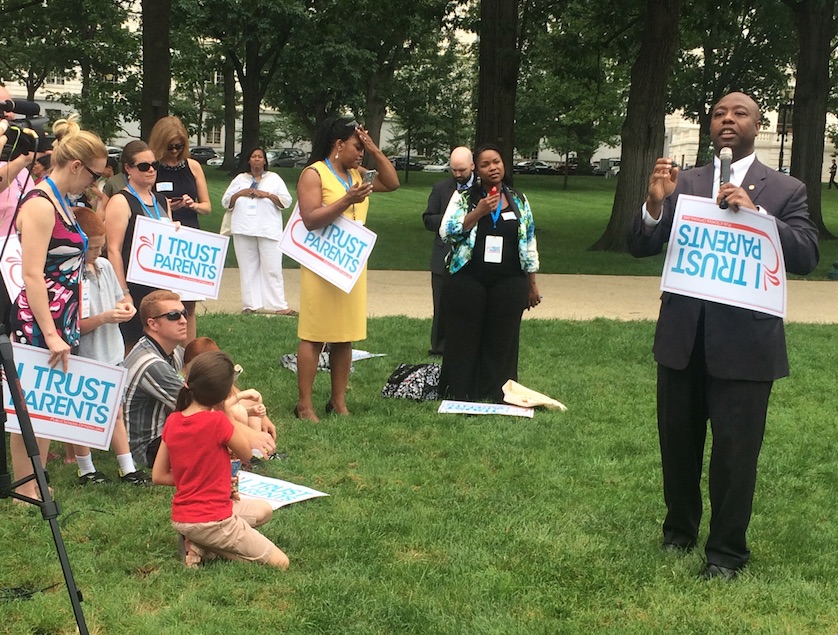
On Tuesday morning, PublicSchoolOptions.org held a rally outside of the U.S. Capitol to unite edreformers in an effort to celebrate school choice as well as push for more options for heightened parent power. The group of those who gathered at the rally was diverse to say the least. Coming from all over the country, students, teachers, education professionals, parents, and kids gathered in Upper Senate Park in support of giving parents the opportunity to make individual school choices for their children. Every parent wants what is best for their child, every mother and father wants to see their son or daughter succeed and live out their dreams. The importance of parent power is undeniable because more so than anyone else, parents have their child’s best interest in mind. All around me I saw impassioned people holding “I Trust Parents” signs and chanting those same words. The atmosphere was infectious and immediately, I was captivated.

To add to the excitement, we were joined by many notable guest speakers including Senator Tim Scott (SC), Congressman Luke Messer (IN), Kevin Chavous, CER board member and Executive Counsel at the American Federation for Children and CER’s very own Kara Kerwin. Each spoke with a sense of urgency for more school choice and each instilled in the crowd a feeling of purpose and pride in the cause. Although the four individuals come from diverse backgrounds and have different experiences, the four cannot deny the importance of choice in education.

One thing that really stuck out to me at the event and that I believe will follow me on my journey in the education reform movement is everyone at some point or another will be touched by school choice. There is an innate sense of universality in school choice and this was reflected in the crowd that gathered. Either you will have the opportunity to make a decision regarding your own or someone else’s education or the decision will be made for you. As a result of this, it is important to empower people of all ages and backgrounds to make smart decisions regarding school choice and to push for their representatives to create opportunity for more options. Through working at CER I have come to recognize the power of good a parent can hold when given the opportunity to choose what is right for their child. I trust parents to make the right decisions for their child’s education and so should you.

Madeline Ryan, CER Intern

In D.C., parents risk jail to get students into highly ranked schools

by Moriah Costa
Watchdog
July 23, 2015

D.C. has cracked down on parents lying to city and school officials about where they live, after an increase in tips that families from nearby Maryland and Virginia are illegally enrolling their children.

In the 2014-15 school year, the Office of the State Superintendent of Education saw a 43 percent increase in tips from the prior year.

It’s a result, the agency says, of increased public awareness.

Parents who lie about living in the district risk up to 90 days in jail and can be required to pay back tuition — up to $15,000 a year.

The city has sued two police officers who enrolled their kids in D.C. Public Schools while living outside the district.

The D.C. area is unique when it comes to school choice, and it ranks high for school-choice options. But school options in the surrounding area are limited. Education experts say the lack of school choice could be a leading factor in residency fraud.

“The problem is we haven’t created enough choices or made choice universal for everybody,” said Kara Kerwin, president of the Center for Education Reform.

“Those two states that border D.C. are very similar in their demographics and their population, yet they have done absolutely nothing to provide choice for families,” she said.

The center ranked Virginia 41st and Maryland 39th in its 2014 charter school law rankings. D.C. was first.

The Office of the State Superintendent of Education has handled illegal enrollment since the city passed the Residency Fraud Amendment Act in 2012. The agency hires a private investigator to look into tips it receives from schools, hotlines or online.

During the 2014-15 school year, the office received 88 tips and conducted 70 investigations. Of the 38 cases that were closed, only two students were found to live outside the city.

Residency fraud isn’t unique to D.C., however.

Jason Botel, executive director of school-choice advocacy group Maryland Can, said he knows of numerous cases of parents lying about where they live to get into a good school in Baltimore County. Botel, previously executive director of KIPP Baltimore, said he had some students whose families lied about living in the city so their children could attend his school.

The fact the counties near D.C. have few, if any, charter schools is only driving parents to find other ways to give their kids a good education.

“Maryland is a place where the surrounding counties spend less on education than D.C. does, especially for low-income kids, and there are very few public school choices.”

Irene Holtzman, executive director of Friends of Choice in Urban Schools, said the best way to prevent residency fraud is for nearby counties to expand school-choice options.

“Where (students) live is determining where they go to school, and (neighborhood schools) may or may not be what they’re looking for or they may or may not be well-resourced to afford a (private school),” she said.

Maryland has reformed its charter school laws, and Botel thinks the changes will help enhance the choices available. But, he said, if lawmakers really want to expand choice they should allow nonprofits to hire teachers and principals. The law says teachers must be hired through the school district, making hiring difficult and, in turn, stifling innovation, Botel said.

Until policymakers start treating parents as consumers and stop zoning the public school system by zip code, Kerwin says, some families will continue to risk jail time so their children have the chance at a good education.

“Despite all the choices that have been created across the U.S., we still haven’t gotten to that marketplace that school choice promised,” she said.

Capitol Hill rally celebrates ‘school choice champions’

by Jason Russell
Washington Examiner
July 21, 2015

School choice advocates gathered on Capitol Hill Tuesday to rally for educational options and celebrate three members of Congress that PublicSchoolOptions.org has named as Champions of School Choice.

Sen. Tim Scott, R-S.C.; Rep. Luke Messer, R-Ind.; and Rep. Todd Rokita, R-Ind., were all awarded small trophies and recognized as Champions of School Choice.

“When you give parents options, when you give them a choice, kids have a better chance,” Scott said. “No one loves their child like their parents, and the results are amazing.” Scott praised the Washington, D.C. Opportunity Scholarships program. Scott said the program has a graduation rate almost twice as high as the District’s traditional public schools and spends only 40 percent per student as much as traditional public schools do.

Messer talked about expanding school choice opportunities for low-income families. “The truth is, in America, you already have school choice, if you can afford it,” Messer said, referring to the ability of wealthy families to afford private school or live in an area with high-quality public schools. “The only real question is, as a country, what are we going to do for everybody else?”

Rokita was unable to attend the event. “I set out four years ago to fight for a commonsense education bill that took Washington out of the way and restored transparency, choice, and flexibility back to our schools,” Rokita said in a statement to the Washington Examiner. “Every student deserves an effective teacher, an engaging classroom, and a quality education. [The Student Success Act] is a step in the right direction and I thank all of the parents and supporters that came to D.C. today to ensure their voices are heard.”

PublicSchoolOptions.org President Tillie Elvrum spoke highly of Scott, Messer and Rokita. “They recognize that parents need options and they trust parents,” Elvrum told the Examiner. “They know that nobody knows a child and what their academic needs are better than a parent.” Elvrum said the three members of Congress listened to what the group had to say and responded by introducing legislation that supports schools.

Cherie Nielsen, a mother of three from Virginia, told the Examiner that she attended the rally to support more school choice options. Nielsen initially homeschooled her children, but then opted for a virtual school. She says Virginia doesn’t have enough school choice options, so her kids were forced to attend public schools starting in the eighth grade.

Kara Kerwin, president of the Center for Education Reform, and Kevin Chavous, an active education reformer and attorney, also spoke at the event. “Money, zip codes and political will should no longer dictate the fundamental right, as parents, to choose what is best for our children,” Kerwin said. “There are 52 million children still trapped in schools without a choice.”

Chavous focused on the effect that parents were having in the school choice movement. “Parents are driving this revolution in education,” Chavous said. “And you know why they’re driving it? Because parents are sick and tired … of being sick and tired.”

PublicSchoolOptions.org is a parent group with 60,000 advocates across the country.

Roughly 75 people attended the rally. Many proudly displayed “I Trust Parents” signs and stickers.

This article was updated on July 22 with a statement from Rokita.

NEWSWIRE: July 21, 2015

Vol. 17, No. 29

STUDENT RIGHTS, ROUND 2. A second lawsuit in defense of student rights is underway in California, this time under the name Jane Doe, et al. v. Antioch Unified School District, et al. Just as the Vergara v. California suit sought to uphold the constitutional rights of students by reversing unproductive teacher employment practices, the Doe v. Antioch case challenges 13 districts in violation of a state law called the Stull Act that requires teacher evaluations to consider student progress. In 2012, the Los Angeles Unified School District was found in violation of the Stull Act, but three years later, the board and teachers union have yet to agree on how to implement the ruling enforcing the inclusion of student performance in teacher evaluations. As the Los Angeles Times Editorial Board notes, “lawsuits aren’t the best way to improve schools,” but when a Legislature is too controlled by the teachers union and thus repeatedly fails to make changes that would benefit students, “sometimes they’re the only way.”

SOLUTION: CHARTERS. With an already strained and ill-prepared workforce, it’s imperative for the U.S economy that we tackle mediocrity and quickly grow education options to meet the needs of our students. Charter schools can, and should be, part of that solution. Growing at a steady, linear pace over the years, charter school growth could be accelerated to allow charters to play a more central role in U.S. education. Take St. Johns County, Florida, for example, where a school board member calls for a tax increase in order for the district to meet an anticipated 47 percent increase of students expected in the next 10 years. The U.S. already spends more than any industrialized nation on education, and with a less than stellar return on investment with less than 40 percent of students able to read and compute at grade level. Combine this with the fact that the bureaucracy of our traditional education system is not synonymous with speedy, and it’s clear that in order to address the urgency at which our children need excellent schools, we must look at innovative, accountable options like charter schools.

TRUST PARENTS. It was hot out this morning in Washington, D.C., but that didn’t stop school choice advocates, parents, educators, and families from coming together to celebrate school choice at the #ITrustParents rally on the Hill. “Despite the widespread acceptance and rapid growth of school choice, millions of families still do not have the freedom to choose the best education for their child,” The Center for Education Reform (CER) President Kara Kerwin told the audience, stressing the need for more and better education options. The D.C. School Reform Act and the Opportunity Scholarship program brought major changes to D.C. education, Kerwin recalled, offering parents for the first time the freedom and opportunity to choose a better future for their child. Echoing those sentiments, Senator Tim Scott (R-SC) noted that with D.C. vouchers, “for 40 cents on the dollar, you can nearly double the graduation rate.” Choices are creating a ripple effect and improving outcomes for students across America, but just five percent of school-aged students are taking advantage of charter schools or school choice programs. As we approach 2016 elections, we must continue to call on elected officials to stop playing politics and do what’s right: trust parents, because “money, zip codes, and political will should no longer dictate our fundamental right as parents to choose what is best for our own children.” Take action now and encourage others to let elected officials know they should trust parents by texting ITRUSTPARENTS to 52886 or clicking here.

Screen Shot 2015-07-21 at 4.47.29 PM

Screen Shot 2015-07-21 at 4.48.04 PM


ICYMI: EVERY CHILD ACHIEVES. In a 87-17 vote, the U.S. Senate passed the Every Child Achieves act last Thursday. Meant to reauthorize the Elementary and Secondary Education Act (ESEA), more recently known as the No Child Left Behind Act, CER is encouraged by the legislation for reinforcing the principle of local autonomy and state sovereignty, and believes that “along with a strong House bill, will correct the overreach of this and subsequent administrations for years to come.” The House passed its ESEA replacement, called the Student Success Act, eight days before the Senate passed its version, and now both bills will go to conference committee for reconciliation.

Parents group rallies at Capitol for school choice

by Caroline Kelly
The Hill
July 21, 2015

Republican lawmakers joined an advocacy group seeking greater powers for parents to choose their children’s schools in a rally at the Capitol on Tuesday.

Sen. Tim Scott (R-S.C.) and Rep. Luke Messer (R-Ind.) spoke at the event organized by PublicSchoolsOptions.org, a group of parents in over 30 states demanding more choices in schooling.

“When you give parents the choice, you really do give the kid a better chance,” Scott told The Hill. “You really open that child’s minds to amazing opportunities that they would not have seen before.”

“The statistics bear it out, and personal experience says it real,” he added.

Supporters of school choice want to allow federal dollars to follow students through vouchers. But Democrats object to such proposals, saying that federal dollars shouldn’t go toward private schools and that such plans would gut the public education system.

The rally comes after lawmakers in both the House and the Senate passed legislation overhauling the No Child Left Behind education law. But the two versions are different on the issue of school choice with the House bill allowing low-income parents to take federal money to the schools of their choice. The Senate rejected such measures.

Lawmakers must now find a compromise between the two versions, but the White House has panned the House bill while offering reserved support for the Senate measure.

Scott said choice was crucial for poor students who often changed homes and were unable to settle at one school.

“The ability to fund the right school for that kid who’s moving around a lot is difficult,” Scott told The Hill, describing his own childhood growing up in a poor neighborhood and attending four elementary schools.

At the rally, Messer called school choice “the civil rights issue of our time.”

“No child in America should have a waitlist to their future,” Messer said, citing the one million children waiting to attend different schools. “That’s one million lives that are being held back because we’re falling short as a nation.

“The truth is, in America, you already have school choice if you can afford it,” Messer told supporters. “You’ll send your kid to the school of your choice, often a private school, or you can just move. The real question as a country is what are we going to do for everybody else.”

Both lawmakers have sponsored education bills this year. Messer introduced the Scholarships for Kids Act in February 2014 to reallocate Kindergarten through 12th-grade funding to help low income students and co-sponsored the Student Digital Privacy and Parental Rights Act of 2015 with Rep. Jared Polis (D-Colo.) last April to restrict the use of student data.

Scott authored the Creating Hope and Opportunity for Individuals and Communities through Education (CHOICE) Act in January to help students who are disabled or from military or low-income families.

Public Schools Options board director Tillie Elvrum at the rally said choice benefitted different kinds of students, helping some get access to advanced coursework and others to leave behind bullies or difficult schools.

“We trust parents to make education decisions for their children,” she added. She said charter schools, online education, magnet schools, tuition scholarships and open enrollment plans all would better help parents.

Other speakers at the event included Kevin Chavous, executive counsel for the American Federation for Children, and Kara Kerwin, president of the Center for Education Reform.

Writing Coming Back Into The Equation

I like to refer to myself as a “professional reader” when I tell people that I am an English Major. What I commonly leave out of the equation is the amount of writing that accompanies, if not equals, the copious amount of reading that awaits me every semester. Writing, like many other skills, is perfected through practice. Writing is critical in the schooling of a student because it is a skill transferrable throughout the disciplines; a skill that is integral to success in several fields, it is not just limited to English.

The National Writing Project (NWP) works as an organization to enhance teacher quality and commitment regarding the reintegration of writing into the curriculum of low-income schools. Elyse Eidman-Aadahl, the executive director of NWP, recently discussed the unfortunate reality that when schools are dubbed as “failing” or “struggling” writing is quickly dismissed from the curriculum to make room for test prep to improve test scores. As made evident through personal experience, being able to answer multiple-choice questions doesn’t transfer directly to success in college and beyond. Eidman-Aadalh and the other panelists made the need to reintegrate writing into the curriculum of these schools imperative, as well as make teachers competent instructors in the field of writing.

Reintegrating writing into the curriculum is one thing, but without effective and quality teachers who can teach students to write well, success will not be obtained. This is where the NWP comes into play, as well as the several devoted individuals across the country who work in tandem with NWP to help teachers optimize their teaching skills and make low-income students gain success through effective writing. Hearing the panelists discuss nationwide initiatives that have helped teachers become more effective at teaching low-income students how to write well and therefore excel across the disciplines not only speaks to the power of writing as a tool of success, but how collaboration, not competition, produces excellent results in schools and students.

I am proud to refer to myself as an individual who is informed about what is going on in the K-12 education world, which has been enhanced by my summer at The Center for Education Reform and the events I have attended. This event is no exception in that I learned how school nomenclature affects the curriculum; failing schools can be forced into a test-centered approach, while successful schools have more freedom in their curriculum. After this event, I have become aware of the collaboration across schools and teachers that encourage and foster success within students; emphasizing the value of a teacher in schools and how integral they are in the outcomes of students.

Elizabeth Kennard, CER Intern

Group sues 13 school districts for not using test scores in teacher evaluations

by Howard Blume
Los Angeles Times
July 16, 2015

An education advocacy group sued 13 California school districts Thursday, claiming that they have ignored a state law requiring teachers’ performance evaluations to include student standardized test scores.

The lawsuit targets the largest school systems in the state that have barred such use of test results through collective-bargaining agreements with teachers unions. These contract provisions are illegal under state law, according to the complaint, which was filed in Contra Costa County.

The litigation represents the latest effort by Students Matter, a Los Angeles-based group that has turned to California courts to make changes in education law that were otherwise blocked at the state and local levels. The organization was founded by tech entrepreneur David F. Welch to build on other attempts to limit teacher job protections and hold them more accountable for student achievement.

Many states and school systems are using scores in instructors’ performance reviews in part because the Obama administration has offered them incentives, including grants and exemptions from some federal rules and penalties. The practice is among those favored by such influential organizations as the Bill and Melinda Gates Foundation and typically opposed by teacher unions.

Students Matter scored a victory last year when a Superior Court judge in Los Angeles ruled that several teacher job protections were unconstitutional. That case, Vergara vs. California, was watched nationally and spawned similar litigation in New York. The California ruling is on hold pending appeals.

If that decision is upheld, teachers would lose the right to earn tenure, and layoffs would no longer be based on seniority. The process for firing instructors also would be streamlined. The Legislature could pass laws restoring some of these job protections in another form, but they would have to survive court scrutiny.

Read the rest of the article

It’s Not Goodbye, It’s See You Later

I can’t quite believe that my seven weeks interning at The Center for Education Reform (CER) are nearly over. It seems like yesterday was my first day.

During my time here, I have been exposed to the demands of nonprofit work, learned about the intricacies of educational policies and have had the opportunity to attend all types of events, from a panel discussion on Capitol Hill about special education to a survey briefing at the American Enterprise Institute (AEI) featuring CER’s own president, Kara Kerwin. The other interns and I even had the chance to spearhead and coordinate our own event. It required countless hours of preparation and collaboration but was a rewarding experience that proved to be a huge success.

My two favorite events centered on socioeconomic status, academic attainment, and educational opportunity. As a sociology major, these topics greatly interest me. The first one was at the American Enterprise Institute and was a critique and discussion of Robert Putnam’s newest book, Our Kids: The American Dream in Crisis. The other, a webinar presentation hosted by the American Institutes for Research, examined inequities within and across education systems and students’ ability to thrive academically despite socioeconomic setbacks.

These events resonated with me because they reminded me distinctly why I want to be a leader in education. I want to provide a voice for those who are usually voiceless. It is my moral imperative.

This internship has really made me question our country’s pedagogical approaches. If we want to reshape our education system, we can’t continue to pass policies enshrined in tradition. It is those kinds of methods that stifle creativity and innovation. Instead, we should concentrate on our changing world and how we can apply new measures to alter the current state of education.

Working at CER has reaffirmed my passion for education and my desire to transform a quality education from a privilege into a right.

Thank you so much to the CER staff for your guidance this summer and your continued devotion to these issues. I am proud to have been a part of your organization and now, the education reform movement.

Hayley Nicholas, CER Intern