











Sign up for our newsletter

Growing and Sustaining Catholic Schools: Lessons From Philly

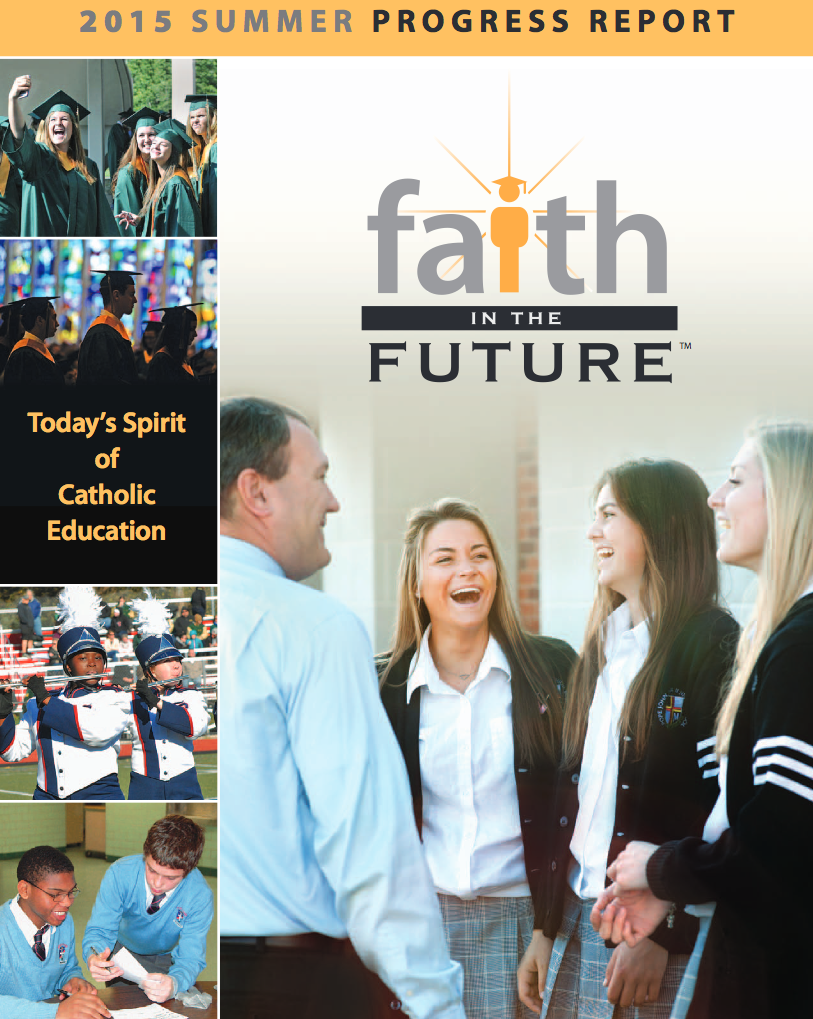
Screen Shot 2015-08-11 at 2.13.55 PMAccording to a new report, the Archdiocese of Philadelphia will have happy news to share with Pope Francis when he comes to visit in September.

Across the United States, Catholic schools have been suffering declining enrollment, but Faith in the Future has announced that the Philadelphia system of Catholic schools are now projecting growth in the number of students they serve. Additionally, the high school system, previously in deficit, is now reporting a surplus in funds, which are being reinvested back into the schools themselves.

While Pennsylvania Catholic schools have also generally benefited from the state’s two tax credit scholarship programs, which allow parents who might not otherwise be able to afford to send their kids to Catholic schools to choose that option. While public policy solutions are important to keep on the table, as they could have a huge impact on the ability of the religious school sector as a whole to remain solvent, Catholic school leaders can’t wait for the next governor to make school choice his or her priority; the crisis is real and now.

In 2011, The Center for Education Reform issued a policy alert taking a critical look at the issues facing struggling Catholic schools, suggesting that the future success of Catholic schools will be tied directly to the ability of Catholic school leaders to integrate faith missions with business skills, and embracing the kinds of changes taking place in the education marketplace at large.

And indeed, the Faith in the Future report notes part of the reason for significant progress has been “reinforcing business process in pursuit of a new growth strategy.”

Acknowledging that it is still early, Faith in the Future believes they are “successfully creating a new operating model to increase educational opportunities, enhance the quality of education in Catholic schools, and demonstrate how private sector solutions can leapfrog even the most innovative charter school reforms.”

In an era where Catholic schools have been struggling to maintain enrollment, these are indeed welcome developments for Catholic education.
Number of Baton Rouge charter schools doubles in 3 years; four new ones open this week

by Charles Lussier
The Advocate
August 5, 2015

Four new charter schools are opening their doors this week in Baton Rouge, joining an increasingly crowded local education marketplace.

They bring the total number of charter schools in East Baton Rouge Parish to 25, double the total just three years ago. Charter schools are public schools run by private organizations via charters, or contracts.

All four of the new schools bill themselves as places that will prepare children for success in college. The vast bulk of their students, though, won’t be old enough to enroll in college for another decade.

Each offers a different formula for how to get them there.

At Democracy Prep Baton Rouge, for instance, the focus is on creating active, informed citizens from the youngest age.

“If a kid hasn’t done a phone bank or raised money for a cause, they can’t graduate from Democracy Prep,” explained Alice Maggin, a spokeswoman for the New York City-based charter management organization, which operates 17 schools in three states, as well as the District of Columbia.

Start-of-the-day classroom meetings are called “town halls.” The need to “change the world” is reinforced repeatedly throughout the school. Come Election Day, students will canvass the community wearing T-shirts and handing out fliers saying, “I Can’t Vote, But You Can!”

Read the rest of the article here

Ed experts mum on improving schools without raising taxes

By PG Veer
Watchdog Arena
August 3, 2015

With the school year just on the horizon, WalletHub published its annual report on states with the best and worst education systems. What catches the eye in this 2015 report is the failure of the experts to answer an important question: What can state and local policymakers do to improve their school systems without raising taxes?

Considering the severe budgetary constraints most states are experiencing, especially because of Medicaid expansion under Obamacare, cost-saving suggestions and solutions would be welcomed.

One possible solution would be to hold ineffective teachers accountable for student performance, even when they have tenure. On that subject, Massachusetts shines, ranking well above the national average, according to the National Council on Teacher Quality. At the other end of the spectrum, states like California, Alaska, Oregon, and Washington, DC, which Wallet Hub ranks among the worse states, have rather poor standards for firing low-performing teachers – when they do have standards.

Another performance booster that could cut costs is school choice. School choice allows parents more options beyond the traditional neighboring school and may actually improve their children’s education, especially for low-income groups in urban areas. Despite depending on public funds for students, charter schools can end up saving money for taxpayers. Since most states don’t fund charter schools capital improvements, administrators are the ones paying for its upkeep. And since most of their teachers are not unionized, they can keep their costs down.

In the Center for Education Reform’s Parent Power Index, which rates states based on how much each empowers parents to make decisions regarding their child’s education, Massachusetts would do well to improve its school choice options as the PPI ranks the state 30th. Its very limited charter school options and virtual school options weighed the state down.

Wallet Hub does show a weak correlation between spending and outcomes in its 2015 report, it isn’t everything. Louisiana, despite its ranking of 47th by Wallet Hub, ranked seventh on the PPI, thanks to a very vast network of school vouchers, online, and charter schools. Massachusetts does spend the most per student (over $14,000) and has the best results, but New York is #2 in spending and has the 34th best education system overall – Alaska respectively ranks 4th in spending with an overall ranking of51.

Utah is only underspent per student ($6,200) by Arizona while having the 14th best education system. Utah also ranks at number six on the PPI. Could money influence such a discrepancy between spending and outcomes?

This article was written by a contributor of Watchdog Arena, Franklin Center’s network of writers, bloggers, and citizen journalists.

The Summer I Became An Education Reformer

It’s hard to believe that it’s been nine weeks since I first walked into the CER office. As I sat in on my first staff meeting that Monday morning, I had a million thoughts swirling in my head about what my time here would be like. Never would I have believed I would have the chance to go to several talks at Capitol Hill, be invited to a multitude of education reform events, have the experience of planning an intern only event or even be a part of an education reform rally. Nor could I have imagined the amount of knowledge I have had the privilege of learning. All these things and more are what encompassed my time here at The Center for Education Reform.

One of my favorite experiences would have to be a discussion we went to at American Enterprise Institute about Robert Putnam’s book, “Our Kids: The American Dream in Crisis.” This event combined my two favorite subjects: education and economics. It was reasonable, logical and laid everything out on the table. I enjoyed hearing the explanation of the book from the author himself, Robert Putnam, but I also enjoyed the critiques different members of the panel gave as well.

Having the opportunity to be in this world and become an education reformer has only reaffirmed my passion in life. Making a difference and doing everything I can to ensure every child is given a proper education is my lifelong dream and being here this summer at CER has given me a chance to start the path to accomplishing this dream.

My experience this summer would not be what it was if it weren’t for the amazing staff here at CER. Without their wisdom, guidance, or knowledge my summer would have not been the enriching experience for which I am so grateful. Thank you for an unforgettable summer and the amazing chance to become an education reformer.

Emily Kelleher, CER Intern

Last Day Blues!

I simply cannot believe that today is my last day here at The Center for Education Reform! Where did the summer go? I remember patiently anticipating my arrival here for a whole month before I began my internship. So many thoughts were going through my head as to how this summer would go, the things I would learn, and if education reform would be the thing for me.

Well let’s just say I answered all of those questions and more. I now look at myself as a well-versed education reformer trainee in this long fight for school choice. CER taught me so many things about the movement that I never would have been able to grasp had I searched for the information myself. For instance, who knew that charter schools are not private schools and vouchers are actually used for more than just shopping, and my favorite (E)SEA is not just the blue waters we play in, etc. Just me? Ok, let’s excuse these little mishaps.

CER has also taught me about the strenuous work of nonprofits. I always knew that a nonprofit was started from a just cause, but I never knew that it took this much work to operate. From doing the office grunt work that many like to avoid, to offering input on education policies in different states, even to doing grassroots work like participating in parent choice rallies, CER works!

One great thing about this internship was being able to go out to events and hear the many different voices in Ed Reform. Going to different events and hearing people passionately speak about their efforts in Ed Reform let me know that the work I’m doing and will do is worth it. One of my favorite events that I attended was called “The State of Entrepreneurship in K-12 Education”. This all-day panel resonated with me the most because we got see the many progressions that are coming about in the education world. School is moving from being the typical paper, pen, and textbook routine; it’s evolving to something that will help move all kids forward and gets us out of the typical 100 year old model.

Being at CER this summer has truly made me a better person and opened my eyes up to a lot of things in and outside of the education reform world. My experience here was something that I truly enjoyed and am grateful for. Thank you CER and all the wonderful people here (including my fellow interns) for a wonderful summer!

Rahdaysha Cummings, CER Intern

On his birthday, Milton Friedman celebrated by school choice movement

by Jason Russell
Washington Examiner
July 31, 2015

Today, the school choice movement still recognizes the significance of Friedman to all the progress that’s been made in advancing school choice. Friday would have been Friedman’s 103rd birthday, and the movement took an opportunity to reflect on his work.

Milton Friedman was one of the first school choice advocates. Back in 1955, the economist and eventual Nobel laureate lamented in an essay that government pays for and runs most schools in a country that is otherwise “predominantly free enterprise in organization and philosophy.” Friedman wanted an education system that would “center attention on the person rather than the institution.”

To do so, Friedman proposed government grants to families to pay for education. Today, these grants are sometimes called school vouchers or opportunity scholarships. A new form of grants called educational savings accounts are now available in several states.

“Government, preferably local governmental units, would give each child, through his parents, a specified sum to be used solely in paying for his general education; the parents would be free to spend this sum at a school of their own choice, provided it met certain minimum standards laid down by the appropriate governmental unit,” Friedman wrote.

“Milton Friedman is the father of school choice — one of the greatest legacies of the Nobel winning economist,” Susan Meyers, national media relations director of the Friedman Foundation for Educational Choice, told the Washington Examiner. “For decades his vision of choice for all students and parents was debated as noble. But in the past three years we’ve seen that dream become reality. There are now 51 private school choice programs in 24 states and Washington, D.C. — most offering segments of the student population school choice. But Nevada this year set the standard of Milton’s vision of school choice for all when it adopted Education Savings Accounts — a new type of school choice tool — to give all children the opportunity to pick an education that works for them.” Friedman and his wife, Rose, founded the Friedman Foundation in 1996. Rose was a noted economist in her own right.

“The work — and name — of Milton Friedman continues to be a huge asset to school choice supporters,” Neal McCluskey, director of the libertarian Cato Institute’s Center for Educational Freedom, told the Examiner. “Just being able to say ‘Milton Friedman wanted this’ is immensely powerful, and Friedman’s work is an indispensable touchstone whenever we get bogged down in political grappling and need a reenergizing reminder of what choice is all about.”

“Dr. Friedman’s influence continues to grow in the field of education with dozens of private choice programs having been enacted across the country,” Matthew Ladner, senior adviser of policy and research for the Foundation for Excellence in Education, told the Examiner. “Without Dr. Friedman’s work, school choice would likely be confined to debates over school district transfer policies and magnet schools. … When it comes to Dr. Friedman’s education legacy, we’re just getting started and the best is yet to come.”

“Milton Friedman’s legacy of freedom has undoubtedly influenced school choice today,” Kara Kerwin, president of the Center for Education Reform told the Examiner. “It’s imperative for Parent Power that more states implement policies that allow more parents to choose the best education option for their child.”

“Milton Friedman’s vision laid the ground work for what has grown to become an education revolution,” Betsy DeVos, chairman of the American Federation for Children, told the Examiner. “Milton Friedman deserves credit for starting the education revolution underway by reimaging the public investment in education — where dollars follow a child, rather than a child following the dollars. It was this impetus that lit the spark of the education revolution underway today.”

What Did I Learn?

“How was your summer working at the National Education Association?”

“Great, except I spent my summer working at The Center for Education Reform.”

Although my dad was misinformed about how and where I spent my summer, I am confident that my dad will not be misinformed of what the Education Reform movement entails when the time comes to answer all his inevitable questions about my summer internship. One of which I anticipate to be, “what did you learn?”

When I think about how responding to this question, I can name a million and three things I learned this summer, but the most prominent was the importance of communication of correct information and knowledge.

This small conversation with my dad parallels a prominent aspect of the Education Reform movement; the power and importance of knowledge and information. Before my summer interning with The Center for Education Reform (CER), I thought that being on the ground was the only way to enact change and progress. Nine weeks later I realize how misinformed I was about the different levels of work being done to propel the education reform movement forward.

Although I could go on for hours reciting and recounting all the things I learned this summer about the education reform movement, one of the most important things I learned was that this movement would be nothing if parents and community members were not accurately informed about their options of education for their children. I gained a new appreciation and understanding of how knowledge encourages and fosters change and progress; without information or knowledge movements can’t change and children can’t be given the quality education that they deserve.

I am not the same person I was walking into the doors of CER as I am walking out. I am not only much more informed about the education reform movement, but I have also learned the importance of information in fostering change and progress. I have a better understanding of what it takes to ensure all students have access to a quality education, which I have also learned is a lot easier said than done. I also have seen and experienced first hand the dedication and countless hours that constitute this movement. The words I have heard on an almost daily basis, “The work in this movement is never done”, inspire me to continue work with the education reform movement long after I exit the office of CER for the final time this summer.

Elizabeth Kennard, CER Intern

NEWSWIRE: July 28, 2015

Vol. 17, No. 30

KATRINA LESSONS. “New Orleans isn’t perfect, but there are lessons that can be learned from its education reforms,” writes Jason Russell in a Washington Examiner piece detailing a dysfunctional education system in the Big Easy, and how charter schools have helped turn it around since Hurricane Katrina. Stories of schools going above and beyond after the storm hit are numerous, but take for example the Hynes school, which would have taken five years to reopen had it stayed as a traditional district school. However because the school’s leadership decided to switch it to an independently-run public charter school, it took just one year to reopen and start serving students in need of a place to be educated. “The devastation really shed light on how dysfunctional the system really was,” CER President Kara Kerwin told Jason as he sifted through hundreds of pages of CER documents surrounding efforts to help misplaced students. But it shouldn’t have taken an act of God to do something about it,” Kerwin finished. As the 10-year anniversary of Hurricane Katrina approaches, we must continue to pose the question of why we are still so tied to a one-size-fits-all system that isn’t working for all kids when we have examples like this of how freedom and flexibility have helped rebuild and revitalize.

VOUCHER WIN. North Carolina’s Supreme Court ruling of the state’s Opportunity Scholarship Program constitutional last Thursday is a major win not only for students and families in North Carolina, but a major win nationally, affirming indeed that parents and students should have power over decisions about how their children are educated, regardless of their race or zip code. While there’s no doubt more needs to be done in North Carolina and across the nation to improve Parent Power, as just six states earn scores above 80 percent on CER’s Parent Power Index, this is undoubtedly a step in the right direction.

UNION DECLINE. The National Education Association (NEA) has lost 10 percent of its membership in the last five years, according to an analysis from Education Intelligence Agency (EIA). From a pool of perhaps a half-million possible members in the last 15 years, the NEA has added no more than 5,000 members. Despite this, NEA dues revenue has increased. Perhaps this is why more teachers are speaking out about the unfairness of having to pay a “fair share” payment when opting out of a union they feel does not represent their interests or values. The good news for teachers, however, is that persistence can pay off, literally. The young teacher from Massachusetts Newswire told readers about a few weeks ago, who did not want to join the union but had $600 deducted from her paycheck from the union anyway, got all of her money back. We have a feeling this #optout movement isn’t going anywhere anytime soon, as teachers deserve to have control over their hard-earned paychecks just as much as parents deserve to have control over how their children are educated.

SUMMER READING. Newswire is going on vacation next week, so be sure to get your fix by reading this edition, in addition to suggested books below to balance out your summer vacation reading (and don’t forget if you buy them through AmazonSmile, Amazon will donate 0.5 percent of the purchase to CER):

A LIGHT SHINES IN HARLEM. Just named a winner of the prestigious 2015 Phillis Wheatley Book Award, A Light Shines in Harlem, written by Mary C. Bounds, is a must-read of what it took to open the first charter school in New York, the Sisulu-Walker Charter School of Harlem. The book includes a foreword by Dr. Wyatt Tee Walker, Sisulu-Walker co-founder and civil rights hero who served as Martin Luther King’s chief of staff and head of the Southern Christian Leadership Conference (SCLC) during the 1950s and early 60s. Walker writes that the work of Dr. King has far-reaching meaning and can be applied to the charter school movement today, because every child deserves an excellent education, and “it is education that will guarantee that segregation and second-class citizenship will never return!”

LOST CLASSROOM, LOST COMMUNITY. This book, written by Margaret F. Brinig and Nicole Stelle Garnett, focuses on the shift in the urban education landscape, with more than 1,600 Catholic schools closing in the last two decades while public charter schools have grown. Charter schools are undoubtedly a positive contribution to U.S. education, but the closure of Catholic schools is not. Just as charter schools have a ripple effect, this book reveals data showing Catholic schools have a spillover effect on neighborhoods, with a 33 percent lower crime rate in neighborhoods where Catholic schools remain open compared to neighborhoods where they had closed. As CER noted in a 2011 policy paper about saving Catholic schools, a variety of excellent, diverse schooling options are what will make our education system strong. We need a portfolio of different kinds of education options for parents to choose from, which is why we need to expand opportunities for students to attend Catholic and private schools as much as any other kind of school. Because even amidst the nearly three million voucher and tax-credit scholarships made possible by state legislatures, ten percent of these opportunities at most are being utilized by students.

2014 NEA Membership Numbers

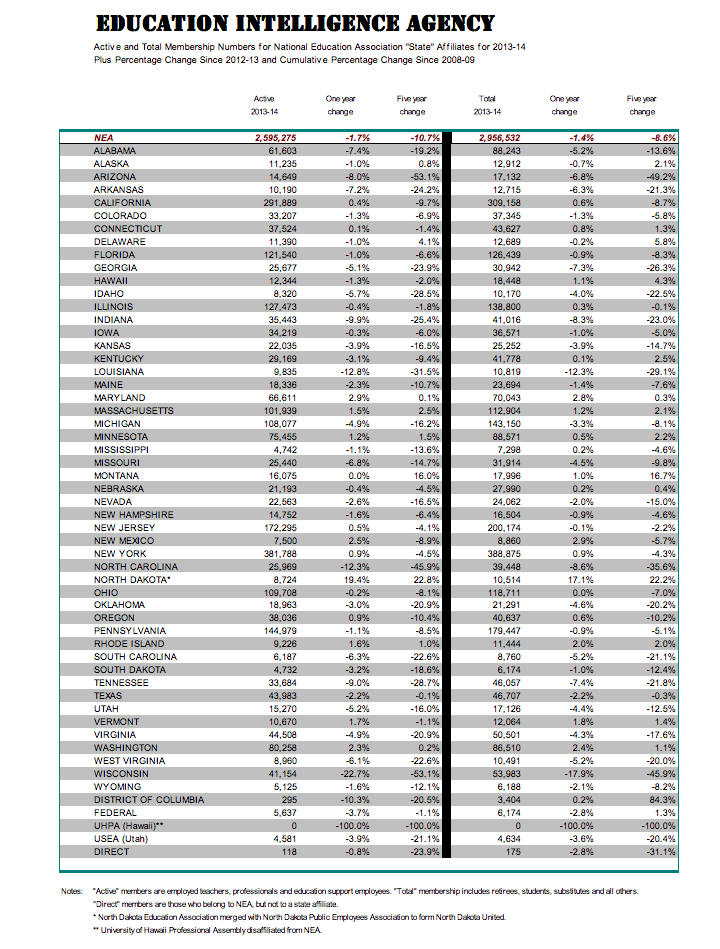
Mike Antonucci of the Education Intelligence Agency (EIA), a one-man contract research firm focused on the inner workings of the teachers’ unions, has compiled a state-by-state chart of membership numbers for the National Education Association (NEA).

The chart contains active and total membership numbers for 2013-14, along with one-year and five-year changes to see how membership numbers have changed over time. Active members are employed teachers, professionals and education support workers. Total membership includes retirees, students, substitutes and all others.

Since last year, the NEA lost 42,000 active members, bringing the union’s total losses among active public school employees to more than 310,000 (10.7%) over the past five years.

Click here for PDF of State-by-State chart. Screen Shot 2015-07-27 at 5.09.18 PM

The charter solution

by Jason Russell
Washington Examiner
July 27, 2015

In the early morning hours of Aug. 29, 2005, Tom and Carolyn Crosby drove through the night to their cottage by Florida’s Gulf Coast to escape Hurricane Katrina. At 6 a.m., they arrived, turned on the television and found good news: The worst of the hurricane was supposed to miss New Orleans.

They went to sleep, ready to drive straight back to New Orleans as soon as possible to reopen their charter school, the International School of Louisiana. But at 2 p.m., they awoke to terrible news.

“There was a whole new world,” Tom told the Washington Examiner.

Ten-foot floods in some neighborhoods. Winds nearly 100 miles per hour. More than 1 million homes damaged and 1,833 people killed.

Economically, Hurricane Katrina — which hit 10 years ago on Aug. 23 — is the worst natural disaster the United States has ever seen. It caused $151 billion in damages. The next-costliest disaster since 1980 caused less than half as much damage, according to the National Oceanic and Atmospheric Administration. Between the immediate evacuations and those in the hurricane’s aftermath, Katrina displaced more than 1 million people.

Among those spread across the country were 372,000 school-age children, enough to fill about 15,000 classrooms. They needed to find schools. Thousands of those students came from low-income families and were already at risk of falling behind or dropping out before their lives were thrown into chaos.

The nationwide charter school community, Tom and Carolyn Crosby included, wasn’t going to sit by and let that happen.

After the storm

Charter schools aren’t traditional public schools, but they are funded by the government. They don’t charge tuition, and they cannot be selective about whom they admit. When a space opens up, a new student is selected though a random lottery system. But compared to traditional public schools, charters have more independence in their operations and curriculum, which is why so many families find charter schools desirable.

By the end of the first day after Katrina hit New Orleans, the Crosbys managed to confirm that half of their students and staff were safe. By the end of the first week, all were accounted for except for two or three students. Eventually, they confirmed that all their students and staff had survived, but they were scattered across the country.

With their lives turned upside down, and unsure whether their home in New Orleans was still standing, the Crosbys set out to reopen their school as fast as possible.

In the immediate aftermath of the hurricane, most New Orleans residents didn’t know whether their homes, relatives, friends or jobs still existed. Given all the uncertainty, it would have been easy and even understandable for them to put off questions about children’s education until everything else was settled. But the national charter community did not want that to happen, so it set out to make educational arrangements as seamless as possible.

“All across the country, schools just responded,” Kara Kerwin, now president of the Center for Education Reform, told the Examiner. “It was a nationwide effort to help families,” and charters were able to do it because of their independence and agility. Kerwin provided access to hundreds of pages of emails and documents from that period. They tell the story of the charter movement’s efforts to help families in the wake of Katrina.

Within days of the hurricane, charter schools from California to Idaho to Pennsylvania were offering open seats to evacuated students. The school year had just begun, and all of the arrangements had to be made on the fly. The Los Angeles Leadership Academy had 10 spots open in the sixth, seventh and 10th grades. It worked with local churches to make sure evacuee families had homes. In Florida, 1,500 seats were available across 23 schools.

To connect evacuee families with schools, the Center for Education Reform coordinated with other groups and schools to set up a national phone hotline. Eight days after Katrina hit New Orleans, the phones opened. It ran seven days a week from 8:30 a.m. to 9 p.m. The center ran public service announcements over the radio to spread the word. The center coordinated the hotline, and businesses donated to support it financially. People even called in to the hotline to offer their teaching skills or to help in whatever way they could.

Staff from the Shekinah Learning Institute, which has multiple campuses in San Antonio, recruited students at the Astrodome, which was being used to shelter thousands of displaced families.

By Sept. 14, a new school was set up in the Baton Rouge River Center. The school served about 50 evacuee children, although that number changed as some families left and new ones entered. The Children’s Charter School and the Baton Rouge Area Foundation each put up $20,000 to get the shelter school off the ground.

Before Katrina

Before Katrina, the public schools in New Orleans were a shameful example of government incompetence. Then-state Rep. Steve Scalise called the system, run by the Orleans Parish School Board, “one of the worst-run public school systems in the country,” in an email to his constituents.

“Before Katrina, New Orleans had what many people would argue was the most-challenged school system in America,” Kenneth Campbell, who was director of charter schools for the Louisiana Department of Education from 2007-10, told the Examiner. Campbell said academic performance and expectations for students were incredibly low.

Before Katrina, barely more than half of New Orleans students graduated. In the 2013-14 school year, three out of four graduated — right in line with Louisiana’s statewide graduation rate.

Nearly two-thirds of New Orleans students attended a failing school before Katrina. Today, just 7 percent do.

In the 2004-05 school year, the average ACT score in New Orleans lagged the state average by 2.8 points. At the close of the school year in 2014, the gap had narrowed to 0.8 points.

The quality of education has dramatically improved since the storm. So have the district’s other problems, which were huge. One was official corruption — bribery, extortion, bank larceny, kickbacks and more — so pervasive that the FBI had its own desk set up within the Orleans Parish School Board offices. Just a couple of examples: One middle school teacher pleaded guilty and another was convicted of conspiracy for altering payroll records to get extra cash. Two other school workers were convicted and another pleaded guilty in the same scheme.

“It was a system that was kind of out of control in a lot of different ways,” Campbell said. “It certainly didn’t have a vision towards improvement.”

“You had a system that was academically bankrupt, it was financially bankrupt and it was facilities-wise, bankrupt. That was before the storm,” Paul Pastorek, Louisiana’s superintendent of education from 2007-11, said at the 2015 American Federation for Children National Policy Summit.

After Katrina, the whole system had to be quickly rebuilt from the ground up, both in terms of facilities and student populations. Administrators had no idea how many students or teachers would return. But that didn’t stop reformers from setting ambitious goals: an all-choice school district with high-quality schools.

Rushing to rebuild

Before Katrina, the International School of Louisiana had two campuses. At one campus, the school rented rooms in a synagogue in New Orleans’ Lakeview neighborhood. The flooding in Lakeview reached 10 feet in some areas. Flooding was so bad that a pit in the synagogue’s worship area had wild fish living inside it a full month after the storm. The synagogue was eventually torn down.

The other campus building was flooded with at least five feet of water. The building survived, but it was in no shape to serve students at the time. So the Crosbys set out to find new grounds.

A parent from the school had been volunteering at a church in Kenner, just outside New Orleans. The church agreed to rent out its Sunday school classrooms and its parking lot, which was used as a playground and a site for trailers to be used as additional classrooms.

The Crosbys’ efforts were slowed by bureaucratic red tape. For example, the school didn’t have any children with disabilities, but government regulations still required ramps for every trailer. The Federal Emergency Management Agency at first agreed to pay for the ramps, then reneged. “That was a big expense,” Tom said.

Every physical improvement required a bid from at least three contractors. But contractors were in such high demand that they often would not submit bids without receiving hundreds of dollars in payment, and there was often a months-long wait until work could begin.

Despite all the obstacles, the International School of Louisiana reopened to 75 students on Oct. 31, just 63 days after Katrina struck New Orleans. It was the first public school to reopen, four weeks before any traditional public school. All of the students had been ones that attended the school before Katrina, with more returning every day.

In mid-October, the city-run school district decided to reopen its first schools as charters. The decision came despite ferocious opposition. At the public meeting where the decision was approved, critics said reopening schools as charters was akin to a “public lynching.”

Critics were concerned about the process: An executive order from the governor waived several rules for the charters, some said they didn’t have enough time to review the proposal to switch to charters, others just didn’t want to hand over public schools to be operated by someone other than the locally-elected school board. Another critic accused the district of “giving away the schools” while dead bodies were still being counted.

By November, the state-run Recovery School District would take over 114 of 131 schools run by the OPSB. The Hynes School was one that reopened as an independently-run charter school within the district.

“[Before Katrina], the school was definitely a place of great academic excellence, although the building suffered a lot of deferred maintenance,” Michelle Douglas, now the principal of Hynes, told the Examiner. Even before the storm, the roofs leaked and halls were used as classrooms. Then Katrina hit, Lakeview flooded and it took Douglas over a week to get back to Hynes, where she had just become an assistant principal. “We just found it completely devastated with seven or eight feet of water.” The building had been stripped of its copper by thieves. It was eventually torn down years later.

In the immediate aftermath, the Hynes School needed a new campus, and it was up to Douglas to find it.

Adjusting to a new normal

The Crosbys had the International School of Louisiana back up and running, but growing pains remained.

FEMA initially told them it could reimburse the school for trailers, plumbing, electricity, the handicap walkways and more. Months later, FEMA reversed course and told the Crosbys they weren’t eligible for any FEMA funds, since their previous leases didn’t hold them responsible for the cost of hurricane repairs.

They weren’t able to hire their English teachers back, so the Crosbys taught the subject themselves. After-school programs took on an extra importance, because parents commuting back from the city were usually delayed by severe highway damage.

At the end of the school year, the Crosbys decided to resign from school administration, although they continued teaching. “With all that, and all the headaches and everything like that, we both say it was our best year of teaching ever,” Carolyn said. “The parents were out of this world, the kids were great, it just felt good.”

Douglas, of the Hynes School, also knows the struggle of working with FEMA. “When you rebuild with a FEMA project, there are many stipulations, there are many requirements,” she said. “There is soil testing. There’s a number of public charrettes, if you will, to have input in what the building should look like.”

Hynes would overcome those barriers to become the first OPSB-rebuilt school in January 2012.

Katrina forced the school to close for the rest of the school year, but it would reopen in August 2006 on two different campuses in New Orleans’ Uptown neighborhood. “We had nothing. We had no furniture, we had no books,” Douglas said. Staff was slim, too: teachers, a janitor, a secretary and herself.

Besides the physical obstacles, there were emotional ones, too. Twenty-eight Hynes staff members lost everything in Katrina. Across the system, schools were dealing with students who returned without their parents. One out of five students in New Orleans was not living at home with his or her parents. Every year when hurricane season began, students lived in fear that another Katrina-level disaster was on its way. “Those kids were challenged beyond belief, and yet they did amazingly well in academic achievement,” Pastorek said.

Extracurriculars were part of the Hynes method to helping kids heal — a welcome distraction from the sad state of New Orleans. Clubs, sports and other activities gave kids something to do while playgrounds were still being rebuilt.

Staff healed by investing all of their time and emotion into Hynes. “This is how we were dealing with our grief,” Douglas said. “We just threw ourselves into this project. Whatever we had to do, we did. And it was hard. But when you have nothing, you’re willing to risk it all, because you have nothing.”

That included switching from a district-operated traditional public school to an independently-operated charter school. Had Hynes stayed under district operations, it would have been closed for five school years instead of one.

“We’ve done it all,” she said. “We’ve moved twice. We’ve shared with two different schools. We have rebuilt a school. And now we stand proud, with 681 students, a pretty significant waiting list, and this is who we are.”

Today, charters flourish

Despite the mass devastation of 2005, signs that Lakeview was once flooded with over 10 feet of water are scarce today. The suburban neighborhood is filled with homes, grassy yards, restaurants, shopping centers and everything else one would expect under normal conditions. Perhaps the only distinguishing factor is that almost every building seems to have been built in the last 10 years.

A high wall and a small road separate Hynes Charter School from the Orleans Avenue Canal, the only one of three New Orleans drainage canals that held during Katrina. Today, the school is located in the same area that its old building stood before Katrina.

The new school building has features that would make many schools jealous, but Douglas insists that the secret behind Hynes’ success is its school pride. “Building that school spirit out of the classroom only enhanced our experience in the classroom,” Douglas said. That extends to the parents, as well.

The school holds events such as picnics and assemblies to build a sense of community. That way, parents don’t just see their child’s teachers once a year at a parent-teacher conference.

That involvement reaches into the classroom. Dawn Lobell, a teacher at Hynes, said she’s been teaching for 17 years but that Hynes is the first place where she knows the parents of every single student. “We are a part of their family now,” Lobell told the Examiner.

The results at Hynes have been nothing short of miraculous. In the 2013-14 school year, nine out of 10 Hynes students were at or above grade level proficiency, compared to seven out of 10 across Louisiana. Of the 1,300 public schools in Louisiana, Hynes is in the 92nd percentile on its state report card.

Douglas emphasized that student behavior and character development are just as important as grades. At the end of the school year, students with good behavior at Hynes are eligible for a special field trip. This year, some students went to Sector 6, a giant trampoline playground, or Kidsports, another giant playground. “We were always at about 60 or 70 percent of our kids being eligible to participate. Lately we’re hitting the 90 percent mark,” Douglas said.

Each grade level at Hynes has three sections of students, one of which is a French immersion section. Native speakers from France, Canada, Belgium and Chad lead these sections. Most of the students don’t speak French at home, but by the second grade they are immersed in the language at school, with only two hours a day taught in English.

Disadvantaged students are able to thrive at Hynes. Almost half of the students come from low-income families that are eligible for the federal free or reduced lunch program. Eighty-four percent of those students are at or above grade level, only slightly lower than the 88 percent figure for all students.

One in 10 students is in special education, with 74 percent of them at or above grade level. Each student with special needs gets an individualized educational plan. Hynes accommodates the needs of these students without segregating them from their classmates.

All the students have plenty of space to play during recess. Hynes has built two $200,000 playgrounds — not with FEMA money, but with funds raised from the local community. All of the school’s bumper stickers on cars in the surrounding neighborhoods tell the story of Hynes pride.

Not every school in New Orleans is like Hynes. But with 90 percent of the schools operating as charter schools, they have the flexibility and the potential to achieve what Hynes has. The failing and corrupt old system is gone, and something unquestionably better has replaced it.

“The academic performance of New Orleans’ schools has improved remarkably over the past 10 years,” Patrick Sims and Vincent Rossmeier, two policy analysts from the Tulane University Cowen Institute for Public Education Initiatives, wrote in a report covering public education in New Orleans since Katrina. “With increasing test scores and graduation rates, everyone involved in education should feel proud of the progress made thus far.”

What’s to come?

There’s no shortage of incredible stories of charter schools going above and beyond to help kids after Katrina. The Knowledge Is Power Program opened its first New Orleans charter school weeks before Katrina. Many of its students evacuated to Houston, enough that KIPP New Orleans West College Prep opened its doors there a month after Katrina.

“A lot of [teachers] within 24 hours of getting the call packed up their car and came to Houston,” Jonathan Bertsch, KIPP New Orleans’ Director of Advocacy, told the Examiner. “We were still in the very early stages of getting the school together, so they didn’t know for sure that they were going to have a teaching job, but they came and wanted to do what they could to help.”

The Houston school’s 400 students had all been evacuated from New Orleans, and came from a variety of schools. The school operated for a couple years while New Orleans was rebuilding.

“It shouldn’t have taken a hurricane. It shouldn’t have taken an act of God to do something about it,” Kerwin said. “The devastation and what happened really shed a light on how dysfunctional the system really was.”

Students that had been almost certainly destined for failure simply by having been born in New Orleans today have the chance to succeed. “There’s nobody that can argue that children are not getting a much better education today than they were getting prior to Hurricane Katrina,” Campbell said.

In May, the first group of kindergartners that started at Hynes after Katrina will graduate the eighth grade and head off to high school. With a long waiting list, Douglas said she’s considering whether Hynes should open a second campus soon.

New Orleans isn’t perfect, but there are lessons that can be learned from its education reforms. The old one-size-fits-all education model is a failure. Flexibility for school leaders can empower them to accomplish amazing things, even in the face of unprecedented adversity. Giving families a choice of where to send their children helps keep schools accountable.

Most importantly, when an education system fails students, don’t wait until God intervenes to fix it.