








Sign up for our newsletter

WA Governor: “Charters appear to have secured funding”

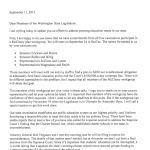
Governor Inslee has said he will not call a special session of the legislature on the matter of charter schools, but recently indicated it appears charter schools have secured private funding to continue operating. In a letter to members of the legislature, he stressed the necessity that students’ education not be interrupted.

Washington state charter schools are doing everything they can to make sure there is no disruption in the education of their 1,200 students.

Click to read letter from Washington State Governor Inslee
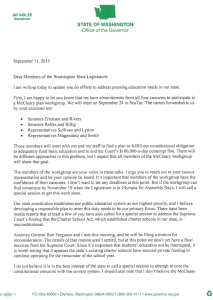
Screen Shot 2015-09-17 at 9.28.12 AM

FROM THE DESK OF… Jeanne Allen, Senior Fellow: Recommendations on the GOP Presidential Debate

In the hands of some very seasoned campaign advisors, most presidential candidates take a safe approach to debates. With a relatively short time to get your talking points out, numerous issues to cover and lots of competitors working hard to hog the stage, they are advised to stay focused. But the measure of a candidate is what they do – and say – when programming is impossible. Who these people are and how they’d do as our president is best measured by dealing with issues that every one of us can relate to, the most communal of issues. That’s why I’m hoping that the candidates find opportunities across every issue to demonstrate their understanding that education is the great equalizer, and its connection to the economy and our international competitiveness, our peace, our safety at home and abroad is all connected to how well we educate our youth and our adults. Education is a big field, of course, so I’ll be looking for the guy or gal who is able to talk about education in the context of the most important current events we face today in improving and revolutionizing our schools. In my book, the candidate who touches well on the following three most important themes will win my vote.

Number One: Celebrate charter schools

Charter schools provide choice and diversity to parents and teachers, and challenge the status quo to do better. They are held accountable by performance contracts and in states where charters are largely independent from state and local bureaucracies they thrive. Charter schools are the reason we talk about standards today, have performance pay and teacher quality on the table and have closed some achievement gaps. Charters have helped breathe new life into cities like Washington, D.C. and New Orleans (just two out of dozens), and brought people back to supporting public education, something that had been in serious decline when they launched in the 90s. Charters are bi-partisan, but they are often underfunded and they threaten the status quo.

PLEASE avoid the trite (and misguided) comment we hear from so many advocates and politicians today that “I support good charter schools and believe in closing bad ones.” It actually means nothing. We don’t have any existing research using randomized controls (the gold standard of research). What we do have is data carefully collected by charter authorizers and by local and regional researchers that reveal major gains over time by charter students in every area where laws are permissive, flexible and parents have multiple options. So please, don’t use data someone on your campaign handed you unless you read it yourself. Instead, talk about what you’ve seen and reflect on the landscape of education reform that has changed the trajectory of education for the better since they began. Two and a half million families and 1.5 million adults involved in charter schooling must know something.

Number Two: Embrace vouchers

Being for school choice is great, because it works. It gives parents the right to have a say in how to educate their own kids, and it’s an important lever for change in the entirety of public education. While you can and should applaud and support the diversity of choice programs that are in place nationwide, it’s also important to use your public position to advocate for expanding the most impactful school choice programs. Today some 14 different school choice programs provide numerous options among private schools to parents who are poor, parents who have children with special needs, parents who live in certain cities, and now, thanks to Nevada, any parent anywhere in that state. Many of these impressive programs provide tax credits and third-party scholarships to families making choices difficult to navigate and often difficult to afford. They are great programs, all of them, and provide parents with some to lots of power. However real power for parents comes from having direct purchasing power in the form of vouchers. Money moves with the parent, putting the school they left in a defensive (and often more competitive posture) and enabling other schools to vie for the privilege of educating their child.

Many legislators, opponents and even advocates point to legal and constitutional barriers as a reason not to push vouchers in a majority of states. We should, however, be willing to challenge the wrongheaded constitutional bans based on religious discrimination, and so my presidential candidate will demand that states not only consider full-scale voucher programs that help the poorest among us, but will challenge any state ban that is rooted in discrimination of any sort to change or be challenged. Let’s get the issue more forcefully on the national table and reengage all in a critical aspect of social justice for all.

Number Three: High standards come in all shapes and sizes

The third principle that my candidate would stand for is a willingness to endorse and support the highest of educational standards, and appreciate that whether or not it sounds chaotic, state and local communities do indeed have every right to determine what they believe are the best standards for their kids. Yes, there is no doubt that uniform expectations for math and reading should be applied to all students, however, when it comes to matters of science, history and literature, expectations for students are wide and varied. Rarely do we hear a presidential candidate demand that we teach our students every bit of foundational content critical for them to be productive actors in our rich American tapestry.

There has yet to be any national effort that fosters among our students a deep understanding of the principles of our nation, important battles fought throughout our nation’s history, aspects of international relations to demonstrate America’s clear exceptionality and the kind of literature rooted in the 18th, 19th, and 20th century. Most common curriculum and standards today are politically correct and emphasize only what is contemporary.

At the national level, when this discussion ensues it normally descends into a battle of what history is most relevant. Most states and local communities understand that’s not acceptable so let’s allow states and communities to battle over standards, which is their constitutional right. Then a president can provide leadership at the national level that simply reinforces and addresses the importance of educational excellence and incentivizes that at the local level.

There are many other things my presidential candidate would do, from ensuring flexibility and freedom for higher-education institutions, to treating all educational organizations regardless of their tax status equally based on results, to reducing bureaucracy that directs states, districts and schools how to spend money they get and at the same time, to being willing to penalize states and communities who treat students and children badly. For now, though, I’ll take the top three.


NEWSWIRE: September 15, 2015

Vol. 17, No. 36

NO SPECIAL SESSION. Seattle teachers are still striking, while charter school students are still in school as the September 24 deadline for a reconsideration of the State Supreme Court ruling declaring charter schools unconstitutional draws nearer.  Supporters called on Governor Jay Inslee to call a special session to #SaveWAcharterschools, but on Friday, the anti-charter school and school choice Governor said he would not call a special session on the matter of charter schools. In the meantime, charter school leaders and teachers continue to do everything in their power to make sure there’s no disruption in schooling for 1,200 students as they work to secure alternative funding to keep their schools going for the duration of the school year.

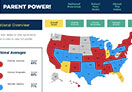
OPPORTUNITY EXPANDED. North Carolina lawmakers have reached a budget deal that expands the amount available for Opportunity Scholarships to nearly $25 million by 2016. The budget awaiting the governor’s signature would allow 6,000 students access to vouchers, a needed increase given the fact that in the first year the scholarships were available, the number of applications nearly doubled the number of scholarships allotted. “Undoubtedly, this is a major win for the thousands of low-income families who’ve desired this Program with over 12,000 applications that have flooded in over the last two years,” PEFNC President Darrell Allison said in a statement.  While there’s still more work to be done in a state that earns a grade of C on CER’s Parent Power Index, this combined with the State Supreme Court’s ruling in July deciding vouchers constitutional are giant steps forward for parent power in North Carolina.

BALTIMORE LAWSUIT. “We were hoping it would not come to this, but we’ve reached a point where we have to stand up for our children and families.” That’s what the principal of a Baltimore City charter school said regarding the lawsuit filed by a group of city charter schools seeking their fair share of funding. According to the Baltimore Sun, these schools are among the highest performing in the city, and they do it with less money than their traditional public school counterparts. Even more frustrating is that of all Maryland districts, Baltimore City spends at or near the top per student, yet just 16 percent of 8th graders and 14 percent of 4th graders are proficient in reading. Inequitable funding has a lot to do with Maryland’s F-rated charter school law, and is exactly why Governor Hogan’s proposal to fix the law should not have been gutted. It’s time for Maryland, a state that ranks 43rd in Parent Power, to take a hard look at its policies and do what’s right for parents and students.

UP CLOSE WITH DEMOCRACY PREP. “Regardless of the route they took to get to school, the Democracy Prep scholars found the same thing once they reached their destination: smiling teachers and principals ready and eager to start a new school year.” That’s an excerpt from Democracy Prep’s new blog started in honor of their 10th anniversary to showcase the stories and achievements of their students and educators. The blog is already jam-packed with stories about scholars winning national competitions and visiting colleges. A great tribute to the over 5,000 scholars Democracy Prep has educated in four regions at 17 schools and one program since it first opened in 2005. Because while policy reports are important in providing guidance on best practices, so too are the day-to-day real results and individual stories that showcase the power of choice and innovation to change trajectories for students, and those need to be highlighted and shared far and wide.

CONSTITUTION DAY. This Thursday, September 17 marks the 228th anniversary of the signing of the U.S. Constitution, a document critical to our nation’s founding. Understanding the system our Founding Fathers put in place years ago – and how the federal government interacts with the states and the governmental powers afforded to each entity – is critical to ensuring the success of education reform. And with the 2016 presidential election drawing nearer, and Congress attempting to reauthorize the Elementary and Secondary Education Act (ESEA), the need to understand the relationship between the federal government and the states is stronger than ever. Read more about the relationship between Constitution Day and education reform at CER’s blog, Edspresso.

10 DAYS. That’s how many days you have left to enroll in EdReformU’s NEW condensed History of Edreform class! Choose between a certificate class, a highly valued course of mentorship and access to the nation’s leading pioneers and experts, or a basic class, with access to all materials and no live classes or homework requirements, allowing you to work at your own pace and participate as you best see fit. Learn more and enroll at university.staging.edreform.com. We look forward to learning with you and arming you with the knowledge and power to lead the next generation of edreform!

Constitution Day and Education Reform

Thursday, September 17 is Constitution Day, marking the 228th anniversary of the document that laid the groundwork for the great experiment that is the United States of America.

Through a series of Articles and Amendments, the Framers of the Constitution provided the blueprint for federalism — that is the way in which the federal government interacts with states, and the governmental powers afforded to each entity.

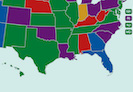
When properly applied, federalism has allowed for governments at each level to function in a way that best serves the American people. The Parent Power Index (PPI) is a reflection of how this system has allowed states to implement their own meaningful reforms that improve student outcomes. PPI actually aids in the federalist process by facilitating the spread of successful programs to other states, as it measures how well state policies and their implementation, in addition to access to information about options, allow for a greater number of excellent education opportunities for the most number of parents.

However, federalism now faces significant challenges, particularly when it comes to education reform.

One challenge to federalism is the debate surrounding the reauthorization of the Elementary and Secondary Education Act (ESEA), at the heart of which is defining the proper role of Congress in education. Lawmakers need to realize that the federal government’s role should be that of assessment and data gathering, while setting up the right balance of carrot and stick when distributing funds to state and local school boards.

Understanding the federalist system the Founding Fathers put in place 228 years ago is critical to ensuring the success of education reform. Failure to achieve the right dynamic does a disservice to the millions of students in need of improved schools and more educational options.

Click here for free educational resources and links to learn more about the US Constitution.

First Day As An Intern

On the way to The Center for Education Reform’s (CER) offices for my first day, I was completely nervous with a million expectations running through my head. While navigating myself from the metro, I basically jogged to get to the office, only to arrive 40 minutes early. No one wants to be late on his or her first day (or any other day), but I made up things to do in order to waste time, as I didn’t want to arrive too early. Already having checked my phone multiple times, I decided to walk around the floor a bit to look for a restroom to assess my outfit (for a third time that morning). I was doing my best to stay calm, but I was so nervous and slightly hot. Somehow I wasted 20 minutes, and decided to go inside 20 minutes early. Upon entering, the internship coordinator, Tyler, graciously welcomed me as if we had met many times before. I instantly enjoyed the office environment and atmosphere. It’s professional, but has a lot of personality, allowing the space to be very comfortable and welcoming. Tyler gave me a very nice CER folder including everything I needed to be informed about CER and my internship. We had a short but fulfilling conversation covering various topics, and then moved on to a quick tour of the office where I was able to meet everyone. My nerves quickly retired as I was beginning to feel more and more comfortable.

As the morning moved along and I became more acquainted with the office and its employees, I began to realize the position I am in being able to work at CER. I really want this internship, not for the title, but to be a progressive vessel in the movement towards positive education reform. While I have recently graduated from college, I am naturally a life long student and I intend to learn as much as I can during my time at CER. I hope to evolve as a professional and improve my approach to academics. Additionally, I am extremely excited to be introduced to new perspectives on the education system, challenge myself intellectually, and increase my overall knowledge on educational policies and the reform movement as a whole. I am looking forward to building relationships and maximizing my time at CER.


Cynphany Brown, CER Intern

WA charter schools ruled unconstitutional by state Supremes

by PG Veer
Watchdog Arena
September 11, 2015

In a 6-3 decision on September 4, the Washington state Supreme Court ruled that the voter-approved referendum to allow charter schools, proposition I-1240, was unconstitutional. The court said that charter schools, since their boards are not elected, cannot be considered “common schools” (i.e. public schools) and are ineligible for public funding.

This decision was met with both surprise and disappointment by the National Alliance for Public Charter Schools, one of the defendants in this case.

“This is the first time such a decision has occurred,” said Nina Rees, president & CEO of the National Alliance for Public Charter Schools. “Charter schools exist in 42 states and the District of Columbia, and they are doing just fine.” She even wondered if the plaintiffs in this lawsuit had an ulterior motive.

When confronted with this charge, Cynthia Stewart, Vice President of the League of Women Voters of Washington (one of the plaintiffs) was puzzled as to “what ulterior motive there could be.” She told Watchdog that “We have worked very hard on the school funding issue for the last few years and believe strongly in the constitutional mandate for ample school funding for all students.”

A study released in 2012 by the Friedman Foundation for Educational Choice found that public charter schools don’t actually drain resources from traditional public schools.

The League also sent a press release saying that they fought charter schools as early as 1996 in order to have “common schools [opened] to all children . . . free, and subject to, and under the control of, the qualified voters of the school district and [not] publicly funded experimental schools whose management was not controlled by and accountable to the voters.”

In reality, charter schools are more accountable than traditional public schools because their charters can be revoked if they do not perform. Of course, the teachers’ unions don’t like that, but they do like this court decision.

“Charter schools steal money from our existing classrooms, and voters have no say in how these charter schools spend taxpayer funding,” said Kim Mead, president of the Washington Education Association.

But they may ultimately have a say in the matter. Rees and her defendant allies will try to work with Governor Inslee in order to at least allow the schools to remain opened for the rest of the year. That might prove to be futile as the Center for Education Reform doesn’t see Inslee as a big fan of charter schools and school choice.

School choice supporters are considering another ballot initiative, this time to amend the constitution to allow charter schools to receive public funding by having an elected board. The next election will be next year.

In the meantime, “we are confident. We have the data and stories on our side,” Rees said. The NAPCS is very active on social media to raise awareness about the battle over school choice in Washington. They actively tweet their concerns using the hashtags #saveWAcharterschools and #EdJusticeforWA.

City charter schools file lawsuit against school system over funding

By Erica L. Green
The Baltimore Sun
September 10, 2015

A group of Baltimore city charter schools has filed a lawsuit against the Baltimore city school system, alleging that the district’s funding formula for charters violates state law and threatens their ability to serve thousands of students.

“We were hoping it would not come to this, but we’ve reached a point where we have to stand up for our children and families,” said Danique Dolly, principal of City Neighbors High School, one of the schools that filed a suit Thursday in Circuit Court.

The schools say the district has not met its contractual obligations to charter schools, and a new funding formula announced this week would drastically reduce funding at 26 of the district’s 34 schools, leaving more than one dozen of them struggling to pay for books and teachers.

The schools seek a monetary judgment of at least $75,000.

The schools are among the highest-performing in the city, and many have waiting lists: Afya Public Charter School, three City Neighbors charter schools, Green School of Baltimore, Patterson Park Public Charter School, Southwest Baltimore Charter School and Tunbridge Public Charter School.

Combined, the schools serve 3,600 of the district’s 13,700 charter school students.

READ MORE

Responding to NEA President: Caveat Venditor

A blog post by National Education Association President Lily Eskelsen Garcia has popped up a few times with little to no traction, so ReformerRed isn’t going to help the piece along by linking to it here. However, it is worth addressing to set the record straight.

Garcia warns caveat emptor! Let the buyer beware when seeking alternatives to failing public schools.

Supporters of education reform in the United States argue the opposite. Caveat venditor! Let the seller (in this case, Garcia and the Status Quo) beware when the product fails to meet the standard of quality consumers expect and deserve.

Of course, caveat venditor has little meaning in a market where only one product sits on the shelf and the consumer is deprived the freedom of choice. That’s the current monopoly Ms. Garcia advocates for today – a world in which parents and children have been forced to accept flat achievement scores for the last forty years, despite huge increases in education funding. Students dropping out or failing to graduate remain high especially among African-American males, and parents of minority students must continue to accept wide racial achievement gaps year after year.

Why? Because for most families, it’s the only game in town.

Despite Ms. Garcia’s assertions to the contrary (assertions based largely on statistics from OECD nations whose public education systems rank far above our own in terms of achievement), parents and children are best served by an open market that forces schools to take responsibility for their educational mission – and that empowers parents and children to opt for a different school when that mission is neglected.

It’s simple economics. Monopolies harm consumers. It’s why we have antitrust laws that govern nearly every industry in the U.S. other than the one that matters most – public education. Caveat venditor puts the customers, parents and students, first. Where else is that more critical than in securing a bright future for our children?

It’s ironic that Ms. Garcia evokes the “buyer beware” mantra given that the product she’s pushing is the one parents are most wary of today. Instead of employing scare tactics and arcane statistics from half a world away to make the case that traditional public schools are doing just fine, she ought to be asking herself why the product she’s pushing is losing customers in droves when they are afforded the opportunity to choose something better. She might also ask herself why teachers themselves are becoming increasingly wary of the monopoly.

Around 300,000 children attend private schools of their parents’ choice thanks to private school choice programs, now enacted in over half the states. And three million students attend close to 7,000 charter schools in 43 states and the District of Columbia. In fact 95 percent of parents whose children participate in the D.C. Opportunity Scholarship Program are satisfied with their choice, and with a 21 percent increase in graduation rates for those students, it’s no wonder parents in the nation’s capital are happy.

By the time a charter school student in New York City has reached the end of eighth grade, research show that she will be scoring about 30 points higher in math than she would have been scoring if she had been lotteried-out and remained in the regular public schools. To put this into perspective, 93 percent of scholars at Success Academies in New York City passed the state math exam, compared to only 35 percent of students citywide.

There’s also no denying the return on investment when looking at the cost effectiveness of charter schools and their student outcomes compared to their traditional public school peers.

When parents hold one product up against the other, there’s no comparison.

That’s why Ms. Garcia and the NEA want to maintain their monopoly. When parents and children are given options, failing traditional public schools lose out to the superior product – school choice.

So if and when you stumble upon Ms. Garcia’s blog, or the countless others generated by the Don’t Worry Be Happy crowd trying to perpetuate myths about school choice, keep a third Latin phrase in the front of your mind. Caveat lector. Let the reader beware.

Kara Kerwin is president of The Center for Education Reform, the pioneer and leading voice for substantive change that transforms learning opportunities and outcomes for America’s children. Additional information about CER and its activities can be found at www.staging.edreform.com.

My First Day At CER

I am ecstatic to begin my journey as an intern here at The Center for Education Reform (CER). As a senior at The George Washington University majoring in human services and social justice, I have been required to take service-learning classes throughout my collegiate career. Thus far I have volunteered as an English as a second language tutor through D.C. Reads, an organization aimed at improving literacy rates in public schools in D.C. In addition, after the completion of my study abroad program in Tunisia this past semester, I worked at the Berlitz Language Center, and taught English to children ages seven through seventeen years old.

I immensely enjoyed my experiences in these classrooms, and through my experiences attending public school myself, have recognized the importance of establishing a strong and efficient education system through these truly transformative years. There is a lot of work to be done in perfecting a constantly changing system that will prepare our future leaders and contributing members of society in their endeavors.

Even though it has only been a couple of hours in the office, I am inspired by the enthusiasm and passion for education reform by all working for CER. As a political science minor, I am so excited to learn more about the process of policy reform, and to experience the education system through a different lens. I am looking forward to learning more about education reform policy and working hard to aid in accomplishing CER’s goals.

Karina Lichtman, CER Intern

NEWSWIRE: September 9, 2015

Vol. 17 No. 35

#SAVEWACHARTERSCHOOLS. As Americans were getting ready to enjoy Labor Day weekend late Friday afternoon, the Washington State Supreme Court handed down a ruling that deemed the state’s newly opened public charter schools – which were filled to capacity – unconstitutional. Rick Hess calls this move “especially gutless,” and we have to agree, especially when you consider the facts. Charter schools are serving more Title I students, are oversubscribed because students WANT to be there, and the justices who decided to go against charter schools received money from – guess who – the Washington State teachers union. Pretty sickening to think about how political this decision was when it’s kids futures that are on the line. Thankfully, charter school leaders and teachers are doing everything in their power to ensure there’s no disruption in schooling for the 1,200 public charter school students while local and national leaders press Governor Jay Inslee to hold a special session to address the state’s charter law. You don’t have to live in Washington State to call on the governor to do what’s best for kids. Take Action NOW at http://p2a.co/savewacharters to tell the governor that public charter schools must remain open for students.

HIGH DEMAND. It’s no secret that charter schools across the nation are achieving great outcomes for kids, despite what status-quo groups like teachers unions are trying to tell the public. In Washington State, while charter schools are new and the law is limited, parents will tell you first-hand that their children are better off in these schools:

Washington Mom @JessicaLinford tweets: @GovInslee This school has changed our lives. Please help us WAcharterkid#SaveWAcharterschools 

Spokane International Academy (SIA) parent says: “In the few short days that SIA has been open we have seen a drastic difference in our son between this year and last year. He is happy. He is more confident. He knows he can do this. He knows it’s ok to make mistakes. He knows he is going to grow. He is relaxed. We chose SIA because of the academic rigor, the foreign language, and the overall concept of REACH. We see it in action already. The topics covered at Open House showed the innovation and commitment that your staff has brought to the table. We are proud of what you and the team have put together so far. We appreciate all of you fighting for a different kind of education for students. The kind of education we want for our children.”

Even a former Colorado charter school student who is now living in Washington State, beamed she got the “best education ever” from her charter school and commented on Facebook after the ruling asking how the public can help. “I don’t have kids and don’t have any affiliation with SIA,” she said, “but… I work with at risk youth and one of the problems is that a lot of kids get lost in the shuffle of public schools and a traditional education is not what they need.”

STRIKE. It looks like the BLOB in Washington state is determined to keep kids out of any school, as new broke today of Seattle teachers going on strike, leaving 53,000 traditional public school students stranded on what was supposed to be their first day of school. Meanwhile, you’ve got charter school students in seats despite a ruling that their school is technically “illegal” because the teachers, kids, and families all want to be there, and will do whatever they can to make sure students don’t lose valuable learning time. Or as Rick Hess puts it, “We’ll see if Washington State’s myopic mandarins really have the nerve to ask law enforcement to shut down these ‘speakeasy’ schools in order to stop the state’s charter school students from illegally pursuing a public education.”

MILLION DOLLAR DEBATE. Back in 2010, Facebook co-founder Mark Zuckerberg pledged $100 million dollars to Newark to improve education in the New Jersey city. Today, that amount is more along the lines of $200 million, and there’s debate over whether that money has truly had an impact. While a portion of funds have helped the proliferation of charter schools, and has actually resulted in a nearly nine percent increase over three years in reading achievement for third graders, a majority of the money has gone towards conducting business as usual, which doesn’t translate into results for kids. The biggest portion of money has gone towards retroactive pay and merit bonuses for teachers, however because of political pressure from unions, test scores count for 10 percent rather than the original proposal of up to 30 percent in overall evaluations. The lesson here is that money will only go so far without systems in place that foster innovation and permit teachers to set high expectations with newfound resources.

ELSEWHERE IN NJ… The NJSCERA is hosting a conference on September 22 on the Camden Public School System, exploring the question of whether it can serve as an effective example of urban school reform for the country. Visit here for details and registration information.

MAKE HISTORY… Don’t repeat it. That’s the goal of EdReformU™, the nation’s first and only effort to create a higher education certificate program to inform, educate and arm the next generation of leaders to make real change happen in America’s schools. Interested in enrolling? Don’t miss your chance! Space is limited, and you must enroll by September 25. Visit university.staging.edreform.com for more information.