









Sign up for our newsletter

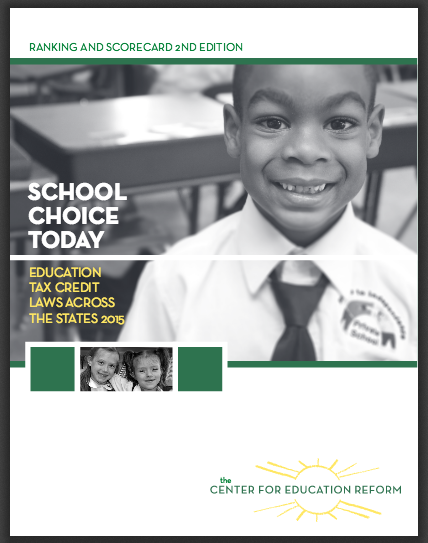
Education Tax Credit Laws Across the States Ranking and Scorecard 2015

Press release

Of the 16 states that have education tax credit programs, only five earn grades of A or B on the second edition of Education Tax Credit Laws Across the States, Ranking and Scorecard 2015 released September 30, 2015 by The Center for Education Reform (CER).

The report provides analysis and state-by-state comparisons, ranking states not only based on the law itself, but real results of programs. The Education Tax Credit Laws Across the States, Ranking and Scorecard 2015 methodology has been revamped from last year’s analysis, placing greater emphasis on participation and implementation, and taking a deeper look at rules and regulations governing programs.

Click here to read School Choice Today: Education Tax Credit Laws Across the States 2015 Ranking and Scorecard
Screen Shot 2015-09-29 at 10.48.01 PM

Access last year’s report here: School Choice Today: Education Tax Credit Scholarships Ranking & Scorecard 2014

The Beginning: CER Intern Chronicles

I am a bit of a nomad. As a kid I moved across the country multiple times; Hawaii, California, South Dakota, Arizona, and South Carolina. Now I am living and working in Washington DC, but I always struggle when people ask me where I am from. It’s a serious identity crisis.

But when people ask me what I want to do when I graduate, or what I am passionate about, I respond with no hesitation or internal debate. “I love education policy.”

Since beginning a policy research project at my first Washington DC summer internship with the Council of State Government (CSG), and picking up my first policy report on school leadership, I knew that I was in love with education policy and research. I have always enjoyed my time spent in school, but I never expected that I would pursue a career in education. However, the more I have learned about the flaws plaguing the schools, especially those in our urban centers, the more I feel compelled to be a part of the solution.

I am not sure exactly where I will fit into the broader picture of improving urban education for the United States, but this semester I am spending the first part of my senior year at Wofford College studying and working in Washington DC. I am spending my mornings working in Senator Tim Scott’s office; I chose to work with him because of his commitment to school choice policies and position on the Senate Health, Education, Labor and Pensions (HELP) Committee.

And in the afternoons I am excited to be working with the Center for Education Reform. I believe that splitting my time between the US Senate and a nationally known education organization will give me a unique and diverse perspective on education policy, research, advocacy, and legislation. There is so much that I hope to learn this semester with CER, but most importantly I want to learn about charter school development, management and expansion. I hope to understand which policies create a favorable climate for charter development, how to best advocate for those policies, and how to get families and communities engaged in discussions about their schools.

It has already been an amazing first day as an intern at CER and I can’t wait to see what the rest of this semester has in store for me.

Lindsay Uhlinger, CER Intern

NEWSWIRE: September 29, 2015

Vol. 17, No. 38

MORATORIUM MADNESS. Nearly all Chicago aldermen (42 out of 50) have signed a resolution seeking a moratorium on new charter schools in the Windy City and across the state. The Illinois Network of Charter Schools says it best, writing the proposed moratorium is misguided and fails to acknowledge the reality that “60,000 Chicago parents have chosen to send their children to charter schools, and thousands of students continue to languish on charter school waitlists.” Those in favor of the moratorium are using the budget crisis as an excuse, saying that the city can barely afford to fund neighborhood schools, however this excuse is a tired one, and the reality is that charter schools have proven time and again to provide a bigger bang for buckTake action now to let Illinois officials know that you do not support action that limits educational opportunities for children.

#SAVETHECHARTERSBMORE. This weekend 1,500 students, parents, teachers, and community members gathered in their #SaveTheChartersBmore shirts to rally in support of fair funding for Charm City public charter schools. The Maryland city’s 34 public charter schools educate nearly 14,000 students, and have more than 5,500 kids on wait lists – a clear sign that parents want more choices when it comes to their children’s education. The City Council voted unanimously to call on the school system to withdraw the proposed funding formula that would’ve reduced funding for charters, however next year’s funding remains unclear, reports the Baltimore Sun. Sadly, inequitable funding issues are just one of the many weaknesses of the state’s F-rated charter school law, and is why CER spoke out so strongly when the legislature gutted Governor Hogan’s proposal to improve the law for a state that ranks 43rd in Parent Power. Go to savethechartersbmore.org to make your voice heard.

COLORADO CHALLENGE. Late last week, news broke that Colorado parents are asking the U.S. Supreme Court to review the constitutionality of the Douglas County voucher program, which was ruled unconstitutional by the Colorado Supreme Court in June 2015. The program was ruled unconstitutional on the grounds of the state’s Blaine Amendment provisions, which place restrictions on aid to religious schools. The district contends Blaine Amendment provisions were designed as a result of anti-Catholic bias, and not only that, but since vouchers are provided directly to students, which are then paid to private schools by parents, funds technically do not flow directly to religious schools. Blaine Amendments have caused problems for school choice in other states, such as Florida and Michigan, however, North Carolina’s Blaine Amendment was not an issue for the state’s voucher program, which was not only recently ruled constitutional by the North Carolina Supreme Court but also expanded in the latest state budget. Here’s to hoping this case ends with a victory for Colorado #ParentPower.

#SAVEWACHARTERS FIGHTS ON. On September 24, the date of the original deadline to file a motion for reconsideration regarding the Washington State Supreme Court’s ruling of charter schools unconstitutional, Attorney General Bob Ferguson officially asked the state’s high court to re-evaluate its decision. But he’s not the only attorney general to think the charter school decision is mistaken and should be reversed, as four others have spoken out against the ruling. Kudos to the Washington official for questioning the ruling and “standing up for children and parents who have been stripped of a voice,” said CER President Kara Kerwin, “considering that Washington voters by a majority voted for parent power.”

BOEHNER BIDS FAREWELL. Last Friday, House Speaker John Boehner announced his resignation as speaker and from Congress at the end of October. In 2011, Boehner was honored with an EdReformie award for his achievements in creating opportunities for students and advancing substantive change in U.S. education. He’s been a tireless supporter of school choice who has never let political pressure get in the way of doing what’s best for kids, most notably his efforts to restore funding for DC’s voucher program. Thank you Speaker Boehner for being a champion for #ParentPower.

GET EXCITED… CER’s Education Tax Credit Laws Across the States, Ranking and Scorecard 2015 is out tomorrow! After our inaugural analysis last year, we’ve tweaked the methodology, placing far more emphasis on participation and implementation, taking a deeper dive into rules and regulations governing education tax credit programs. Because without considering implementation and participation, even the best-written school choice law is rendered meaningless.

Washington Yu Ying Charter School Recognized For Excellence By Michelle Obama

This weekend, First Lady Michelle Obama, Madame Peng, wife of President Xi of China, and students from the Washington Yu Ying Public Charter School, attended the naming ceremony of the new baby panda at the National Zoo in Washington, D.C. (his name is Bei Bei!) At this ceremony, the Yu Ying School was recognized by Michelle Obama for being part of the steps forward toward reaching the goal that President Obama and President Xi established: an initiative to teach one million students in the U.S. to speak Mandarin Chinese by the year 2020, the One Million Strong initiative.

Yu YingModeled after a girls’ school founded in 1911 in Beijing, China, the Yu Ying Charter School provides Chinese language immersion with the structured inquiry approach of the International Baccalaureate. The school provides children in grades PreK-5 with the opportunity to a quality public education and Chinese language and culture immersion.

Michelle Obama recognized that students at the Yu Ying School are among the first to be in an immersive school that promotes the idea of global citizenship, and the ability to connect with people around the world due to their early exposure to a different language and culture. She emphasized that this generation does not need to leave the country to be exposed to the rest of the world. That all is attainable with Internet access, and that Yu Ying students have the ability to extend their community across the world as they have the skills to do so. The First Lady encourages students worldwide to follow the Yu Ying students in their journey to expand their communities past language and cultural barriers.

Karina Lichtman, CER Intern

CER Applauds Washington State Attorney General Asking to Reconsider Charter School Ruling

September 25, 2015

Kara Kerwin, president of The Center for Education Reform (CER), issued the following statement on the Washington State Attorney General filing a motion for the State Supreme Court to reconsider the unconstitutional charter school ruling late yesterday:

“Attorney General Bob Ferguson is absolutely right in questioning the State Supreme Court’s ruling of charter schools unconstitutional. He’s standing up for children and parents who have been stripped of a voice in this ruling, considering that Washington voters by a majority voted for parent power.”

BACKGROUND:  On Friday, September 4, 2015, the Washington State Supreme Court ruled charter schools unconstitutional on the basis that public charter schools are not “common schools” because they are not overseen by local school boards, and thus cannot receive public funds. In 2012, Washington voters approved  charter schools, making their charter school law the 43rd charter school law in 42 states plus the District of Columbia.

NEWSWIRE: September 22, 2015

Vol. 17, No. 37

CATHOLIC SCHOOL SPOTLIGHT. In honor of the Pope coming to town, we’re highlighting a few facts about Catholic schools, a rich tradition in U.S. education that has provided an alternative education to many families. Catholic schools’ academic and community benefits are many, and while Catholic schools have struggled to survive, a report from Faith in the Future indicates they’re making a comeback in Philly thanks to innovative thinking and business models. With most states earning less than satisfactory grades on Parent Power, it’s critical these schools that save money while positively impacting student achievement and communities remain part of the fabric of choice for U.S. parents, and that more is done to provide access to all parents who wish to choose this type of education for their child.

WA SUPREME COURT GRANTS EXTENSION. The Washington State Supreme Court has granted charter schools additional time to file a Motion for Reconsideration regarding the ruling that came Labor Day weekend that found the alternative public schools unconstitutional. The deadline has been extended from September 24 to October 23. This means that all nine of the state’s charter schools, which remain open and continue to do everything in their power to ensure there’s no disruption in valuable learning time for students, will receive their public allocations until the new October deadline. It also suggests that the court is fully aware of the collateral damage of the ruling, giving charter schools additional time “to thoroughly explore the Court’s decision and the full range of its legal implications.”

ESA LAWSUIT. It seems that with every new school choice program comes a legal challenge, and this is in fact the case with Nevada’s new Education Savings Account (ESA) program. “It’s sickening that a group with the slogan of protecting individual rights and liberties is in fact doing the opposite and challenging a program that would give parents the freedom to exercise their right to ensure their child gets the best education possible,” said CER president Kara Kerwin when news of the lawsuit broke late August. Thankfully, history has been on the side of parents and students when it comes to legal challenges against school choice (most notably in the 2002 U.S. Supreme Court Zelman v. Simmons-Harris case, and most recently in North Carolina), and a national law firm with experience defending parents and students’ rights has been hired to help in Nevada. Five families have boldly joined the Institute for Justice (IJ) to defend the ESA program intended to give nearly all Silver State parents a choice in how to use education funds best in order to fit their child’s unique individual learning needs.

NEW VISION FOR PARENT POWER. Great Lakes State lawmaker Rep. Tim Kelley (R- 94th District), Chair of the Michigan House Appropriations Subcommittee on School Aid and Member of the House Education Committee, last week released his own vision for Detroit schools. This plan comes as both Gov. Snyder and the Coalition for the Future of Detroit School Children released their own proposals to improve education conditions in the Motor City. Rep. Kelly’s plan aims to expand school choice and empower parents, even going as far to suggest “Parent Power Cards” in light of the barrier that is the state’s Blaine Amendment. Despite that constitutional barrier, we applaud this leader for championing the idea that we must create conditions that put parents, not bureaucrats, in the driver’s seat when it comes to education.

REJECTED DESPITE DEMAND. A proposed arts charter school in Georgia, Columbia County School for the Arts, wants to be the first charter school in its county and provide an arts-based curriculum for students in grades K-12. Many local community members have expressed their support for the school, which is evident by the 900 students preregistered for just 794 spots. However, the school has been denied not once, but twice, by the state charter commission, even after many of the commission’s concerns regarding the school’s application were addressed. Now, the school is going back for another try for approval from the commission. This school’s struggles are why we continue to advocate for multiple and independent authorizers; charter school commissions are not independent from the traditional education bureaucracy, and are often antagonistic and the antithesis of the charter school concept. An effective “commission” requires complete independence to have a positive impact on the development of more and better education opportunities for students.

COMING SOON. Stay tuned for CER’s Education Tax Credit Laws Across the States 2015 Ranking & Scorecard out next week!

Catholic School Facts

In honor of the Pope visiting Washington, D.C. this week, we’re highlighting a few facts on Catholic schools, which have been and continue to be an integral part of education and parental choice in the United States. For more information, visit the U.S. Conference of Catholic Bishops website and the National Catholic Educational Association website.


DEMOGRAPHICS & COST

  • In 2014, about 49.8 million children attended public schools; 4.5 million children attended private schools, with 2 million in Catholic schools. (NCEA)
  • 99% of students who attend Catholic high school graduate. Of those, 86% attend 4-year colleges. (NCEA)
  • The minority population accounts for 19.8% of the Catholic school population (15% Latino; 8% Black/African American; 5% Asian American; 5.6% Multiracial). (NCEA)
  • 45% of Catholic schools in the United States participate in Federal Nutrition Programs, which provide over 270,000 free meals to children daily.
  • The mean cost per pupil at Catholic schools is $5,847; the national per pupil average is $12,054). (NCEA; National Center for Education Statistics)
  • Catholic schools provide over 24 billion dollars a year in savings for the nation. (NCEA)


CIVIC BENEFITS

  • Catholic schools tend to operate as communities rather than bureaucracies, which links to higher levels of teacher commitment, student engagement, and student achievement. [1]
  • The Catholic school climate, mission, and purpose positively impact student achievement and attendance. [2]
  • A faith-based orientation builds coherence and integration of schools and school community.[3]


[1] Marks, G. (2009). Accounting for school-sector differences in university entrance performance. Australian Journal of Education, 53, 19-38.  [2]Bryk, A.S., Lee, V.E., & Holland, P.B. (1993). Catholic Schools and the Common Good. Boston: Harvard University Press. [3] Ibid.


Catholic schools are sacred places helping to build a better society:

  • Graduates of Catholic high schools are more likely to vote. (Cohen & Chafee, 2012)
  • Catholic school graduates enjoy higher earning potential than public school graduates. (Neal, 1997, p. 108; Owyang, and Vermann, 2012, p. 4)
  • Catholic school graduates are more civically engaged, more tolerant of diverse views, and more committed to service as adults, and less likely to be incarcerated than their public school peers. (Campbell, 2001)


Catholic school emphasis on community stimulates parental engagement:

  • Inner-city Catholic school parents report taking an active role in their children’s education, and they believe that participating in the Catholic school community represents an opportunity to break the cycle of poverty. (Stewart, Wolf, et. al, 2009)


Catholic schools generate social cohesion and preserve civic order in the local community:

  • Neighborhood social cohesion decreases and disorder increases following the closure of a Catholic elementary school. (Brinig & Garnett, 2010, p. 890 )
  • Police beats in Chicago that experienced at least one Catholic school closure had a higher crime rate than those in which there were no closures. (Brinig & Garnett, 2011, p. 906)


ACHIEVEMENT

  • In Catholic schools, the student achievement gap is smaller than in public schools.[1]
  • In Catholic schools, overall academic achievement is higher. [2]
  • In Catholic schools, student math scores improve between sophomore and senior years.[3]
  • Latino and African American students in Catholic schools are more likely to graduate from high school and college. [4]
  • Students with multiple disadvantages benefit most from Catholic schools.[5]


[1] Jeynes, W.H. (2007). Religion, Intact Families, & the Achievement Gap. Interdisciplinary Journal of Research on Religion, 3, 1-24; Marks, H.M., and Lee V.E. (1989). National Assessment of Educational Proficiency in Reading 1985-1986: Catholic and Public Schools Compared. Washington, DC: National Catholic Educational Association.  [2] Coleman, J., Hoffman, T., & Kilgore, S. (1982). High School Achievement: Catholic and Public Schools Compared. NY: Basic Books; Sander, W. (1996).Catholic Schools: Private and Social Effects. Boston: Kluwer Academic. [3] Covay, E., and Carbonaro W. (2010). After the Bell: Participation in Extra-Curricular Activities, Classroom Behavior, and Academic Achievement. Sociology of Education, 83(1), 20-45.  [4] Jeffrey Grogger and Derek A. Neal; “Further Evidence of the Effects of Catholic Secondary Schooling,” Brookings-Wharton Papers on Urban Affairs, 2000, pp. 151-93.  [5]  Derek A. Neal; “Measuring Catholic School Performance.” Public Interest, 1997, (127), pp. 81; Derek A. Neal; “The Effects of Catholic Secondary Schooling on Educational Achievement.”Journal of Labor Economics, 1997, 15(1, Part 1), pp. 98-123; Evans, W.N. & Schwab, R.M. (Nov. 1995). “Finishing High School and Starting College: Do Catholic Schools Make a Difference?” Quarterly Journal of Economic, vol. 110, no. 4, 941-974.


WA Charter School Update: Motion for Reconsideration Deadline Extended to October 23

September 21, 2015
from the Washington State Charter Schools Association:

State Supreme Court Grants WA Charters Additional Time to File Motion for Reconsideration


Last Friday, the State Supreme Court granted a request by the Washington State Charter Schools Association (WA Charters) to extend the deadline to file a Motion for Reconsideration to October 23. This additional time gives WA Charters and our member public charter schools an opportunity to thoroughly explore the Court’s decision and the full range of its legal implications.

For example, the minority opinion argues that the same glitch the Court says disqualifies public charter schools from receiving public funding could also de-fund Running Start, tribal compact schools, schools for the deaf and blind, and any other public school program that isn’t directly supervised by an elected board. We requested more time to dive deeper into the ruling and its implications, and the Court has agreed.

In the meantime, all nine public charter schools remain open and continue to serve, engage, and inspire around 1,300 students across the state. Deanne Hilburn, whose sixth grade son Austin is attending Excel Public Charter School in Kent, said she is “so frustrated and angry” that this new and excellent school option could be taken away from her son. At Excel, Austin is thriving and more excited about learning than his mom can ever remember.

WA Charters will spend the next month preparing a Motion for Reconsideration and examining every possible option available to us to keep these public charter schools open for children like Austin for the remainder of the school year, and ensure parents and communities have high-quality public charter school options well into the future.

###

Show your support for charter schools on social media with the hashtag #saveWACharterSchools!

Ten Years After Katrina

After attending the event Ten Years After Katrina: Education Reform in New Orleans at the American Enterprise Institute, I am left with many thoughts. A bit of confusion of course, since I am still learning when it comes to education reform and all of the technicalities that come with it, but I was also very unsettled and surprised. I had no idea until I started interning at The Center for Education Reform (CER) of all of the organizations, people, and work put into reforming education. I also would never have guessed that there were conferences held in Washington D.C. that focus on New Orleans’ successes and struggles (specifically regarding education) still 10 years after the hurricane hit.

The speakers began from a general viewpoint, talking about education, and focusing on areas such as Memphis, Tennessee and Boston, Massachusetts. I really liked the fact that people and organizations care and are passionate about school systems in other cities. The panelists were so knowledgeable about these cities; they were shooting out statistics left and right, as well as answering in-depth questions. I applaud their knowledge and passion of education.

Although I was so impressed by the knowledge of the speakers, in my mind I still always ask one question: How much do conferences, policies, and formal business meetings really help? The real world is so much different than a formal business conference – there is such a big gap between what is happening in New Orleans (and all over the country) and what the speakers are saying. So many people from the audience ask “so HOW do we do this?” and sometimes the panelists would say, “The only question is HOW do we keep this policy in place and functioning?” There are so many “how” factors that it is quite overwhelming. One panelist said “kids can’t put their education on hold and keep waiting for adults to get their act together!” I agree with that and it reminded me of the situation in Washington State where children and families have their charter school seats threatened by the adults/courts who are making the decisions. However, on a positive note, people are getting their act together by having conferences, being concerned, and opening organizations that work for education reform. Although I previously said that it is hard for me to understand how conferences and talking and such will actually help to make a change, in the long run I know it does.

Overall, this conference was a great experience and very eye opening. There is no simple solution to anything, as I used to think. I now am beginning to understand all of the technicalities of education reform, whereas I didn’t as much before. I like knowing that there are people working to help cities such as New Orleans, and many other places across the country. I had a very nice time and I hope I am lucky enough to attend another conference sometime soon!

Gianna Manzella, CER Intern

Desperate families losing education options in Washington state

By Jason Russell
Washington Examiner
September 21, 2015

“He was just getting angry and frustrated. Crying every day. Stomach aches. Chronically ill. Biting his fingernails until his fingers bled,” Deanne Hilburn told the Washington Examiner about her son Austin’s experience in a public school in Washington state. “He was very stressed.”

Then Austin got the opportunity to attend Excel Public Charter School, in Kent, Wash.

“Even though school is hard work, it’s fun. I never get bored, and my environment is relaxing,” Austin told his mom.

A remarkable transformation, made possible by a public charter school.

“My daughter is pretty well-off academically,” Jessica Garcia told the Washington Examiner about her daughter Isadora. “Because Isadora was ahead of most of the class, she ended up becoming a tutor because the teacher couldn’t advance learning.” Eventually, helping other students became the main focus of Isadora’s school day, meaning she couldn’t advance further on her own. “I feel for the general population, but my daughter needs an education now.”

Enter Destiny Charter Middle School, in Tacoma, Wash. The school opened in August, and now Isadora gets a customized education.

“Each kid is taught based on their personal academic level, so they’re constantly assessed, and their individual lessons are tailored to where they are academically,” Garcia said about life at Destiny. “It doesn’t matter where your kid is, they’re going to be brought to where they need to be, they’re going to be challenged to advance.”

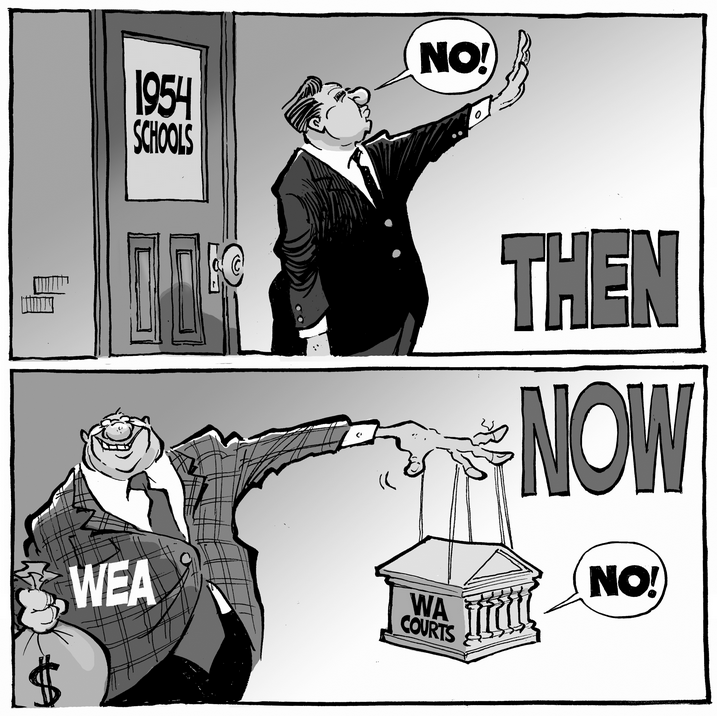
Screen Shot 2015-09-21 at 9.24.07 AMSadly, public charter schools in Washington state face an uncertain future. On Sept. 4, the Washington State Supreme Court ruled the state’s charter law unconstitutional. The lawsuit, and the election of several state supreme court justices, was funded by the state’s largest teachers’ union. The court said the schools cannot receive state funding because they aren’t “common schools” with elected school boards, like traditional public schools.

Charter schools are scrambling to get the law fixed, but Gov. Jay Inslee, a Democrat, says he won’t call a special legislative session to pass a new law. Instead, schools will have to seek legal options. Fortunately, both Excel and Destiny have enough private funding to remain open for the rest of the school year.

Traditional public schools weren’t right for their children, but the Hilburns and the Garcias don’t blame their students’ former teachers.

“Teachers were always wonderful, it was just we were at that cap point when we couldn’t open up another classroom to make the classes smaller,” Hilburn told the Examiner.

Garcia places some blame on the school district. “It’s not the teachers’ fault,” she said, “it’s just the way our districts are set up. They don’t leave room for innovation. They don’t leave room to have the freedom to hold students accountable.”

Hilburn and Garcia are very impressed with their children’s charter school teachers. “They treat each child like an individual. I was amazed the second day of school, the teachers were shaking the kids’ hands and greeting them by name. That, for me, was very touching,” Hilburn said of the teachers at Excel.

“One time I sent an email at 9 o’clock at night. I wasn’t expecting to get anything back, and I was responded to within 20 minutes. That’s the standard,” Garcia said about Isadora’s new charter school.

For some families, the benefits of charter schools reach into home life. “Our charter school has changed the dynamic of our family. Our home is filled with laughter and happiness again, and it’s all because of what our charter school has done for our son and many other children,” Hilburn said.

Garcia mentioned that she lost faith in public schools after her son Alex, who has autism, was regularly bullied starting in fourth grade. He suffered through 13 physical incidents and daily verbal abuse; at one point, the police had to get involved. Alex graduated this spring.

“Our entire family was severely affected by what happened to Alex. I mean, he was suicidal,” Garcia said. If the Garcias had had the charter school option at the time, his childhood might have been much better. Isadora was supposed to go to the same public middle school as Alex, until Destiny opened its doors.

Hilburn hopes Excel will find a way to stay open. “It’s beautiful we have an option, and parents have a choice, and even the children have a choice,” Hilburn said. “As far as what’s going to happen afterwards … I am very optimistic our children won’t be let down.”

Until they can be sure their schools will survive, Washington families will live in an uncertain world. “I want to know that my daughter’s guaranteed the education I want her to have after this year’s over,” Garcia said.

Without public charter schools, Washington state parents will have extremely limited school options, unless they can afford private schools. Every year, the Center for Education Reform grades states based on the power parents have to choose the best education for their children. Last year, Washington state was ranked 24th in the nation. Without charter school options, Washington may drop to among the worst 10 states for parent power, the center told the Examiner.

Charter schools are government-funded, but independently operated. They do not charge tuition and they are open to all students, but they often don’t have enough space to meet demand. They use a lottery system to determine admission when there aren’t enough seats. Compared to traditional public schools, charter schools have more independence in their operations and curriculum, which is why so many families find charter schools desirable.