









Sign up for our newsletter

Statement by CER Founder & CEO Jeanne Allen on the President’s Executive Order on Federal Overreach in Education

The First 100 Days An Agenda for Federal Action on Education

WASHINGTON, DC – Center for Education Reform Founder & CEO Jeanne Allen issued the following statement on the President’s anticipated signing of an executive order to the Department of Education to review the federal government’s role in schools:

We applaud the Trump Administration for pushing forward on one of the four main points of CER’s recommendations for the First 100 Days: The path to going bold on education innovation & opportunity.

In it we clearly make the case for a major effort to “…review all federal regulations and the thousands of non-statutory guidelines that are, essentially, bureaucratic dictates that have accumulated over time…”

Conducting such a review is part and parcel of ensuring that education innovation and opportunity are able to take root throughout our various education sectors. The process will also allow the public to learn just how much oversight occurs as a result of bureaucracy, not law, and pave the way for all schools to focus on outcomes, not compliance.

The connection between freedom and excellence is no secret. Just today U.S. News & World Report revealed that schools permitted to exercise flexibility and choice  – charter schools – are disproportionately represented among the top performing high schools in America.

While it doesn’t take a law or an order to dispose of non-regulatory guidance, it’s a big plus to have the weight of the Oval Office to overcome the inevitable bureaucratic pushback that will occur. We hope that this comprehensive effort will swiftly uncover all the habits, rules, and guidance created from Washington that obscure, stifle and discourage the freedom and flexibility schools need to succeed.


Newswire: April 25, 2017

DANGER IN DC? The competitive education sector in Washington, DC is once again in danger from opponents in Congress who want to prevent the SOAR Act from being reauthorized, again. Despite support from House Speaker Paul Ryan and the leadership, the modest $45 million program which is a lifeline to students to attend the school (link to Serving our children) of their choice and supports traditional and public charter schools alike is opposed by the teachers unions and thus their supporters in Congress. Time to take action. Learn more and write your congressional representatives now.

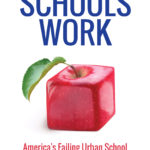
EACH TIME EDUCATION FAILS, THE AMERICAN DREAM DIES A LITTLE BIT. In an excerpt of his new book, Charter Schools Work: America’s Failing Urban School Districts Can Be Transformed, Bush Helzberg observes that the traditional public-school systems in America’s urban cores have failed students for decades. Put simply, millions of kids from low-income families lack access to a high-quality K-12 education. Helzberg argues that this state of affairs is “not only a tremendous social injustice, but is in direct conflict with the American dream ethos inspired by the Constitution.” Read the rest of his insightful work, exclusively on EdReform.com.


THE POWER OF THE PEN. Jeanne Allen thinks that Arizonans should be thanking local parents, political leaders and pundits, not Washington, DC, for the recent expansion of the Grand Canyon state’s ESAs—and says so in her letter to the editor of The New York Times.

KATE O’BEIRNE, R I P. The tributes keep coming. Whether CNN, NationalReview or this perfect homage by April Ponnuru, they barely scratch the surface of the witty, wise and beautiful commentator, principled thought leader, friend, wife and mother the world lost this weekend. Kate also served as a founding CER board member, and her informal advice throughout the years was always invaluable. Jeanne Allen talks about her own experiences with Kate here. The CER extended family is but a fraction of those who feel the loss of such a great American. Our hearts and prayers go out to her friends and family.

May the road rise to meet you.
May the wind be always at your back.
May the sun shine warm upon your face.
And rains fall soft upon your fields.

And until we meet again,
May God hold you in
the hollow of His hand.

Newswire: April 18, 2017

Children

EVERYTHING’S UP TO DATE IN KANSAS CITY? Well, not exactly, but it’s a work in progress. We offer a hearty welcome to the Ed Reform arena to the new SchoolSmart KC, an education organization dedicated to closing the achievement gap in the Kansas City public school system in the next ten years. One big lesson that we hope will drive your work: remember that the ingredients for successful parent empowerment are Innovation – with real flexibility for schools to be innovative and personalize learning; and Opportunity – the opportunity to control your child’s school choice, and for teachers and school leaders to control how they allocate and spend dollars. For more on why, get to know the University of Arkansas’ Department of Education Reform.

THIS IS PROGRESS? The District of Columbia State Education Agency submitted an ESSA plan that commits both traditional public and charter schools to a “common accountability system,” with the blessing of the charter leadership in the city. It’s extraordinary that there was so much support to capture charter schools under the SEA state plan umbrella, when no such requirement exists in federal law and the charters themselves are LEAs, accountable for federal law through their authorizer, not the district/state. It’s as if they believed that pulling all charters under one accountability umbrella is consistent with their mandate to offer diverse options across all D.C. students attending public schools and charter schools. Does anyone know that ESSA plans become the foundation for federal intervention (no matter what administration comes and goes)? Guess not.

ACTUALLY ­THIS IS PROGRESS. Show me a state that is moving the needle for kids and I’ll show you a state where opportunity and innovation have been deeply seeded into the educational terrain. In this case, the state is Florida where an annual Department of Education study reveals that in 2015-2016 the state’s charter school students made greater learning gains than their peers in traditional public schools and outperformed them on state exams in 65 out of 77 comparisons. It also found that racial achievement gaps were smaller in charter schools, and that charter students learned more from one year to the next in 82 of 96 comparisons that focused on learning gains. Also, in 20 out of 22 comparisons, charters had smaller achievement gaps in math, English and social studies between white students and their black and Hispanic peers.

A quick glance at Florida’s education department website also earns the state a big thumbs up. Not only is it user friendly, it also offers a state-supported array of information and options that empowers educators and parents.

GAO STUDYING CHOICE? That’s like asking the teachers unions to study teacher performance. Originally called the Government Accounting Office, and set up as the “Investigative arm of Congress charged with the auditing and evaluation of Government programs and activities,” they are now used as the personal play thing for some lawmakers who want to challenge policy proposals with which they don’t agree. Concerned about the potential progress of a new federally supported school choice program, Democratic Senators Patty Murray, Sheldon Whitehouse and Ron Wyden want the GAO to investigate the “schemes” that are currently helping millions of students with scholarships to attend schools that meet their needs (and who, unlike most members of congress, can’t afford to pay on their own!). For years the GAO has been asked to conduct misleading and politically charged studies without qualification or a legitimate role.
Maybe the Trump administration should defund this agency, too.

TRUMP ED STAFF. But first he should engage one of his head honchos to uncork the bottleneck that seems to be preventing critical and qualified high-level hires at the US Department of Education. It’s not possible to drive innovation, flexibility and change in the status quo without a leadership team fighting for it every day. Hundreds of qualified leaders from the Ed Reform front lines are battle worn and tested and ready to aid and abet serious federal policy efforts. What’s the hold up? Inquiring minds want to know.

According to a New Department of Education Study, Charter Schools Outperform Traditional Public Shows

Charter Schools Outperform Traditional Public Schools

This article originally appeared in, and is copyrighted by, POLITICO.

By Jessica Bakeman
April 17, 2017

Florida’s charter school students performed better on state exams and made greater learning gains than their peers in traditional public schools in 2015-16, and racial achievement gaps were smaller in charter schools, according to a new state report.

The Department of Education study, required by law to be released annually, found that charter schools outperformed their traditional public school peers on state exams in 65 out of 77 comparisons. Charter school students learned more from one year to the next in 82 of 96 comparisons that focused on learning gains.

Also, in 20 out of 22 comparisons, charters had smaller achievement gaps in math, English and social studies between white students and their black and Hispanic peers.

Only students who attended either a charter school or a traditional public school for the entire school year were included in the analysis. The study looked at 4.2 million test scores from 2015-16.

In 2015-16, public school students enrolled more than 2.5 million students, while about 271,000 attended charters.

Traditional public schools enrolled higher percentages of white and black students than charters, while charter schools served a significantly higher percentage of Hispanic students than traditional public schools.

While 62 percent of public school students in Florida qualified for free or reduced-price lunch, that share was only 49 percent for charters. In traditional public schools, 10 percent of students were non-native English speakers and 14 percent had disabilities. At charter schools, about 9 percent were ELLs and 9 percent were disabled.

A higher percentage of charter schools earn A and B ratings, but also a higher proportion earn F ratings than traditional public schools. In 2015-16, 55 percent of charters earned As and Bs, compared to 44 percent of public schools. But 6 percent of charters were failing, while that number was 3 percent for traditional public schools.

This year’s report was released as the Legislature debates a variety of policy changes and financial incentives to boost the charter school sector, including by attracting charters to open in communities where traditional public schools are failing.

Read the report here.

8 Sentences Would Give Arizona Lawmakers the Power to Micromanage and Second-Guess Charter Schools

By Jeanne Allen

The just-released 17th edition of the Center for Education Reform’s yearly scorecard of state charter school laws once again finds the Arizona charter law right up there at the top of the list — one of only two states (plus the District of Columbia) to receive an “A” this year.

Arizona was among the pioneers of the American charter-school movement when it passed its law authorizing public charter schools back in 1994, and has led the way ever since, in no small part because of its high scores in the areas of school autonomy, teacher freedom, and the wide latitude it allows for freedom to innovate.

Unfortunately, there are some dark clouds on the horizon. A prime example of “regulatory reload” has made an appearance in this year’s session of the Arizona legislature. A remarkably successful charter community, comprised of 547 schools and serving some 180,000 students, is targeted for a massive and virtually open-ended regulatory intrusion.

The legislative vehicle for this regulatory overreach is SB 1178, a “strike everything” bit of legerdemain that allowed the Arizona House Education Committee to bring back from the dead a bill that was defeated in a Senate committee a few days earlier. It would require an annual report accounting for every penny that a school spends, and authorizes the auditor general to “request” any additional information he may wish to see, a “request” with which the school “shall comply.”

In one breathtaking move, the bill’s eight sentences of text would give the state government the authority to micromanage and second-guess every decision that a charter school operator may make about apportioning its resources to provide a quality education. The amazing thing is that this massive intrusion into charter school operation is the work of comfortable Republican majorities in both chambers of the legislature.

The record of charter schools in Arizona over the past several years is extraordinary. Their students have outperformed the state average at virtually every grade level and subject, and have earned top scores in the nation in the National Assessment of Educational Progress.

Ordinarily, policymakers would regard a record like that as something well worth preserving and encouraging. Instead, legislators appear to be preparing to cripple Arizona’s charter schools. Cooler heads need to prevail, and soon.

Jeanne Allen is the founder and chief executive of the Center for Education Reform. Follow her on Twitter, at @JeanneAllen.

Newswire: April 11, 2017

Education is hot today in Washington. 17 CEOs are at the White House, scheduled to talk about issues ranging from education & infrastructure (note: we think they go together). The Atlantic’s 3rd annual ideas summit is up and running and we’re happy to see the presence of Derrell Bradford to balance that of Randi Weingarten. Education choice is, like the pollen count, spreading into the ether, and more…

 A TALKING POINT FOR THE WHITE HOUSE & THE CEOS. Imagine combining needed improvements in rural infrastructure in those red states that so handily won the race for Trump with expanded and improved educational options, and private sector development of teacher villages to attract talent. That should be what is on the national agenda today. “Until educational, social and economic policies are implemented with rural communities in mind, rural citizens should continue to work to break down barriers for more socially just rural schools and communities in the same way that urban citizens have.” That’s the argument from a Penn State Professor for one piece of the puzzle improving rural communities – “The Unique case for rural charter schools,” . Together with providing much needed flexibility for school districts to innovate and incentives for public private partnerships, a commitment to rural America could make today’s meeting truly pathbreaking.

 MEANWHILE OVER AT THE NEWSEUM… The Atlantic is hosting its education summit, conducting interviews of newsmakers in education as a look into what’s next for edreform. AFT head Randi Weingarten was on the same stage (sadly, not together) with long time ed reformer Derrell Bradford. Watch here.

OH, WHAT? Asked for comment following a discussion on charters, Weingarten lamented, “Oh god…,” and went on to claim the schools were the AFT’s idea. Not so! The real origin?

#BLACKDEGREESMATTER. If you want to know what parents and students really think about school choice, check out this piece from the Philadelphia Citizen.

CHOICE SPREADS. It’s been imbedded deeper and deeper in the environment, and in a society that is all about advancement, after 26 years you’d expect to reach a tipping point. By now it should be clear: education must evolve at the pace of its nation.

The latest spread is in pioneering Arizona, where a universally available new choice program will allow 5,500 additional students this year and 30,000 by 2022 to sign up for Empowerment Scholarship Accounts, giving them access to programs that biggest meet their children’s needs.

How Low-Income Students Can Achieve at the Highest Levels

Charter Schols Work

The below essay is excerpted from Bush Helzberg’s excellent book, Charter Schools Work: America’s Failing Urban School Districts Can Be Transformed.

Politicians talk about a grand bargain in America. If you work hard, you can have a comfortable middle class job or better. Any career is possible regardless of one’s ethnicity or socioeconomic status at birth.

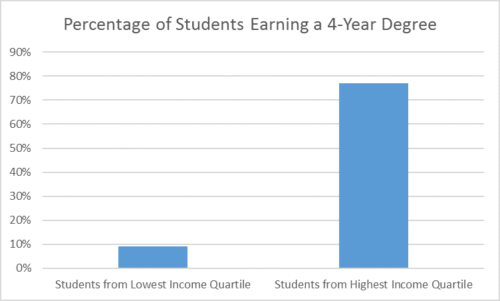
Unfortunately, the reality in America today is not even close to this ideal. A staggering disparity exists between college completion rates for students from wealthy and low-income families in the United States. According to a 2015 article in the Wall Street Journal, nationally only 9% of students from lowest quartile income families earn a college degree by the time they turn 24. However, 77% of students from highest quartile income families earn a college degree by the time they turn 24.[1]

College Completion Gap

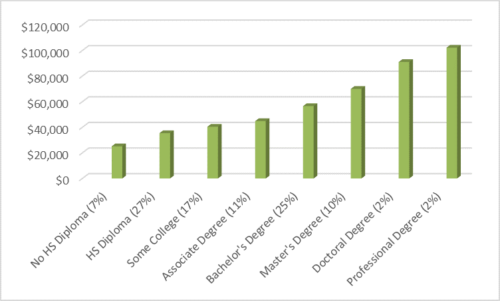
In the 21st century a college education is critical. A report from the McCourt School of Public Policy at Georgetown forecasts that by 2018, 63% of all jobs will require at least some postsecondary education. The vast majority of jobs that pay enough to allow a middle-class lifestyle or better require a college degree. As the chart below illustrates, individuals with a college degree earn significantly more than those with a high school degree or less.

Median Earnings of Full-Time Workers by Education Level[2]
Median Earnings of Full-Time Workers by Education Level

The traditional public school systems in most of America’s urban cores have failed students for decades. Millions of students from low-income families have not had access to high-quality K-12 education. The result for many is a lack of available opportunities. There is no mystery as to why our inner cities are plagued by high unemployment, crime, and violence. If people are not educated, they do not have good opportunities. If they do not have good opportunities, they are much more likely to get involved in criminal activities and end up in the criminal justice system.

Education is a huge and important civil rights issue. African-Americans are much more likely to live in a zip code that has failing public schools and thus have been disproportionately impacted by the failure of our nation’s urban public school systems. The state of K-12 education in America’s inner cities is not only a tremendous social injustice, but is in direct conflict with the American Dream ethos inspired by the Constitution. To have a fair shot at the American Dream, all children must have the opportunity to have the preparation and skills to succeed in college.

One’s destiny in America should not be largely determined by one’s zip code and it does not need to be. In Kansas City where I grew up, the traditional public school district has been failing children for decades. Fortunately, in 1998, Missouri passed a charter school law which allowed others to operate public schools within the boundaries of the Kansas City Missouri School District (“KCMSD”). Charter public schools have collectively transformed the educational opportunities available for thousands of students in the KCMSD.

In 2016 charter public schools educated roughly 40% of the K-12 public school students living within the boundaries of the KCMSD. This level of market share is in the top five in the nation behind New Orleans, Detroit, and Washington, DC. Charter public schools have created a competitive educational landscape which has created an incentive for the traditional school district to improve. While the traditional Kansas City Missouri School District is still far from high-quality, it has shown meaningful improvement in recent years actually achieving its highest rating from the state in three decades for the 2015-2016 school year.

Charter public schools were created in the early 1990s to improve our nation’s public school systems. Charter schools are public schools and like traditional public schools, are funded by local, state and federal tax dollars based on student enrollment. They are free and do not have special entrance requirements. Charter schools are not religious and cannot discriminate against students on any basis. Just like traditional public schools, charter public schools are accountable for state and federal academic standards. As of 2016, there were more than 6,700 charter schools operating in 42 states and the District of Columbia educating nearly 3 million children.[3]

Today, K-12 education within the boundaries of the Kansas City Missouri School District is at an inflection point. There is even optimism among local education reform practitioners that a significant majority of the students in Kansas City, Missouri could be getting a high-quality education within a decade. Hopefully, this book will shed light on the progress that has taken place and potentially serve as a roadmap for others who have the desire and will to address failing inner-city school systems.

For the last decade as Chairman of University Academy (UA), a K-12 college-preparatory charter public school that serves 1,000 students who reside in the boundaries of the KCMSD, I have seen that it is possible for low-income students to achieve at the highest levels. I have also witnessed how multiple charter public schools can collectively create a competitive educational landscape that benefits students and the community.

[1] Melissa Korn, “Big Gap in College Graduation Rates for Rich and Poor, Study Finds,” Wall Street Journal, February 3, 2015.

[2] U.S. Census Bureau, 2012, Table PINC-03; Internal Revenue Service, 2010.

[3] From the website of the National Alliance for Public Charter Schools.

Newswire: April 4, 2017

INNOVATORS: START YOUR ENGINES…


… The Trump campaign made it clear they’d give states and localities unprecedented flexibility. He also said he’d ensure that disadvantaged families would have unprecedented access to school choice. Once in charge, he passed the baton to his new EdSec Betsy DeVos, who has said that not only will the ESSA state review process be fluid but that she will look for ways to encourage innovation as well as open up the conversation for how school choice might be encouraged. This is consistent with the vision of the bill’s main steward, HELP Committee Chair Lamar Alexander. So innovators, start your engines…

SOME ARE WARY. Pray tell, why? Some Members of Congress just can’t live without micromanaging education policy. According to Politico Education, several Democratic Senators want the ESSA plans to consult with “stakeholders” (AKA the Education Blob). But that rule was removed by the new EdSec to allow states to decide how best to develop their plans. The notion that Washington should be telling states who to talk to is, well, it’s nuts. Here’s why we think so.


MILITARY CHOICES. We’ve said it before – we should stop at nothing when it comes to serving Military families. And we’ve written about it. So we are thrilled to see that military options are the subject of much talk in Washington and around the country. Sen. Tim Scott (R-SC) introduced a bill this year which would provide scholarships to students in military families on base of up to $8,000 for elementary school students and $12,000 for high school students. On the charter front, bases such as Washington, DC’s Joint Base Anacostia-Bolling have invited proposals for a new charter school to serve families.  We would take it all step further – how about a full voucher for every child of an active or veteran military family to attend the public, private or public charter of their choice, no matter where they are located? That would be the least we could do.

DEEP IN THE HEART OF TEXAS.  Good news, bad news this week in Texas where the Senate passed a bill which would create a tax credit scholarship program for low income students as well as Education Savings Accounts for low income students who want to attend private schools. If it clears the Texas House the Lone Star State would join 25 other states and DC in advancing parent power and choice. The bad news: chair of the Texas House Committee on Public Education, Rep. Dan Huberty says he sees the bill is dead.  Want to help? Contact Texans for Parent Power.

MEANWHILE IN THE SHOW ME STATE.  Recently the Missouri House passed Rep. Rebecca Roeber’s bill which would fix a major flaw in the state’s charter school law: that charter schools are only allowed in Kansas City and St. Louis. But the bill, now in the Senate, is in jeopardy of being tabled because of an exceptionally heavy legislative case load. If you live in Missouri, contact your senator and let him or her know that ensuring opportunity for students is one of the most important things that they can do, and to vote for the darn bill! Contact MissouriCharterSchools.org to get involved in bringing more opportunities to Missouri!

IN OTHER NEWS. Congratulations to West Michigan Academy of Environmental Sciences principal Kerri Barrett, who is one of the top finalists for the state’s administrator of the year.  Her school also happens to be one of the highest ranking in the state among all public schools. Oh, and its run by a local management company. (Thanks go to the state’s charter advocacy group, MAPSA, for the heads up.)

Never Trade Flexibility and Autonomy for Money and Buildings

The Georgia State Capitol

By Jeanne Allen

As the Georgia legislature races this afternoon to finish its work before adjournment, an important piece of legislation may yet get an up-or-down vote. On the bright side, the bill would guarantee that local school districts provide charter schools easier access to critical funding and facilities. Unfortunately, HB 430 includes new, prescriptive regulations that would take Georgia charter school in a very bad direction. It’s another example of why policymakers need to always be on high alert for regulatory creep within charter school policy.

Section 1 of the bill would direct the State Board of Education and State Charter Schools Commission to jointly create one-size fits all standards of “high-quality authorizing practices,” and would then have an “independent party” make sure that charters are deprived of the most important reason for their success: freedom from the regulatory strait jacket that hobbles traditional public schools.

The bill would require that the “independent party” possess a “demonstrated history of evaluating charter school authorizers for quality authorizing practices.” Don’t be fooled. If this section of the bill had a nickname, it would be the National Association of Charter School Authorizers (NACSA) Guaranteed Contract and Empowerment Act. It’s a sweetheart deal with the organization that would love to insure that its idea of how charters should be run be guaranteed by law.

There’s nothing wrong with having the State Board of Education and/or the State Charter Schools Commission developing what they believe to be best practices for authorizing, but it should be just that — best practices. There should be flexibility and autonomy for authorizers to do this in the way they deem best for the types of schools they oversee.

But mandatory one-size-fits-all-standards are never good policy in charter schooling. It discourages innovation and is antithetical to core principles of charter schools. But if standards are to be imposed, they should be developed openly and with the involvement of the entire charter school community, not in the dark by an unelected and unaccountable third party.

In an otherwise worthy piece of legislation, this language represents the very opposite of what makes charters special in the first place. It would centralize control of charter schools, develop a single set of standards outside an open rulemaking process, use an unelected, unaccountable third party to use those standards to evaluate authorizers annually and determine whether to terminate authorizers and the charter schools they oversee.

In other words: No accountability. No transparency. No due process. And, most alarmingly, no effort to involve in the process the most important stakeholders — parents, teachers and charter school boards. Is this really the direction we want to go after fighting so hard to pass the Georgia Charter Schools Amendment in 2012 that gave charter schooling more freedom?

To be clear: there’s nothing wrong with quality authorizing and standards. But increased regulation and centralized control is not the answer. Not in Georgia, and not in any state.

Charter school supporters should never feel pressured to trade flexibility and autonomy for money and buildings. The offending language should simply be removed and individual charter schools and authorizers allowed to be free to contract and set standards and goals they believe are best for the students they serve.

Jeanne Allen is the founder and chief executive of the Center for Education Reform. Follow her on Twitter, at @JeanneAllen.

Newswire Special Edition! The National Charter School Laws Rankings: March 28, 2017

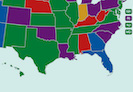
CER’S NATIONAL CHARTER SCHOOL LAW RANKINGS AND SCORECARDLast week the Center for Education Reform (CER) released its annual ranking of charter school laws for the states and the District of Columbia, giving fewer than a quarter of state charter school laws in the U.S. above-average grades.

CER'S NATIONAL CHARTER SCHOOL LAW RANKINGS AND SCORECARD.


1. MULTIPLE AUTHORIZERS MATTER. States that permit a number of entities in addition to local school boards to authorize charter schools, and that provide applicants with a binding appeals process, encourage more activity. In states with strong charter school laws like Indiana, Michigan and New York, universities have proven to be incredibly sophisticated and successful charter school authorizers. Universities combine expertise and operational capabilities of a robust educational institution with the independence to embrace cutting edge teaching methods that move the needle for students.

2. IMPLEMENTATION OFTEN DIFFERS FROM WHAT’S ON PAPER. States that follow what’s written in law tend to have healthier charter school environments. For example, some states say they’re going to fund schools equitably but fail to do so.

3. ON THE UPS. The two states that improved their rankings the most from 2015 to 2016 were Massachusetts, which jumped from 27th place to 10th and North Carolina which moved from 23rd place to 13th. Three states experienced double digit drops in their rankings: Washington fell from 28th to 40th, Delaware dropped from 21st to 31st, and Ohio went from 14th to 24th.

4. GOING DOWN. Compared to our 2015 rankings, we lowered the grades of 13 states: Minnesota and Michigan from A to B; Utah, Missouri and Idaho from B to C; Delaware, Oregon, Washington, Hawaii, Maine and Illinois form C to D; and Alaska and Iowa from D to F. Only the District of Columbia, Arizona and Indiana received A’s, while Michigan, Minnesota, Colorado, California, Florida, New York, Massachusetts and South Carolina earned B’s.

5. WATCH FOR REGULATORY RELOAD. Don’t take our word for it, just ask Ben Lindquist’s whose piece says overregulation undermines the ability of charter schools “to offer distinctive, high-quality options to students and families with differing needs and preferences.” (A not-so-fun fact from his article: “In 2014-15, Arkansas charters were each expected to submit 374 separate reports” through nine reporting systems.)

Huerta and Zuckerman studied the inception of this regulatory fervor in 2009—called it Management Recentralization (2009)—which many of today’s most influential charter leaders believe is the necessary extension of replacing the “frontier era” of charter schooling with more centralized “planning and coordination.”  Not on our watch.