










Sign up for our newsletter

Voices of Color, Voices for Opportunity

A series of opinions by African-American leaders engaged in the battle for educational opportunity in their communities. Given the movement for systemic change and an end to racism once and for all we are resurfacing these voices who came together to stand up for equal access to opportunity to students of color.  As we argue in this Special Newswire, education is a vehicle for change. It cannot solve all of society’s ills or get rid of inequity for good, but it’s a critical foundation.


Voices of Color, Voices for Opportunity, CER, Feb. 2018
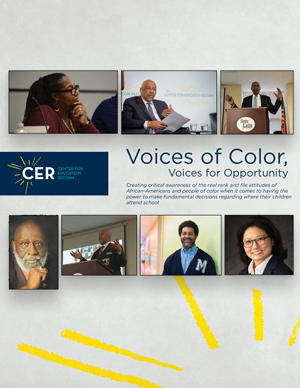
Creating critical awareness of the real rank and file attitudes of African-Americans and people of color when it comes to having the power to make fundamental decisions regarding where their children attend school


Supporting Black Colleges Helps Charter Schools

The op-ed below written by Johnny C. Taylor Jr. appeared in the Times Record News on September 29th, 2017. Taylor is the president and CEO of the Thurgood Marshall College Fund, the largest organization exclusively representing the black college community. He is one of CER’s “Voices of Opportunity.” Follow him on Twitter at @JohnnyCTaylorJr.


The greatest country on earth is awash in fragile communities in which less than 20 percent of adults are literate, fourth graders lack proficiency in basic reading and math, jobs are scarce, and incarceration is as common as college.

These fragile communities are black, white, brown and yellow. They exist in places as different as Appalachia and Fort Lauderdale.

I know. I grew up in one. And had it not been for my mother’s choice to take me out of a traditional public school and take advantage of the educational opportunity offered at a pilot magnet school, I would never have become a successful lawyer, corporate executive and now the head of the Thurgood Marshall College Fund, which represents 47 historically black colleges and universities (HBCUs) — schools established when black students had no option other than segregated institutions. These schools have a long history of educating some of the nation’s most influential and successful African-American doctors, educators, lawyers, business leaders and entrepreneurs.

It is through the lens of HBCUs that we have come to see that the plight of students trapped in poor schools, often in fragile communities, is not only an economic challenge for this nation, but an issue of national security.

We have a unique understanding at our colleges. We know what it takes to help students who are most economically disadvantaged and educationally vulnerable. And we know that when students are well prepared in primary and secondary grades, they are more likely to learn and to graduate from higher education than if they were disserved.

We also have a vested interest in ensuring that the children who arrive as freshmen on our campuses are extraordinarily well-prepared. Although some of our campuses have experienced enrollment growth recently, the challenge we increasingly face is how to graduate young people who arrive as college freshmen woefully under-prepared academically. Currently, about 35 percent of HBCU students graduate within 6 years of starting their education. As federal and state governments refuse to fund remedial education for university students and demand higher graduation rates from post-secondary institutions, the only way HBCUs can survive is if the students who show up are college ready when they leave the PK-12 system.

Better parental choices are, frankly, a matter of life or death for many of our country’s HBCUs. And the only way to impact that is to ensure that high quality secondary school choices abound and that parents are aware of the options that exist to help them take their families out of traditional district schools that have long failed their precious youth.

HBCUs have stepped up to the plate to provide this leadership. Howard University, for example, started a charter school called Howard University Middle School of Mathematics and Science, which is preparing the next generation of leaders for careers in science, technology, engineering and mathematics. This area of focus is of particular importance because African-Americans receive just 7.6 percent of all STEM bachelor’s degrees and 4.5 percent of doctorates in STEM.

Another example of HBCUs taking matters into their own hands can be found in Tallahassee’s Florida A&M University, which opened the Developmental Research School in 1877. The Research School gives a nationally competitive college preparatory education to each of its students and serves as a state-of-the-art laboratory for education innovation. Throughout its 140 years of existence, the school has graduated thousands of students who have gone on to become leaders in their chosen professions.

These are some of the things we are doing to address fragile communities. If we don’t do it, who will?

It’s become clear the organization that once supported the greatest needs of our disadvantaged is no longer interested in that work. The NAACP recently came out and again called for a moratorium on charter schools, absurdly claiming that the promise of charters never materialized.

This was preceded by American Federation of Teachers boss Randi Weingarten’s attacks on school choice, referring to charters as the “polite cousins of segregation.”

We cannot afford this kind of issue-myopia in our society. The stakes are simply too high as fragile communities continue a downward spiral. The only solution is to improve educational outcomes and that begins with increasing school choices for parents. We have seen the dangerous domino effect if kids in these communities are forced to stay in failing schools.

And while the NAACP and Weingarten seem to be perfectly comfortable with that scenario, we are not.

We will continue to fight for these fragile communities. And if the NAACP continues to reject the educational opportunities school choice provides them, they risk becoming irrelevant — or worse — an enemy of the very people they claim to fight for.

CER Welcomes New President & COO

Press Release from the Center for Education Reform:

Lesley Albanese joins nation’s leader in fight for innovation and opportunity
New Board member also announced 

(Washington DC) – The Center for Education Reform (CER) announced today that Lesley Albanese, a nationally recognized leader and development professional has been appointed president and COO, taking on a new and critical role in the organization’s mission to advance education opportunity and innovation in America’s schools.

“I am beyond thrilled that Lesley has joined us,” said Founder & CEO Jeanne Allen.  Her passion and commitment to opportunity and freedom, along with her keen knowledge and record of success are already making a huge impact just 3 months into her tenure here.”

Lesley Albanese courtesy Philadelphia Business Journal

Albanese served most recently as vice president at the National Constitution Center (NCC) in Philadelphia. There she oversaw all the fundraising, including ongoing capital and endowment projects, and the NCC’s annual Liberty Medal Ceremony and Gala.

Prior to joining NCC, Albanese worked at the Cato Institute where her 17-year career culminated in service as Vice President of Development.

Albanese received a Bachelor of Arts in business and political science from the University of Pittsburgh and an MBA from Johns Hopkins University.

In addition to this key hire, CER announced that Richard Harmon, managing director BB&T Capital Markets will join CER’s board of directors. Board Chair Jon Hage noted, “Richard Harmon is a nationally recognized leader who brings wide ranging experience at the intersection of finance and education. His leadership and 32 years of experience will contribute greatly to bold work CER performs every day.”

“I am honored and excited to join CER in their effort to expand education opportunity,” said Harmon. “This is an organization dedicated to pushing boundaries, expanding choices and putting the needs of parents and students first.”

Currently based in Columbus, Ohio, Harmon manages BB&T’s nationally recognized education finance team. He has more than 34 years of dedicated experience working with nonprofit charter and private schools, higher education, senior living and hospital organizations. Before joining BB&T Capital Markets, Mr. Harmon spent 10 years at Ziegler spearheading its charter school initiative.

Mr. Harmon is a frequent speaker and panelist at various national and state charter school conferences, the National Association of Bond Lawyers and currently serves as treasurer for a charter school on Chicago’s south side.

A graduate of Denison University, with a bachelor’s degree in mathematical sciences and a minor in economics, Harmon received his juris doctor at Capital University Law School and was admitted to the Ohio bar.

CER’s Take on the 2017 SAT Scores

THE NEW SAT. First there was the original, then there was the one they rescored years later to soften the blow, then they added writing, and subsequently many more essay questions (and took out that pesky “if this then that” analogy section). Now there’s the wholly new test – results of which are out today – that the College Board has created to measure more than just test taking skills and aptitude but to gauge readiness for college. It’s a noble goal, but still not entirely clear what it all means. However, the number of students who take the test continues to increase, the “readiness” of students for college is only 46%. Why these scores should mean something is well known, but for a refresher read CER’s New Opportunity Agenda.

Newswire September 26th, 2017

THE NEW SAT. First there was the original, then there was the one they rescored years later to soften the blow, then they added writing, and subsequently many more essay questions (and took out that pesky “if this then that” analogy section). Now there’s the wholly new test – results of which are out today – that the College Board has created to measure more than just test taking skills and aptitude but to gauge readiness for college. It’s a noble goal, but still not entirely clear what it all means. However, the number of students who take the test continues to increase, the “readiness” of students for college is only 46%. Why these scores should mean something is well known, but for a refresher read CER’s New Opportunity Agenda.

AFT HYPOCRISY. AFT president Randi Weingarten continues to astound audiences with incredible pronouncements of absurd and/or offensive nonsense. To re-cap: this past summer she characterized pioneers of education opportunity as segregationists and racists. Then, when called on to apologize for the insult, doubled down, pointing to actions from the Jim Crow era as proof of her offensive conclusion. Then in reaction to a study on absentee teachers which found 28 percent of teachers in traditional public schools miss more than ten days of work each year versus just 10 percent of charter school teachers, instead of calling it a crying shame and calling for revised public school policies she suggested charter schools needed to give their own teachers more time off. Finally, as Hurricane Irma battered Florida, she declared that the state’s charter schools were shirking their social responsibilities because their buildings weren’t required to be constructed as storm shelters. Clearly our friend is grasping at straws to come up with reasoned, reasonable – or even relevant – talking points on education issues. Either that, or she’s gone completely off the rails. Regardless, she should resign as head of the AFT.

LET MIKEY DO IT. Former Michigan Gov. John Engler has a solution for Detroit’s ailing public schools – let Mayor Mike Duggan, or any successor, run them.” The Governor makes a good point. As Detroit schools continue to struggle to escape the morass of, well, themselves, Engler notes that when on a road to recovery, accountability is key: “The mayor is a political figure who is held accountable. You couldn’t get 50 people in Detroit to be able to successfully name who is on the Detroit public school board.”  And while we’re on the subject of Detroit schools, Forbes recently carried an article rebutting a skewed analysis published in the New York Times about charter schools in Motor City. The piece points major errors – some factual and other errors of omission. It’s worth your time.

THE PHILADELPHIA STORY, STARRING… Charter advocacy in Philadelphia got a big boost last week with the appointment of Sylvia Simms as the first executive director of Educational Opportunities for Families an organization that represents parents seeking more charter schools and educational choice. Simms, a longtime parent advocate and former member of the Philadelphia School Reform Commission will be leading “an aggressive new initiative to engage more parents in support of school reform, particularly in North Philadelphia.” Simms hopes to create opportunities for parents and community members to talk and ensure that families, especially those in low-income neighborhoods, have high-quality schools for their children. Or, as she puts it, “We always talk about having high-quality schools close to where you live [but] there are no high-quality schools close to where I live, so what are we going to do about that?”

Sylvia Simms in 2013

LET’S GET PERSONALIZED. According to the non-profit group EducationSuperHighway https://www.educationsuperhighway.org/ America inches ever closer to its dream of high-speed internet access for all students with 94 percent of public school districts having connectivity that supports 100 kbps per student of Internet access. This is great news for anyone living in the 21st century, and a boon for advancing opportunities, and creating a wide range of learning environments for personalized learning (through self-directed discovery, with their peers, and with the guidance of adults). It also puts a nice crack in the brittle 150-year-old education mold by favoring learning experiences that are adaptable to the needs, potential – and that support the highest possible outcomes – for each and every learner.”

Did you see T. Willard Fair’s piece in USA Today last week?  Here’s another chance to read this civil right’s icon’s plea for choice for children in need across the land.

School choice is crucial for African-American students’ success

The article below, written by T. Willard Fair, appeared in USA Today on September 21st, 2017

The NAACP refuses to acknowledge the benefits that come from school choice and expects all people of color should follow their lead. I won’t.

Once upon a time it may have been unheard of for the head of an urban league dedicated to the improvement of lives for African-American children to partner with a Republican to work on school reform. As part of one of his education reform efforts, Florida governor Jeb Bush convinced me to help him go around that state in an attempt to get school choice legislation passed. I leapt at the opportunity because I was desperately concerned about the lack of quality educational options for children in Liberty City, a neighborhood of the city of Miami where a branch of the urban league is headquartered.

But that one achievement 30 plus years ago created a path that has changed lives for the children not only for Liberty City but children across the state. That is why I am compelled to speak up with deep concern and opposition to the statements of late by the NAACP, whose leadership has begun to ignore the reality of communities like mine, and indeed the conditions of African American students all over the country.

Here’s what I need to say to them, to the people of this nation, to people of color — I am involved in the school choice movement because the future of my life and your life depends upon it. Starting the state’s first charter school was one of the most significant accomplishments of my life. Because of our willingness to look beyond traditional divisions and leave beyond our tendency to only work with those with whom we are comfortable, our children of color are closing the achievement gap. African-American students in charter schools are scoring 4% higher on reading tests than those in traditional public schools and Florida charter school students are more likely to attend college.

Hispanic students do 12% better than their peers at traditional public schools. These are but two of the many indicators that point to increased success for students of color because their families were empowered to find schools that better met the needs of their children.

Far too many people and organizations, like the NAACP, refuse to acknowledge this. Their recent recommendations to curb charter schools, reduce their numbers and their independence, are wrong, and they expect falsely that all people of color should follow their lead because the color of your skin should dictate who you believe. I have worked a lifetime to change this misperception, to help people see that good policies for our kids do not have a color.

Too many of our African-American leaders simply defer their beliefs to organizations like the NAACP which once represented our people well. What they must do however is recognize times have changed and we have to have the honest discussions about what we were going to do about our children who continue to be failed by traditional institutions and bureaucracy.

Most important, even when trusted leaders talk about our children, the restoration process can be articulated only by those to whom the children belong, the parents.  We can fight. We can mobilize. We can train. We can energize community members. But at the end of the day we have to have informed and trained and energized parents enough and in the right way to lead the charge for what is right for their children.

Time is running out. Choice now!! “Choice now” has to be one of the new refrains to “we shall overcome.”

We can’t wait 20 more years. Time is most certainly running out. The circumstances that we deal with every day in Miami — and I dare say in every major urban area in the United States — are getting worse, not better. Time is running out for our communities, and we cannot wait another moment, let alone another decade to live without the kind of good choice among good schools that will eventually make a world of difference.

We need to give parents real power over the education available to their children, power that will take many different forms. Choice is at the top of the list.

T. Willard Fair is president and chief executive officer of the Urban League of Greater Miami, Inc. A powerful voice in the effort to improve his community, he has worked for the Urban League since September, 1963.

Newswire September 19th, 2017

BLUE STATE CELEBRATION.  Leaders of education opportunity in Illinois gathered last night in Chicago to celebrate the first school choice program to ever grace a blue state. One Chance Illinois, the local advocacy group whose work contributed to the historic accomplishment, will lead the effort to implement the tax credit scholarship program, which permits businesses to contribute to organizations whose sole job is to provide scholarships to poor and at-risk kids who would not otherwise have access to private schools. In a city like Chicago, there is no shortage of need, or demand. The school funding bill – which was negotiated by Gov. Rauner and Senate Minority Leader Bill Brady, and in the end had the support of the speaker – also equalized funding for public schools and increased support for charter schools that have been underfunded. For more information go to INCS. Our hearts are full knowing more kids will have opportunity in the Land of Lincoln.

NEWARK’S BACK IN CHARGE.  After 20 years of state intervention, the Newark public schools are being “returned” to the district, the same one that sent it into disarray and was largely responsible for corruption, plummeting achievement and permitting unions to control the show.  While David Chen writes in “After More Than 20 Years, Newark to Regain Control of Its Schools,”that some things have improved in Newark’s schools (especially since the growth of charters caused a response and the state pushed hard for results), the old district model isn’t the solution. School systems that look like they did 150 years ago don’t solve the problem of students lacking the personalization of education they need. Just read Ted Kolderie’s The Split Screen Strategy if you want to understand that and what to do about it. While “local control” has a nice ring to it, beware of what it really means and who it helps – or hurts.

DC DOES IT.  Newark might take a page out of DC, where the move to mayoral control some 10 years ago, following a dramatic expansion of new schooling opportunities through charter schools and subsequently low income-based scholarships, kicked a system long in disarray into high gear. In fact, it’s so noteworthy that even John Oliver (who usually spends most of his time ineffectually maligning great education reforms) sent #DCPublicSchoolstrending on Twitter with one comment on the Emmys. DC Schools immediately responded to the applause of its supporters and fans. If only Oliver really knew how much trending DC Schools really means in the landscape of education reform and the model it is for other communities – especially its charter schools.

WE DON’T NEED NO… INNOVATION.  The list of schools eligible for takeover from the North Carolina’s Innovative School District (ISD) was released last week, and the effort is on to narrow the list of nearly 50 schools down to just a few that the state will take and partner with an innovative charter school partner in an effort to improve their academic performance. “Don’t come to us,” says Durham and Johnston counties, which have asked to be excluded from consideration. The schools are being considered for the ISD because their performance scores are among the lowest five percent in state, so it’s not like this is a case of mistaken eligibility that they don’t need help. It’s more a matter of who gets control. As Lt. Gov. Dan Forest puts it, ‘some turf wars’ between the ISD and local school systems were probably inevitable. But, he said, taking a ‘calculated risk’ was necessary to help low-performing schools. “It’s a brand new strategy in our state [and] a brand new opportunity to look at how do we really create a model that I think others can follow in how state and local communities partner together to improve outcomes for kids.”

PARENT POWER IN MINNESOTA.  In an interesting (although not surprising) look at the impact of parental choice on public school enrollment in Minnesota, The Star-Tribune reports that “Last year, about 132,000 Minnesota students enrolled in schools outside their home district, four times the number making that choice in 2000.” Among the many “wow” data points discussed in the article is the fact that “In Minneapolis and St. Paul, the number of students leaving has almost doubled in the past decade, and total enrollment is plunging. Both cities now lose a third of their school-age population to other districts or charter schools.” Joe Nathan, director of the Center for School Change, says that parents for do what’s best for their children and “people of all races deserve options.” Well said.

SPEAKING OF PARENT POWER: CER’S latest Index of Parent Power in the states is coming soon, with detailed analysis of what states offer it, how and what you can do to seize control of your own education. Stay tuned!

Newswire September 12th, 2017


A SILVER ANNIVERSARY CELEBRATION. While the establishment and others are crowing over charter schools and trying regulate, slow or limit their growth, you may want to pause a moment to read the Wall Street Journal piece, “Charter Schools Are Flourishing on Their Silver Anniversary.” As we noted last week, City Academy, the nation’s first charter school opened in St. Paul, Minn. on Sept. 8, 1992. “Since then (charters) have spread and proven their success [as today] some 7,000 of these schools serve about three million students around the U.S.” Let’s take this occasion to remember just what the charter movement is all about: Freedom, innovation and opportunity for kids; not bureaucracy, the status quo, or a 19th century model of education. It’s talked about in CER’s book, released this summer, Charting a New Course – The Case for Freedom, Flexibility & Opportunity Through Charter Schools. Another great source is the numerous important research and analysis done by the Godfather of charter schools, Ted Kolderie, his work available at educationevolving.org.

UNION WATCH. Exercising lobbying muscle and throwing around political weight the NEA and AFT have long been a roadblock to change, a maddening thorn in the side of education reformers and pro-opportunity advocates, and a sharp-clawed force to be feared by anyone with political ambitions. But all across the country – in some very unlikely places – leaders are standing up to the unions and dramatically changing the dynamics of education reform. Read about it in Jeanne Allen’s Washington Examiner op-ed “How teachers’ unions became the paper tigers of education reform.”

WITH THAT SAID … Union activities are far from dead as witnessed by this headline: “Teachers At Chicago’s Largest Charter School Network Renew Push To Unionize.” The AFT affiliate can’t stand the fact that a successful charter network has educated scores of at risk kids without their input, or their ongoing member losses. Fear mongering of teachers is ongoing, but we trust principle will prevail.

WILD WEST OUTPERFORMS. “If Arizona’s public charter students were separated and measured as their own state, it would rank among a handful of the top-performing states in the entire country on the Nation’s Report Card,” says the Arizona Charter Schools Association. For the third straight year Arizona’s charter school students have beaten the averages in the state’s AzMERIT scores in virtually every subject area and at every grade level. And, we’ll also note, per the item above, that Arizona was not far behind Minnesota in launching charters – opening their first school in 1995. The state now has 556 schools that serve 185,000 students. No wonder both Arizona and Minnesota score high on the 17th Edition of CER’s National Charter School Law Rankings & Scorecard.

MEANWHILE IN WASHINGTON, D.C. … Rumors that a federal effort to expand parent power has stalled are premature and exaggerated. A story today in Politico quoting insiders and those claiming to be in the know about the issues is, well, out-of-the-know. Interest in ensuring that more Americans have real access to parent power remains high on active issue on Capitol Hill and throughout Washington. How and who participates, and when it gets done actually takes a long time when dealing with a complex representative democracy (NB: readers may want to consult Tocqueville about this). Indeed thousands of supporters from around the country have been flooding Washington, meeting with their members of Congress within their own communities and working to educate the policy makers and policy leaders about why this issue matter. As they say in politics, “those who say don’t know, and those who know, don’t say.”

###

AND IN CASE YOU MISSED IT.  Log onto EdReform.com for the latest on the AFT Chronicles or the ongoing effort by African-American leaders to show they have a different point of view on educational opportunity than many established organizations who claim to represent their views.

NEA at NPC

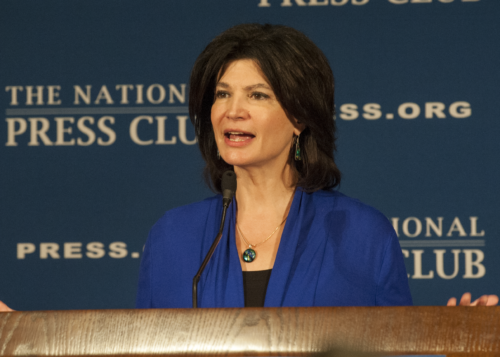
Tuesday, September 12, 2017 (Washington, D.C.) NEA President Lily Eskelsen Garcia was the featured speaker at the National Press Club last Friday, and served up a heaping portion of partisanship. The President, she said “creates fear in children, and that is unforgivable.” Then with a straight face, she added, “For me, this is not partisan. I’m from Utah.” Where, we might add, she ran for Congress as a Democrat.

She hailed passage of ESSA in 2015 as “the last time Congress got together and did a good thing for kids.” She might have mentioned the bipartisan vote in the Illinois legislature this month, in which majorities of both parties voted to create a new tax credit program for school vouchers in that deep blue state, but the NEA and its affiliates fought fiercely against it, and that would not have fit their narrative.

How Teachers’ Unions Became the Paper Tigers of Education Reform

Written by Jeanne Allen, Founder and CEO of the Center for Education Reform 

The Chinese term “paper tiger” (zhilaohu) describes someone who appears to have power but who is actually weak and conquerable. It’s a perfect description of the nation’s largest teachers’ unions, something to bear in mind when National Education Association President Lily Eskelsen García speaks Friday at a National Press Club luncheon in Washington.

Although the NEA and its smaller rival, the American Federation for Teachers, have long used political donations, political intimidation, and organizing to control Democratic Party education policy nationwide, they’re the very embodiment of a paper tiger.

The latest evidence of their vulnerability is Illinois’ education funding compromise, signed into law last week, which has huge national ramifications. The bill was adamantly opposed by teachers’ unions, yet their opposition crumbled as Republicans and Democrats came together to boldly improve Illinois’ education system.

Since 1987, when then-U.S. Secretary of Education William J. Bennett described Chicago public schools as the worst in the nation, little to no education reform has been enacted there.

Deep-blue Illinois has long been dominated by the Democratic Party and few institutions wield as much control in Democratic politics than teachers’ unions. And as a result, Illinois has been impervious to education reforms happening in every other surrounding state.

That all changed last week. The bipartisan agreement created Illinois’ first private school choice program, aimed at helping low-income and working-class families attend a school of their parents’ choice.

The agreement also addressed equitable funding for public charter schools, taking the innovative schools of choice from 75 percent of per pupil funding to 90 percent. Finally, the bipartisan law created a new funding formula to benefit traditional public schools and fund teacher pensions.

What’s most telling about the teachers’ unions defeat in Illinois is that this is not a unique story, but that it’s taking place in a state they would have never dreamt of “losing.” After all, the AFT was founded in Illinois. The reason for teachers’ union decline in influence is rooted entirely in its status as a paper tiger.

Over the course of the past 30 years, teachers’ unions have become increasingly political and even within their sole support for Democratic candidates, they strongly oppose any dissent.

The NEA once called on President Barack Obama to fire his secretary of education, Arne Duncan, a native of Illinois, claiming, “He’s destroying what it means to teach, what it means to learn.” When then-presidential candidate Hillary Clinton spoke at the 2016 NEA convention and referenced “charters,” she was booed.

Like many paper tigers, the unions’ bark is always bigger than their bite.

In May, teachers’ unions lost a series of major races in another deep-blue state in a deep-blue community — the Los Angeles Unified School District. Pro-public charter candidates secured their first-ever majority on the LAUSD school board, with upsets that included defeating the union-supported school board president.

Several years ago in Wisconsin, another state dominated by union politics, Gov. Scott Walker pledged to expand school choice and advocated for a series of reforms as part Wisconsin Act 10.

The teachers’ unions (along with other public sector unions) protested relentlessly, but not only was Walker able to expand education options in Wisconsin, his Act 10 was passed and he would later go on win re-election twice, once as part of a recall and later re-election.

Within the education arena, the key to overcoming a paper tiger is simple: Remain principled and always put students first. That’s precisely what Gov. Bruce Rauner, R-Ill., did in the weeks leading up to adoption of the final school funding bill.

He saw the possibilities and worked with the legislative leadership to understand that accepting the status quo as the state has done year after year was untenable. And, as a result of bold leadership, pragmatism prevailed and Republicans and Democrats came together.

In the end, the union showed its inability to repel principled positions, and a bipartisan majority created substantive, structural changes in education in Illinois that will dramatically improve lives for millions of students.

Governors and legislative leaders from across the country should take note – success is possible, even in the face of teachers’ unions.

To date, public charter laws and private school choice laws continue to attract support from both parties, from conservatives who oppose the education monopoly, and liberals who are tired of blindly supporting the teachers’ union agenda at the detriment of children. It happened in Wisconsin, Florida, California, New York, and now Illinois.