












Sign up for our newsletter

Newswire November 21st, 2017

TAX REFORM. The focus on the economy has consumed much of the nation’s attention as of late, but CER is continuing to drive the potential for education opportunity to share the spotlight with economic opportunity.

First the good news: Support for tax credits to enable learners at all levels to gain additional and new educational opportunities is growing. CER has engaged dozens of congressional leaders in a discussion of the importance of allowing a tax credit to benefit entire families – with students able to access new private scholarship dollars and adults to access new apprenticeship and workforce training programs. While that proposed initiative did not make it into the tax bill – yet – what did get through both houses is an expansion of the 529 program, to help K-12students. More needs to be done to reach students most in need, but it’s a good start.​

Now the not so-good-news, but we are optimistic… Charter schools were inadvertently swept under the fiscal savings rug through the elimination of something called private activity bonds, which provide charter schools access to private capital to build facilities, that they would otherwise not be able to afford. Understand that most states do not allow public charters to utilize construction and capital dollars (and no state fully funds charters) (for perspective on the issue check out the this op-ed in the Washington Post). We are supporting the charter movement’s efforts to educate leaders in Congress to not eliminate private activity bonds – and we are cautiously optimistic of the outcome.

BLENDED BEYOND BORDERS. How do we make that happen, you ask? The Clayton Christensen Institute has taken a fascinating look at on-line learning, asking “how exactly the rise in technology correlates with fundamental shifts in teaching, learning, and student outcomes,” analyzing how brick-and-mortar schools in three countries use online learning to deliver content in new, more flexible ways. For ten years the Institute has been studying how schools can use technology to better differentiate students’ needs—i.e. blended learning—and in this study, they analyze data from respondents in Brazil, Malaysia, and South Africa, along with case studies of specific school models. Check out the report here: Blended beyond borders

VOUCHERS BACK IN? Progressives on the left and right have often been aligned on the importance of social justice through school choice. Berkeley Profs John Coons and Steve Sugarman who proposed the original voucher idea in California say it may be time to bring the issue back to California. In an op-ed in The San Francisco Chronicle they point to a statewide poll that found 55 percent of respondents favoring “government subsidies for low-income families to enable parents to choose a private school for their children.” The professors believe that, unlike previous voucher plans, which have been voted down in the Golden State, an appropriately drafted initiative to allow taxpayer funded scholarships, or a tax credit plan to encourage charitable funding of such scholarship, supported by a well-run campaign, could succeed.

DON’T FORGET… NY ED TECH WEEK. Yes, the annual global innovation festival is less than a month away: Dec. 18-20 at NYU’s Washington Square Campus. A packed agenda, a truly impressive roster of speakers, and great special features – including an Innovation Gallery (featuring more than 50 seed-to-growth-stage EdTech investment opportunities, EdTech products, and the chance to talk with CEOs about their companies), Open Labs at innovative education organizations and landmarks around New York City, and small-group two-hour Masterclasses presented by in-demand experts – again make it the must-attend event of the season. Hope to see you there.

HAPPY THANKSGIVING TO ALL. As we head out to spend a wonderful long weekend with family and friends (and hope that you’re doing the same) we leave you a short list of things that we give thanks for this holiday season:

Opportunity, especially educational opportunity – for everyone – so that all kids might someday have access to a school that best meets their needs.

We are thankful to the legislators and policymakers who provide such opportunities,

We are thankful to the entrepreneurs and innovators who ensure that our nation’s educators, learners at all levels and parents have access to the best this nation can muster,

We are thankful to our nation’s leaders, our families, our members, our staffs and all those who toil for educational excellence,

And we are thankful to God for providing us with such bounty, and pray that others may share in all we have.

Enjoy the holiday!

Newswire November 14th, 2017


BETTER SERVING THOSE WHO SERVE. America’s 1.3 million service men and women are parents to some 750,000 school-aged children who share the unique burdens of military service: education mobility – bouncing from school to school; attending schools on military bases – most of which are stuck in decades-old pedagogy and lack the personalization and sophistication in educational practice that kids in military families need; and attending traditional public schools that are unequipped to meet their unique needs. These kids deserve better and every service parent should be able to choose any school that will best serve their child’s needs, whether it’s a local public school that’s outside of their zone, a private school or a charter school. In other words, “Our military kids need an education system as flexible as they are.” Read about it here.


PAPER TIGERS. If you follow New Jersey politics you know that the New Jersey Education Association was hopping mad at state Senate President Steve Sweeney saying he broke a promise to lobby for a ballot question that would guarantee teachers’ pensions be funded by the state. So, to get even, for last week’s election the NJEA threw its support to Sweeney’s opponent in the 3rd District race, and poured $4.5 MILLION into a campaign to defeat the incumbent. The only problem for the NJEA is, Sweeney won anyway leaving the union described as “out of touch,” “politically damaged” and its campaign called “a fool’s errand.”  It’s another example of “How Teachers’ Unions Became the Paper Tigers of Education Reform.”


OPPORTUNITY KNOCKS. As Puerto Rico continues to struggle to recover from the devastation wrought by Hurricane Maria, rays of sunlight are emerging that could put the island’s education system on a new footing. As The Interceptreports, PR’s Ed Sec, Julia Keleher, is pushing hard to use the recovery as a vehicle for achieving substantive change. Citing New Orleans’ recovery from Katrina as a “point of reference” she called on Puerto Ricans to see their plight as a “real opportunity to press the reset button…and to create new, better schools.” Her biggest worry, she says, is not capitalizing “on this learning opportunity, this transformational opportunity for us to start to think fundamentally differently about what it is to be in school, and how one goes about getting an education.” You have to admire her goals and enthusiasm, and charter operators and virtual education providers across the country should be thinking about how they can get involved in Puerto Rico’s post-Maria landscape.


JOBS AND TAXES. With all the Sturm und Drang over the proposed tax overhaul an important point has been lost: that, as part of tax reform, there is an urgent need to ensure the preparation of current and future workers for the changing needs of the economy. Job creation and job preparation must go hand in hand. Expanding 529 accounts is the only education item in the current package, but the ability to set aside dollars under a 529 plan simply is not a reality for most Americans. A much better approach: the proposed Education, Workforce and Apprenticeship Tax Credit Act which would encourage charitable donations to nonprofit organizations for community-based apprenticeship initiatives, career and technical education, workforce development, and educational preparedness. Read more here.


Newswire November 7th, 2017

CONGRESS, TAXES & EDUCATION. CER’s focus on Helping Learners at All Levels” to access the American dream is at the heart of a new proposal being considered on Capitol Hill. Expanding the economy requires more skilled workers, but not without the depth of education and training that will help them succeed. Read what we have to say about how to achieve this.

HIGHER ED & CONGRESS. And, since it’s important to always keep innovation at the forefront of the conversation, Congressional leaders would do well to read this evergreen piece by the Christiansen Institute– College transformed:  Five institutions leading the charge in innovation – which points the way to how we can transform higher education. Christiansen also has published a great resource on how to innovate under ESSA – The state innovator’s toolkit: a guide to successfully managing innovation under ESSA. This is a great homework assignment for all the nation’s educators.

EDUCATION & BLACK COLLEGES. The bold and forthright leader of the Thurgood Marshall College Fund, Johnny Taylor, has some strong words for the NAACP. Talking about his own experience, and his mother’s decision to send him out of his neighborhood to a better school, Taylor said,

“The notion that someone sitting in the NAACP’s headquarters in Baltimore could take that choice away from my mother is unacceptable.”

Taylor’s comment, from an interview that appeared in the WSJ this past weekend, expands on an op-ed he penned earlier last month as part of CER’s Voices of Color, Voices for Opportunity series where he wrote: “If the NAACP continues to reject the educational opportunities school choice provides them, they risk becoming irrelevant – or worse – an enemy of the very people they claim to fight for.” Every day more and more leaders from communities of color are coming together to fight arcane efforts to protect the status quo. Kudos to Taylor, T. Willard Fair, Donald Hense and others who step up every day and put the interests of kids and families first.

AND THE AWARD GOES TO. Congratulations to Kansas City’s University Academy—Upper School, and to all the other winners of the Department of Education’s National Blue Ribbon Schools award for 2017. Pictured above: Tony Kline, University Academy Superintendent; Bush Helzberg, University Academy Board Chairman; Jeanne Allen, CER Founder and CEO; Barnett Helzberg, University Academy Founder; and Elizabeth Helzberg, CER Policy Associate.

TEACHERS & HIGHER ED. Not only did the State University of New York last month adopt a path breaking plan to allow charter schools to train their own teachers but just yesterday the NY Times editorial board endorsed the plan. Yes, we’ll repeat that: the NY Times editorial board endorsed the plan. Under the headline “The Best Charter Schools Deserve More Leeway on Hiring”  the board writes, “The new certification rules represent a reasonable attempt to let these schools avoid the weak state teacher education system that has long been criticized for churning out graduates who are unprepared to manage the classroom.” It’s a good editorial from start to finish – which isn’t something we can always say about a Times’ editorial. You should read it.

The Education, Workforce and Apprenticeship Tax Credit Act Will Encourage Job Creation and Job Preparation

Washington, D.C. – Jeanne Allen, Founder and CEO of the Center for Education Reform released the following statement regarding the proposed Federal Tax Reform Package:

As part of tax reform, there is an urgent need to ensure the preparation of current and future workers for the changing needs of the U.S. economy. Job creation and job preparation must go hand in hand. The only area of the current House tax package that addresses education is an expansion of 529 plans to include qualified K-12 expenses and apprenticeships. That is a laudable step, but it leaves too many Americans out of the equation.

The ability to set aside dollars under a 529 plan simply is not a reality for most Americans. In extending the 529 benefit to families for K-12 expenses and apprenticeships, the House’s tax reform package does not account for the importance of providing meaningful opportunities to Americans – opportunities our education, training and workforce programs have failed to provide – and underscores this stark reality.

We urge Congress to adopt the Education, Workforce and Apprenticeship Tax Credit Act which would encourage charitable donations to nonprofit organizations for community-based apprenticeship initiatives, career and technical education, workforce development, and educational preparedness.  Eligible organizations would include educational institutions, community organizations, training institutes, community colleges, non-profit scholarship granting organizations, and nonprofits affiliated with labor unions and labor-management committees.

These local programs are crucial to the national effort of preparing American workers for jobs. Education is the foundation of success, and it’s a means to that end. With the seriousness in which Washington is now moving toward an economic solution, we must ensure that Americans at all levels have the means to participate in the future.

To schedule an interview with Jeanne Allen, Founder & CEO of the Center for Education Reform, please contact Christina Mazzanti, Director of Communications: christina@staging.edreform.com | 202-750-0016.


Civil Rights Leaders Speak Out on NAACP’s Charter School Stance

David Hardy and Donald Hense

November 2, 2017

The NAACP’s new president recently issued a renewed call for a moratorium on charter schools. This stance keeps the Association at odds with thousands of parents and community leaders of color who know, firsthand, the critical role charters play in providing quality education to those in desperate need.

In light of this unfortunate action, the following statement, which originally appeared on July 31, 2017, is being reissued today.


African-American Education Leaders Speak Out Against NAACP Actions

The following statement was issued by CER directors David Hardy, founder and chair of Boys’ Latin Philadelphia Charter School, and Donald Hense, founder and chair of Washington, D.C.’s Friendship Public Charter Schools.

The NAACP’s campaign against charter schools is detrimental and disrespectful to all parents who struggle to ensure a quality education for their children.

Rather than embrace, and work to expand, the opportunities that charter schools represent to America’s disadvantaged, and to families of color across the nation, the NAACP has chosen to stand as an obstacle, and work to stifle, a movement that, for thousands of children, is the greatest — and only – hope for achieving a quality education.

The association’s recently released report is intentionally skewed to further a union-driven, anti-charter school agenda, and its “model legislation” effort is an outrageous political scheme to further support the union’s agenda by undermining the voice and will of parents who are fighting for options for their children’s education and for the right and freedom to choose.

The NAACP has a long history of fighting for justice and for individual rights that further opportunities, hopes and human dignity.

These efforts are the antithesis of that long fight, putting the association sadly, and uncharacteristically, on the wrong side of history.

Jeanne Allen on Rob Schilling Show, WINA in Charlottesville

Center for Education Reform founder and CEO Jeanne Allen went on WINA in Charlottesville on October 31st, 2017 to discuss the controversy surrounding her appearance in Backpack Full of Cash. She talks about CER’s mission, current events, and more, Listen here:

Newswire October 31st, 2017

HAPPY HALLOWEEN! Here’s one of several “spooky” spoof videos to help you celebrate the day in EdReform Style! These and others from CER’s “Lucky 13th” Anniversary in 2006. Everything old is new again!

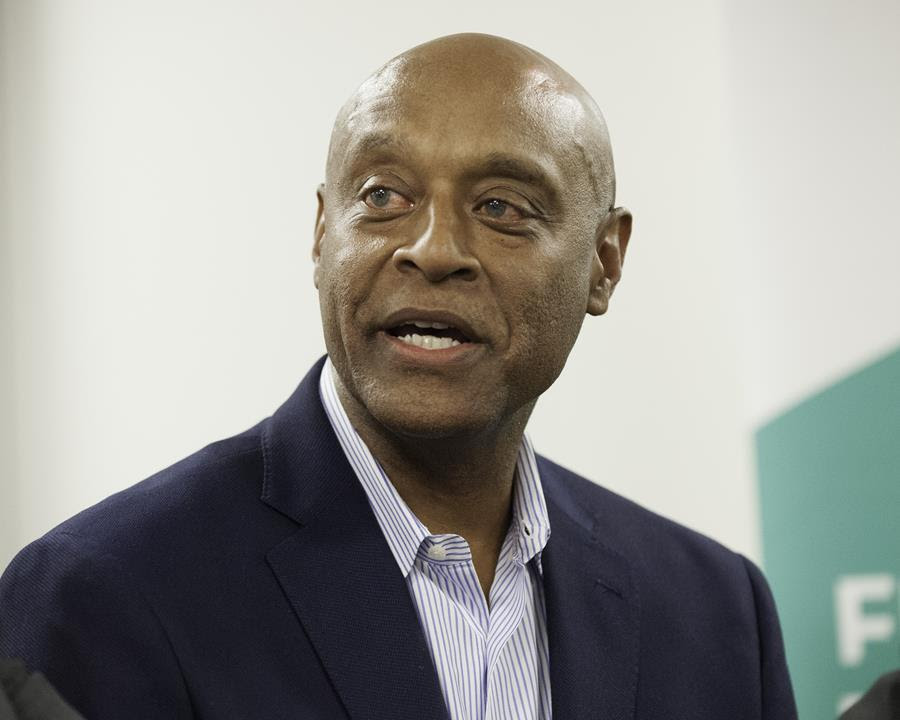
CONGRATULATIONS AND APPLAUSE. Good friend and CER Board Member Kevin Chavous is the new president of the Virginia-based ed-tech and on-line learning company K-12 Inc. CER and Kevin go way back – working together in DC to shape a robust charter schools program, and to win funding of the District’s Opportunity Scholarship Program (efforts which, by the way, were also supported by BAEO). A highly respected voice of reform and a strong advocate of growing a learning culture in America so all can participate in the future, he’ll be an exceptional asset to K-12. Read our statement on Kevin here. While you’re at it, pick up a copy of one of Kevin’s many books, including his latest, a novel, called The Plan.

Kevin Chavous

FONDNESS AND FAREWELL.  It is with great fondess but sorrow that we note the dissolution of the Black Alliance for Educational Options, an organization well ahead of its time. BAEO’s primary founder – the great Howard Fuller  – whose book No Struggle, No Progress chronicles why and how we must fight for children – told us in 1998 at CER’s 5th Anniversary why we must change the complexion of the room if we were to succeed in our endeavor to truly make educational opportunity work for children of color. And change the complexion of the proverbial edreform room he did, along with a host of other fellow warriors, like Deborah McGriff, then-Pennsylvania State Representative and now Congressman Dwight Evans, Virginia Walden Ford, among others. A dozen became more than a thousand and their impact has been felt in just about every major reform battle. BAEO’s clear, unwavering, powerful voice in the reform movement will be missed and it is incumbent upon those who continue the fight, to embrace BAEO’s principles and help to carry their work forward. (We’d also call on funders to recognize that sometimes the hardest work that the eye cannot actually see is the most important. But that’s another story, for another day).

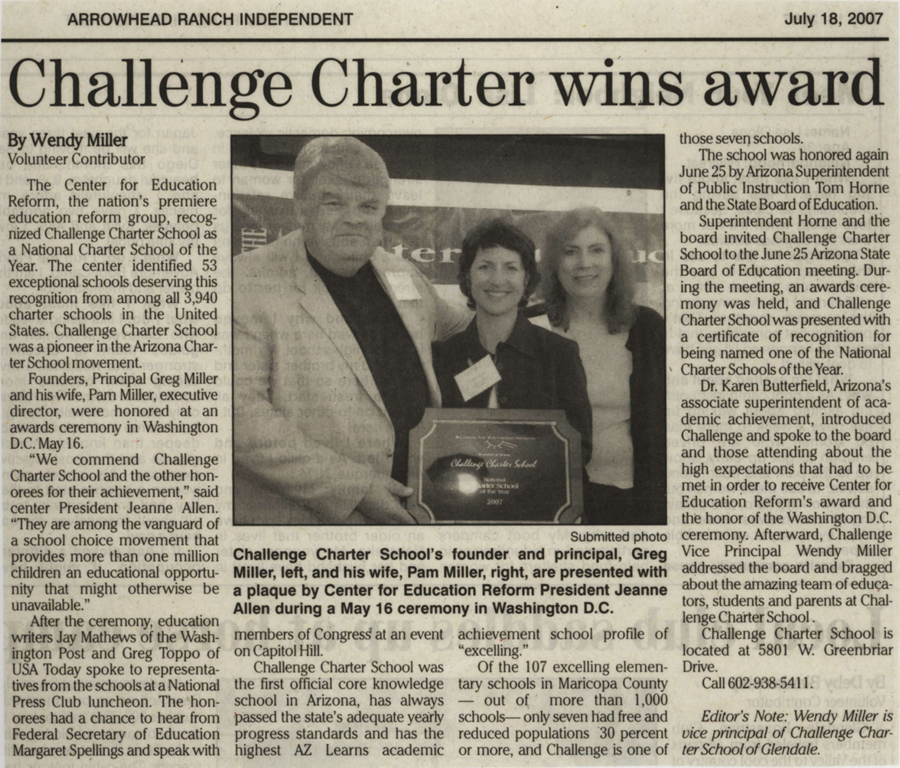
Challenge Charter wins award - July 18 2007

CONDOLENCES AND PRAISE  We are also extremely sad to report on the passing of Greg Miller, recently president of the Arizona State Board of Education and founder, along with his wife Pam of Challenge Charter School in Glendale in 1996 (a CER Charter School of the Year award winner!). An edreform pioneer, Greg was a member of the group that pushed for and won the passage of the Arizona law authorizing charter schools in 1994. Today, more than 180,000 children are enrolled in more than 550 charters in the state – a fantastic accomplishment and legacy for a fantastic guy. (Challenge Charter also continues to thrive with 500 children enrolled in grades K-6.) Our heartfelt sympathies go out to Pam, daughter Wendy Miller (who serves as CEO and principal at Challenge) and all the family & friends of the Millers. He will be missed.

What if We Gave Each Child a Backpack Full of Cash?

Jeanne Allen on Common Ground With Bill Walton

Our founder and chief executive, Jeanne Allen, recently sat down with William Walton. They discussed the controversy surrounding Matt Damon’s new film, the misleadingly titled Backpack Full of Cash, and how to bring the U.S. education system into the 21st century.

Watch the full interview above — and then read Bill’s op-ed, “The Answer to Failing Schools? Give Students “’Backpacks Full of Cash.’”

CER Applauds Board Member Kevin Chavous on New Role

Statement from Center for Education Reform Founder and CEO Jeanne Allen on Kevin Chavous’s new role:

“It is with great pleasure that I am pleased to announce that longtime friend, CER board member, and reform movement leader Kevin Chavous will become the president of K12 Inc.

I first met Kevin when he was a District of Columbia city councilman in the 1990s fighting for these new innovative things called “charter schools.” I saw him then as he is now, a forward thinking innovative leader on issues surrounding education.

When it comes to educating children, personalized learning and emerging technology have become a large part of the equation, and Kevin is the perfect leader to help grow that conversation. Our entire staff and board members here at CER wish him the best in his new endeavor.”

####

October 28th, 2017:

Backpack Full of Hypocrisy

The op-ed below written by Jeanne Allen was published in Realcleareducation.com on October 26th, 2017

Matt Damon and I are “in” the same film. I should be thrilled, but it’s a poorly contrived documentary with a storyline worlds apart from the reality of education for most Americans.

Entitled “Backpack Full of Cash” for a phrase I used in an interview with the filmmakers, it posits that the point of any form of education choice – charter schools, opportunity scholarship programs and other alternatives to traditional public schools – is to privatize American education, hence the use of my comments to frame the documentary. The full metaphor is actually focused on equity, and how choice can give power to the least powerful in society when their children are “worth” the same amount of money as everyone else.

Then, schools must vie for the privilege of educating our children, versus forcing them into specific schools, chosen by political actors in school systems, and based on one’s ZIP code. Rather than educate the public about these artificial, adult-centered school assignments and their impact on student outcomes, the producers of the film depict those who believe in education choice as people who seek profit and the ruin of public schools, and those who run failing public schools and fight with millions in taxpayer dollars to protect their contracts, their zoning and their turf day after day as selfless characters. What?!

The traditional school system and its protectors have a captive clientele. Unless you have the money, a proverbial backpack full of cash, to go to private school or move, you are stuck. Being stuck is precisely why charter schools and myriad other options were created. These tools that give parents real power have mitigated poverty, criminality, dysfunctional communities and discrimination – all conditions prolonged by an education system that fails approximately 60 percent of its students year after year.

Sarah Mondale should know this. A producer of the film, she and her uncle, former Vice President Walter Mondale are from Minnesota – the birthplace of charter schools, where progressive educators embraced the importance of student-centered learning, of innovation that knows no walls and of power for parents to decide what school or learning environment works best for their child.

Hollywood star Matt Damon should also know this. A Hollywood millionaire and the film’s narrator, he was blessed with living in the right ZIP code and went to a prestigious little high school a stone’s throw from Harvard Yard, where he would attend college. Only a few miles away, kids in Boston’s poorest neighborhoods find themselves in the wrong ZIP code, with futures as dim as Damon’s was bright. Damon could have described their plight; instead, his narrative papers over a system where bureaucracy and unions mandate uniformity, seniority and tenure, and students are expected to abide a centuries-old system while the rest of the world moves on without them.

It’s not like our actor friend doesn’t understand school choice. Damon chose not to send his children to their assigned public school, even in Pacific Palisades, CA. He once told The Guardian that sending their kids “to private school was a big, big, big deal.” He went on to explain: “And it was a giant family discussion. But it was a circular conversation, really, because ultimately, we don’t have a choice. I mean, I pay for a private education and I’m trying to get the one that most matches the public education that I had, but that kind of progressive education no longer exists in the public system. It’s unfair.” I’ll tell you what’s unfair. Unfair is telling parents of few means that their ZIP code, not the aspirations for their children, will sentence their children to attend schools that fail to educate their students year-after-year, decade-after-decade and generation-after-generation.

By his participation in the film, Damon has taken a very public stand against education opportunity. That’s hypocrisy. He, like many of us, make choices every day that we believe will help our kids receive an education that meets their needs. Surveys and experience show that most Americans believe such choices should be available to every parent, particularly the disadvantaged. He does not. Rather than embrace the notion that money should follow students to the schools that best meet their needs, he succumbed to hallow rhetoric bought and sold by unions whose membership and support base is in decline.

The backers of “Backpack Full of Cash” ignore the global paradigm shift that is transforming education, from small rural districts that have personalized learning to private micro-schools in Africa giving students their first access to learning. The one-size-fits-all factory model of schooling is obsolete – it’s evident in America’s flat test scores and startling high college remedial course rate. SAT scores find less than half of all students exceed college and career readiness benchmarks. And for students who do enroll in college, an estimated 40 percent to 60 percent of first-year students require remedial courses. Technology has transformed access to knowledge, and research has produced information about how brains function and the way students learn that should be changing the way schools are structured. But that’s nowhere in the documentary. It is written like it’s 1950 and Martians have invaded the schools – looking for cash.

The documentary’s trailer ironically argues that the innovations in teaching and learning, to which parents, once given a choice, are making a beeline for their kids to choose, have “a devastating impact on public schools, and the most vulnerable children who rely on them.”

The filmmakers have it exactly backward. It’s the system they are defending that now has the devastating impact on those it was intended to serve.  When the zones around failing schools are no longer a barrier and doors are open to them, those who have an alternative will take the exit. They know that their children need schools that work for them, schools that reflect today’s world, not a 180-year old system. When you’re ready to narrate that film Matt Damon, we’ll get you a truly progressive filmmaker. And some cash.

Jeanne Allen is Founder & CEO of the Center for Education Reform. Allen was interviewed for the film, which was portrayed by the producers as a broad overview of education reform, with no indication of the bias of the actual product.