








Sign up for our newsletter

Newswire – March 27, 2018

THE CAUSE AND THE PROMISE OF INNOVATION AND OPPORTUNITY

THE NATIONAL CHARTER SCHOOL LAWS AND RANKINGS. In its 22nd year, this flagship national report of laws represents much more than a trusted source of standings, compelling data and trends in today’s charter school sector — all in a user-friendly online format. The 2018 report takes an unparalleled, holistic approach to evaluating and analyzing the driving forces that have attempted to chip away at the charter school cause and promise of innovation and opportunity for learners at all levels. The report also provides case studies that demonstrate how meaningful change is possible through the impact of research leading to smarter policy.

The data and state-specific case studies in this report find that where strong charter school laws are in place supported by real autonomy, sufficient and secure funding above the political fray and ongoing operational diversity, the charter sector flourishes, which in turn is good for the entire public school sector.

A look at the following three states will give you a sense of what’s most important and what’s most likely to result in meaningful opportunities for families and students.

COLORADO: B 
Glows: With no cap, Colorado has seen increased growth and diversity. Colorado doesn’t cap the number of charter schools, which means there is always room for more schools, more diversity of school choices and more innovation.Grows: Colorado has two authorizers, but there’s a catch: Some districts have exclusive authorizing authority, which means that its semi-independent state institute can’t authorize charters in some places. Colorado is already home to some of the leading charter schools in the country — imagine how strong the charter sector would be if districts didn’t have such exclusive authority!


“Any solution starts with recognizing that charter schools can only reinvent public education if they operate outside of the traditional system. The best people to build great charter schools, district charter portfolios, and statewide charter sectors are visionary educators and reform-minded entrepreneurs passionate about enabling charters to fulfill their distinct mission.” —Benjamin Lindquist, The Colorado League of Charter Schools


MISSOURI: C
Glows
: Missouri allows multiple entities to authorize charter schools, and charters receive a lot of the operational autonomy they need to innovate. Yet…

Grows: The state limits the establishment of charters to only the two major urban centers (St. Louis and Kansas City). This geographic limitation places a de facto cap on charter school growth and prevents charter operators from meeting demand in other parts of the state.

NEVADA: C
Glows
: Nevada’s charter school law creates the opportunity for a robust and diverse charter sector. However…Grows: The current situation in Nevada is a case study in how a well-intentioned law can go awry in practice. The Nevada Public Charter School Authority puts bureaucratic burdens on charters and has been slow to replicate even the best charter schools in the state. This regulatory environment limits autonomy and growth.


“The point is that parents and students have real choice when we give charters the autonomy to be different.” —Michael Q. McShane, EdCHOICE


WHY IS THIS NATIONAL CHARTER SCHOOL LAW RANKING AND SCORECARD MORE TRUSTED, ACCURATE AND VERIFIABLE THAN ANY OTHER RANKING MODEL IN THE COUNTRY? The Essential Guide to Charter School Laws assesses how well states adhere to the principles of the charter school movement by looking at both policy and practice. CER’s work measures states on how and to what degree they allow for the proliferation of innovation and diversity, which are the tenets of the original charter idea.

DID YOU KNOW? That while charter school enrollment has nearly tripled over the past 10 years, it’s slowed considerably in the past two. Here’s a graph from the Heritage Foundation:
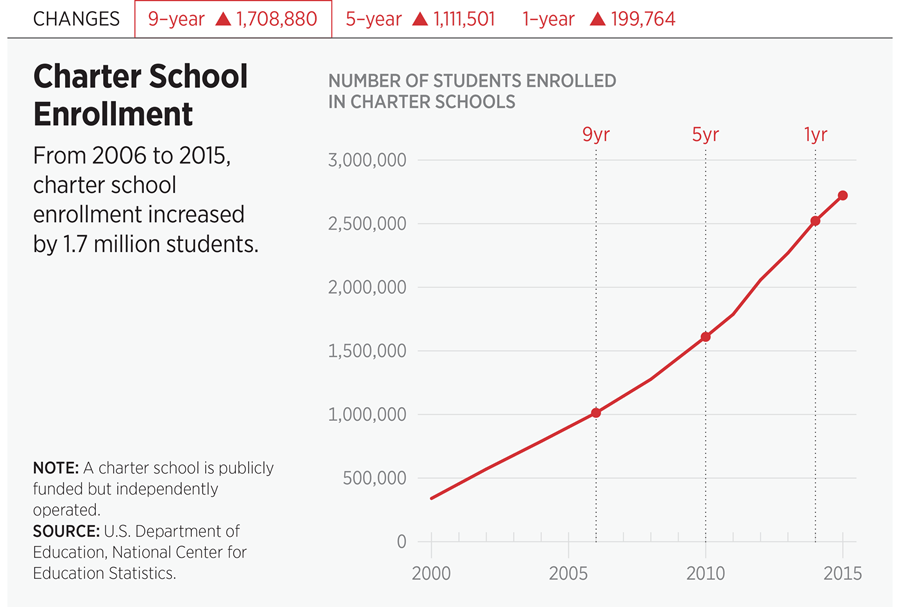
Charter School Enrollment
TRIBUTE. We remember Linda Brown, the schoolgirl pioneer for education freedom and equality at the center of Brown v. Board of Education. Her strength and lifelong activism inspired us all.

Ineffective laws and overregulation are strangling education opportunity, CER charter school law research finds

(WASHINGTON, DC)—Despite increasing demand for charter schools throughout the United States, an increased supply of new education opportunities for students has been compromised. This is owing to poorly written charter school laws and overregulation in many states, according to a new report from the Center for Education Reform. The 2018 National Charter School Law and Rankings is “the Essential Guide to Charter School Laws,” and provides not only state by state analyses and data but research and case studies which make the case for radical change.

“There is a huge gap between the best and worst state charter school laws,” said CER’s Founder and CEO Jeanne Allen. “Too many states and some advocates have forgotten the vision that built the original charter school movement: providing more opportunity for innovation, freedom and flexibility to enable better, more individualized schools for students, families and educators.”

“Too often regulations and cookie-cutter accountability systems force charter schools to abandon their often unique and individualized approaches,” added Allen.

Only three states, Arizona, Indiana and Minnesota, as well as the District of Columbia, received an “A” grade in the 2018 Scorecard. At the bottom of the CER rankings are Alaska, Virginia, Kansas, Maryland, and Iowa, all of which received a grade of “F” in the Scorecard. Iowa has the dubious distinction of having the worst charter law in the country, and only 3 charter schools 22 years after passing its charter law. All the “F” states limit operations, funding and authorizers to local school districts only.

“When the latest National Assessments of Educational Progress (NAEP) are released on April 10, we know that even with modest progress, more than half of our children are lacking in critical competencies. We must stop the overreach into these critical innovations and once again allow innovation to thrive.”

The 2018 Essential Guide can be accessed and downloaded from the CER website by using this link.

Newswire – March 20, 2018

CITY SCHOOLS FAILURE NOT A FUNCTION OF EDREFORM… though from reading the papers lately it would seem that some believe adult misbehaviors stems from edreform measures versus the real reason: that we haven’t changed those systems enough! Indeed, these systems remain fixed on the antiquated notion that attendance (time in the chair) is a more valid indicator (an easily manipulated indicator) than content mastery when striving for graduation. What is readiness when subject mastery hasn’t been accomplished? Indeed, the DC scandals, like other systems, are a result of their failure to evolve, not failure to maintain status quo.

…BUT IT COULD BE SOLVEDthrough a paradigm shift. Personalized learning has implications for teachers, learners and leaders, according to EdElements. You might consider subscribing to EdReimagined’s Pioneer to learn how – and why transforming schooling is essential to improving education.

STILL, DC SCHOOLS show enormous progress. Many seem to forget it was the worst school system in the nation just over 10 short years ago. Or perhaps they never knew because they didn’t live here or see the abject failure. We did. As the Washington Post recently reported, “So dysfunctional was the central office that textbooks went undelivered, teachers unpaid and student performance untracked.” Buildings were falling apart, there were scandals, no heat and air, and student performance was continually on the downslide. Enter charter schools, mayoral control, performance pay, and schools being reconstituted and closed for the first time. People began moving to DC, and now the economy is booming. The gaps are still there, but dramatically improved. Now it’s time to do more, not walk away because some misbehaved.

STRIKE TWO! Following the lead of WVA, teachers in the Sooner state are preparing to strike in what seems to be becoming a trend. Yet the coverage ignores the most fundamental issues of teacher compensation – that while the pay increases demanded here and gained in states like WVA resolved immediate demands for higher salaries, nothing is being done about the most vital long-term issues of pay equity and fairness. Teacher strikes and legislation should not be about more, but be about paying them better which leads to MORE. Teacher excellence should earn more than average performance, added responsibilities should yield additional earnings, and a job that’s hard to fill should offer higher pay. The National Institute for Excellence in Teaching (formerly the Teacher Advancement Program) launched by the Milken Family Foundation is a great resource for legislators willing to pursue such a transformational model, offering models that incorporate performance-based compensation based on fair evaluations, career pathways, professional development and leadership – all while providing teachers with powerful opportunities for career advancement and financial reward and, in turn, providing opportunities for dramatic improvements in the quality of education children receive.

GLOBAL EDUCATION AND SKILLS FORUM just concluded. How are nations answering the urgent question, “How do we prepare young people for the world of 2030 and beyond?” Jeanne Allen was there with global leaders from public, private and social sectors discussing and debating the paths toward achieving education, equity, employment and innovation for all. It turns out, people from other nations think teacher quality is actually a huge issue, and don’t have any problem being honest in saying so and working together productively to address it. Check out the discussion and Global Teacher Prize ceremony. Kudos to GEMS Education and the Varkey Foundation for leading the charge for addressing education globally.

IN THE NEWS LA supreme court makes it official, though it’s ridiculous that in 2018 we still are having this fight. The reality is that CHARTER SCHOOLS ARE PUBLIC SCHOOLS AND THUS THEIR STUDENTS ARE PUBLIC SCHOOL STUDENTS. As such, the schools can and must be funded publicly, like all other public schools. GET IT?

Congratulations to education reform pioneer, Frank Brogan, who has been by cleared the Senate Committee on Health, Education, Labor, and Pensions to serve at DoEd. (There’s Jeanne with Frank, many moons ago when he was FL Lt. Gov.!)

Newswire – March 13, 2018

SPOTLIGHT ON… HIGHER LEARNING


Some people are talking about reimagining high school and beyond to address deficiencies in learning, narrow the skills gap, and meet the needs of a new generation of work and the realities of a 21st century life filled with technology. At CER, we are working on taking it one step further – let’s not reimagine, let’s

REVOLUTIONIZE IT. We offer some ideas from our colleagues, and our own, that should be on the minds of policymakers particularly in Washington as they look toward solving these issues this year.


REINVENT HIGH SCHOOL? It’s been the buzz for a while now. The XQ Super School Project picked it up and ran with it with grants of $10 million to schools to replicate (still a work in progress). Jobs for the Future has been talking about it since before 2012. And the NAEP data we see every few years is a clear indication that something is not right about these 12th graders (so much so that some cities like DC have to cheat to get people out the door!) but alas these big ideas take time. Now, an article by 2 scholars in a think tank’s blog goes a step further with a clear-cut plan to truly turn it upside down. Their prescription? Change how we measure, ensure that students master the material (not just sit through a class) and yes, realign all they are expected to learn with higher ed and work.


“…it’s important to change how we measure success. If we want high schools to ultimately turn out responsible and productive citizens and we agree that not every graduate in America today fits that criteria, then let’s not use graduation rate as our ultimate measure of success. …The solution—personalized learning, the educational buzz word that has every school across the nation attempting to better serve each student’s unique needs and goals.” MORE


REINVENT HIGHER EDUCATION. At SXSW edX CEO Anant Agarwal offered this prescription to Ed Sec Betsy DeVos’ question about how best to “rethink” higher ed:


“Let’s make education modular; let’s unbundle education so that we can share and combine and stack pieces and do things in a very innovative and forward looking way.


“If I’m working and I need to up-skill, where do I learn data science today? I don’t have time to go and get a two-year masters. We need these modular credentials. We need the employers to accept these. And, he argued, we need to change the way federal financial aid flows to recognize these new credentials and scores more being created by employers, universities and others trying to respond to the growing skills gap and intransience of higher ed to adapt:


“Today a student can use $20,000 of funding to fund a fly-by-night, terrible degree program, but they cannot use a thousand dollars for a micro masters in artificial intelligence, or cyber security from Columbia, or MIT, or Harvard.,” like those now available on the non-profit EdX’s platform. Let students decide how they wish to spend the aid, he suggested, “and watch how fast things will change.”


THE NEW DEGREE. GSV’s A2APPLE Weekly Brief reports that companies are co-creating their own higher ed programs to address the deficiencies in traditional higher ed. “… re-skilling and adapting the workforce to modern technology is becoming one of the biggest focus areas for corporations. As an illustration — open IT positions in the global workforce are currently growing at 15% per year. Not surprisingly therefore, Coursera’s recently launched B2B offering has already gained over 900 global company customers, up 25x compared to 2016!” The aforementioned EdX has new Micro-degrees and ASU and others are creating new masters programs in computer science and data sciences.


REINVENT WORKFORCE & APPRENTICESHIPS. We’ve been marching around the Hill saying it for nearly a year – the critical missing link isn’t whether we do vocational education well, or how we fund workforce development programs, but whether Americans have access in real time to the education, workforce and apprenticeship opportunities that can ensure continued learning and a career path that makes sense. Enter the Education, Workforce and Apprentice Tax Credit Proposal of 2017 that has been Introduced in 2018 by Cong. Lloyd Smucker as the USA Workforce Tax Credit Act (H.R. 5152). U.S. businesses and individuals who wish to support scholarships for students who want to pursue better learning opportunities at every level would get a tax credit for their contribution. This would spur relevant and responsive programs to be developed at every level and more workers would have access to the education they and their families need in real time. Check it out. We’re fans! (Then again, it was our idea!)


WE STILL LOVE THE LIBERAL ARTS. As Burning Glass Technologies argues in their blog on this subject that employers want the critical thinking, comms and soft skills that liberal arts provide, but they also need the specific skills that are suited to the job market. It’s not either or, it’s both, AND! And yes, Senator Rubio, we do need more philosophers!


DID YOU KNOW?


IN OTHER NEWS… The future of knowledge, education, issues like you find in today’s Newswire and more will be covered inside and out at the 2018 ASU+GSV Summit this April 16-18 in San Diego, CA. Speakers include former President George Bush, Ed Secretary Duncan, Orange County Superintendent Barbara Jenkins and many others. Join us at the hottest confab of the year!


TELL US YOUR STORY! Families all over the country have education stories to tell. Send us yours!

Newswire – March 6, 2018

SXSW

SPOTLIGHT ON… SXSW, INNOVATIONS AND MORE

SOUTH-BY. It’s the place to be, they say. Thousands gathered for the beginning of several days of “SOUTH-BY…” as in, “Are you going to SOUTH-BY?” South by Southwest EDU, FILM and MUSIC. And from just a day around the “campus,” it’s clear why: Austin is one big town full of everyone and everything who is (or thinks) they’re doing something relevant or innovative or who just wants to learn what it all means.

SXSW

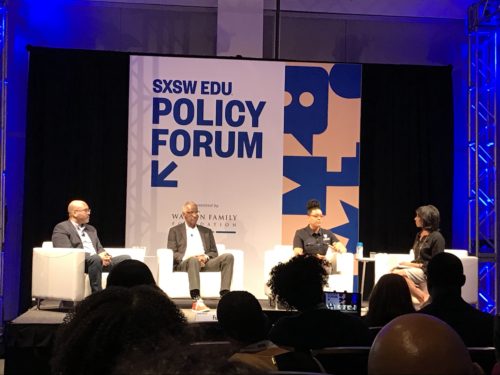
GREAT PANELS ABOUND. And the room was packed to hear some of the smartest minds in education today talk directly and honestly about the impact of educational failure on black kids. In particular, and how it happens, was Monday’s highlight. Moderator Rehema Ellis from NBC was clearly blown away by the intensity and honesty of the discussion. For example, Margaret Fortune talked about what she sees as the greatest challenge in charter schools. “If you’re a black person with an idea, you’re a novice; if you’re a white person with an idea, you’re an innovator.” Dr. Howard Fuller addressed how difficult it will be to teach kids if you’re not capable of doing so. “Just being fully credentialed doesn’t necessarily mean you know how to teach our kids.” Chris Stewart offered, “I believe parents have been professionalized out of the equation of our children’s education … And, black people are the new cotton. People and companies are trying to harvest our children.” These and hundreds of other insights should be featured at every event, no matter the subject, if we are to make real progress, real change.

Intrigued? Follow along with SXSW EDU.

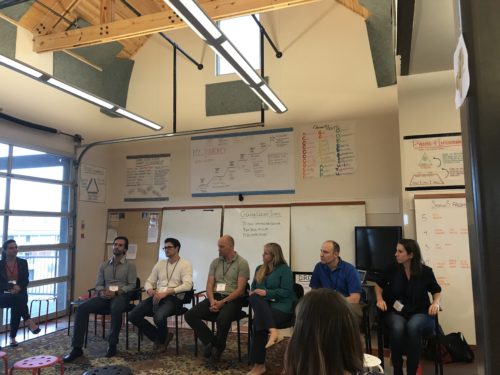
ALSO IN AUSTIN, A PROMISING NEW SCHOOLS CONFAB. They call themselves the “one-room schoolhouse for the 21st century.” And based on what we’ve seen, this schoolhouse is indeed transformative. The founders of Acton Academy are tapping a growing army of entrepreneurs to start schools that offer a new learning revolution. Teaching students to be self-governing, using adaptive tools and personalized learning, employing an apprenticeship model, following Montessori — these and more are staples of an Acton school. Its founders, Jeff and Laura Sandefer, are evangelists for teaching that puts students at the center of learning and does away with the hundreds of other unnecessary things that exist to accommodate rules and adults. It’s a revolution that isn’t for the faint of heart, but if you like how this sounds and you ever thought of opening your own school, this may be for you.

SXSW

DID YOU KNOW?… that Puerto Rico gets far more of its education budget from the federal government than any US state? Last year it was 37%! And now, in the wake of Hurricane Maria, despite stiff opposition from teachers’ unions, Puerto Rico is poised to reinvent its school system with the introduction of innovative charter schools.

Which states still have no charter school law? Montana, Nebraska, North Dakota, South Dakota, Vermont and West Virginia.

SPEAKING OF W. VA… The unions still have teachers out on strike after almost two weeks. The issue? Teacher pay of course. But what if it were about more than just raising salaries? What if you could raise the salary of a teacher who was accomplishing more, contributing more and able to get better results? That’s what happened to narrow the achievement gap in DC (yes, some bad actors manipulated results for gain, but the majority of DC teachers are doing more, doing better and earning more as a result!).

IN OTHER NEWS. New faces at the Department of Ed? The Senate Committee on Health, Education, Labor and Pensions will vote on two nominees: Frank Brogan, for assistant secretary of elementary and secondary education, and Mark Schneider, for director of the Institute of Education Sciences (the Department’s research arm).

WHERE WE ARE. Later this month, CER will be represented at the prestigious Global Education and Skills Forum in Dubai. Joining education leaders, policymakers, innovators, philanthropists and thought leaders shaping the future of education, our founder and CEO Jeanne Allen will speak about innovative approaches in recruiting the next generation of the best and brightest educators. Follow her on Twitter, @JeanneAllen.

GOING TO ASU+GSV? It’s not too late to join us in San Diego at the hottest event of the year for education innovation, education transformation and the knowledge industry. Industry leaders (like Margaret Spellings and Jeb Bush) will join celebrities (like Bill Gates and Richard Branson). CER will lead several discussions on how Ed Tech Can Save Rural America: Getting Personal and Education Opportunity in America. Beat the rush and sign up now.

TELL US YOUR STORY! Families all over the country have education stories to tell. Send us yours!

Newswire – February 28, 2018

The Steps of the Supreme Court

“The health of a democratic society may be measured by the quality of functions performed by private citizens.”

— Alexis de Tocqueville, Democracy in America

SPOTLIGHT ON… DEMOCRACY IN AMERICA

The Steps of the Supreme Court

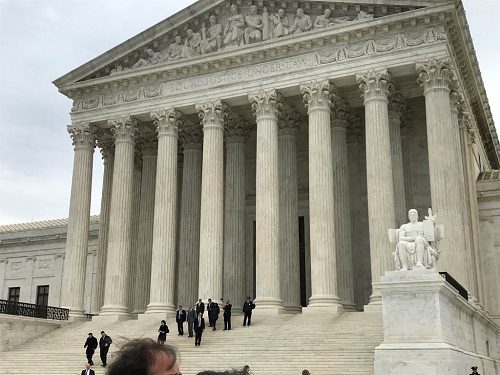
A VIEW FROM SCOTUS. Democracy was alive and LOUD on the steps of the Supreme Court this past Monday. Oral arguments in the long-anticipated case, Janus v. AFSCME, were delivered inside the High Court, and, as expected, the scene outside was, well, colorful and surreal. There were signs and slogans and yelling and an obscene amount of swearing from people claiming to support kids and workers.

Maybe it’s because a decision in favor of Mark Janus and for worker freedom could deal a powerful blow to public worker unions — chief among them, teachers’ unions (whose political spending surpasses all but one company, including the NRA!). But regardless of hard-fought issues, the optics were not befitting a nation as great as the US.

Union Thug Pin

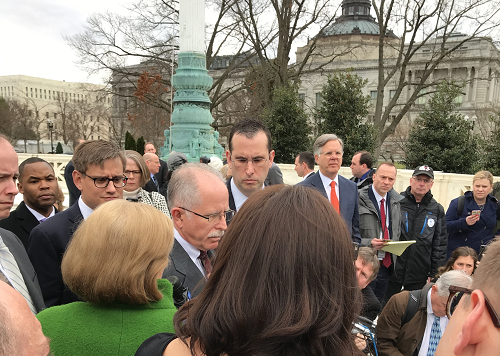
WHO WAS THERE? Our man on the street interviews revealed many who did not know why they were there or what the issues were (including the woman with the union thug sign!). Asked who they were, sign holders refused to answer; some just said they were paid to hold a sign. They told supporters of worker freedom — like us — that we were tools of the Koch brothers. Scabs, in it for the profit. (Huh?) AFT’s Randi Weingarten arrived on the steps presumably from inside after the arguments and seemed to mope around the noise.

Mark Janus

During and after the rally, speaker after speaker implored the crowd to appreciate the importance of worker freedom, of great opportunities for teachers. Speakers included the plaintiff himself Mark Janus (pictured above); the lead plaintiff in Friedrichs v. California Teachers’ Association, Rebecca Friedrichs; EdChoice’s Leslie Hiner; Colin Sharkey and CER’s Jeanne Allen, who fired up the crowd with the following line: “Today in America we have freedom to choose just about everything in our lives — except if we want to join a union.”

WHAT’S AT STAKE? In her column for the Washington Examiner, Jeanne Allen summed up Janus as follows: “The significance of this case cannot be overstated; the decision could potentially restore the freedom of public employees to choose how they want their hard-earned paychecks spent and might put decisions about voluntary union membership back into the hands of the employees themselves.”

Lawyers from both sides gave statements and transcripts revealed that some interesting tête-à-tête was had with both sides, including this exchange between the AFSCME lawyer and Justice Kennedy:

This week’s Reality Check with Jeanne Allen featured Mark Mix of the National Right to Work Legal Defense Foundation. Mix gets to the heart of the matter: “When you look at Mark and people like him in previous cases like Pam Harris, Diane Knox, Rebecca Friedrichs, these are ordinary people just trying to exercise their basic freedoms and do their job.”

SPEAKING OF CIVICS

We continue to grieve and despair in the wake of Parkland’s tragedy. Students who are speaking up, walking out and taking action are demonstrating their interest, through town halls, marches, social media campaigns and more. But in the spirit of true education, we want them to take their newfound popularity and accomplish their mission. Can they engage in the political process with the diligence and knowhow of how generations past have accomplished democratic social change? Will their efforts take a civil — even if justifiably heated approach — to democracy in action, or will they fall into divisiveness rather than righting the wrongs they seek? We wish them well, and offer them this important resource from the Constitution Center in the nation’s most historic city, Philadelphia, PA.

DID YOU KNOW?

How long the issue of public sector workers being required to pay the fair-share, or agency, fees if they decline to join the union has been going on? Since 1977, in Abood v. Detroit Board of Education.

TELL US YOUR STORY!

Families all over the country have school choice stories to tell. Send us yours!

Employee Freedom on Trial Monday

Favorable decision Janus case could mean better education, expanded opportunity

MEDIA ADVISORY
Friday, February 22, 2018
 CONTACT
Christina Mazzanti, Dir., Communications
(202) 750-0016

Monday: US Supreme Court hears arguments on worker freedom
Janus v. AFSCME decision, whether favorable or not, will have wide-ranging implications for public-sector union employees and education at large


(Washington, D.C.) – On Monday the U.S. Supreme Court hears oral arguments in Janus v. AFSCME. The significance of this case cannot be overstated; the decision could potentially restore the freedom of public employees to choose how they want their hard-earned paychecks spent, and might put decisions about voluntary union membership back into the hands of the employees themselves.


According to the Manhattan Institute, the decision can affect 5 million public workers across 22 states including California, Illinois, and New York.

The case results will also have implications for the quality of education we deliver to our children. The teachers unions fight hard to protect mediocrity, even in failing schools, and support policies that keep ineffective teachers in the classroom, a taken-for-granted practice which in turn discourages more quality entrants to the profession.

Union demands for teachers to all behave and comply with fixed rules about how schools are run stifle innovation.

The largest teachers unions in the U.S., the National Education Association and the American Federation of Teachers, are also among the largest political donors of all time, together spending the second most in political donations nationally. Many of the policies and politicians they support, and programs they seek to have implemented prevent children from escaping failing schools and deny parents their due power to determine which education best meets the needs of their children.

Leaders on both sides of the argument will be at the Supreme Court Monday. CER and its leadership will be on site to arrange interviews, and CER Founder & CEO Jeanne Allen will be available for comment. For more, contact Christina Mazzanti at (202) 750-0016 or christina@staging.edreform.com, and for information on location Monday contact Patrick Korten at (202) 288-4307 or patrick.korten@kortenmedia.com.


Monday: US Supreme Court hears arguments on worker freedom

Janus v. AFSCME decision, whether favorable or not, will have wide-ranging implications for public-sector union employees and education at large

(Washington, D.C.) – On Monday the U.S. Supreme Court hears oral arguments in Janus v. AFSCME. The significance of this case cannot be overstated; the decision could potentially restore the freedom of public employees to choose how they want their hard-earned paychecks spent, and might put decisions about voluntary union membership back into the hands of the employees themselves.

According to the Manhattan Institute, the decision can affect 5 million public workers across 22 states including California, Illinois, and New York.

The case results will also have implications for the quality of education we deliver to our children. The teachers’ unions fight hard to protect mediocrity, even in failing schools, and support policies that keep ineffective teachers in the classroom, a taken-for-granted practice which in turn discourages more quality entrants to the profession.

Union demands for teachers to all behave and comply with fixed rules about how schools are run stifle innovation.

The largest teachers’ unions in the U.S., the National Education Association and the American Federation of Teachers, are also among the largest political donors of all time, together spending the second most in political donations nationally. Many of the policies and politicians they support, and programs they seek to have implemented prevent children from escaping failing schools and deny parents their due power to determine which education best meets the needs of their children.

Leaders on both sides of the argument will be at the Supreme Court Monday. CER and its leadership will be on site to arrange interviews, and CER Founder & CEO Jeanne Allen will be available for comment. For more, contact Christina Mazzanti at (202) 750-0016 or christina@staging.edreform.com, and for information on-location Monday contact Patrick Korten at (202) 288-4307 or patrick.korten@kortenmedia.com.

Education Mediocrity Remains

New Report Outlines “disappointing reality” for most students

(WASHINGTON, D.C.) – Education gaps, access to training, technology and lack of options all add up to a ‘disappointing reality’ for most US citizens, according a new report authored by Dr. Cara Candal, Research Fellow at the Center for Education Reform.

“This gap in access leads to staggering achievement gaps of six years of learning between low-income students and their more affluent peers,” writes Candal, an expert educator and assessment specialist who has worked in and studied classrooms in the US and abroad.

Roughly 43 percent of American children are growing up in low-income households without access to quality education options. In some other nations, the bleakness for these young, which later translates into high illiteracy rates and workforce challenges, is rarely tolerated. As the report documents, other countries have higher standards of rigor in all schooling, subsidize early childhood education, invest heavily in curriculum and teachers and provide parents widespread flexibility to choose schools.

The US has one of the most deeply inequitable systems of education in the world. “The US is not an outlier when it comes to racial, ethnic and socioeconomic diversity,” Candal explains, “it just doesn’t do as good a job of providing access to high quality options for all students.”

The first in a series, The Case for Education Transformation is available online at staging.edreform.com. For interviews with Dr. Candal please contact CER at 202-750-0016

Newswire – February 21, 2018

SPOTLIGHT ON… THE CASE THAT MAY LIVE IN INFAMY.

SCOTUS VS. UNIONS

President Roosevelt famously declared December 7, 1941 as a “day which will live in infamy.” We don’t think that word is on the SATs anymore — or even taught — likely because we’ve made education such a dull, uniformly focused system. For decades, teachers have been relegated to work in factory-like conditions with little chance for true control over their professions.

That may finally all change this Monday (February 26), when the Supreme Court hears arguments in Janus v. AFSCME. Janus could lead to a landmark decision on the power of unions in the United States and potentially reverse their ability to extract taxpayer funds, via paychecks, to cover their political activities against a teacher’s First Amendments rights.

That decision, if made, will surely live in infamy for the unions, which are able to spend the hard-earned money of public employees — like plaintiff Mark Janus — and thus wage battle after battle against innovation, opportunity and change in US schools.

JUST ONE YEAR AGO

The case has been winding its way through federal courts since early 2015. Essentially, it’s a re-do of Friedrichs v. California Teachers Association, which the Court deadlocked on 4-4. CER said then that this split decision on whether teachers should have the freedom to make decisions regarding their employment — unfettered by union control — “does not mean that the issue of teachers’ rights is going away.” Well, it hasn’t, and with Janus now on the docket, it’ll finally get addressed.

OPPONENTS BELIEVE

Per the high court’s 1977 decision in Abood v. Detroit Board of Education (which Friedrichs sought to overturn), the unions will argue that while union membership cannot be mandated, nonunion members can be required to pay the portion of a union’s dues that support efforts from which they derive benefit (e.g., collective bargaining on wages, benefits, workplace safety, etc.)

SUPPORTERS OF JANUS

Those who disagree — including teachers — argue that regardless of benefit, forcing a nonunion member to pay for union activities amounts to unconstitutionally compelled speech.

As our CEO Jeanne Allen observed last year, “A favorable outcome could pave the way for a loosening on the stranglehold of other public-sector employees compelled to pay mandatory union fees. Public school teachers, in particular, stand to benefit from the freedom that would allow them to make their own decisions as to whether they pay union dues and fees.”

In fact, a ruling in favor of Mark Janus would improve the learning experience for students across the nation. By dramatically empowering teachers, Janus could change the course of American education.

Colin Sharkey, of the Association of American Educators, adds another important point: “For too long America’s workers — teachers especially — have been forced into joining or funding labor unions because they do not know they have the right to opt out. This coerced membership and forced dues run contrary to freedom of association all Americans should enjoy.”

THE CASE IN A NUTSHELL

For Monday’s installment of her podcast, Reality Check, Jeanne Allen talked to Mark Mix, President of the National Right to Work Legal Defense Foundation and of the National Right to Work Committee. According to Mix,

Janus brings up a core issue of the First Amendment and asks the question, Can a private organization force someone to pay them to ‘speak on their behalf’ without their consent? You know better than most people of these types of battles waged against the monopoly power of the teachers’ unions. This is something we have been intimately involved in, and this will be another case the National Right to Work Legal Defense Foundation brings to the court and asks them to adjudicate the First Amendment question.”

To hear the podcast in its entirety, click here.

The list of Janus supporters is a starry constellation of public-interest law groups, state executives, lawyers and state-based think tanks from across the country. These notables include the Atlantic Legal Foundation, Becket Fund for Religious Liberty, Competitive Enterprise Institute, James Madison Institute, Landmark Legal Foundation and Southeastern Legal Foundation.

The list of Janus opponents is equally noteworthy, although their stars shine in a completely different galaxy. These folks include the teachers unions (of course), American Civil Liberties Union, National Organization for Women, Southern Poverty Law Center, National Urban League, Sierra Club (go figure), YWCA USA, National Center for Lesbian Rights, National LGBTQ Task Force and United Students Against Sweatshops. Interestingly, among the mayors who organized an amicus brief is Chicago’s Rahm Emmanuel, who the unions have given no shortage of grief in his tenure.

WHAT WILL HAPPEN?

We can’t say for certain, but given the 4-4 tie in Friedrichs and the expectation that Justice Gorsuch (Scalia’s replacement) will side with his colleagues who voted to overturn Abood (Justices Roberts, Kennedy and Thomas), the wind seems to be blowing strongly in favor of Mr. Janus.

And that ain’t just us talkin’. Here’s the assessment of Erwin Chemerinsky, the Dean of Law at UC Berkeley: “No one — liberal or conservative — has any doubt about the outcome or that the ideologically motivated decision will hurt public workers in this state and elsewhere.”

TOP TAKEAWAYS IF SCOTUS RULES IN FAVOR OF JANUS

1. Millions of workers, including public school teachers, will be unshackled from compelled association, which in and of itself is a clear violation of the First Amendment.

2. No one will be forced anymore to pay union fees when opting out of union representation.

3. More take-home pay for teachers and more freedom to operate as they see fit when opting out of mandated associations with teachers’ unions.

4. More innovation in public schools, as the money that unions spend to lobby against education change will be dramatically reduced, as will their power.

5. A pro-Janus ruling will have no impact on a union’s right to organize and function, just on an employee’s right to not pay up.

TELL US YOUR STORY!

Families all over the country have school choice stories to tell. Send us yours!