









Sign up for our newsletter

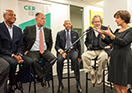
Exclusive Interview with Kara Kerwin, President, The Center for Education Reform

By Mark Lerner
Examiner
November 10, 2014

It was a most appropriate time to be interviewing Ms. Kerwin, the president of The Center for Education Reform. November 1st marked the one year anniversary of her assuming her new position. The mission of CER is “to accelerate the growth of the education reform movement in ways that make available to families new and meaningful choices, give parents fundamental power over their children’s education, and allow teachers and schools to innovate in ways that transform student learning.” I asked her if the group had a preferred school choice mechanism for accomplishing their goals.

“There is not one type of reform that we favor over the other and we don’t discriminate based on tax-status or whether education is delivered in a brick and mortar environment or online, publicly or privately,” the CER president answered without hesitation. “We are most interested in striving for educational excellence by advancing all opportunities for children. When Jeanne Allen founded this organization 21 years ago there was no one behind this kind of effort. Our group is bridging the gap between policy and practice. We specialize in empowering people doing the work on the ground. We are striving to give parents the fundamental right over their child’s education through coaching leadership, making connections, and remaining principled on policy. We provide data analysis in order to support parents and policymakers. Finally we support parents in their efforts to implement high standards in their schools.”

As an illustration of the type of work of which CER is proud, Ms. Kerwin talked to me about Leah Vukmir, who since 2011 has been a distinguished member of the Wisconsin State Senate. Prior to serving in the State Senate she was a representative in the Wisconsin Assembly. Ms. Vukmir is a registered nurse and certified pediatric nurse practitioner with 25 years of experience. She became interested in running for office when she became frustrated with the reading program in her kid’s school. The Center for Education Reform assisted her in creating the group Parents Raising Educational Standards in Schools (PRESS) which has led to significant literacy improvements for low income Wisconsin children.

Janet Barresi was another individual who CER helped to further educational freedom. Ms. Barresi became the first new state superintendent in Oklahoma in 20 years in 2011. For 24 years she was a dentist with her own private practice. CER supported her efforts to create the state charter law and then open the first charter school, Independence Charter Middle School, in 2000. In 2003 Ms. Barresi created the Harding Charter Preparatory High School. Both charters focus on serving inner-city students, many living in poverty.

“We aid people to become part of the movement along side a broader network of reformers which we have the expertise to do,” Ms. Kerwin explained. But at the same time that CER has made significant progress, Ms. Kerwin is definitely not satisfied as to where the movement currently stands.

“Two and a half million children currently attend a charter school in this country, while a million more are on waiting lists,” the CER president informed me. “About 300,000 children take advantage of tuition tax credits and voucher programs, yet close to three million more opportunities have been created by state legislation that are not being fully implemented. Five million more children are in private school. However, there are 49 million kids attending traditional public schools. This means that only five percent of school aged children are currently utilizing school choice. While this is the current educational landscape, devastatingly, only 34 percent of American students by the eighth grade are proficient in both reading and math.”

It is this public policy problem that CER is striving day and night to fix. It is quite a challenge with close to a two million dollar a year budget and roughly 15 full time equivalent employees. But it is amazing what CER has accomplished. Ms. Kerwin is extremely proud of the 160 million impressions a year that CER receives in the media. Her goal is nothing less than to influence the school choice movement to make it “bigger, better, and grow it faster.”

Ms. Kerwin related to me that CER is not a lobbying organization because “we are not in the business of buying influence.” In addition, she said, “We do not believe in establishing chapters. Our energy is focused on motivating and elevating the voice of the people on the ground, in their communities, across the states. We educate policymakers, thought leaders, and parents, and are not afraid to create the necessary friction, calling out friends and detractors alike, as we strive for whatever is needed to do what’s right for kids.”

She went on to expound that while CER is completely agnostic as to the form school choice takes, the organization does care about the structure of particular laws.

“Recently we ranked tax credit and voucher plans, which made some public officials uncomfortable. But after we did it people thanked us for the effort. Every year we weigh in on the quality of charter laws in each of the states. CER is unique in focusing on the implementation of those laws, not just how they measure up to some model, but how they result in greater opportunities for students. We help develop education literacy and provide meaningful data to make sure local lawmakers get it right,” Ms. Kerwin detailed.

Part of the goal, the CER president mentioned, is to have states take responsibility for their own legislation. “We know that strong charter school laws and robust charter school authorizers lead to higher student academic achievement. We actually prefer that there are multiple chartering bodies so that they can bring in new practices, while we caution against over-regulating schools to death so they can innovate and be successful. Of course, here in Washington D.C., due to the excellent charter law and the outstanding efforts of the Public Charter School Board,charter schools have exceeded state averages for nine straight years.”

The CER president also emphasized the crucial role that charter boards play. “Charter school boards need help in understanding how important they are to the success of the schools they oversee,” Ms. Kerwin asserted. “We need to give the charter school laws an opportunity to work and there are lots of people out there who have the knowledge and experience to get this right.”

It became abundantly clear to me during our conversation that Ms. Kerwin is an expert on the subject we had been discussing. I asked her how she came to CER. “I was a political science major at American University,” she informed me. “I completed an internship here during which Ms. Allen sent me to Friendship Public Charter School’s Chamberlain campus. I was truly blown away by the enthusiasm of the teachers and the engagement demonstrated by the students. I thought that this is the way public education should be accomplished. I have been at CER almost exclusively from the moment I visited Chamberlain, which equates to 15 of the last 21 years.”

I then asked Ms. Kerwin to describe what it is like following in the footsteps of Ms. Allen. She could not wait to answer this question. “These are big shoes to fill. For years Jeanne was alone in this fight. She has taken a lot of arrows over time. I respect everything she has done. Jeanne has challenged me to be better, to grow the organization, to do things my way, and most importantly to get more kids in choice schools. She provided me with a fantastic foundation. Now we need to conceptualize what success looks like. With a dedicated staff, strong leadership from CER’s Board of Directors, including DC’s own education reform pioneers Donald Hense and Kevin P. Chavous, we are constantly evaluating our impact and progress toward this vision.”

Ms. Kerwin then became philosophical. “We must get away from the one size fits all mentality. We have to ask ourselves whether a particular school provides value and whether it is doing well intentionally. But you have to understand that the way we are educating children right now is not working for the great majority of kids. Local school boards do not know how to manage the facilities under their care. They are controlled by special interests. Superintendents come and go. Teachers are not treated as the professionals they are. We need to eliminate teacher tenure. It is all about the standards we set from day one. The traditional school system should not be allowed to stand any longer. It needs to be completely turned upside down. I hope in my lifetime I’ll get to see localities educating their youth exercising 100 percent choice and demanding accountability for all schools.”
Study Shows Marked Charter Enrollment Growth

By Dr. Brady Nelson
Heartland
November 7, 2014

Approximately 2.5 million public school students were enrolled in charter schools last school year, up more than 12 percent from last year and more than 30 percent from a decade earlier, a recent report from the National Alliance for Public Schools states, based on a February survey.

“Parents are increasingly voting with their feet,” said Nina Rees, president and CEO of theNational Alliance for Public Charter Schools. “This is the largest increase in the number of students attending charter schools we’ve seen since [researchers began] tracking enrollment growth.”

There are 6,400 charter schools in the 42 states that permit them, with between 500 and 600 new charter schools opening each year, according to The National Alliance for Public Charter Schools.

But Kara Kerwin, president of the Center for Education Reform, warns, “Yes, charter school enrollment continues to grow, but according to the 2014 Survey of America’s Charter Schools, it’s growing at a steady, linear pace with an average rate of 340 schools per year. Growth must accelerate if charter schools are to play a central role in improving U.S. education and meeting parent demand for new and meaningful educational options.”

California Led Growth

California, reportedly led the nation in charter school growth last year, with 104 new schools.

The report from the National Alliance for Public Charter Schools also said about 200 public charter schools closed. The schools were closed for several reasons, including low enrolment, financial problems, and low academic performance.

“The goal of the charter school movement is not simply to increase the number of schools and students enrolled, but rather the number of high-quality public school options for families who need them most,” said Rees. “These closures reflect that, and we will continue to advocate for strong accountability measures to ensure that only high-quality schools are allowed to serve our nation’s students.”

Despite those closures, the number of public charter schools still grew by 7 percent over the 2012-2013 school year.

“The tremendous growth in charter schools over the past decade suggests that parents are enthusiastic about having new options outside of the traditional public school system,” said Lindsay Burke, an education expert at the Heritage Foundation. “The type of choice charters provide enables parents to better match educational options with their children’s unique learning needs, and they’re jumping at the chance.

“For the handful of states that still don’t allow charter schools to operate, growth in charter enrollment over the past year should demonstrate to them that they’re lagging behind the education innovation curve,” Burke said.

Neal McCluskey, Ph.D., of the Cato Institute offered a caveat, saying: “It is great that charters provide many kids much-needed options other than their traditional public schools. But as ‘free’ alternatives, charters have also been shown to draw heavily from private schools, and that is damaging a much more independent, valuable form of choice.”

Election Analysis: More than Half of Nation’s State Executives Well-Equipped to Positively Impact Education System

CER Press Release
Washington, D.C.
November 6, 2014

With two gubernatorial election results pending, more than half (57 percent) of governors and governors-elect in the United States and the mayor of Washington, D.C. hold encouraging views or have proven track records on promoting charter schools, school choice and teacher quality measures, according to an Education50 Election Day analysis from The Center for Education Reform.

“It’s incredibly heartening to see voters were able to spot the real reformers in a majority of gubernatorial elections during this midterm cycle,” said Kara Kerwin, president of The Center for Education Reform. “Americans have made it abundantly clear that there must be meaningful change at the state level to increase parental empowerment and access to opportunities that will help students excel.”

Of the 36 gubernatorial elections and the D.C. mayoral race held in 2014, an impressive 62 percent so far (Alaska and Vermont pending) have resulted in a pro-reform candidate emerging victorious. Notably, governors-elect candidates Doug Ducey of Arizona, Bruce Rauner of Illinois,  and Greg Abbott of Texas will join the ranks of states currently led by reformers.

“While on the campaign trail or during their incumbencies, these candidates have demonstrated a commitment to creating policy environments in which educational options and classroom freedom can truly thrive,” said Kerwin.

“Now that the gubernatorial campaign dust has settled, governors must embrace their ability as state executives to take the lead on implementing policies rooted in choice and accountability for families.”

Click here for An Education50 Analysis: Governor Grades on Education Reform 2014.

Governor Grades on Education Reform 2014

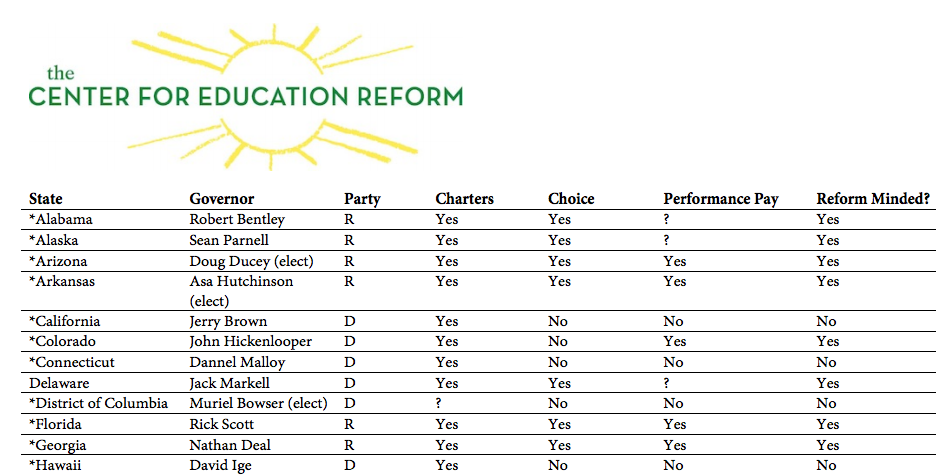
After the 2014 election, 52% of governors (including Washington D.C. mayor) are considered education reformers.

Leaders are considered reform-minded or not based on where they stand on charter schools, school choice, and performance pay. These ratings do not just consider what governors have said about the issues, but also what they have done to champion reforms in their state. (See FAQ on criteria here).


Screen shot 2014-11-05 at 7.54.57 PM


This chart lists the current governors and lays out where each of them stand on critical education reform issues. For more on governor races in 2014, please see Education50.

Download or print your PDF copy of Governor Grades on Education Reform 2014.

2014 Midterm Elections and School Choice: Q and A With Advocates

By Arianna Prothero
Education Week
November 5, 2014

The 2014 midterm elections were a big win for Republicans, but how did they shake out for school choice? I reached out to the National Alliance of Public Charter Schools’ state policy wiz Todd Ziebarth and the head of the Center for Education Reform, Kara Kerwin, to see how these two school choice advocates and organizations are reading the results.

Read the rest of the interview here.


Rick Scott Inches Past Charlie Crist to Re-Election in Florida

By Allie Bidwell
U.S. News & World Report
November 4, 2014

Florida GOP Gov. Rick Scott eked out a win over Republican-turned-Democratic challenger Charlie Crist Tuesday in a tight race that came down to fewer than 100,000 votes.

Citing technical difficulties that made voting difficult throughout the day, Crist filed an emergency motionseeking to extend voting hours in Broward County, but a judge blocked the motion. In the end, Scott pulled out a slim win when The Associated Press called the race at 10:20 p.m.

Throughout the campaign, Scott and Crist sparred over who would do more to increase funding for education. Although most states are still spending less on K-12 education than before the Great Recession, Florida is one of a handful of states that decreased spending per student in the 2015 fiscal year – by 1.6 percent, or $62 dollars.

During his tenure, Scott irked teachers throughout the state, both Democrats and Republicans. An October poll conducted by Hamilton Campaigns showed 91 percent of Democratic teachers and 62 percent of Republican teachers gave him a negative rating.

Although Crist won the support of teachers unions who heavily campaigned on his behalf – American Federation of Teachers President Randi Weingarten made a stop in Florida during the final week before the election – the half-million dollars the American Federation of Teachers donated to his campaign was not enough to put him over the edge.

Early voting data compiled by the American Federation of Teachers showed union members turned out to Florida voting booths in significantly higher numbers than the general population: Teachers union members outperformed the general population by 10.2 percentage points.

Kara Kerwin, president of the Center for Education Reform, says Crist returning to the governor’s mansion would have been “a huge setback” for education reform policies.

On the other hand, Scott has been supportive of expanding school voucher and scholarship programs, tax credits and merit pay for teachers. But union members say Scott has placed too much of an emphasis on standardized testing at all grade levels. Those student test scores also count for a significant portion of teacher evaluations.

“[Crist] has already declared he would like to roll back scholarship programs and tax-cut programs,” Kerwin says. “He was not easy to work with when it came to charter school policy when he was in office before.”

2014 Election Results Signal Big Wins for Students

Voters Send Mandate that Education Reform Is Tops

CER Statement
Washington, D.C.
November 5, 2014

While some states await final election results from all 36 gubernatorial races in the 2014 midterm elections, major victories for America’s students have already been affirmed in Arizona, Florida, Illinois, Michigan, and Wisconsin. These states have elected leaders who support school choice programs, charter schools, and performance pay measures for teachers.

“I’d call it a mandate for change sent boldly from voters,” said Kara Kerwin president of The Center for Education Reform. “Governors-elect in these states have proven themselves to be champions of reforms during their tenure as incumbent state executives, or have run on platforms that don’t shy away from being really vocal, putting students and parents first.”

“Too few of our modern-day state leaders have appreciated the absolute role they must play in bringing about substantive change in America’s schools. Voters agreed yesterday. State leaders are critical in leading the discussion and educating lawmakers on the policy conditions necessary for measures that will put the focus on student success and answer the demand for more and better educational options parents so desperately desire,” Kerwin concluded.

For more election results and to find out what other state races mean for student success and parent empowerment see CER’s Education50, continually being updated as election results roll in.


NEWSWIRE: November 4, 2014

Vol. 16, No. 43

KNOW BEFORE YOU GO. Today, Americans face the important task of electing candidates who will best serve their interests and appreciate the urgency with which leaders must act to improve student outcomes. State leaders are vital to improving education, and some – but not all – have recognized this responsibility by expanding new and meaningful educational choices for families. History tells us that political fortune favors those who take bold actions. It’s up to governors and state leaders to effect meaningful change, but it’s up to voters to give them that opportunity, and then hold them accountable for results. CER’s Education50 breaks down which candidates are up to the challenge of making bold choices for students.

OH THE IRONY. It comes as no surprise that Mike Antonucci’s Intercepts blog gets a little zanier during an election year, exhibit A being a letter to the editor from a local AFT official lamenting an “outrageous” amount of spending by an outside group during a school board election. The amount in question was $31,000 to fill a school board seat in the District of Columbia. No doubt a big chunk of change, but peanuts compared to say, the $450,000 spent by the AFT in a school board election down in New Orleans. Not to mention the $60 million plus that unions planned on spending leading up to Election Day to roll back policies that put more power in the hands of parents and students. This is why it’s critical voters know where candidates stand on education issues so they’re able to spot the real reformers for themselves.

BREAKING TRENDS. We’ve seen the same headlines year after year about what should be done about the unacceptable stagnation in SAT scores among American high schoolers. While the persistent lack of any meaningful shift in average scores is noteworthy in and of itself, what often gets missed is the fact that scores vary depending on the type of school students attend. Students attending private schools significantly outscored public students in math, reading and writing sections, ultimately buoying national averages across all student demographics. Perhaps voters in at least one of the 36 gubernatorial elections will find a candidate undeterred from ensuring students are able to have a choice.

RELATIONSHIP BUILDING. Recently released federal data show a seven percent uptick in the number of charter schools during the 2012-13 school year, consistent with the steady, linear growth in charter schools reported by CER’s 2014 Survey of America’s Charter Schools. What’s also consistent is the uneven proliferation of charter schools on a state-by-state basis. The data show a direct correlation between the number of charter school campuses created during 2012-13, and whether a state charter law contains the financial and oversight mechanisms necessary for charters to truly thrive. This relationship goes to the heart of how state policy can influence reforms on the ground, and why voters must select candidates who have the best chance of creating a positive environment in which educational options can grow.

IS HE FOR REAL. Speaking of spotting a REAL reformer, former NYC Schools Chancellor Joel Klein has a new book out this week, reflecting on his experience of changing education for the better in the Big Apple. Facing an uphill battle to insert a healthy dose of much-needed accountability, Klein’s writing shows an implicit acknowledgement that things needed to change, which was followed up with sweeping policy initiatives to identify teacher performance in the classroom, to introduce data-based accountability, and to give underserved families choices beyond their zip code-designated school. The work of Klein and other real reformers in New York is far from over but this reflection serves as a conversation starter and – once the Election Day dust settles – hopefully a blueprint for action.

AFTER THE VOTES ARE TALLIED, find out what midterm election results mean for the future of education policy at a discussion this Thursday from 3:30-5:00pm hosted by the American Enterprise Institute (AEI). CER’s Senior Fellow and president emeritus Jeanne Allen will be there to weigh in along with AEI’s Rick Hess, Education Week’s Alyson Klein, Bethany Little of Education Counsel and Charles Barone of Democrats for Education Reform, with AEI’s Michael Q. McShane serving as moderator. Livestream will be available here.

The Irony: “Outrageous Spending” in School Board Elections

EIA Intercept’s Mike Antonucci’s blog post today calls out the irony in a Washington Post letter to the editor written by Elizabeth Davis, president of the Washington Teachers Union (an AFT affiliate), and Delvone Michael, director of DC Working Families. The letter has a problem with the fact that an outside group spent more than $31,000 to “elect its candidate of choice” for a special election to fill a school board seat in DC’s Ward 8.

The letter starts out saying, “Across the country, wealthy business interests and conservative political operatives are buying up local boards of education. And if we don’t stand up and say no, D.C. will be the next notch on their belt.”

Antonucci’s reaction to the letter says it best, saying “Wow. $31,000 of outside money for a school board seat is outrageous. What adjective, then, should we use for this October 28 story in the New Orleans Times-Picayune?”

The October 28th story notes how the American Federation of Teachers (AFT) spent almost $450,000 on local school board elections.

Read the full EIA Intercept blog post here.

The Governors and Vergara: Why It’s Both Necessary – and Avoidable – to Take Education Reform to Court

By Jeanne Allen
The Huffington Post
November 3rd, 2014

Policymakers, pundits and ed reformers are gleeful in the wake of the Vergara decision finding the practice of teacher tenure in California unconstitutional. It’s been nearly 30 years since the issue of teacher union protections was first raised as a possible cause for the failing schools first revealed in A Nation at Risk. While few love the idea of taking policy issues to court, weak-kneed politicians have brought it on themselves. After all, few heroes remain in our states’ leadership who are willing to buck the unions for fear of negative political consequences. History shows us the outcomes of such actions are otherwise, however. Brave governors, in particular, have demonstrated that taking the principled position actually pays off. As the Wall Street Journal opined just a few weeks ago, “…There’s no reward for restraint on [education reform], so political leaders might as well do something worthwhile.” Truer words have seldom been spoken.

Not only is holding back on education reform never rewarded, it’s inevitably punished, as Pennsylvania Governor Tom Corbett has learned from the union-led assault on his reelection campaign. Like so many governors who promise and yet fail to deliver big on education reform, he insisted that the teachers union were to maintain a seat at the table. That kind invitation earned him their support of his opponent who will likely take over and accelerate the union campaign against reform. It’s a cautionary tale for the 36 sets of candidates running for chief executive of their state. Yet, an analysis by The Center for Education Reform finds that, out of 36 races for Governor this year – in what is a dramatic opportunity to change course in the states – only 17 of 28 incumbents are considered reformers. Scholar Frederick Hess of AEI reports that only 3% of all gubernatorial candidates even talk about education reform on their website!

Reform opponents only win when the state’s executive lets them, as history shows.

Governor John Engler led Michigan in the 90’s to adopt decentralized funding, a break the mold charter law, and tests with teeth. He was rewarded with bi-partisan support, and three terms in office.

Governor William Weld (R-MA) led the enactment of one of the nation’s earliest charter laws in 1993, against fierce union opposition and would win a landslide reelection in 1994.

Colorado’s Bill Owens’ controversial improvements to the state charter school law, a new school choice program, and accountability via school report cards would earn him the largest reelection in history in 2002.

Virginia standards and high stakes testing didn’t preclude Governor George Allen from winning a Senate seat despite national union opposition. George Voinovich won a huge reelection in Ohio after creating vouchers and charter schools, and was later elected to the U.S. Senate showing again that the union bark was much bigger than the bite. Christie Todd-Whitman did not cow-tow to the myth of union domination in her native New Jersey. She served two terms, and ushered in charter schools and high standards.

And from 1999-2007, Jeb Bush would enact sweeping reforms as Governor of Florida, and remains today one of the most well-respected state leaders of all time, by members of both parties.

While Republicans have found it easier to buck constituencies that are more at home in the other party, let’s not forget that Democrats seeded early attempts to innovate. Minnesota’s Rudy Perpich was the first to celebrate public school choice and charters, and Delaware’s Tom Carper and then U.S. Senator Joe Biden were once on board. Yet it was Bill Clinton who was right there with many a Republican governor endorsing reform, before it was cool, as it were. From Arkansas, he praised–in writing–State Representative Polly Williams, an African-American leader in Wisconsin, in her fight for vouchers for the poor. He would join hands at the famous Charlottesville Summitwith President George H.W. Bush in calling for improvements that included performance-based accountability and choice, though as president he would retreat considerably.

Not since these Governors served has there been such a critical mass at one time accomplishing dramatic changes to the once stagnant school system. Those who take up the baton with gusto and boldly challenge the status quo are not only rewarded with public support, but often emerge as political stars.

Some have tried since, and a few have succeeded, but not like this coalition of Governors, who are largely responsible for why there is education reform, at all, today.

Yes, some bright spots of success among sitting Governors exist; Louisiana Governor Bobby Jindal, Tennessee’s Bill Haslam, and Colorado’s John Hickenlooper have all increased choice and accountability, modestly, though, when compared to the sea-changing work of previous generations. Others have been wholly ineffective despite promises to the contrary.

Why is there so little valor anymore? The real problem is that many ed reformers themselves, knowing little of the early battles, wrongly believe conciliation is superior to struggle and so they operate as if the battle is over. Many newer organizations believe that demanding results is unpractical and would rather get along, avoiding contentious debates that have proven always to make policy results better in the long run.

The contrast between Tom Corbett and Tom Ridge as Pennsylvania governor dispels the myth that being conciliatory gets you results. Corbett started out looking for commonality. Ridge started out firm about his goals and vocal about his opposition. He would use that clarity of purpose to bridge a longtime partisan gap with Philadelphia Democrat Dwight Evans on his side, and together they put the unions on notice that they were demanding reform. That’s leadership.

The nation is lacking in leadership – in education reform particularly – because we don’t demand it anymore. It’s folly to fear the unions and the status quo forces; they are paper tigers. Their actions are only as strong as the politician is weak. They seem terrifying, as Mao Tse-Tung put it, but in reality, are weak or ineffectual. When I ran into Colorado’s Owens a few years after he’d left his gubernatorial post, he thanked me for the leadership my organization showed. “You always had people out there pushing us, demanding we do more and then helping us get it done. Thank you.” Citizens need to give them incentives, and then have their backs.

Politicians don’t lose by fighting for education reform. They lose by being inarticulate and squishy. With just a few days more before the election it’s worth recognizing that bold state leadership can indeed cure many ills, is more likely to sustain change, and avoids the need to take every problem to court.