








Sign up for our newsletter

Alabama Poised To Become 44th Charter School Law In The Nation

Charter School Legislation Awaits Governor’s Signature

CER Press Release
Washington, DC
March 19, 2015

Last night, the Alabama Legislature passed SB 45, which would allow the creation of up to ten charter schools and an unlimited number of charter school conversions annually.

“This is undoubtedly a step forward for Alabama, but the ability of charter schools to truly influence student outcomes depends on the quality and the implementation of that law,” said Kara Kerwin, president of The Center for Education Reform (CER).

According to CER’s methodology in determining our 16th edition of Charter School Laws Across the States 2015: Rankings and Scorecard released earlier this week, Alabama’s law likely would’ve earned a mediocre grade.

Since 1996, CER has studied and evaluated charter school laws based on their construction and implementation, and whether or not they yield the intended result of the charter school policy, which is to ensure the creation of numerous quality learning opportunities for children.

“Strong charter laws feature independent, multiple authorizers, few limits on expansion, equitable funding, and high levels of school autonomy,” said Alison Consoletti Zgainer, CER Executive Vice President and the report’s lead editor. “Many states that appear to have all of the critical components of a strong law struggle with the implementation of key provisions, which is why the rankings over the past few years have shown little variance and have remained relatively stagnant.”

On paper, concerns with Alabama’s legislation include a cap on the number of schools allowed and a lack of independent and multiple authorizers.

“The 16th edition of Charter School Laws Across the States 2015: Rankings and Scorecard revealed a lack of political will to improve charter school laws to play a more central role in addressing the needs and demands of our nation’s students,” said Kerwin. “It’s tremendous that Alabama lawmakers passed legislation allowing for new opportunities for students, but it’s imperative they pay close attention to how the law plays out on the ground and continually improve it so that charter schools are given the equity, accountability, and freedom to be true innovators in meeting more students’ educational needs.”
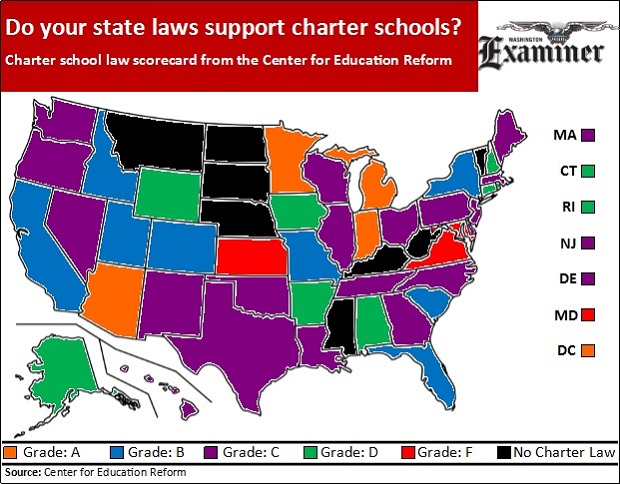
Do your state laws support charter schools?

By Jason Russell
Washington Examiner
March 17, 2015

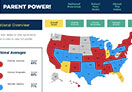
The Center for Education Reform released its 16th rankings of charter school laws in each state Monday. Minnesota beat Indiana, Michigan, and Arizona for state laws most supportive of charter schools. However, the District of Columbia had slightly better charter school laws than Minnesota.

031715-Charter-School-Map

“Strong charter laws feature independent, multiple authorizers, few limits on expansion, equitable funding, and high levels of school autonomy,” the accompanying report explained.

States were graded in four different areas. The more entities allowed to open a charter school, the better. Restrictions on the number of charter schools or number of students they can serve drive down a state’s score. Independence in making operating decisions improves a score. Equal and guaranteed funding for each charter school student versus all other public school students also raises a state’s grade.

Eight states have no laws allowing charter schools at all: Alabama, Kentucky, Montana, Nebraska, North Dakota, South Dakota, Vermont, and West Virginia.

According to the accompanying report, 2.9 million students attend roughly 6,700 charter schools in 42 states and the District of Columbia. That’s approximately 6 percent of the elementary and secondary student population in the country.

The Midwest appears to be the region most friendly to charter schools. Indiana, Michigan, and Minnesota all earn A grades for their charter school laws. No other Midwest state earns a grade lower than C.

Outside the Midwest, the regions are surprisingly diverse. In the Northeast, New York gets a B grade, the best of any Northeast state. The South has a few B states in Florida and South Carolina, but Mississippi has no charter laws at all. Four Plains states have no charter laws at all, and Kansas gets an F grade — but then four other Plains states get a B grade.

Charter schools are publicly-funded schools that don’t charge tuition and are open to all students, but have more independence in their operations and curriculum than traditional public schools.

“We’re going to figure out a way. We’ve figured out a way so far.”

By Sara Schaefer
WTHITV10.com
March 17, 2015

DUGGER, Ind. (WTHI) – On Tuesday night the Dugger Union community gathers for another meeting regarding getting their own charter.

Right now, they’re currently a branch of Indiana Cyber Charter School.

It’s been a long process but board member Greg Ellis says they won’t stop trying anytime soon.

“We’re not going to give up. This is going to happen and we’re not going to go away,” he said.

A recent report released by The Center for Education Reform gives Indiana charter schools an A, placing them in top three nationwide.

An outlet that could be positive for Dugger Union.

The highest score schools could get was a 55. Indiana scored a 41. The report claims that shows there’s still room for improvement.

Dugger’s growth is too recent to be included in these numbers but they’re a testament to the push for charters.

“We’re working really hard here to do something that we think is innovative and creative and a tremendous opportunity for our kids. This is going to work. We’re going to figure out a way, we’ve figured out a way so far,” Ellis said.

Ellis says now they’re just waiting and feeling confident about the chance to stand on their own.

Illinois charter schools received a grade of a C. See the grades and full report here.

Maryland, D.C., other states should be kinder, gentler to charter students

By Deborah Simmons
The Washington Times
March 16, 2015

Gov. Larry Hogan is stirring up the public education troth in the state of Maryland, and well he should.

His predecessor and guitar-playing presidential aspirant, Martin O’Malley, used to brag about the state’s traditional public schools and how well the students who attended them fared on standards and testing. Mr. Hogan is taking a different approach.

Mr. Hogan wants to loosen the reins on charter schools, including giving them the power to hire and fire their teachers.

That has turned into a dicey proposition for charter school legislation before the Maryland General Assembly, where a stalwart of Maryland’s Democratic machine, Mike Miller, has served as Senate president since 1975.

Mr. Hogan, a Republican, assumed office in January, and as you can imagine, Mr. Miller, 72, who grew up in the southern part of liberal Prince George’s County, doesn’t naturally cotton to Republicans or fiscal conservatives running things in Annapolis.

An infusion of pro-choice perspectives may be just what’s needed — and they needed it yesterday.

A study released Monday by the Center for Education Reform shows that Maryland students and parents just can’t seem to get a break in the Old Line State, which didn’t pass charter school laws until 2003 and where lawmakers and the O’Malley administration have been moving slower than molasses ever since.

The study, which ranked the District and the 42 states with charter laws, said this:

“Maryland should be ranked dead last on this scorecard. However, despite the odds being stacked against them, charter schools in the Old Line State shine. Maryland has one of the weakest charter laws in the country because of the enormous obstacles charter applicants face from school boards the minute they show interest. Charters face outward hostilities from boards, [and] are micromanaged, operationally limited, poorly funded and are not even allowed to hire their own principals and staff to ensure success under their model. Lawmakers in Annapolis are poised to change that in 2015 with a modest, yet promising, proposal on the table.”

Charters were birthed in hostile environments of unions, progressives and beholders of the status quo, and school-choice supporters continue to battle those same elements.

Take charter school staffing. The individual schools do not have carte blanche to draft and cherry-pick to hire. The schools don’t even have carte blanche to fire a teacher who doesn’t measure up or can’t handle the academic truth.

That authority — that power and that cherry-picking — rests in the hands of the various school districts, which abide by state law when it comes hiring, firing, retirement and the like. The districts also control operational matters and spending.

He who controls the purse strings holds the power.

Enter Mr. Hogan and his budget, which are trying to get Annapolis to do right by Maryland families. Mr. Hogan is trying to get lawmakers to think about charter students instead of charter schools.

Sometimes D.C. is an example

On Tuesday, a slew of education overseers are scheduled to release a new audit of D.C. charter schools, and there is room for concern, especially considering a press release that said an audit found that the chartering authority and the state superintendent “had room for improvement.”

On the other hand, the Center for Education Reform found that the District “has the strongest charter school law in the country,” which is a very, very good thing for families.

D.C. charter schools enroll about 44 percent of city students compared with traditional public schools, and have higher academic proficiency and advanced rates — even among special-education and socioeconomically disadvantaged students.

Charter schools, meanwhile, are underfunded, and students get short-shrift regarding sports/recreational and other facilities.

That’s because the purse strings that affect D.C. students are controlled by the mayor and the lawmakers, as is the case in the Maryland.

Critics of charter schools are right: Charters take money from traditional public schools. But that is because the money is supposed to follow the student into the charter schoolhouse.

Sometimes it does, and sometimes it doesn’t, which is why a lawsuit on behalf of charter students was filed against D.C.

He who controls the purse strings …

NEWSWIRE: March 17, 2015

Vol. 17, No. 11

STATE OF CHARTER LAWS. The Center for Education Reform released the Charter School Laws Across the States 2015: Rankings & Scorecard, revealing a remarkable lack of progress in statehouses nationwide when it comes to implementing policies that could allow charter schools to play an even bigger role in addressing the needs of our students. While charter schools continue to grow at a linear pace nationally, parent demand for more options shows no signs of slowing down, with most charter schools reporting wait lists with 300 or more students. True, lack of action can be chalked up to politics, but the bigger culprit is misinformation about what constitutes strong policy. For 19 years, CER has seen firsthand and evaluated what works in expanding charter schools, and which laws can truly withstand the test of time and political interests. Click here to read the full report, and find out how your state could be encouraging meaningful choices for families.

APATHY. Though not as weak as the “F” graded Maryland, Virginia and Kansas, the “D” graded New Hampshire charter law has ample room for improvement, especially when it comes to funding equity. A recent op-ed out of the Granite State rightly criticizes “legislative apathy,” a problem that not only affects New Hampshire but dozens of other states that made little to no progress in strengthening charter laws. The New Hampshire funding disparity between traditional and charter schools is currently estimated at an unacceptable 50 percent. Between this funding shortfall and a restrictive charter cap, it’s no wonder there are fewer than 25 charter schools statewide. Structural problems like these do a disservice to public charter students, and all students in the state who would be better served by a school of choice, and it’s time New Hampshire lawmakers (and lawmakers nationwide!) turn apathy into action.

BEYOND THE BOROUGHS. Not surprisingly, the education challenges of New York City tend to receive the lion’s share of the media spotlight in comparison to other municipalities. However, on the other side of New York State is Buffalo, another city where reformers on the ground are tirelessly trying to improve student outcomes through choice. Currently, Buffalo district officials are debating whether to lease vacant buildings to charter schools, a move that would invite reputable operators to provide new schools for students in need of alternatives.  Last year, state lawmakers took steps to remedy charter facility challenges in the Big Apple, but ended up neglecting the rest of the state. Expanding facility access, along with the innovative Education Investment Tax Credit program, are just two of the state-level reforms waiting in the wings that would bring new opportunity. Speak up and make your voice heard in support of these critical changes for the Empire State!

WRONGFUL EVICTION. The Magnolia Science Academy (MSA) charter school in Santa Clara, CA offers students a rigorous, STEM-based education. Ninety-one percent of students met or exceeded proficiency on science state assessments, far surpassing the 60 percent state average. A similarly high 80 percent scored proficient in English. And yet, the Santa Clara home district is forcing the closure of the school in order to make way for a renovated traditional school, taking away this high-performing education option. A closer look at California’s charter school law ranking reveals local boards are the primary authorizers in the Golden State, a problem since many are openly hostile to school choice. Even worse, many districts do not follow state law when it comes to providing equitable access to facilities. The struggle for MSA families to save their chosen school epitomizes the importance of having strong laws that protect against the whims of local control and the status quo, and ensure charters have the support they need to flourish.

VIRTUAL INSANITY. While parents in Santa Clara are fighting to keep their school of choice open, parents and guardians of students at Tennessee Virtual Academy (TNVA) filed a lawsuit, challenging the State Commissioner’s misguided decision to shut down TNVA at the end of the school year. The Posans, legal guardians of their grandson Austin, a TNVA student with autism, say Austin is a “different child” thanks to the school. Before Austin attended the school he wasn’t reading at all. Now, he’s reading at a fourth-grade level. From 2013-14, TNVA increased its school growth measure in all subjects, and second and third-year students are making learning gains at higher levels. Parents and guardians like the Posans sought out TNVA because the online learning model is the right fit for their children, and they’re taking necessary action to preserve the choice they made.

SYMPOSIUM COUNTDOWN. In less than 48 hours, Black Alliance for Educational Options (BAEO) will be holding its Symposium in Memphis, TN, where reformers from across the country will connect to empower families and expand opportunity for black children. Click here for more information.

Maryland’s Charter School Law Must Improve!

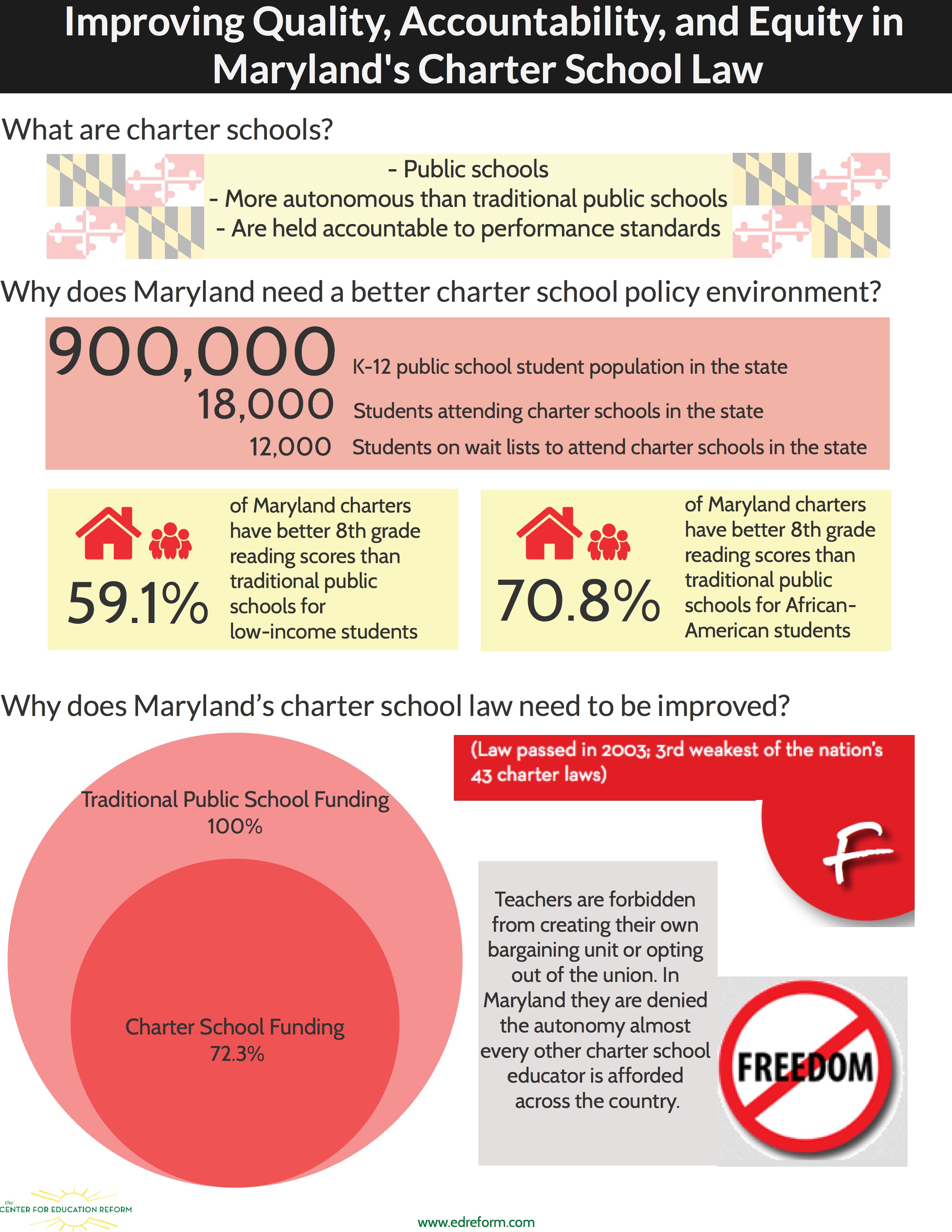
MDcharterInfographicDespite its long-standing reputation for quality schools, Maryland is in need of more and better educational opportunities for children.

The Maryland charter law that passed in 2003 is among the nation’s weakest laws, not only because it’s restrictive, but also because it’s incredibly vague. The law is silent on some of the most critical policy issues for charter school development, including the level of funding required to support a charter school, the number of schools that can be started, the term of the charter, the governance structure of the school, and student admission requirements. Due to the weakness of the state’s law, Maryland has not been eligible for certain federal grants and has not attracted other investments from philanthropy to support these innovative public charter schools.

Unfortunately, charter school legislation passed by the Maryland General Assembly, SB 595, would not improve the charter school environment for schools, students, or families in Maryland.

As the Washington Post said in an editorial after listening to CER’s concerns with the bill and analyzing it themselves, Governor Hogan should veto this bill, as “the legislature took a bad law and made it worse.”

Click here to ask Governor Hogan to Veto SB 595.

In The News:
Maryland becomes first state in nation to roll back charter law, Statement from CER President Kara Kerwin, 5.12.15
The Schools Baltimore Needs, Washington Post Editorial Board, 5.8.15
Charter school bill excludes online education, MarylandReporter.com, 4.30.15
National charter schools advocate wants Hogan to veto charter bill, Washington Post, 4.27.15
Legislation only hurts charter schools, Baltimore Sun Letter to the Editor, 4.20.15
Opinion: Parents Want Choice in Montgomery County, Washington Post, 4.17.15
Dysfunction in Annapolis, Washington Post Editorial Board, 4.15.15
Maryland’s Charter Bill No Laughing Matter, 4.15.15
Statement on Maryland General Assembly’s Passage of Charter School Bill, 4.14.15
Maryland Senate Panel Undermines Governor’s Education Plan, 4.1.15
CER Hopes Maryland Lawmakers Continue To Debate Critical Changes To State’s Charter School Law, 3.26.15
Maryland gets an ‘F’ on its charter school laws, Watchdog.org, 3.26.15
Senate panel rewrites Hogan’s charter school law, Baltimore Sun, 3.25.15
Gov. Hogan’s charter bill is in trouble; Md. lawmakers striking key provisions, Washington Post, 3.22.15
Charter schools and public accountability, Baltimore Sun Letter to the Editor, 3.19.15

Letter to Maryland charter school teachers.
Baltimore Teachers Union response

For more information on Maryland’s charter school law, click here.

Advocates bemoan lack of progress on state charter school policies

By Travis Pillow
RedefinEd
March 17, 2015

Around the country, few states approved new policies giving charter schools greater autonomy or helping them grow, according to a new report.

The report by the Center for Education Reform gives Florida’s policies a B, the same grade it received last year, as most states, including those with relatively charter-friendly policies, saw little change in their scores.

Kara Kerwin, the organization’s president, blames the lack of movement on election-year politics and a “growing body of misinformation” fueling calls for increased regulation.

“It is abundantly clear that little to no progress has been made over the past year,” she writes in the report’s introduction. “Charter school growth does continue at a steady, nearly linear pace nationally, especially in states with charter laws graded ‘A’ or ‘B,’ but an even more accelerated pace would allow charter schools to play a more central role in addressing the demands and needs of our nation’s students.”

The center looks at factors that help charter schools grow, like the funding the receive, the autonomy they are granted and their ability to open new schools without facings caps or other restrictions.

It’s worth looking at how these rankings line up with other reports that grade states on different factors. Three jurisdictions, (Michigan, Indiana and Washington D.C.) out-rank Florida in both the center’s report and an analysis released last fall by the National Alliance for Public Charter Schools.

Arizona, meanwhile, gets an A in center’s report but lower marks from the alliance, which notes charter schools in that state tend to serve fewer low-income and minority students than traditional public schools, and their students tend to show lower academic growth.

On a new blog at U.S. News and World Report, David Osborne notes a common thread among jurisdictions where charters outperform traditional schools: Strong authorizing.

The original charter idea was to open the public school monopoly to competition from new schools, operated on contract by other organizations: nonprofits, teacher cooperatives, universities, even for-profit businesses. The charter was usually a five-year performance contract, laying out the results expected from the school. Charter authorizers – typically school districts or state boards of education – would reject charter applications from groups that did not appear equipped to succeed, and they would close schools if students did not learn as promised.

This approach is largely a reality in New York, Massachusetts, Rhode Island, Indiana, Louisiana, Tennessee and Washington, D.C. But any good idea can be implemented poorly. In Arizona two statewide authorizers handed out 15-year charters like candy but lacked the capacity to oversee the more than 500 schools that sprung up.

Florida didn’t pass any major charter school legislation last year, in part because some key lawmakers wanted to give some of the laws they passed in 2012, like a law creating standard charter school contracts, a chance to take effect.

This year, the Legislature is likely to take some steps to improve charter school authorizing. Whether it will offer increased funding for charter school facilities should become clearer this week, as the House and Senate release draft budget proposals. But it loses points from various advocacy groups for not allowing organizations other than school districts to authorize charters, an issue complicated by the state’s constitution.

As for the national picture, it looks like charter school advocates see some chances to make serious gains this year.

Arizona’s approach to charter schools ranked among top in US

By Martha Maurer
KTAR News
March 17, 2015

PHOENIX — Arizona ranked fifth in the nation on a national list comparing state charter school policies.

The list, compiled by the Center for Education Reform, gave just five states that allow charter schools, including Arizona, an “A” rating for their flexibility and accessibility to create and maintain the schools.

To pass CER’s ranking, each state’s system had to meet four requirements. If it did, it was given a point value, which was used to assign the letter grades:

The state must allow groups other than traditional school boards to create and manage charter schools

In Arizona, the Arizona State Board for Charter Schools oversees the charter system. Other eligible authorizers in the state are public universities and community colleges with at least 15,000 students.

“That one entity [ASBCS] is really authorizing schools,” CER President Kara Kerwin said.

Of the 15 points possible in this category, Arizona received 10.

Does the state cap the number of charter schools?

Arizona has no caps in place for charter schools. There are more than 623 charters open or opening in Arizona, giving it the third-largest student enrollment behind only California and Texas.

“Arizona really has led the way in terms of allowing children access to great opportunities,” Kerwin said.

In this category, Arizona received a perfect score of 10 points.

Charter schools must be free to operate as they deem fit

In looking at state, district and teacher autonomy, CER found Arizona to be relatively restriction-free.

Charter schools in Arizona receive a blanket waiver from most rules and regulations that govern traditional schools. Arizona law states charters are autonomous — fiscally and legally — and do not have to follow traditional district rules. The same freedom is given for contracting teachers.

In this category, Arizona received 12 out of 15 points.

Charters should receive similar funding to traditional schools

Arizona law calculates a base support level for charter schools and gives them equal access to all categories, include federal and state funding. However, there are some disparities, especially in facility and federal funding, CER found.

“In terms of equitable funding, still not great, but Arizona is better than other states,” Kerwin said. “I think if you were a charter operator in Arizona you would say the funding is less than equal.”

When it comes to funding for facilities, Arizona provides roughly $1,707 per students in K-8 and nearly $2,000 per student in grades 9-12.

In this category, Arizona received 8 out of 15 points.

CER compared 42 states and Washington, D.C. Eight states do not allow charter schools.

Group backing charter schools criticizes Ohio’s laws

By Catherine Candisky
The Columbus Dispatch
March 16, 2015

A national group that promotes tax-funded, privately operated charter schools, gave Ohio a “C” for its state laws and policies allowing the growth of the alternative public schools.

In a report released yesterday, the Center for Education Reform, Ohio ranked 14th out of 42 states and District of Columbia that allow charter schools. Only a third scored above average.

“Little to no progress has been made over the past year. Charter school growth does continue at a steady, nearly linear pace nationally, especially in states with charter laws graded ‘A’ or ‘ B,’ but an even more accelerated pace would allow charter schools to play a more central role in addressing the demands and needs of our nation’s students,” said Kara Kerwin, president of the center.

Read the report here.

The report’s release comes as other charter-school supporters are pushing for a crackdown on Ohio charter schools, ensuring better accountability of the tax dollars the schools receive and student performance.

In response, Gov. John Kasich and the Republican-controlled General Assembly have been working on several measures that would increase state aid to charter schools, improve accountability and transparency of operations, and close poor-performing schools.

The center’s report referred to some of those issues, including lack of sufficient funding for charters. The group says Ohio’s charter schools lag in per-pupil funding, along with aid for transportation and facilities.

Overall, the District of Columbia ranked 1st followed by Minnesota and Indiana, all earning “ A’s.” Kansas was last, earning an “F” along with Virginia and Maryland.

Ohio’s ranked 14th, earning 29.5 of a possible 55 points, and was among 19 states earning a “ C.”

The report criticized Ohio for providing only limited autonomy to charter schools, capping growth of the schools and inequitable funding.

The report suggests that the November 2014 election prevented some legislators from supporting pro-charter school bills and motivated others to push anti-charter bills.

In Ohio, Kasich’s state budget plan includes requirements that fiscal officers for charter schools be independent of sponsors and operators and that every sponsor be approved by the state Department of Education. Sponsors also would be prohibited from selling their services to their schools which many currently do.

In the House, legislation has been introduced including similar proposals as well as a requirement that the Department of Education publish an annual performance report of charters. The Senate has a committee studying possible reforms.

The efforts come after a pair of reports commissioned by the pro-charter Thomas B. Fordham Foundation criticized Ohio’s regulations and laws. The analysis found they favor for-profit management companies, encourage less oversight and allow poor-performing schools to remain open while keeping quality schools from locating in Ohio.

According to the Ohio Department of Education, about 124,000 students are attending 381 charter schools across the state.

American Millennials Are Falling Even Further Behind Their International Peers

By Jon Levine
Mic
March 13, 2015

There has been another study about Millennials, and no, the results are not inspiring.

A new report from the Educational Testing Service, makers of the GRE, found that young people in the United States, despite being the most well-educated generation in American history, fall far behind most of their international peers in reading, math and tech know-how.

The study found that American Millennials scored lower than their peers in 15 of 22 tested countries in reading, tying for third from the bottom. Math scores were even more abysmal, with the United States in dead last along with Italy and Spain. In “problem solving in technology-rich environments,” the U.S. was tied for last with the Slovak Republic, Ireland and Poland.

The report also showed that the trends were broadly consistent among Millennials, including those “best performing and most educated” and those from the “highest socioeconomic background.”

“We have a really large crisis ahead of us,” Kara Kerwin, president of the Center for Education Reform, told Mic. The Washington, D.C.-based center supports the promotion of charter schools. “If our Millennials cannot make it into the workforce, it will impact our economy.”

Why are American Millennials so far behind? The answers may start in America’s public schools. According tocensus data, there are roughly 49 million Americans currently enrolled in K-12 public school, but in recent years, local budgets have allocated fewer and fewer resources to them.

An analysis by the Center on Budget and Policy Priorities found that since the Great Recession, at least 35 stateshave slashed school budgets, with 14 states making cuts of more 10% to their per-student allotments. In a vicious cycle, the study also found that education cuts actively contributed to the recession by reducing the purchasing power of school workers who were laid off.

Still, America as a whole far outspends the rest of the world when it comes to education, so clearly there is more to the story. “We really haven’t had much of a return on that investment,” Kerwin said. In some cases, like combating lost skills during America’s very long summer vacation, the money will have no effect. In others, the cash is spent on the unique challenges of teaching America’s heterogeneous melting pot culture. New York City public school students speak 176 languages; in Japan, it’s mostly Japanese.

Some lay blame on America’s teachers. Good teaching has been found to have a direct impact on student test scores and even translates into higher rates of college attendance and lower teen pregnancy. Without good teachers, we wouldn’t have any doctors curing cancer or engineers taking us into outer space. So much for “those who can do, and those who can’t teach.”

As Thomas Friedman points out, some nations, like Finland and Denmark have insisted that their teachers come from the top third of their graduating class, and have made massive investments in education to support them. While American teachers may not all come from the bottom of their class, as has often been claimed, the comparative differences remain stark. Rather than celebrate the contributions of teaching, certain American politicians attack the profession. New Jersey governor Chris Christie is particularly well known for his hostility. In South Korea, teachers are considered “nation builders” — imagine if the U.S. took the same approach.

Childhood education may be the key. New York City Mayor Bill de Blasio rode into office on a wave in 2014, in part because of a promise to provide pre-kindergarten to every child in the city. While it wasn’t everything the mayor wanted, what’s not in doubt is that pre-kindergarten education is really, really important.

A 2005 Rutgers University study looked at pre-kindergarten programs in Michigan, New Jersey, Oklahoma, South Carolina, and West Virginia and found that it led to significant gains in early language, literacy and mathematical development. If that’s not enough, there’s also this study, and this one, and this one. Yet according to the National Institute for Early Education Research, in 2012-2013, only 28% of 4-year-olds in the U.S. were enrolled in a state-funded preschool program. That’s more than 7 out of 10 kids who are missing out.

Kids in Sweden are not missing out. That government does not distinguish between childcare and pre-kindergarten, and preschool begins at the age of one. Fees are proportional to the income of parents, and 94% of children between the ages of three and five are presently enrolled, according to Miriam Nordfors, who served as a political adviser to Sweden’s minister of gender equality. (For the record, Sweden kicked the U.S.’s ass on the same test that measured Millennial competency.)

American Millennials are falling behind in global academic rankings for reasons as numerous as Millennials themselves, which means that tackling the nation’s falling educational standards might require a shotgun approach. But where can we salvage the funds to pay for early childhood education, teacher training and general school support? The Defense Department might be a good place to start — after all, the federal government spends ten times as much training Millennials to fight wars as it does preparing them to enter the workforce.